描述
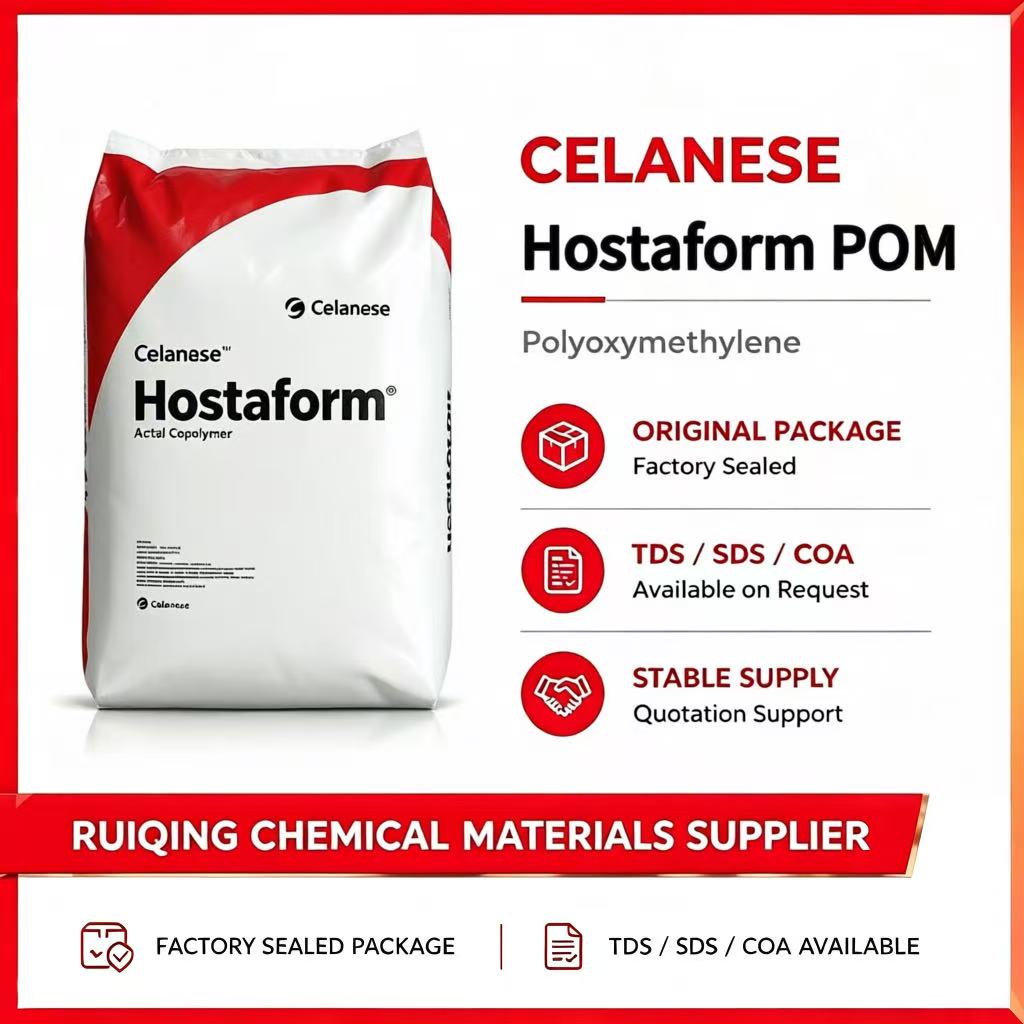
Hostaform C 9021 SW XAP2 LS is a medium-flowing, anti-friction POM-C (Polyoxymethylene Copolymer) injection molding material, genuinely manufactured by Celanese and imported as original product. We supply this grade as an authorized distributor / trader, ensuring full traceability and access to official Celanese technical documentation.
This grade is specially modified with anti-friction additives to provide low wear, low coefficient of friction, and effective prevention of squeaking noise. It also incorporates XAP2 low emission technology for reduced VOC emissions and low odor, along with UV stabilization for excellent weathering resistance.
The “SW” designation stands for Slip & Wear, while “XAP2” and “LS” indicate low emission / low VOC technology.
It is a very hard and rigid, heavy-metal free POM copolymer grade that exhibits outstanding chemical resistance (solvents, fuels & strong alkalis), hydrolysis resistance, fatigue resistance, creep resistance, moisture resistance, and stress cracking resistance. It also maintains toughness down to -40°C, offers good heat distortion temperature (up to 100°C), very good slip/wear properties, excellent resilience, and low moisture absorption. With regular stock availability, we support both trial orders and bulk shipments for precision engineering, automotive, electrical, and appliance applications.
Key Features
Hostaform C 9021 SW XAP2 LS offers the following key performance benefits:
-
Anti-Friction Modification – Specially modified with anti-friction additives for low wear, low coefficient of friction, and effective prevention of squeaking noise.
-
XAP2 Low Emission Technology – Reduced emission grade with low VOC and low odor, meeting stringent automotive interior air quality standards.
-
UV Stabilized – Excellent UV resistance for long-term outdoor and automotive applications.
-
Very Hard & Rigid – A very hard and rigid grade providing excellent structural strength and surface hardness.
-
Heavy-Metal Free – Environmentally friendly formulation.
-
Outstanding Chemical Resistance – Resistant to solvents, fuels, and strong alkalis.
-
Good Hydrolysis Resistance – Maintains properties in moist environments.
-
High Resistance to Thermal & Oxidative Degradation – Higher stability compared to acetal homopolymers.
-
Excellent Fatigue, Creep, Moisture & Stress Cracking Resistance – Ensures long-term performance under demanding conditions.
-
High Toughness – Maintains toughness even at low temperatures (down to -40°C).
-
Good Heat Resistance – Heat distortion temperature up to 100°C.
-
Very Good Slip/Wear Properties – Self-lubricating properties for moving parts and sliding applications.
-
Excellent Resilience – High resilience for demanding applications.
-
Low Moisture Absorption – Ensures dimensional stability across varying environmental conditions.
-
Easy Colorization – Can be easily colored to meet specific design requirements.
Typical Applications
| Industry | Typical Components & Considerations |
|---|---|
| Automotive Interior | Sliding combinations with low wear and low coefficient of friction – seat adjustment mechanisms, window regulator slides, interior mechanisms, door handles, mirrors. XAP2 low emission technology ensures compliance with cabin air quality standards. UV stabilization ensures long-term color stability. |
| Precision Engineering | Precision gears, sliding combinations with low wear and low coefficient of friction, spring mechanisms, snap-fit components. |
| Electrical & Electronics | Audio equipment (CD, LD, MD players, radios, headphones), printer components, keyboard parts, CD-ROM drives, terminal blocks, switch housings, connectors. |
| Household Appliances | Washing machine components, dryers, hair dryers, appliance gears and sliding parts. |
| Consumer Goods | Cameras, watches, sporting equipment, furniture mechanisms. |
| Building & Construction | Architectural components, building parts. |
Explore our full range of engineering plastics solutions for more industry-specific case studies.
Material Advantages
The following material advantages make Hostaform C 9021 SW XAP2 LS the preferred choice for noise-sensitive, low-emission, and tribological applications:
-
Anti-Friction Technology for Noise Prevention – The special anti-friction additive modification provides effective prevention of squeaking noise, ensuring quiet, smooth operation in precision mechanisms.
-
XAP2 Low Emission Technology – Reduced emission grade with emissions according to VDA 275 <5 mg/kg; meets stringent automotive interior air quality standards.
-
UV Stabilization – Excellent UV resistance ensures long-term color stability and mechanical property retention in outdoor and sunlight-exposed applications.
-
Very Hard & Rigid – A very hard and rigid grade that provides exceptional structural strength and surface hardness for demanding applications.
-
Outstanding Chemical & Environmental Resistance – Excellent resistance to solvents, fuels, strong alkalis, hydrolysis, fatigue, creep, moisture, and stress cracking.
-
High Toughness – Maintains impact resistance and toughness even at low temperatures (down to -40°C).
-
Good Thermal Stability – Higher stability to thermal and oxidative degradation compared to acetal homopolymers.
-
Excellent Resilience – High resilience for demanding applications.
-
Dimensional Stability – Low moisture absorption ensures parts maintain their dimensions across varying environmental conditions.
-
Heavy-Metal Free – Environmentally friendly formulation.
-
Easy Colorization – Can be easily colored to meet specific design requirements.
-
Batch-to-Batch Consistency – Produced by Celanese under strict ISO standards, ensuring stable properties across all shipments.
-
Reliable Supply – We maintain inventory and a stable supply chain. For details on our supply capabilities, please see our company background .
Typical Properties (ISO Standards)
Typical properties of Hostaform C 9021 SW XAP2 LS measured per ISO standards are listed below:
| Property | Test Standard | Typical Value | Unit |
|---|---|---|---|
| Physical Properties | |||
| Density | ISO 1183 | 1420 | kg/m³ |
| Melt Volume Flow Rate (MVR) | ISO 1133 (190°C/2.16kg) | 6.5 – 7 | cm³/10min |
| Moulding Shrinkage, Parallel | ISO 294-4, 2577 | 2.1 | % |
| Moulding Shrinkage, Normal | ISO 294-4, 2577 | 1.7 | % |
| Mechanical Properties | |||
| Tensile Modulus | ISO 527-1/-2 | 2700 – 2850 | MPa |
| Tensile Stress at Yield | ISO 527-1/-2 | 52 – 53 | MPa |
| Tensile Strain at Yield | ISO 527-1/-2 | 7 | % |
| Nominal Strain at Break | ISO 527-1/-2 | 16 | % |
| Charpy Notched Impact (+23°C) | ISO 179/1eA | 4 | kJ/m² |
| Charpy Notched Impact (-30°C) | ISO 179/1eA | 4 | kJ/m² |
| Charpy Impact Strength (+23°C) | ISO 179/1eU | 90 | kJ/m² |
| Charpy Impact Strength (-30°C) | ISO 179/1eU | 85 | kJ/m² |
| Ball Indentation Hardness (H 358/30) | ISO 2039-1 | 135 | MPa |
| Tensile Creep Modulus, 1h | ISO 899-1 | 2400 | MPa |
| Tensile Creep Modulus, 1000h | ISO 899-1 | 1200 | MPa |
| Thermal Properties | |||
| Melting Temperature | ISO 11357-1/-3 | 166 | °C |
| Heat Deflection Temp (1.8 MPa) | ISO 75-1/-2 | 80 | °C |
| CLTE, Parallel | ISO 11359-1/-2 | 120 | E-6/K |
| Flammability | |||
| Flammability (1.6mm) | UL94 / IEC 60695-11-10 | HB | – |
| Burning Rate (thickness >1.5mm) | FMVSS 302 / ISO 3795 | <100 | mm/min |
Important Notes on Typical Data:
Values listed are typical and based on Celanese official data sheets. They do not constitute a product specification.
Batch-to-batch variations may occur. Confirm properties with specific batch certificate for critical applications.
Final product performance depends on part design, molding conditions, and end-use environment.
Celanese original TDS remains the definitive reference. For detailed data, request the latest official TDS for Hostaform C 9021 SW XAP2 LS from our team.
Processing Guidelines (Injection Molding)
The following injection molding parameters are recommended for Hostaform C 9021 SW XAP2 LS:
| Parameter | Recommended Setting |
|---|---|
| Pre-drying | Generally not necessary; however, drying is recommended if moisture is present |
| Drying Temperature | 100 – 120°C |
| Drying Time | 3 – 4 hours |
| Max. Moisture Content | ≤0.2% |
| Melt Temperature | 190 – 210°C |
| Manifold / Hot Runner Temperature | 190 – 210°C |
| Mold Temperature | 80 – 120°C |
| Screw Design | Standard injection molding machines with three-phase (15–25 D) plasticating screws |
Critical Processing Warnings for Hostaform C 9021 SW XAP2 LS:
Thermal Degradation: POM can decompose at high temperatures, releasing formaldehyde gas. Ensure adequate ventilation and avoid prolonged residence time in the barrel.
Material Purity: Strictly avoid contamination with other polymers, as this will compromise the anti-friction properties, low emission characteristics, and overall performance.
Regrind/Recycled Material: Adding regrind is not recommended for this specialty grade. Anti-friction additives can degrade during re-processing, compromising mechanical and tribological properties, and may introduce additional volatile compounds that compromise XAP2 low emission properties. If necessary, use a very small percentage (<10%) only with prior validation testing.
Storage: Store in a cool, dry place and use sealed, original packaging when possible to maintain low-emission characteristics.
Related Products
-
Explore Our Full POM Product Portfolio – Browse all POM copolymer and homopolymer grades we supply.
-
Anti-Friction Tribological POM (SW Series) – Discover noise-prevention and low-friction grades for sliding applications.
-
Low Emission POM (XAP2 Series) – Discover low VOC, low odor grades for automotive interior applications.
-
High-Performance POM-C Grades – Discover copolymer acetal options with enhanced impact and creep resistance.
-
POM for Automotive Applications – View grades specifically suited for automotive interior components.
Technical Documents
We provide the following documentation to support your material selection and compliance needs:
| Document Type | Description & Source |
|---|---|
| Celanese Official TDS | Complete physical, thermal, mechanical, and tribological properties. Issued by Celanese (original). |
| Celanese Official SDS | GHS-compliant chemical safety documentation. Issued by Celanese (original). |
| Celanese Distributor Authorization Certificate | Proof of our authorized distributor status with Celanese. Available upon request. |
| VDA 275 Emission Test Report | Low emission / low VOC compliance documentation for automotive interior applications. |
| UV Stability Test Report | Weathering and UV resistance performance data. |
| RoHS / REACH Compliance Declarations | Available upon request. |
| UL Yellow Card | UL94 HB rating documentation. |
| FMVSS 302 Compliance | Automotive flammability compliance (<100 mm/min). |
| Processing & Molding Guide | Detailed guidelines for optimal processing of anti-friction, low emission POM. |
To request any of the above documents, please contact us via:
Email:
ruiqingchem@gmail.comOnline form: Our contact page
We will respond within 1 working day. Please specify the document type and material grade.
External Reference
For additional information, please refer to the official Celanese Hostaform product portal and the latest material datasheets. Key technical standards referenced in this document include:
-
ISO 1043 / ISO 11469 – Resin identification and part marking
-
ISO 1183 – Density measurement
-
ISO 527-1/-2 – Tensile properties
-
ISO 179/1eA / 1eU – Impact resistance
-
ISO 75-1/-2 – Heat deflection temperature
-
ISO 1133 – Melt volume-flow rate
-
ISO 11357-1/-3 – Melting temperature
-
ISO 294-4 / 2577 – Mold shrinkage
-
ISO 899-1 – Tensile creep modulus
-
ISO 2039-1 – Ball indentation hardness
-
ISO 11359-1/-2 – Coefficient of linear thermal expansion
-
VDA 275 – Automotive interior emission testing
-
UL94 / IEC 60695-11-10 – Flammability
-
FMVSS 302 / ISO 3795 – Automotive flammability
Our team can provide relevant excerpts from these standards for your reference.
FAQ
Q1: What is Hostaform C 9021 SW XAP2 LS and what is it used for?
A: It is an anti-friction, low emission POM-C (Polyoxymethylene Copolymer) injection molding material specially modified with anti-friction additives for prevention of squeaking noise. The “XAP2” and “LS” designations indicate low emission / low VOC technology with UV stabilization. It is designed for sliding combinations with low wear and low coefficient of friction. It is widely used in automotive interior (seat adjustment mechanisms, window regulator slides), precision engineering (gears, springs, snap-fit components), electrical & electronics (audio equipment, printers, keyboards), household appliances, and consumer goods.
Q2: What does “SW”, “XAP2”, and “LS” mean in the grade name?
A: SW stands for Slip & Wear, indicating anti-friction additive modification for squeaking noise prevention. XAP2 is Celanese’s low emission technology that reduces VOC emissions and odor. LS stands for Low Smoke / Low Emission. The resin identification code is POM-KD10.
Q3: What are the emission properties of this material?
A: Hostaform C 9021 SW XAP2 LS is a reduced emission grade with low VOC and low odor. Emissions according to VDA 275 are <5 mg/kg for automotive interior applications.
Q4: Is this material UV stabilized?
A: Yes, Hostaform C 9021 SW XAP2 LS is UV-stabilized, providing excellent weathering resistance for outdoor and automotive applications.
Q5: What are the key mechanical properties?
A: Tensile modulus of 2700 – 2850 MPa, tensile stress at yield of 52 – 53 MPa, nominal strain at break of 16%, Charpy notched impact strength of 4 kJ/m², ball indentation hardness of 135 MPa, and melting temperature of 166°C.
Q6: What is the UL flammability rating?
A: UL94 HB rated. UL recognition for natural and black with thickness >1.5 mm. Burning rate ISO 3795 and FMVSS 302 is <100 mm/min for thickness >1.5 mm.
Q7: Can I purchase this material and what is the lead time?
A: Yes, simply send your inquiry via our quick inquiry form or email us at ruiqingchem@gmail.com with your required quantity, application, and delivery address. Regular orders (1–5 tons) are typically delivered within 7–10 working days after order confirmation and payment receipt. Larger quantities or urgent orders can be discussed with our team.
Q8: What are the limitations of this material?
A: POM materials are not suitable for use with strong acids, strong oxidizing agents, or continuous high-temperature water (>80°C) . Please consult our technical team for chemical compatibility data for your specific use environment.
CTA (Call to Action)
Ready to order Hostaform C 9021 SW XAP2 LS?
To provide you with an accurate quotation and technical support, please share the following information:
-
Estimated quantity (kg or tons)
-
Destination port or delivery address
-
Intended application and part design (e.g., wall thickness, dimensions, sliding/wear requirements)
-
Key performance requirements (e.g., noise prevention, friction coefficient, wear resistance, low emission / VOC requirements)
-
Color requirements (natural or specific color code)
-
Need for third-party testing or compliance documentation (e.g., VDA 275 test report for automotive applications)
Sample Policy:
-
Samples are provided for laboratory testing and validation only and are not for mass production.
-
International freight costs for samples are borne by the buyer.
-
If bulk material shows typical batch-to-batch variation from the sample, Celanese official TDS shall be the definitive reference standard.
Take action now:
-
Send Inquiry – Use our quick inquiry form
-
Email Us –
ruiqingchem@gmail.com -
Live Chat – Click the chat button at the bottom right to speak with our team
After-Sales Support
We provide the following after-sales support to ensure a smooth procurement experience:
| Service | Details |
|---|---|
| Quality Inspection Period | Any quality claims must be raised within 7 working days of delivery, with supporting data and photographic evidence. |
| Return / Exchange Policy | Defective material confirmed to be our responsibility will be replaced or refunded. Conditions apply – please refer to our full Terms & Conditions. |
| Logistics Damage | Any shipping damage must be reported to the carrier immediately upon receipt. We will assist with claim documentation. |
| Technical Support | Remote technical support is available. On-site molding troubleshooting assistance may be arranged upon request. |
| Export Documentation | We provide standard export documents (commercial invoice, packing list, bill of lading, COA). Additional certifications (e.g., VDA 275 test reports, UV stability reports) can be arranged upon request. |
Disclaimer
DISCLAIMER: All data provided is for reference based on manufacturer (Celanese) typical values. Our company is an authorized distributor/trader, not a manufacturer. Final product performance depends on part design, processing, and end-use. User is responsible for evaluating material suitability for their specific application. We shall not be liable for end-product performance or design failures. Please refer to the latest official Celanese TDS for definitive specifications.