
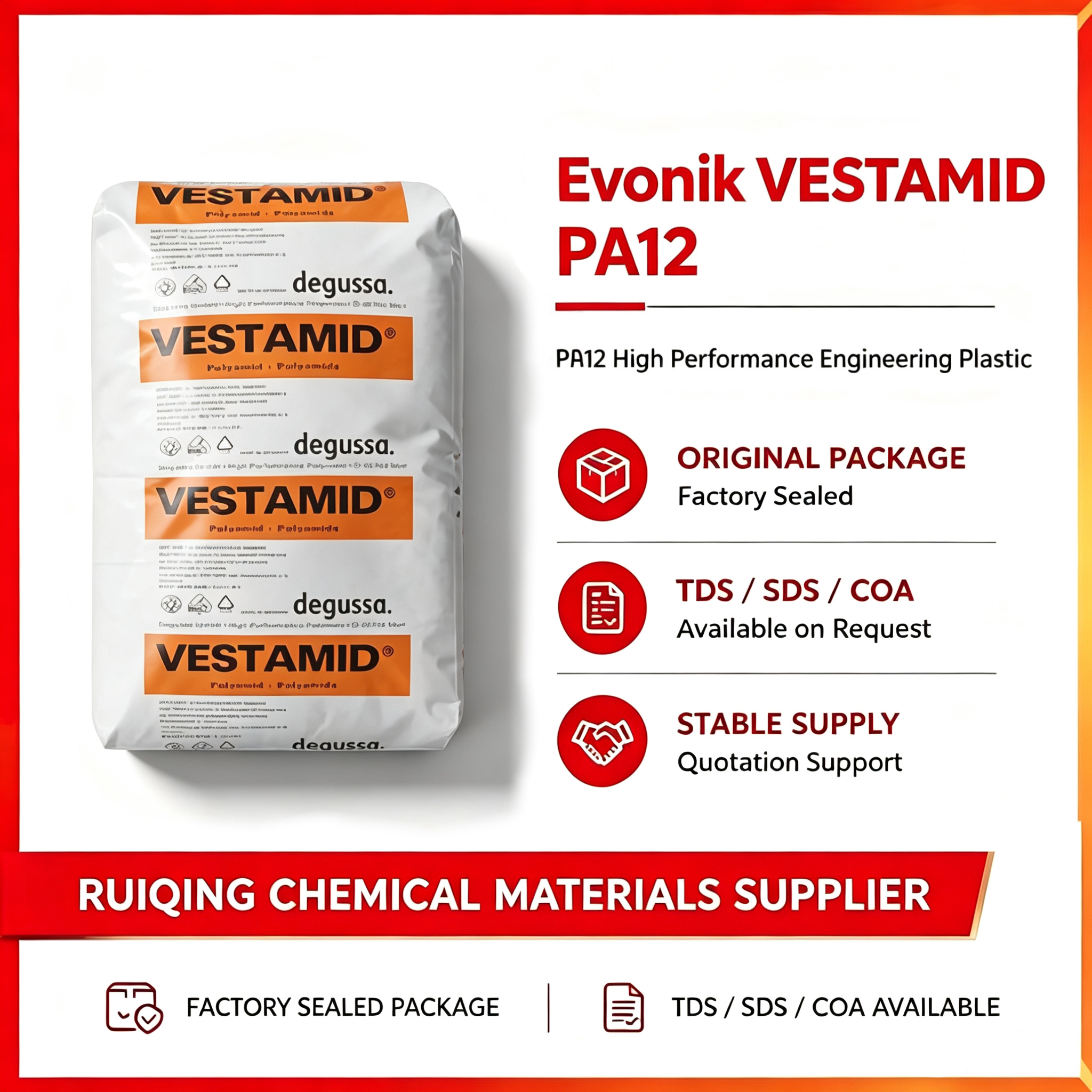
描述
VESTAMID E40-S3 is a heat- and light-stabilized polyether block copolyamide (PEBA) elastomer from Evonik Operations GmbH. It is based on PA 12 segments and polyether segments, belonging to the VESTAMID E series of thermoplastic elastomers (TPE). The material is free of volatile or migrating plasticizer.
VESTAMID E40-S3 is especially developed for sport shoe soles, offering good impact strength at low temperatures. The PA12-based PEBA elastomer combines the major properties of PA 12 with elastomer characteristics, providing flexibility, high impact strength at cold temperatures, and excellent recovery.
Compared to other contending thermoplastic elastomers, PA 12 elastomers are distinguished by their low density, high resistance to chemicals and solvents, easy processability and coloring, and excellent impact strength at low temperatures. Their hardness and flexibility can be varied over a wide range, and their mechanical properties are only slightly temperature-dependent.
Typical applications include noiseless gears, seals, functional elements of sports shoes, processing aids in the extrusion of thermoplastic polyurethanes, and films.
For more VESTAMID grades and technical information, please visit our Engineering Plastics product page.
Key Features of VESTAMID E40-S3
| # | Feature | Benefit |
|---|---|---|
| 1 | PA12-Based PEBA Elastomer | Combines PA12 properties with elastomer flexibility |
| 2 | Heat, UV & Light Stabilized | Maintains properties under thermal, UV, and light exposure |
| 3 | Free of Volatile/Migrating Plasticizer | No plasticizer migration concerns for sensitive applications |
| 4 | Excellent Low-Temperature Impact Strength | No break in Charpy impact tests at -30°C |
| 5 | High Elasticity | Excellent recovery and flexibility |
| 6 | Low Density | 1.01 g/cm³ – among the lowest of commercial polyamides |
| 7 | Good Chemical Resistance | Resistant to chemicals and solvents |
| 8 | Easy Processability & Colorability | Suitable for extrusion and injection molding; easy to color |
| 9 | Good Printability | Can be decorated by heat transfer printing |
| 10 | Wide Hardness Range | Shore D 40 with adjustable flexibility |
| 11 | Good Abrasion Resistance | 105 mm³/40 m rubbing distance (DIN 53516) |
| 12 | GM Automotive Approved | Meets GM GMW15702-020961 specification |
Typical Applications for VESTAMID E40-S3
| Industry | Typical Components & Considerations |
|---|---|
| Sport Shoe Soles | Functional elements of sports shoes – utilizing low-temperature impact strength, elasticity, and heat/light stabilization |
| Noiseless Gears | Gears requiring quiet operation and wear resistance |
| Seals | Seals requiring chemical resistance and elasticity |
| Extrusion Processing Aids | Processing aids in the extrusion of thermoplastic polyurethanes |
| Films | Flexible films requiring good impact strength and chemical resistance |
| Automotive | Components meeting GM GMW15702-020961 specification |
Typical Properties of VESTAMID E40-S3
| Property | Value | Test Method |
|---|---|---|
| Physical | ||
| Density | 1.01 g/cm³ | ISO 1183 |
| Water Absorption (Saturation, 23°C) | 1.0% | ISO 62 |
| Viscosity Number | 190 cm³/g | ISO 307 |
| Linear Mold Shrinkage – Flow (3 mm) | 0.60 – 0.90% | ISO 294-4 |
| Linear Mold Shrinkage – Transverse | 0.70 – 1.30% | ISO 294-4 |
| Mechanical | ||
| Tensile Modulus (0.5% strain, 1 hr) | 80.0 MPa | ISO 527-2 |
| Tensile Modulus (at 0.5% strain) | 87 MPa | ISO 527 |
| Tensile Strength at Break | 17.0 MPa | ISO 527-1/-2 |
| Stress at 50% Strain | 9.50 MPa | ISO 527-2 |
| Tensile Strain at Break | > 200% | ISO 527-2 |
| Tensile Creep Modulus (1000 hr) | 60.0 MPa | ISO 899-1 |
| Shore D Hardness | 40 | ISO 868 |
| Impact | ||
| Charpy Notched Impact (23°C) | No Break | ISO 179/1eA |
| Charpy Notched Impact (-30°C) | No Break | ISO 179/1eA |
| Charpy Unnotched Impact (23°C) | No Break | ISO 179/1eU |
| Charpy Unnotched Impact (-30°C) | No Break | ISO 179/1eU |
| Abrasion Resistance | 105 mm³ | DIN 53516 |
| Thermal | ||
| HDT @ 0.45 MPa (Unannealed) | 55.0°C | ISO 75-2/B |
| Vicat Softening Temperature (Method A) | 125°C | ISO 306/A |
| Vicat Softening Temperature (Method B) | 60.0°C | ISO 306/B |
| CTE – Flow (23-55°C) | 2.4 × 10⁻⁴ /°C | ISO 11359-2 |
| CTE – Transverse (23-55°C) | 2.1 × 10⁻⁴ /°C | ISO 11359-2 |
| Electrical | ||
| Surface Resistivity | 1.0 × 10¹³ ohms | IEC 60093 |
| Volume Resistivity | 1.0 × 10¹¹ ohm·cm | IEC 60093 |
| Dielectric Strength | 35 kV/mm | IEC 60243-1 |
| Relative Permittivity (100 Hz) | 7.50 | IEC 60250 |
| Relative Permittivity (1 MHz) | 4.90 | IEC 60250 |
| Dissipation Factor (100 Hz) | 0.070 | IEC 60250 |
| Dissipation Factor (1 MHz) | 0.12 | IEC 60250 |
| CTI (Solution A) | 600 V | IEC 60112 |
| Flammability | ||
| Flammability (1.6 mm) | HB | UL 94 |
Important Notes on Typical Data
📌 Values are typical – The data listed above is sourced from manufacturer data sheets for reference only and does not constitute binding product specifications for VESTAMID E40-S3.
📌 Batch variations – Batch-to-batch deviations may exist. For critical applications, validate performance with batch-specific COA certificates.
📌 Pigmentation – The use of colorants or pigmentation may affect property values.
📌 Final performance – Actual performance depends on processing conditions and part design. Refer to ISO testing standards for detailed methodology.
📌 Authoritative reference – The manufacturer’s official TDS shall serve as the definitive technical reference for VESTAMID E40-S3. Request the latest official TDS from our sales team.
Processing Guidelines for VESTAMID E40-S3
| Step | Process |
|---|---|
| Processing Methods | Extrusion, Injection Molding |
| Drying Recommended | Yes |
| Suggested Max Moisture | ≤ 0.10% |
| Processing (Melt) Temperature | 170 – 210°C |
| Mold Temperature | 20 – 40°C |
| Storage | Store in original, sealed packaging in a cool, dry place away from direct sunlight |
Critical Processing Warnings for VESTAMID E40-S3
⚠️ Drying Requirement – VESTAMID E40-S3 should be dried prior to processing to ensure maximum part quality. Suggested maximum moisture content is ≤ 0.10%.
⚠️ Processing Temperature – The recommended processing (melt) temperature range is 170–210°C. Avoid exceeding 210°C to prevent material degradation.
⚠️ Mold Temperature – A mold temperature range of 20–40°C is recommended for injection molding.
⚠️ Pigmentation – The use of colorants or pigmentation may affect property values. Validate performance with colored batches for critical applications.
⚠️ Storage – Store in original, sealed packaging in a cool, dry place away from direct sunlight. For subsequent storage, the material should be stored dry until processed.
Comparison: VESTAMID E40-S3 vs. Standard PA12
| Feature | VESTAMID E40-S3 | Standard PA12 |
|---|---|---|
| Material Type | PEBA Elastomer | Polyamide 12 |
| Shore D Hardness | 40 | ~75 |
| Key Feature | High elasticity, low-temperature impact | Rigidity, dimensional stability |
| Tensile Modulus | 80.0 MPa | ~1,400 MPa |
| Tensile Strength | 17.0 MPa | ~43 MPa |
| Elongation at Break | > 200% | > 50% |
| Density | 1.01 g/cm³ | ~1.02 g/cm³ |
| Impact (-30°C) | No Break | Limited |
| Primary Application | Sport shoe soles, noiseless gears | General injection molding |
Related Products
-
Engineering Plastics – Browse all engineering plastic materials
-
VESTAMID E47-S3 – Higher hardness PEBA elastomer for demanding applications
-
VESTAMID E62-S3 – High hardness PEBA elastomer with fuel resistance
-
VESTAMID E55-S3 – Medium hardness PEBA elastomer for injection molding and profile extrusion
-
About Our Company – Learn more about our supply capabilities and quality assurance
Technical Documents for VESTAMID E40-S3
| Document Type | Description & Source |
|---|---|
| Manufacturer Official TDS | Complete physical, thermal, and mechanical properties of VESTAMID E40-S3 |
| Manufacturer Official SDS | GHS-compliant safety documentation |
| COA (Certificate of Analysis) | Batch-specific quality certification for VESTAMID E40-S3 |
| UL Yellow Card | UL safety certification |
Request any document above by:
📧 Email: ruiqingchem@gmail.com
📝 Online form: Our contact page
We reply within one working business day. Please clearly state product (VESTAMID E40-S3) and document type you require.
FAQ about VESTAMID E40-S3
Q1: What is VESTAMID E40-S3?
A: VESTAMID E40-S3 is a heat- and light-stabilized polyether block copolyamide (PEBA) elastomer from Evonik, based on PA 12 segments and polyether segments, specifically developed for sport shoe soles.
Q2: Is VESTAMID E40-S3 a PA12 grade?
A: It is a PA12-based PEBA elastomer (polyether block copolyamide), not a standard PA12 compound. It combines PA12 properties with elastomer flexibility.
Q3: What are the key features of VESTAMID E40-S3?
A: PA12-based PEBA elastomer; heat, UV & light stabilized; free of volatile/migrating plasticizer; excellent low-temperature impact strength; high elasticity; low density (1.01 g/cm³); good chemical resistance; easy processability and colorability.
Q4: What are the typical applications for VESTAMID E40-S3?
A: Sport shoe soles, noiseless gears, seals, processing aids in TPU extrusion, films, and automotive components meeting GM GMW15702-020961.
Q5: What is the hardness of VESTAMID E40-S3?
A: Shore D 40 (ISO 868).
Q6: What is the density of VESTAMID E40-S3?
A: 1.01 g/cm³ (ISO 1183).
Q7: What is the tensile strength of VESTAMID E40-S3?
A: 17.0 MPa at break (ISO 527).
Q8: What is the elongation at break of VESTAMID E40-S3?
A: > 200% (ISO 527-2).
Q9: What is the low-temperature impact performance of VESTAMID E40-S3?
A: Charpy notched and unnotched impact tests show “No Break” at both 23°C and -30°C (ISO 179/1eA, ISO 179/1eU).
Q10: What is the recommended processing temperature for VESTAMID E40-S3?
A: Processing (melt) temperature: 170–210°C. Mold temperature: 20–40°C.
Q11: What is the water absorption of VESTAMID E40-S3?
A: 1.0% at saturation, 23°C (ISO 62).
Q12: What regions is VESTAMID E40-S3 available in?
A: Europe and North America.
Q13: Is VESTAMID E40-S3 free of plasticizer?
A: Yes, the material is free of volatile or migrating plasticizer.
Q14: What is the Vicat softening temperature of VESTAMID E40-S3?
A: 125°C (Method A) and 60.0°C (Method B).
Q15: What is the CTI of VESTAMID E40-S3?
A: 600 V (IEC 60112, Solution A).
Q16: What automotive specification does VESTAMID E40-S3 meet?
A: GM GMW15702-020961.
Q17: Is VESTAMID E40-S3 suitable for injection molding?
A: Yes, it is suitable for both extrusion and injection molding.
Q18: What is the shrinkage of VESTAMID E40-S3?
A: 0.60–0.90% in flow direction and 0.70–1.30% in transverse direction (ISO 294-4).
CTA (Call to Action)
Ready to order VESTAMID E40-S3?
To get a precise quotation and professional technical support for VESTAMID E40-S3, please share:
-
Required quantity (kg)
-
Destination port or delivery address
-
Target application (sport shoe soles, gears, seals, films, etc.)
-
Document requirements (TDS, SDS, COA, UL docs)
Sample Policy:
-
Samples of VESTAMID E40-S3 are for laboratory validation tests only, not for production use.
-
Buyer bears international sample-shipping freight.
-
If bulk-product performance deviates from sample reference, the manufacturer’s official TDS serves as the authoritative benchmark.
Take action now:
📧 Email Us – ruiqingchem@gmail.com
📝 Send Inquiry – Use our quick inquiry form
💬 Live Chat – Click the bottom-right chat widget to speak directly with our team
After-Sales Support
| Service | Details |
|---|---|
| Quality Inspection Period | All quality-related claims must be submitted within 7 working days after delivery, supported by test data and photographic evidence. |
| Return / Exchange Policy | Confirmed product defects caused by our side trigger replacement or refund. Terms and conditions apply. |
| Logistics Damage | Report shipping damage directly to carrier immediately upon goods receipt. We assist with claim-document preparation. |
| Technical Support | Remote technical guidance available. On-site troubleshooting can be arranged upon special request. |
| Export Documentation | We supply commercial invoice, packing list, bill of lading, COA, and additional compliance certificates on request. |
Disclaimer
DISCLAIMER: All technical data is referenced from original manufacturer typical values for VESTAMID E40-S3. Our company acts as supplier/trader rather than original manufacturer. Final performance depends on processing conditions and part design. Buyers shall independently validate product suitability for individual applications. Our firm bears no liability for product failure caused by improper processing or improper usage. Always reference the latest manufacturer official TDS of VESTAMID E40-S3 as the definitive specification.