描述
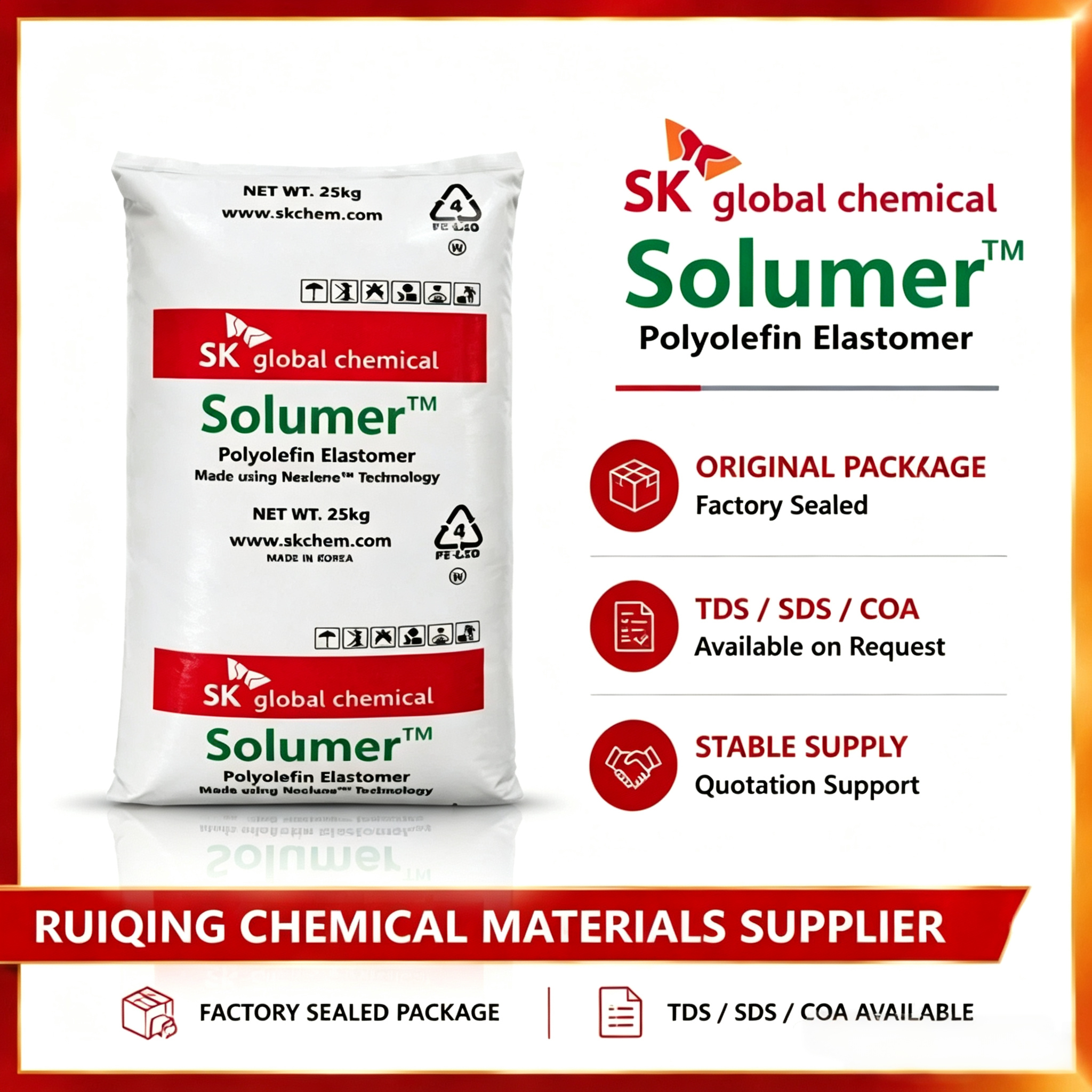
Solumer™ 8605L SK Nexlene Metallocene Ethylene-Octene POE, High Flow
Melt Index (190°C/2.16kg): 0.5 g/10min
Melting Point: 45°C
Form: Free-Flowing Pellets
✅ High Flow Metallocene POE
Solumer™ 8605L is an ethylene-octene copolymer produced via proprietary SK Nexlene metallocene technology. It features outstanding fluidity and balanced mechanical performance, suitable for various general thermoplastic elastomer formulations. This POE delivers remarkable low-temperature flexibility and impact resistance when blended with polypropylene.
🔹 Stable Supply & Technical Support
We supply spot stock of SK Solumer 8605L. Free samples, complete TDS/SDS documents and formulation technical guidance are available for compound factories, wire & cable manufacturers and injection molding processors. Contact us for quotation.
This metallocene POE shows excellent miscibility with PP resins, effectively improving low-temperature toughness and reducing brittleness of rigid polypropylene products. It can be widely used in TPO compounding, wire cable insulation and general PP impact modification systems.
Stable processing performance makes Solumer 8605L suitable for twin-screw compounding, extrusion and injection molding processes, maintaining consistent product quality during continuous mass production.
If you are looking for high flow metallocene POE for TPO and cable materials, please contact our team for grade comparison and processing formula suggestions.
📩 Request Pricing, TDS & Samples
✅ Free samples & same-day quotation
Solumer™ 8605L Typical Physical Properties
| Item | Typical Value | Unit | Test Standard |
| Density | 0.863 | g/cm³ | ASTM D792 |
| Melt Index (190°C/2.16kg) | 0.5 | g/10min | ASTM D1238 |
| Mooney Viscosity (ML1+4 @121°C) | 36 | MU | ASTM D1646 |
| Tensile Strength at Break | 62 | kgf/cm² | ASTM D638 |
| Elongation at Break | >1000 | % | ASTM D638 |
| 100% Tensile Modulus | 19 | kgf/cm² | ASTM D638 |
| 1% Secant Flexural Modulus | 85 | kgf/cm² | ASTM D790 |
| Type C Tear Strength | 34 | kgf/cm² | ASTM D624 |
| Shore A Hardness (1s) | 64 | – | ASTM D2240 |
| Shore D Hardness (1s) | 17 | – | ASTM D2240 |
| Melting Temperature | 45 | °C | SK Internal Test |
| Glass Transition Temperature | -56 | °C | SK Internal Test |
Test specimens are compression molded at 170°C for 4 minutes; tensile test crosshead speed: 500 mm/min. All values are typical reference data, not official specifications. Actual performance shall be verified by customer trial production.
Core Advantages of Solumer™ 8605L
- Adopts SK proprietary Nexlene metallocene polymerization technology, uniform molecular structure
- High flow property for smooth extrusion and compounding production
- Ultra-low glass transition temperature, excellent low-temperature impact resistance
- Good compatibility with PP, stable toughening modification effect
- Balanced tensile, elongation and tear mechanical properties
- Wide processing window for TPO, wire cable and general plastic modification
Main Applications
- General-purpose thermoplastic elastomer TPO compound
- Wire & cable insulation and sheath materials
- Polypropylene impact toughening modifier
Processing Suggestions
| Parameter | Recommended Range |
| Processing Temperature | 170°C – 220°C |
| Drying Treatment | No drying required under normal storage |
| Mixing Method | Dry blend or twin-screw compounding with PP |
Product Documents
| Document Name | Introduction | Access |
| TDS | Technical Data Sheet with full physical & thermal parameters | Request TDS |
| SDS | Safety Data Sheet for storage & transportation guidance | Request SDS |
| COA | Batch Certificate of Analysis | Request COA |
Frequently Asked Questions
What is Solumer™ 8605L?
Solumer™ 8605L is a metallocene ethylene-octene polyolefin elastomer (POE) manufactured by SK Geo Centric via Nexlene technology, designed for plastic modification and elastomer compounding.
What are the main applications of Solumer™ 8605L?
It is widely used for PP low-temperature toughening, TPO compound production, wire & cable insulation and sheath formulations.
What advantages does high-flow grade 8605L compare with other POE grades?
It delivers better melt fluidity during extrusion and compounding, maintains excellent low-temperature toughness, and provides stable mixing uniformity when blended with polypropylene.
Can Solumer™ 8605L be blended with homo-PP and random PP?
Yes. It has good compatibility with both homopolymer polypropylene and random copolymer PP, effectively improving impact strength at low temperature.
Is pre-drying required before processing?
No drying is required under normal sealed storage. If pellets absorb moisture from humid environment, drying at 60~80°C for 2 hours is recommended.
What is the recommended processing temperature range?
The recommended processing temperature is 170°C to 220°C for twin-screw compounding, extrusion and injection molding.
Can I get free samples for lab testing?
Yes, we provide small trial samples for customer formulation testing. Please submit inquiry on our contact page to apply samples and technical documents.
What is the packing specification of Solumer™ 8605L?
Standard package is 25kg per polypropylene bag. Bulk container loading is available for large order quantity.
How long is the shelf life of this POE?
Under dry, cool and sealed storage conditions, the shelf life reaches 24 months. Avoid direct sunlight and high temperature environment.
Is Solumer™ 8605L suitable for outdoor cable materials?
It can be used for general cable sheath. If excellent weather resistance and UV stability are required, please add anti-UV stabilizer in your formulation.
Do you supply original SK factory stock?
We supply authentic SK Geo Centric Solumer series POE with complete supporting documents including TDS, SDS and batch COA.
Get Solumer™ 8605L Price & Documents
We provide stable stock of SK Solumer 8605L metallocene POE. Competitive price, free trial samples and one-stop technical service are available for compound manufacturers and cable factories.
Disclaimer: All data listed on this page is extracted from official SK TDS for reference only. Typical values cannot be regarded as product specifications. Customers shall complete independent trial tests according to actual production environment and application requirements before mass production. Product indexes may fluctuate in different batches.