描述
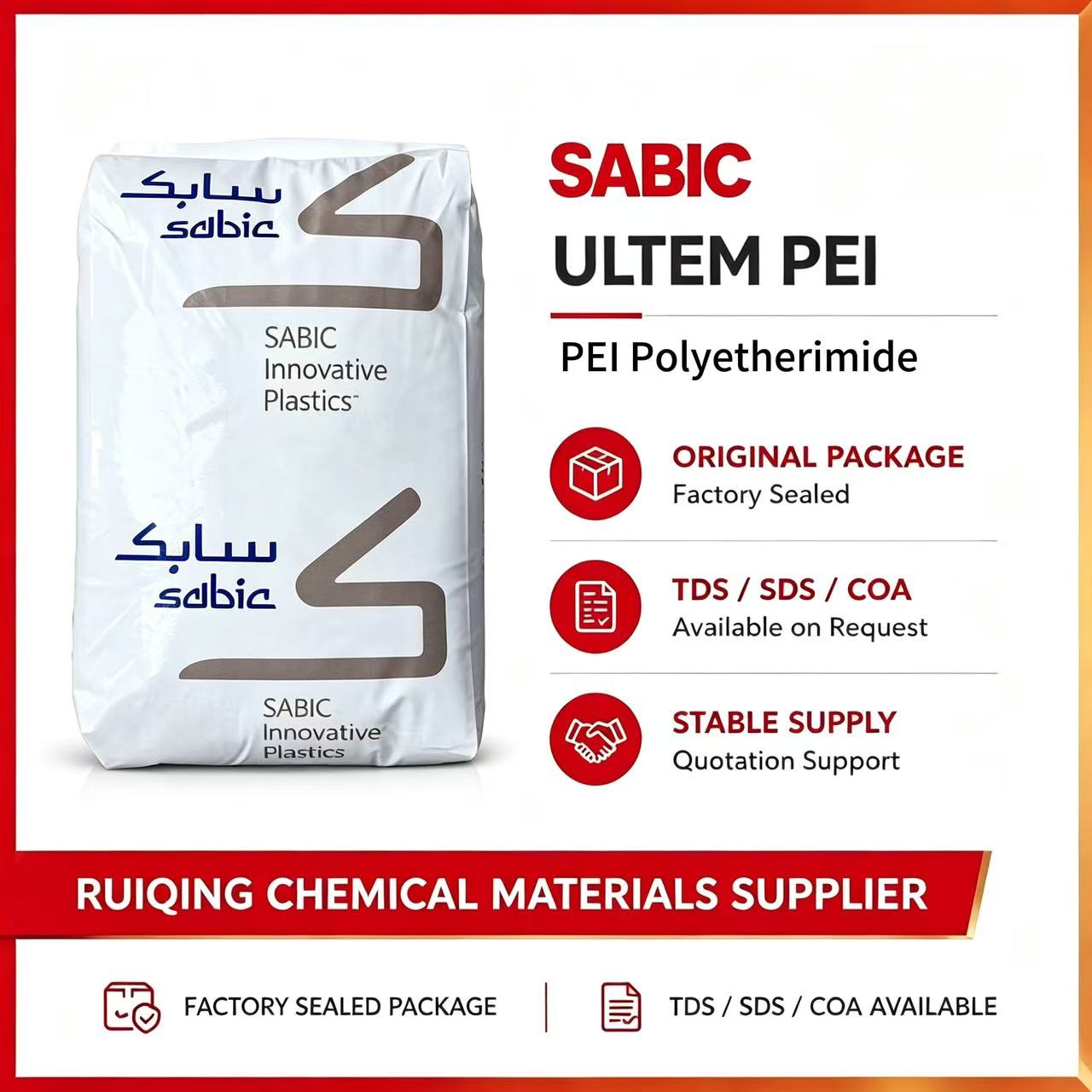
ULTEM Resin 2100F is a 10% glass fiber reinforced, amorphous polyetherimide (PEI) engineering thermoplastic manufactured by SABIC. As an authorized distributor and trader, we supply genuine SABIC materials with full traceability. For more product options and company information, please visit our website at https://szrqchem.com/.
ULTEM 2100F is a standard flow, 10% glass fiber reinforced grade that delivers an outstanding balance of mechanical, thermal, and electrical properties with enhanced stiffness. Key attributes include:
-
10% Glass Fiber Reinforcement – Increased stiffness, strength, and dimensional stability compared to unreinforced grades
-
Food Contact Compliant – Complies with US FDA and EU Food Contact regulations ; NSF 51 listed ; WRAS certified in recognized colors
-
High Heat Resistance – Glass transition temperature (Tg) of 217°C ; RTI of 170°C
-
Inherent Flame Retardancy – UL94 V-0 and 5VA ratings without additives
-
High Stiffness & Strength – Tensile modulus of 4,680 MPa ; yield stress of 114 MPa
-
Excellent Dimensional Stability – Low creep sensitivity and low shrinkage (0.5-0.6%)
-
Hydrolytic Stability – Good resistance to moisture and hydrolysis
-
Good Metal Adhesion – Suitable for applications requiring metal bonding
Key Features of ULTEM 2100F
-
10% Glass Fiber Reinforced – Provides increased stiffness, strength, and dimensional stability compared to unreinforced grades; offers better rigidity and improved dimensional stability vs ULTEM 1000 series
-
Food Contact Compliant – Complies with US FDA and EU Food Contact regulations ; NSF 51 listed for food equipment applications ; WRAS certified in recognized colors ; exceptions may exist in some jurisdictions – request a declaration for details
-
Standard Flow Grade – Designed for injection molding with good flow characteristics
-
High Heat Resistance – Glass transition temperature of 217°C ; RTI of 170°C ; Vicat softening temperature of 223°C
-
Inherent Flame Retardancy – UL94 V-0 (0.4mm) and 5VA (1.9mm) ratings ; oxygen index of 47% ; low smoke and toxicity – products of combustion no more toxic than wood
-
High Mechanical Strength – Tensile modulus of 4,680 MPa ; yield stress of 114 MPa ; flexural strength of 199 MPa ; flexural modulus of 5,170 MPa ; Rockwell hardness M114
-
Excellent Dimensional Stability – Low shrinkage (0.5-0.6%) ; low creep sensitivity; high tolerance dimensional capabilities
-
Good Chemical Resistance – Resists automotive and aircraft fluids, aliphatic hydrocarbons, alcohols, acids, and weak aqueous solutions
-
Hydrolytic Stability – Good resistance to moisture and hydrolysis
-
Outstanding Electrical Properties – Volume resistivity >1×10¹⁵ Ω·cm ; dielectric strength of 27.6 kV/mm
-
Good Metal Adhesion – Suitable for applications requiring metal bonding
-
ECO Conforming & RoHS Compliant – Meets environmental compliance standards
-
Versatile Processing – Suitable for injection molding, extrusion, thermoforming, and blow molding
Typical Applications for ULTEM 2100F
| Industry | Typical Applications |
|---|---|
| Food Processing | Food contact equipment, food processing components, FDA/NSF compliant parts |
| Medical & Pharmaceutical | Sterilizable medical devices, surgical instruments, pharmaceutical equipment – supports steam, gamma, EtO, and E-beam sterilization |
| Electrical & Electronics | High-temperature connectors, IC sockets, electrical components, electronics material handling |
| Aerospace & Mass Transportation | Aircraft interiors, heavy truck, bus, specialty vehicles – low smoke and toxicity |
| Automotive | Under-hood sensors, connectors, interior components |
| Semiconductor | High-temperature wafer carriers, sockets, and fluid handling components |
| Plumbing & Water Systems | WRAS certified components in recognized colors |
| Industrial | High-performance structural components, fasteners, and precision parts requiring high stiffness |
Typical Properties
| Property | ULTEM 2100F | Unit | Test Method |
|---|---|---|---|
| Density / Specific Gravity | 1.34 | g/cm³ | ASTM D792 / ISO 1183 |
| Mold Shrinkage (Flow) | 0.5 – 0.6 | % | SABIC Method |
| Melt Flow Rate (MFR) – 337°C/6.6kg | 7 | g/10min | ASTM D1238 |
| Melt Volume Rate (MVR) – 360°C/5kg | 9 | cm³/10min | ISO 1133 |
| Glass Transition Temperature (Tg) | 217 | °C | |
| Heat Deflection Temp. (1.8MPa) | 208 | °C | ASTM D648 |
| Vicat Softening Temperature | 223 | °C | ASTM D1525 |
| RTI (Elec/Imp/Str) | 170 | °C | UL 746 |
| Tensile Modulus | 4,680 | MPa | ASTM D638 |
| Tensile Strength (Yield) | 114 | MPa | ASTM D638 |
| Tensile Strength (Break) | 115 | MPa | ASTM D638 |
| Elongation at Break | 6 | % | ASTM D638 |
| Flexural Strength | 199 | MPa | ASTM D790 |
| Flexural Modulus | 5,170 | MPa | ASTM D790 |
| Izod Impact (Notched, 23°C) | 53 | J/m | ASTM D256 |
| Izod Impact (Unnotched) | 480 | J/m | ASTM D4812 |
| Rockwell Hardness | M114 | – | ASTM D785 |
| Water Absorption (24 hrs) | 0.21 | % | ASTM D570 |
| Water Absorption (Saturation) | 1.2 | % | ASTM D570 |
| Volume Resistivity | >1×10¹⁵ | Ω·cm | ASTM D257 |
| Dielectric Strength | 27.6 | kV/mm | ASTM D149 |
| UL 94 Flammability | V-0 (0.4mm), 5VA (1.9mm) | – | UL 94 |
Important Notes on Typical Data:
-
Values listed are typical and sourced from SABIC official data sheets. They do not constitute binding product specification.
-
Batch-to-batch deviations may exist. For critical applications, validate performance with batch-specific COA certificate.
-
Final performance depends on processing conditions, mold design, and part geometry.
-
SABIC official TDS shall serve as definitive technical reference. Request the latest official TDS from our sales team.
Processing Guidelines
| Parameter | Recommended Conditions |
|---|---|
| Drying | 150°C for 4-6 hours |
| Recommended Moisture | ≤0.02% |
| Melt Temperature | 350 – 400°C |
| Rear Zone Temperature | 330 – 400°C |
| Middle Zone Temperature | 340 – 400°C |
| Front Zone Temperature | 345 – 400°C |
| Nozzle Temperature | 345 – 400°C |
| Mold Temperature | 135 – 165°C |
| Screw Speed | 40 – 70 rpm |
Critical Processing Warnings:
-
Drying: ULTEM 2100F is hygroscopic and must be dried to <0.02% moisture before processing. Dry at 150°C for 4-6 hours.
-
Melt Temperature: Recommended melt temperature range is 350-400°C. Avoid excessive residence times to prevent thermal degradation.
-
Mold Temperature: Higher mold temperatures (135-165°C) improve flow and reduce residual stress.
-
Gate Design: Use large gates and runners to minimize flow resistance and reduce molded-in stress.
-
Regrind: Regrind can be used up to 20-25% with virgin material, provided it is clean and properly dried.
-
Food Contact Compliance: This material is food contact compliant in most jurisdictions – exceptions may exist, request a declaration for details.
-
Not for Medical Applications: Effective June 2007, this grade is no longer supported with biocompatibility information and should not be used for medical applications which require biocompatibility. For medical applications, please use alternative grade HU2100 (ISO 10993/USP Class VI biocompatible).
Related Products
-
Explore PEI / Polyetherimide – Browse all ULTEM PEI resin options
-
Explore Engineering Plastics – Browse all engineering plastic materials
-
About Our Company – Learn more about our supply capabilities and quality assurance
Technical Documents
| Document Type | Description & Source |
|---|---|
| SABIC Official TDS | Complete physical, thermal, and mechanical properties of ULTEM 2100F |
| SABIC Official SDS | GHS-compliant chemical safety documentation |
| UL Yellow Card | UL certification E121562-102518191 |
| FDA Compliance Declaration | US FDA food contact compliance |
| EU Food Contact Compliance | European food contact compliance |
| NSF 51 Listing | Food equipment certification |
| WRAS Certification | Water Regulations Advisory Scheme certification |
| COA (Certificate of Analysis) | Batch-specific quality certification |
| Processing Guide | Detailed processing guidelines for ULTEM resins |
Request any document above by:
-
Email:
ruiqingchem@gmail.com -
Online form: Our contact page
We reply within one working business day. Please clearly state product (ULTEM 2100F) and document type you require.
FAQ
Q1: What is ULTEM 2100F and what is it used for?
A: ULTEM 2100F is a 10% glass fiber reinforced polyetherimide (PEI) resin manufactured by SABIC. It combines high heat resistance (Tg 217°C), inherent flame retardancy (UL94 V-0 & 5VA), and enhanced stiffness. It is FDA and EU food contact compliant, NSF 51 listed, and widely used in food processing equipment, electrical/electronic components, aerospace interiors, automotive under-hood applications, and industrial components.
Q2: Is ULTEM 2100F FDA compliant?
A: Yes. ULTEM 2100F complies with US FDA and EU Food Contact regulations. It is also NSF 51 listed and WRAS certified in recognized colors.
Q3: What is the glass fiber content of ULTEM 2100F?
A: ULTEM 2100F contains 10% glass fiber reinforcement.
Q4: What is the glass transition temperature of ULTEM 2100F?
A: The glass transition temperature (Tg) is 217°C.
Q5: What is the density of ULTEM 2100F?
A: The density is 1.34 g/cm³.
Q6: Is ULTEM 2100F flame retardant?
A: Yes. ULTEM 2100F is inherently flame retardant with UL94 V-0 (0.4mm) and 5VA (1.9mm) ratings.
Q7: What is the tensile modulus of ULTEM 2100F?
A: The tensile modulus is 4,680 MPa (ASTM D638).
Q8: What processing methods can be used for ULTEM 2100F?
A: ULTEM 2100F is primarily processed by injection molding, and can also be extruded, thermoformed, and blow molded.
Q9: Can ULTEM 2100F be used for medical applications?
A: No. Effective June 2007, this grade is no longer supported with biocompatibility information and should not be used for medical applications which require biocompatibility. For medical applications, please use alternative grade HU2100.
Q10: What is the lead time for orders?
A: Regular orders ship within 7-10 working days after payment confirmation. Large-volume or urgent orders can be negotiated separately.
CTA (Call to Action)
Ready to order ULTEM 2100F?
To get a precise quotation and professional technical support, please share:
-
Required quantity (kg)
-
Destination port or delivery address
-
Target application (food processing, electrical, aerospace, automotive, etc.)
-
Processing method (injection molding, extrusion, etc.)
-
Color requirement (opaque, various colors available)
-
Document requirement (TDS, SDS, UL, FDA compliance, NSF 51, COA, etc.)
Sample Policy:
-
Samples are for laboratory validation tests only, not for production use.
-
Buyer bears international sample-shipping freight.
-
If bulk-product performance deviates from sample reference, SABIC official TDS serves as the authoritative benchmark.
Take action now:
-
📧 Email Us –
ruiqingchem@gmail.com -
📝 Send Inquiry – Use our quick inquiry form
-
💬 Live Chat – Click the bottom-right chat widget to speak directly with our team
After-Sales Support
| Service | Details |
|---|---|
| Quality Inspection Period | All quality-related claims must be submitted within 7 working-days after delivery, supported by test data and photographic evidence. |
| Return / Exchange Policy | Confirmed product defects caused by our side trigger replacement or refund. Terms and conditions apply. |
| Logistics Damage | Report shipping damage directly to carrier immediately upon goods receipt. We assist with claim-document preparation. |
| Technical Support | Remote technical guidance available. On-site troubleshooting can be arranged upon special request. |
| Export Documentation | We supply commercial invoice, packing list, bill of lading, COA, and additional compliance certificates (e.g., FDA, EU, NSF 51, WRAS, UL, RoHS) on request. |
Disclaimer
DISCLAIMER: All technical data is referenced from original SABIC typical values for ULTEM 2100F. Our company acts as authorized distributor/trader rather than original manufacturer. Final performance depends on processing conditions, mold design, and part geometry. Buyers shall independently validate product suitability for individual applications. Our firm bears no liability for product failure caused by improper processing or improper usage. Always reference the latest SABIC official TDS of ULTEM 2100F as the definitive specification.