描述
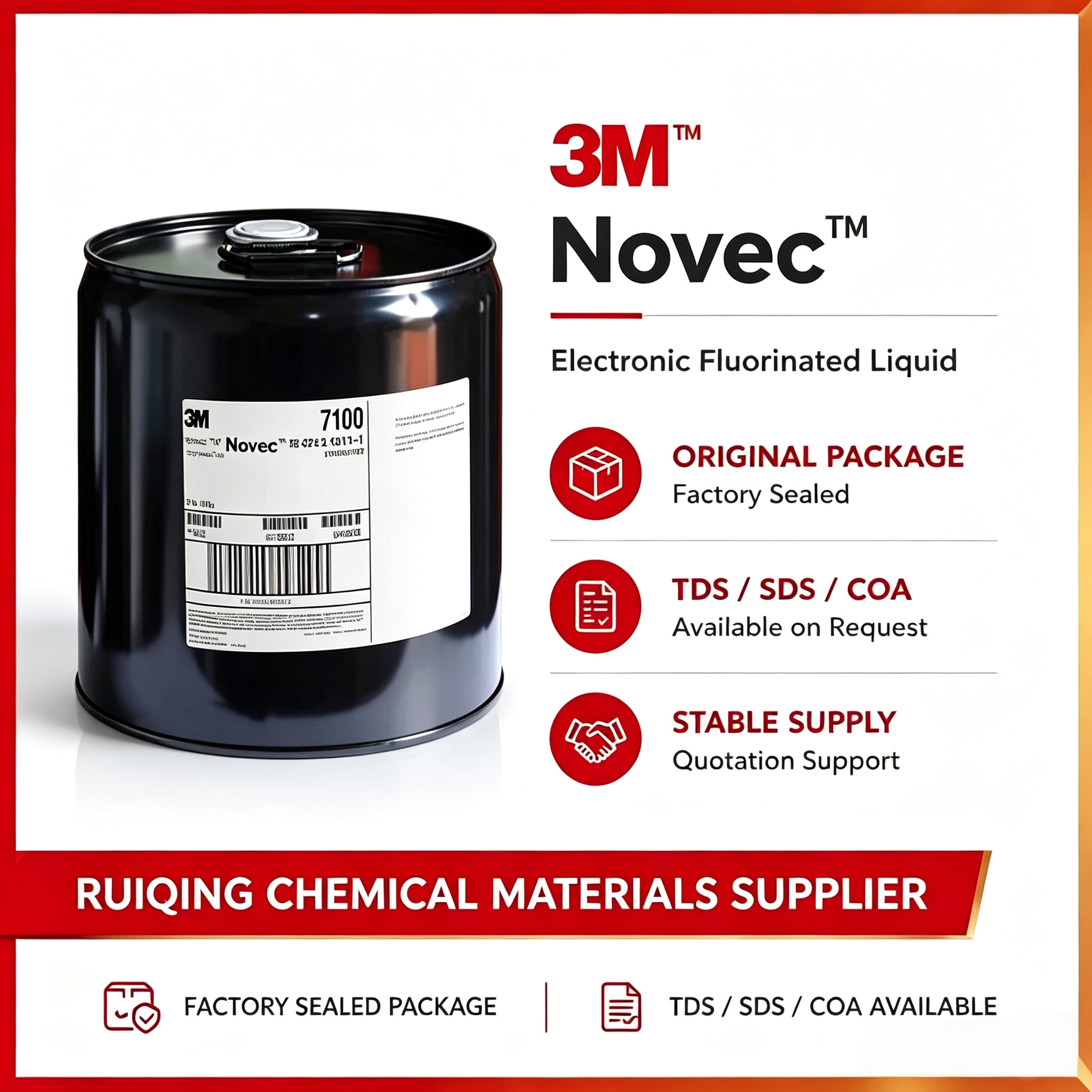
3M Novec 7000 Engineered Fluid Ultra Low Boiling Point Heat Transfer
Chemistry: 1-methoxyheptafluoropropane
Boiling Point: 34°C
Viscosity (25°C): 0.32 cSt
Freeze Point: -122.5°C
Packing: 20 kg / drum
3M Novec 7000 Engineered Fluid is a nonflammable, low global warming potential heat transfer fluid capable of reaching temperatures as low as -120°C. Chemically known as 1-methoxyheptafluoropropane (C₃F₇OCH₃), this ultra-low boiling point fluid (34°C) offers exceptional performance in semiconductor manufacturing equipment cooling, direct expansion refrigeration, and extreme low temperature heat transfer applications. With zero ozone depletion potential, a GWP of 370, and an exceptionally low viscosity of 0.32 cSt at 25°C, Novec 7000 delivers reliable thermal management in ion implanters, dry etchers, CVD/PVD tools, supercomputers, and sensitive military electronics.
Novec 7000 maintains excellent flow characteristics even at extreme low temperatures — viscosity of 2.0 cSt at -80°C and 17 cSt at -120°C — ensuring consistent performance in demanding cryogenic applications. Its excellent dielectric properties (dielectric constant 7.4, dielectric strength -40 kV, volume resistivity 10⁸ ohm-cm) provide reliable electrical insulation in high-voltage environments. Nonflammable, non-corrosive, and thermally stable, Novec 7000 ensures safe operation in electronics cooling, industrial freeze dryers, chemical reactors, fuel cells, and electronics reliability testing.
Genuine 3M Imported Stock and Technical Support
We supply stable spot inventory of genuine 3M Novec 7000 engineered fluid. Official TDS, SDS, and batch COA documents are available for semiconductor cooling, extreme low temperature heat transfer, and direct expansion refrigeration applications.
Request Novec 7000 Quotation, TDS, SDS, and Sample
Complete SDS, COA, and customs clearance documents available
Core Advantages of 3M Novec 7000 Engineered Fluid
- Ultra-low boiling point: 34°C — ideal for direct expansion refrigeration and low-temperature heat transfer
- Extreme low temperature capability: -122.5°C — maintains fluidity down to cryogenic temperatures
- Ultra-low viscosity: 0.32 cSt at 25°C — excellent flow characteristics across wide temperature range
- Low GWP: 370 — environmentally sustainable alternative to high-GWP refrigerants
- Zero ODP — no ozone depletion potential
- Excellent dielectric properties — dielectric constant 7.4, dielectric strength -40 kV
- Nonflammable — no flash point, safe operation in critical electronics cooling
- Broad material compatibility — compatible with most metals and hard polymers
Main Applications
- Semiconductor manufacturing — ion implanters, dry etchers, CVD/PVD tools cooling
- Electronic cooling — supercomputers, sensitive military electronics, high-voltage transformers
- Industrial/Pharmaceutical — chemical reactors, freeze dryers, VOC capture systems
- Fuel cells — thermal management and cooling
- Electronics reliability testing — temperature calibration, thermal shock testing
- Autocascade refrigeration — HCFC-123 replacement in refrigeration systems
- Medical/Lab — histobath working fluid for laboratory applications
Full Technical Parameters
| Property | Typical Value | Test Method |
| Chemical Name | 1-methoxyheptafluoropropane (C₃F₇OCH₃) | — |
| Appearance | Clear colorless liquid | Visual |
| Purity | 99.5% by weight minimum | — |
| Non-Volatile Residue (NVR) | 25.0 ppm maximum | — |
| Molecular Weight | 200 g/mol | — |
| Boiling Point (@1 atm) | 34°C | ASTM D1078 |
| Freeze Point | -122.5°C | ASTM D97 |
| Liquid Density (25°C) | 1.40 g/cm³ | ASTM D891 |
| Kinematic Viscosity (25°C) | 0.32 cSt | ASTM D445 |
| Kinematic Viscosity (-80°C) | 2.0 cSt | — |
| Kinematic Viscosity (-120°C) | 17 cSt | — |
| Surface Tension | 12.4 dynes/cm | — |
| Dielectric Constant | 7.4 | — |
| Dielectric Strength | -40 kV | ASTM D877 |
| Volume Resistivity | 10⁸ ohm-cm | — |
| Thermal Conductivity | 0.075 W m⁻¹ K⁻¹ | — |
| Specific Heat | 1300 J kg⁻¹ K⁻¹ | — |
| Vapor Pressure (25°C) | 64.6 kPa | — |
| Coefficient of Expansion | 0.00219 K⁻¹ | — |
| Critical Temperature | 165°C | — |
| Critical Pressure | 2.48 MPa | — |
| Ozone Depletion Potential | 0.0 | — |
| Global Warming Potential | 370 | — |
| Atmospheric Lifetime | 4.9 years | — |
| Flash Point | None | — |
| Exposure Guideline (8hr TWA) | 75 ppm | AIHA |
| Acute Toxicity (4h LC50 Rat) | >30,000 ppm | — |
Note: All listed figures are typical values and may vary by production batch. Complete independent qualification testing is required before mass production deployment.
Handling and Storage Recommendations
| Storage Rules | Store sealed original containers in a dry, well-ventilated area away from heat sources and direct sunlight. |
| Forbidden Environments | Avoid exposure to open flames, strong oxidizing agents, and reactive metal powders. |
| Operation Protection | Maintain adequate ventilation. Wear nitrile protective gloves and anti-splash safety goggles during handling. |
Official Technical Documentation
| Document Type | Document Introduction | Document Request |
| TDS | 3M Novec 7000 original factory technical data sheet | Request TDS |
| SDS | Safety data sheet covering transport, storage, and handling guidelines | Request SDS |
| COA | Batch-specific certificate of analysis for incoming goods inspection | Request COA |
Frequently Asked Questions
What is the boiling point of Novec 7000?
Novec 7000 has an ultra-low boiling point of 34°C at 1 atm and a freeze point of -122.5°C, providing an exceptionally wide liquid range for extreme low temperature heat transfer and direct expansion refrigeration applications.
What is the viscosity of Novec 7000 at low temperatures?
Novec 7000 has a kinematic viscosity of 0.32 cSt at 25°C, 2.0 cSt at -80°C, and 17 cSt at -120°C, maintaining excellent flow characteristics even at extreme low temperatures.
Is Novec 7000 flammable?
No. Novec 7000 is nonflammable with no flash point, providing safe operation in electronics cooling and industrial heat transfer applications.
What is the GWP of Novec 7000?
Novec 7000 has a global warming potential (GWP) of 370 (100-year ITH) and zero ozone depletion potential (ODP), offering an environmentally sustainable alternative to high-GWP refrigerants.
What applications is Novec 7000 suitable for?
Novec 7000 is ideal for semiconductor manufacturing (ion implanters, dry etchers, CVD/PVD tools), electronic cooling (supercomputers, military electronics), industrial/pharmaceutical freeze dryers, chemical reactors, fuel cells, electronics reliability testing, temperature calibration, and autocascade refrigeration.
What is the exposure guideline for Novec 7000?
Novec 7000 has an 8-hour time-weighted average exposure guideline of 75 ppm, based on a 28-day inhalation study with a NOAEL of 1000 ppm.
What is the dielectric constant of Novec 7000?
Novec 7000 has a dielectric constant of 7.4, dielectric strength of -40 kV, and volume resistivity of 10⁸ ohm-cm, providing excellent electrical insulation for high-voltage electronics cooling.
Related 3M Novec Engineered Fluids
Compare 3M Novec engineered fluids for different heat transfer and application requirements.
| Product Grade | Boiling Point | Freeze Point | Viscosity (25°C) | GWP | Exposure Guideline | Core Application |
| Novec 7000 | 34°C | -122.5°C | 0.32 cSt | 370 | 75 ppm | Ultra-low temperature heat transfer, refrigeration |
| Novec 7100 | 61°C | -135°C | 0.61 cSt | 320 | 750 ppm | Solvent cleaning, heat transfer |
| Novec 7200 | 76°C | -138°C | 0.80 cSt | 55 | 200 ppm | Higher boiling solvent |
Get 3M Novec 7000 Bulk Pricing and Technical Support
We supply genuine 3M Novec 7000 engineered fluid for semiconductor cooling, extreme low temperature heat transfer, and direct expansion refrigeration applications. Contact us for bulk pricing, sample availability, technical documents, and application support.
Request Novec 7000 Technical Details
Disclaimer: All technical data on this page are for general guidance only and are not product specifications. Buyers must carry out independent trials and verify suitability before bulk ordering. Actual values may vary between production lots.