描述
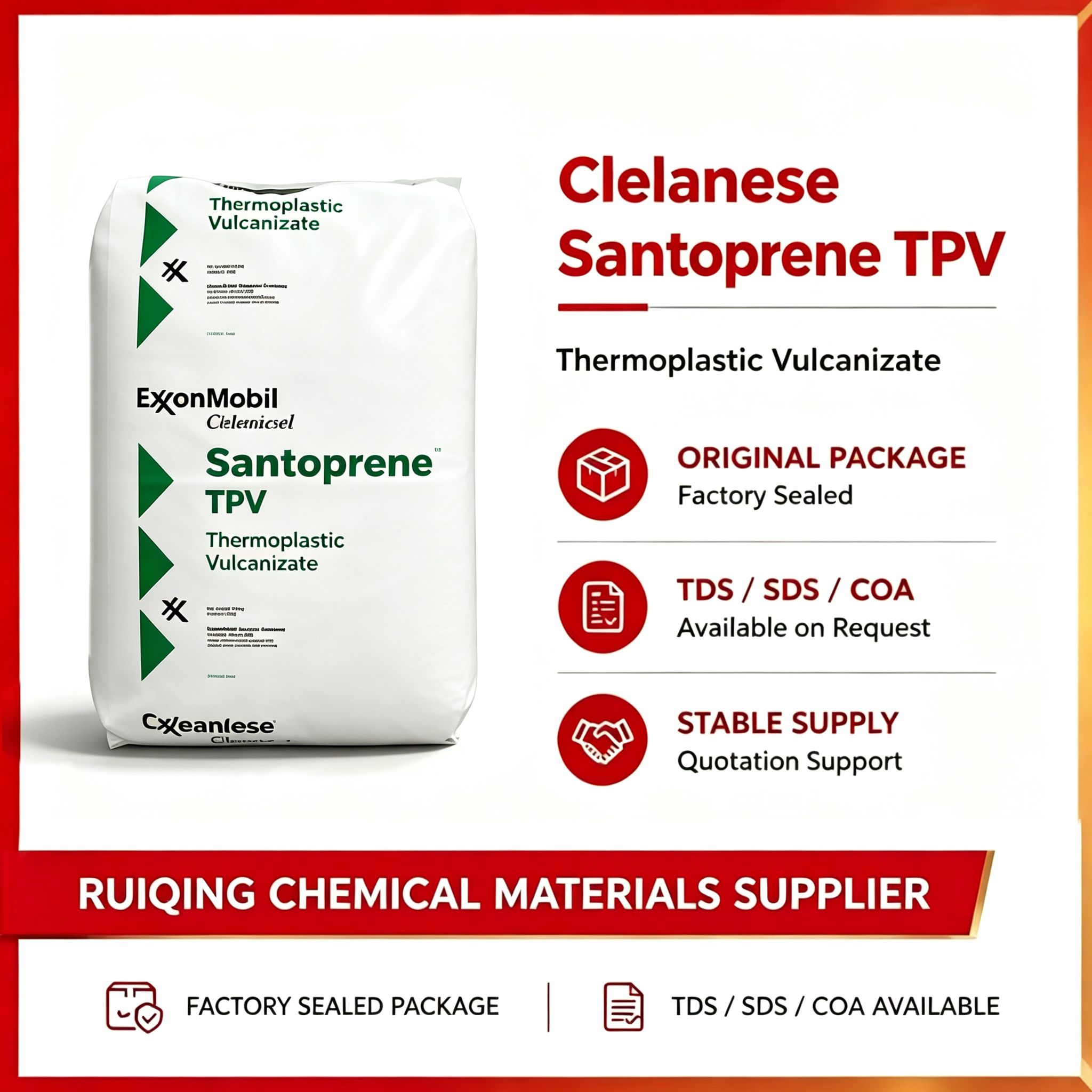
Santoprene 8201-70 is a natural, colorable thermoplastic vulcanizate from Celanese designed for a broad range of extrusion and molding applications.
It belongs to the Santoprene Enhanced Colorability family and combines rubber-like flexibility with thermoplastic processing efficiency.
Current Celanese portfolio data lists:
- 75 Shore A hardness
- Natural appearance
- 570% elongation at break
- 7.5 MPa tensile stress at break
- 2.9 MPa stress at 100% elongation
- 36% compression set at 70°C / 22 h
- General-purpose extrusion and molding
- Colorable formulation
Santoprene 8201-70 is especially useful where manufacturers need a flexible elastomeric material that can be customized in color rather than using a standard black compound.
The grade is also non-hygroscopic and shear dependent, giving it good processing flexibility across injection molding, extrusion, blow molding and thermoforming.
Typical applications include:
- Flexible seals
- Soft-touch grips
- Consumer products
- Appliance parts
- Kitchenware
- Electrical strain reliefs
- Flexible profiles
- Molded technical components
For more TPV products, visit our TPV Thermoplastic Vulcanizates Product Category →.
For current Santoprene portfolio information, see the Official Celanese Santoprene & Geolast Product Finder →.
Key Features of Santoprene 8201-70
| Feature | Engineering Benefit |
|---|---|
| 75 Shore A Hardness | Provides a medium-firm elastomeric response |
| Natural / Colorable | Supports custom-colored consumer and industrial parts |
| 570% Elongation at Break | Provides high flexibility and deformation capability |
| 7.5 MPa Tensile Stress at Break | Provides useful mechanical strength |
| 2.9 MPa Stress at 100% Elongation | Supports flexible sealing and grip applications |
| 36% Compression Set at 70°C | Supports general sealing applications |
| Non-Hygroscopic | Reduces drying sensitivity during normal storage and handling |
| Excellent Ozone Resistance | Useful for exposed elastomeric components |
| Excellent Flex-Fatigue Resistance | Suitable for repeatedly flexed parts |
| Good Chemical Resistance | Useful in consumer, industrial and sealing environments |
| Broad Processing Capability | Supports molding, extrusion, blow molding and thermoforming |
| Shear-Dependent Flow | Apparent viscosity decreases as shear increases |
| Enhanced Colorability | Suitable for appearance-sensitive applications |
| Polyolefin-Based TPV | Combines thermoplastic processing with rubber-like behavior |
| Manufacturing-Stream Recyclability | Clean production scrap can be reprocessed under controlled conditions |
Typical Applications for Santoprene 8201-70
Santoprene 8201-70 is a broad-use grade suitable for flexible molded and extruded applications.
| Application Area | Typical Use |
|---|---|
| Seals | Flexible molded and extruded sealing components |
| Gaskets | Compression interfaces |
| Soft-Touch Grips | Flexible hand-contact surfaces |
| Kitchenware | Colored flexible kitchen components |
| Appliance Components | Flexible technical parts |
| Strain Reliefs | Flexible cable-support elements |
| Consumer Electronics | Protective and flexible parts |
| Stationery | Soft grips and flexible components |
| Profile Extrusion | Flexible continuous sections |
| Sheet Extrusion | Flexible TPV sheet |
| Blow-Molded Parts | Flexible hollow components |
| Multi-Injection Parts | Selected hard/soft designs |
| General Consumer Products | Colored flexible molded components |
The grade is particularly useful when the application needs both colorability and broad processing freedom.
Typical Properties of Santoprene 8201-70
Physical Properties
| Property | Typical Value | Test Method |
|---|---|---|
| Density | 0.950 g/cm³ | ISO 1183 / ASTM D792 |
| Shore A Hardness, 15 s | 75 | ISO 868 |
| Appearance | Natural | Manufacturer Information |
| Product Form | Pellets | Manufacturer Information |
| Material Family | TPV / TPE-V | Manufacturer Information |
| Moisture Behavior | Non-Hygroscopic | Manufacturer Information |
The number 70 in the grade designation should not be treated as the current measured hardness. The published typical value is approximately 75 Shore A.
Mechanical Properties
| Property | Typical Value | Test Method |
|---|---|---|
| Tensile Stress at 100% Elongation | 2.9 MPa | ASTM D412 / ISO 37 |
| Tensile Stress at Break | 7.5 MPa | ASTM D412 / ISO 37 |
| Elongation at Break | 570% | ASTM D412 / ISO 37 |
| Compression Set, 70°C / 22 h | 36% | ASTM D395B / ISO 815 |
| Compression Set, 125°C / 70 h | 57% | ASTM D395B / ISO 815 |
These values give Santoprene 8201-70 a useful balance between flexibility, tensile strength and sealing recovery.
Low-Temperature Performance
Santoprene 8201-70 has a published brittleness temperature of approximately:
-63°C
This indicates useful flexibility in low-temperature environments.
Potential applications include:
- Outdoor equipment
- Automotive components
- Cold-storage components
- Flexible seals
- Consumer products
Brittleness temperature should not be interpreted as a guaranteed continuous operating limit, but it is useful for comparative low-temperature material selection.
Natural & Enhanced Colorability
One of the strongest features of Santoprene 8201-70 is its natural, easy-coloring formulation.
Potential finished colors include:
- White
- Gray
- Blue
- Red
- Green
- Beige
- Custom brand colors
This is useful for:
- Kitchen tools
- Appliances
- Consumer electronics
- Stationery
- Flexible grips
- Visible technical parts
Compatible color masterbatch should be selected to maintain:
- Mechanical properties
- Surface quality
- Processing stability
- Color uniformity
- Long-term appearance
Non-Hygroscopic Behavior
Santoprene 8201-70 is described as non-hygroscopic.
Under normal storage conditions, the grade requires little or no drying compared with strongly moisture-sensitive engineering plastics.
This can provide:
- Faster production start-up
- Reduced dryer use
- Lower energy consumption
- Easier material handling
If material becomes wet or exposed to condensation, controlled drying may still be used before processing.
Ozone Resistance
Santoprene 8201-70 is recommended for applications requiring excellent ozone resistance.
This is especially useful for:
- Seals
- Flexible interfaces
- Exterior components
- Industrial elastomeric parts
Ozone resistance helps reduce the risk of surface cracking in flexible components exposed to atmospheric ozone while under strain.
Flex-Fatigue Resistance
The grade also provides excellent flex-fatigue resistance.
This supports components that repeatedly:
- Bend
- Stretch
- Compress
- Recover
- Fold
- Move during service
Typical examples include:
- Flexible grips
- Strain reliefs
- Sealing lips
- Repeated-motion components
Sealing Performance
Santoprene 8201-70 is suitable for general sealing applications.
The combination of:
- 75 Shore A hardness
- 570% elongation
- 7.5 MPa tensile strength
- 36% compression set at 70°C
makes it relevant to:
- Housing seals
- Gaskets
- Flexible interfaces
- Protective sealing components
- Molded sealing rings
- Extruded sealing profiles
Thermal Performance
Published grade-specific thermal data includes:
| Property | Typical Value |
|---|---|
| Brittleness Temperature | -63°C |
| RTI Electrical | 100°C |
| RTI Mechanical Strength, 1.1 mm | 90°C |
| RTI Mechanical Strength, 1.6 mm | 90°C |
| RTI Mechanical Strength, 3.0 mm | 95°C |
These values provide useful engineering guidance for electrical and mechanical applications.
Electrical Properties
Published historical data includes:
| Property | Typical Rating |
|---|---|
| Comparative Tracking Index, CTI | PLC 0 |
| High Amp Arc Ignition, HAI | PLC 0 |
| High Voltage Arc Resistance, HVAR | PLC 5 |
| Hot Wire Ignition, 1.6 mm | PLC 3 |
| Hot Wire Ignition, 3.0 mm | PLC 2 |
These properties can be relevant in:
- Cable accessories
- Strain reliefs
- Flexible protective electrical parts
- Consumer electronics
Flammability
Published historical grade data gives:
| Thickness | UL 94 Rating |
|---|---|
| 1.1 mm | HB |
| 1.6 mm | HB |
| 3.0 mm | HB |
Santoprene 8201-70 should therefore be treated as an HB-rated general-purpose TPV, not a flame-retardant V-0 grade.
Heat-Aging Performance
Published heat-aging data after 150°C for 168 hours includes approximately:
| Property | Typical Change |
|---|---|
| Tensile Strength | -9% |
| Elongation at Break | -8% |
| Shore A Hardness | +2 points |
| Mass | -9% |
These values show useful property retention under the specified aging test.
They should not be interpreted as a universal 150°C continuous-service rating.
Why Choose Santoprene 8201-70?
The strongest reason to select Santoprene 8201-70 is its combination of colorability, medium-firm flexibility and broad thermoplastic processability.
The grade provides:
- 75 Shore A hardness
- 0.950 g/cm³ density
- 570% elongation
- 7.5 MPa tensile stress at break
- 2.9 MPa stress at 100% elongation
- 36% compression set at 70°C / 22 h
- 57% compression set at 125°C / 70 h
- Natural/colorable appearance
- Non-hygroscopic behavior
- Excellent ozone resistance
- Excellent flex-fatigue resistance
- Good chemical resistance
- Injection molding
- Extrusion
- Blow molding
- Thermoforming
- Vacuum forming
For customers requiring a natural, colorable and versatile TPV for flexible molded or extruded parts, Santoprene 8201-70 is a strong general-purpose grade.
Processing Guidelines for Santoprene 8201-70
Santoprene 8201-70 supports a wide range of thermoplastic processing methods:
- Injection Molding
- Multi-Injection Molding
- Coextrusion
- Extrusion
- Profile Extrusion
- Sheet Extrusion
- Extrusion Blow Molding
- Blow Molding
- Injection Blow Molding
- Thermoforming
- Vacuum Forming
Injection Molding Conditions
| Processing Parameter | Typical Range |
|---|---|
| Maximum Moisture Content | 0.08% |
| Maximum Regrind | 20% |
| Rear Barrel Temperature | 179–196°C |
| Middle Barrel Temperature | 185–199°C |
| Front Barrel Temperature | 191–204°C |
| Nozzle Temperature | 191–210°C |
| Melt Temperature | 199–216°C |
| Mold Temperature | 24–52°C |
| Injection Speed | Fast |
| Back Pressure | 0.345–0.689 MPa |
| Screw Speed | 100–200 rpm |
| Clamp Pressure | 41–69 MPa |
Screw Design
Published processing guidance includes:
| Parameter | Recommended Range |
|---|---|
| Screw L/D Ratio | 16:1 to 20:1 |
| Screw Compression Ratio | 2.0:1 to 2.5:1 |
| Vent Depth | Approx. 0.025 mm |
These settings help support stable melt preparation and consistent injection behavior.
Extrusion Conditions
| Processing Parameter | Typical Range |
|---|---|
| Melt Temperature | 185–221°C |
| Die Temperature | 185–221°C |
Actual extrusion settings depend on:
- Profile geometry
- Extruder size
- Screw design
- Line speed
- Die design
- Surface-quality requirements
Shear-Dependent Flow
Santoprene 8201-70 is shear dependent.
As shear rate increases, apparent melt viscosity decreases.
This means flow can be improved by optimizing:
- Injection speed
- Screw speed
- Gate size
- Runner design
- Die geometry
rather than simply increasing temperature.
This characteristic is useful for:
- Thin flexible sections
- Sealing lips
- Complex molded geometries
- Long flow paths
- Fine extrusion profiles
Multi-Injection Molding
Santoprene 8201-70 can also be processed by multi-injection molding.
Potential applications include:
- Hard/soft components
- Flexible grips
- Integrated sealing areas
- Multi-material consumer products
However, this is not a dedicated bonding grade like the B100 or B150 families.
Adhesion to the rigid substrate should be tested with the exact resin formulation.
Blow Molding
Santoprene 8201-70 supports:
- Blow Molding
- Extrusion Blow Molding
- Injection Blow Molding
This allows production of flexible hollow components where conventional rigid thermoplastics may not provide sufficient elasticity.
Thermoforming & Vacuum Forming
The grade can also be used for:
- Thermoforming
- Vacuum Forming
Potential applications include flexible sheets, protective components and formed elastomeric parts.
Material Compatibility
Santoprene TPV is incompatible with:
- POM / Acetal
- PVC
Processing equipment should be thoroughly purged when switching between these materials and Santoprene 8201-70.
Manufacturing-Stream Recyclability
Santoprene 8201-70 is polyolefin based and suitable for controlled manufacturing-stream recycling.
Published processing guidance permits up to approximately:
20% regrind
as a starting reference.
Potential clean process scrap includes:
- Sprues
- Runners
- Extrusion trim
- Start-up scrap
- Selected rejected components
Regrind levels should be controlled according to:
- Mechanical properties
- Surface quality
- Color consistency
- Final qualification requirements
Related Products
We supply Santoprene TPV grades for different hardness, colorability, flow and processing requirements.
Typical product families include:
- Santoprene 8201 Series
- Santoprene enhanced-colorability TPV
- Santoprene natural TPV grades
- Santoprene injection-molding grades
- Santoprene extrusion grades
- Santoprene blow-molding grades
- Santoprene sealing grades
- Santoprene consumer-product TPV
- Santoprene flexible-grip materials
View More TPV Thermoplastic Vulcanizates →
Technical Documents for Santoprene 8201-70
| Document Type | Description |
|---|---|
| TDS | Physical, mechanical, thermal and processing data |
| SDS | Safety Data Sheet |
| Injection Molding Guide | Molding and tool-design guidance |
| Extrusion Guide | Profile and sheet extrusion guidance |
| Electrical Data | CTI, HAI, HVAR and RTI information |
| Coloring Information | Guidance for Natural TPV pigmentation |
| COA | Batch-specific quality information where available |
Need technical documents for Santoprene 8201-70?
📧 Email: ruiqingchem@gmail.com
📝 Online form: Contact Us →
FAQ About Santoprene 8201-70
Q1: What is Santoprene 8201-70?
Santoprene 8201-70 is a natural, enhanced-colorability TPV from Celanese designed for general-purpose extrusion and molding applications.
Q2: What is the hardness of Santoprene 8201-70?
The current published typical hardness is approximately 75 Shore A.
Q3: Is Santoprene 8201-70 exactly 70 Shore A?
No. The grade designation contains 70, but the current published typical hardness is 75 Shore A.
Q4: What is the density?
The typical density is approximately 0.950 g/cm³.
Q5: What is the elongation at break?
The typical value is approximately 570%.
Q6: What is the tensile stress at break?
The typical value is approximately 7.5 MPa.
Q7: What is the stress at 100% elongation?
The typical value is approximately 2.9 MPa.
Q8: What is the compression set?
Published values include approximately 36% at 70°C / 22 h and 57% at 125°C / 70 h.
Q9: Is Santoprene 8201-70 Natural or Black?
The standard grade is Natural.
Q10: Can Santoprene 8201-70 be colored?
Yes. It belongs to Celanese’s Enhanced Colorability TPV family.
Q11: Is Santoprene 8201-70 non-hygroscopic?
Yes. The grade is described as non-hygroscopic and normally requires little to no drying under proper storage conditions.
Q12: Is Santoprene 8201-70 suitable for seals?
Yes. Sealing applications are specifically listed for this grade.
Q13: Can Santoprene 8201-70 be injection molded?
Yes. Injection molding and multi-injection molding are supported.
Q14: Can Santoprene 8201-70 be extruded?
Yes. Extrusion, profile extrusion, sheet extrusion and coextrusion are supported.
Q15: Can Santoprene 8201-70 be blow molded?
Yes. Blow molding, extrusion blow molding and injection blow molding are all listed processing routes.
Q16: Is Santoprene 8201-70 flame retardant?
No. Historical published data gives UL 94 HB, so it should not be marketed as a V-0 flame-retardant grade.
Request Santoprene 8201-70 Price & Technical Support
For pricing, availability, technical documents or application support for Santoprene 8201-70, please provide:
- Required quantity
- Destination country or port
- Application
- Required hardness
- Required color
- Seal / grip / appliance / consumer application
- Injection / extrusion / blow-molding process
- Operating temperature
- Chemical-contact conditions
- Flex-fatigue requirement
- TDS / SDS requirement
- COA requirement
- Sample requirement, if applicable
📧 Email: ruiqingchem@gmail.com