描述
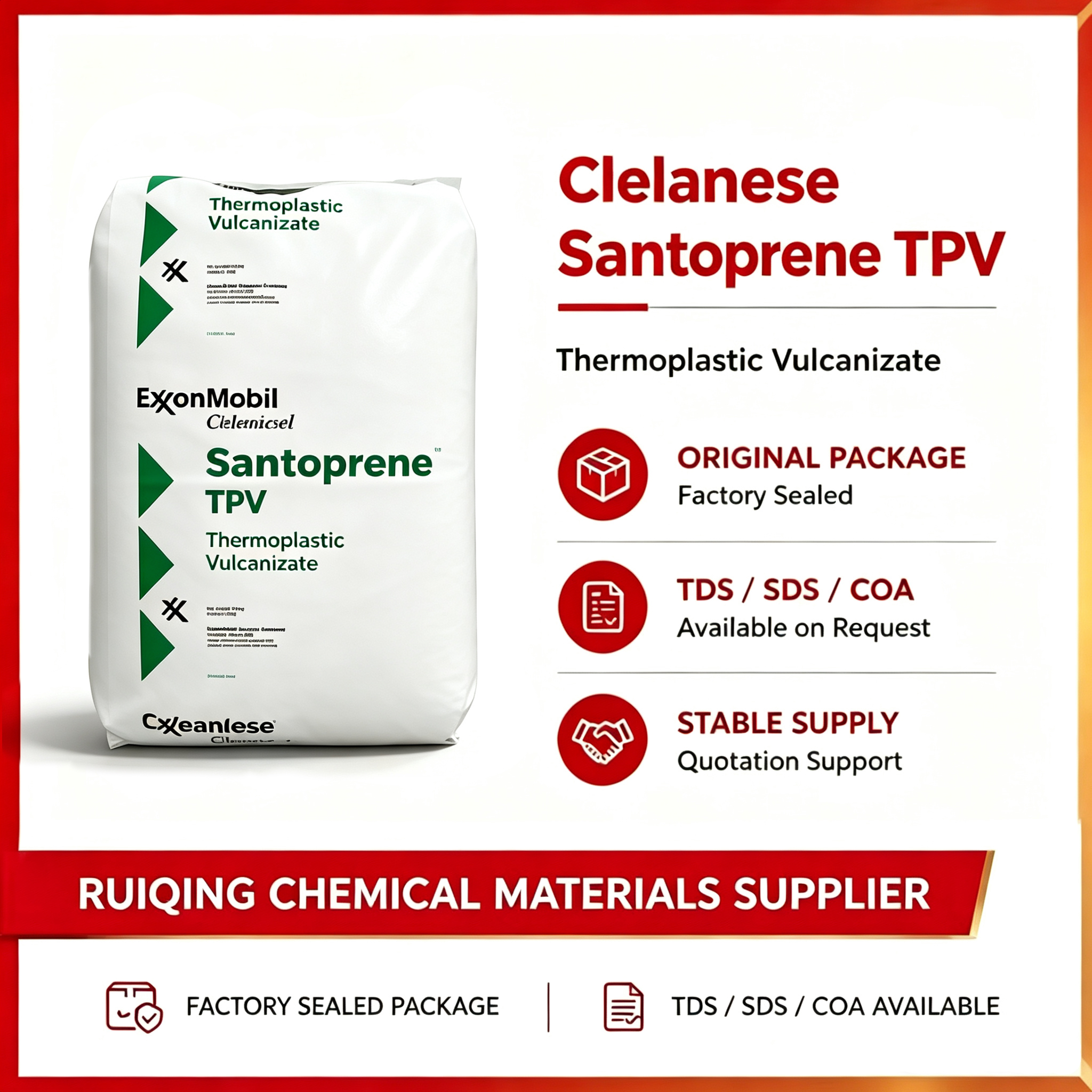
Santoprene 111-35 is a soft, black, high-flow thermoplastic vulcanizate (TPV) from Celanese designed for a wide range of injection-molding applications requiring rubber-like flexibility with thermoplastic processing efficiency.
The grade belongs to the general-purpose Santoprene TPV family and is specifically described by Celanese as a material for high-flow applications.
This is an important distinction. Many very soft elastomers can become difficult to fill through thin walls, small gates or complex geometries. Santoprene 111-35 is designed to combine very low hardness with improved processing flow under shear.
The material has a Shore A hardness of approximately 38, making it one of the softer black general-purpose grades in the Santoprene portfolio.
The numerical grade name should not be treated as an exact hardness specification. Although the designation contains “35,” current Celanese data lists the measured hardness at approximately Shore A 38.
The grade is polyolefin based and combines the elastic response of vulcanized rubber with the processing characteristics of a thermoplastic.
Celanese highlights excellent flex-fatigue resistance, excellent ozone resistance, good physical properties and chemical resistance.
These characteristics make Santoprene 111-35 suitable for flexible molded parts that may be repeatedly compressed, bent, stretched or exposed to environmental ozone.
Current Celanese grade data lists approximately 330% elongation at break, 2.9 MPa tensile stress at break, 1.0 MPa tensile stress at 100% elongation, and a shear modulus of approximately 0.888 MPa.
The very low modulus and low hardness create a soft, compliant material that can conform to sealing surfaces and absorb movement.
Low-temperature performance is another important strength. The grade has a published brittleness temperature of approximately -63°C, giving it useful flexibility for cold-weather automotive and outdoor applications.
Compression-set performance is also notable for such a soft TPV. Published Celanese data lists approximately 10% compression set at 23°C for 24 hours and approximately 31% at 125°C for 70 hours.
For sealing components, lower compression set can help the material recover after being compressed and maintain contact pressure over time.
The grade is UL recognized, with Celanese listing QMFZ2.E80017 for the United States and QMFZ8.E80017 for Canada.
Current grade data lists HB at 1.5 mm under IEC 60695-11-10 / UL 94-related testing. The material is therefore not positioned as a dedicated flame-retardant grade.
Santoprene 111-35 is shear dependent. As shear rate increases during molding, apparent melt viscosity decreases. This behavior is central to the grade’s high-flow processing characteristics.
For more TPV products, visit our TPV Thermoplastic Vulcanizates Product Category →.
For the current Celanese TPV portfolio, see the Official Celanese Santoprene & Geolast Product Finder →.
Key Features of Santoprene 111-35
| Feature | Engineering Benefit |
|---|---|
| Shore A 38 | Very soft elastomeric feel for compliant seals and flexible molded components |
| High-Flow Design | Helps fill thin walls, small gates and complex injection-molded geometries |
| Excellent Flex-Fatigue Resistance | Supports repeated bending and cyclic deformation |
| Excellent Ozone Resistance | Useful for automotive and outdoor environments |
| 330% Elongation at Break | Allows substantial deformation before break |
| -63°C Brittleness Temperature | Strong low-temperature flexibility |
| 10% Compression Set @ 23°C / 24 h | Good elastic recovery at room temperature |
| 31% Compression Set @ 125°C / 70 h | Useful compression recovery at elevated temperature |
| Good Chemical Resistance | Suitable for many general industrial and automotive environments |
| UL Recognized | Published Celanese data references E80017 |
| Shear-Dependent Flow | Apparent viscosity falls as shear increases |
| Polyolefin Based | Low density and thermoplastic processing behavior |
| Manufacturing-Stream Recyclability | Controlled process scrap can be recycled within the manufacturing stream |
The core value of Santoprene 111-35 is the combination of very soft hardness and high-flow injection-molding behavior.
Typical Applications for Santoprene 111-35
Santoprene 111-35 is primarily suited to soft injection-molded parts where high flow, flexibility and fatigue resistance are important.
| Application Area | Typical Use |
|---|---|
| Soft Seals & Gaskets | Highly compliant sealing parts around housings and interfaces |
| Grommets | Flexible cable, automotive and industrial protection components |
| Plugs | Soft protective and sealing plugs |
| Bumpers & Stops | Flexible impact and vibration-control parts |
| Clips & Flexible Retainers | Soft molded components requiring repeated deformation |
| Flexible Covers | Protective elastomeric covers and boots |
| Automotive Molded Parts | Soft interior, exterior or under-hood elastomeric components |
| Consumer Components | Soft-touch and resilient molded parts |
| Electrical / Electronic Parts | Flexible protective components and seals |
| Complex Thin-Wall Moldings | Parts benefiting from the grade’s high-flow behavior |
The best fit is typically a part that requires very soft 38A hardness but still needs efficient cavity filling during injection molding.
Typical Properties of Santoprene 111-35
Physical Properties
| Property | Typical Value | Test Method |
|---|---|---|
| Density | 930 kg/m³ / 0.930 g/cm³ | ISO 1183 |
| Shore A Hardness, 15 s | 38 | ISO 48-4 / ISO 868 |
| Resin Identification | TPV | ISO 1043 |
| Part Marking Code | >TPV< | ISO 11469 |
| Color | Black | Manufacturer information |
| Product Form | Pellets / Granules | Manufacturer information |
The low density of approximately 0.93 g/cm³ is useful for lightweight soft-touch and sealing components.
Mechanical Properties
| Property | Typical Value | Test Method |
|---|---|---|
| Tensile Stress at 100% Elongation | 1.0 MPa | ISO 527-1/-2 or ISO 37 |
| Tensile Stress at Break | 2.9 MPa | ISO 527-1/-2 or ISO 37 |
| Elongation at Break | 330% | ISO 527-1/-2 or ISO 37 |
| Shear Modulus | 0.888 MPa | ISO 6721 |
| Brittleness Temperature | -63°C | ASTM D746 |
| Low-Temperature Brittleness | -63°C | ISO 812 |
| Compression Set, 23°C / 24 h | 10% | ISO 815 |
| Compression Set, 125°C / 70 h | 31% | ISO 815 |
The low shear modulus confirms the highly compliant character of Santoprene 111-35.
Flammability Properties
| Property | Typical Value | Test Method |
|---|---|---|
| Burning Behavior | HB | IEC 60695-11-10 / UL 94 |
| Thickness Tested | 1.5 mm | IEC 60695-11-10 / UL 94 |
| UL Recognition | Yes | UL 94 |
The grade is designed for general-purpose elastomeric performance rather than flame-retardant applications.
Environmental & Durability Characteristics
Celanese specifically identifies the following grade-level characteristics:
- Excellent flex-fatigue resistance
- Excellent ozone resistance
- Good physical properties
- Good chemical resistance
- Low-temperature flexibility
- High-flow molding capability
This combination is particularly useful for soft elastomeric parts that experience repeated movement or outdoor exposure.
Automotive OEM Specification References
Published Celanese Materials Database information for Santoprene 111-35 lists the following automotive specification references:
| OEM | Specification / Reference |
|---|---|
| Stellantis / Chrysler | MS-AR-100 AMN |
| Ford | WSD-M2D378-A4 |
| General Motors | GMW15813 Type 2 |
| Mercedes-Benz Group | DBL 5562 |
| Volkswagen Group | VW 50123 |
These references make Santoprene 111-35 useful for automotive suppliers evaluating a very soft black TPV for qualified component programs.
Why Choose Santoprene 111-35?
The main reason to choose Santoprene 111-35 is that it offers a combination that is difficult to achieve with many conventional thermoplastics: very low hardness together with high-flow injection molding.
At Shore A 38, the grade is substantially softer than mainstream 60A, 70A and 80A TPV grades.
This can be valuable for seals and flexible parts that need excellent conformability.
A very soft material can, however, become difficult to process if melt flow is poor. Santoprene 111-35 is specifically described by Celanese as designed for high-flow applications.
The shear-dependent rheology means the apparent viscosity decreases when shear increases during molding. Proper gate design and injection speed can therefore help the material fill complex cavities effectively.
The grade also maintains useful mechanical integrity. Its 330% elongation allows considerable stretching before failure, while the 2.9 MPa stress at break is appropriate for a very soft TPV.
The -63°C brittleness temperature is another major advantage. It allows soft components to remain functional in cold environments where many elastomeric materials stiffen significantly.
Flex-fatigue resistance supports repeated movement, while ozone resistance helps reduce environmental cracking during long-term exposure.
Compression-set performance is also relevant to sealing. At room temperature, the published value of approximately 10% after 24 hours indicates strong recovery for a very soft elastomer.
Because the material is thermoplastic, it can be molded without the separate vulcanization cycle required by conventional thermoset rubber.
For customers seeking a soft black TPV with Shore A 38, high flow, ozone resistance and low-temperature flexibility, Santoprene 111-35 is a focused grade to evaluate.
Processing Guidelines for Santoprene 111-35
Current Celanese grade data provides detailed injection-molding guidance for Santoprene 111-35.
Injection Molding Conditions
| Processing Parameter | Celanese Guidance |
|---|---|
| Drying Temperature | 82°C |
| Drying Time | 3 hours in a dehumidified dryer |
| Processing Moisture Content | ≤0.08% |
| Maximum Regrind Level | 20% |
| Optimum Melt Temperature | 215°C |
| Minimum Melt Temperature | 165°C |
| Maximum Melt Temperature | 265°C |
| Optimum Mold Temperature | 50°C |
| Minimum Mold Temperature | 20°C |
| Maximum Mold Temperature | 80°C |
| Back Pressure | 0.517 MPa |
| Ejection Temperature | 87°C |
Celanese also provides a broader Santoprene TPV processing note of approximately 175–230°C.
The grade-specific 165–265°C injection range is broader than the general family note. For initial process setup, the 215°C optimum melt temperature is the more useful starting point.
Drying
Desiccant drying for approximately 3 hours at 80–82°C is recommended.
Moisture should be controlled at or below approximately 0.08% before molding.
Shear-Dependent High-Flow Behavior
The high-flow behavior of Santoprene 111-35 is strongly influenced by shear.
As shear rate rises, apparent melt viscosity falls.
Processors should therefore pay close attention to injection speed, gate size, gate position, screw speed, back pressure, melt temperature, mold temperature, venting, cooling time and part thickness.
Very low injection speed may not take full advantage of the grade’s shear-thinning behavior.
Regrind
Current Celanese data lists a maximum regrind level of approximately 20%.
Regrind use should be controlled according to the finished-part specification, appearance requirements and contamination limits.
Material Compatibility
Celanese states that Santoprene TPV is incompatible with acetal (POM) and PVC.
Equipment should be thoroughly purged when changing between these materials and Santoprene TPV.
Santoprene 111-35 vs. Santoprene 111-45
| Feature | Santoprene 111-35 | Santoprene 111-45 |
|---|---|---|
| Material Family | TPV | TPV |
| Color | Black | Black |
| Product Positioning | General purpose / high-flow soft grade | General-purpose soft grade |
| Shore A Hardness | 38 | 49 |
| Elongation at Break | 330% | Approx. 340% |
| Tensile Stress at Break | 2.9 MPa | Approx. 3.5 MPa |
| Tensile Stress @ 100% Elongation | 1.0 MPa | Approx. 1.4 MPa |
| Main Selection Difference | Softer and more compliant | Higher hardness and tensile stress |
Choose Santoprene 111-35 when the application requires the softest feel and high-flow molding performance.
Choose Santoprene 111-45 when additional hardness and mechanical support are preferred while remaining within the soft general-purpose Santoprene range.
Related Products
Santoprene 111-45 – Black general-purpose soft TPV with approximately Shore A 49 hardness.
Santoprene 8211-35 – Natural-color Shore A 38 TPV with improved flow and enhanced colorability.
Santoprene 101-55 – Black general-purpose Shore A 60 TPV with higher mechanical strength and strong elastomeric performance.
View More TPV Thermoplastic Vulcanizates →
Technical Documents for Santoprene 111-35
| Document Type | Description |
|---|---|
| TDS | Current Celanese physical, mechanical, flammability and processing data |
| SDS | Safety Data Sheet |
| UL Information | QMFZ2.E80017 / QMFZ8.E80017 recognition |
| Automotive Specification Information | Published OEM references for Ford, GM, Mercedes-Benz, Stellantis and VW |
| Santoprene Product Finder | Celanese grade comparison and portfolio positioning |
| Processing Guide | Injection-molding guidance |
| COA | Batch-specific quality information where available |
Need technical documents for Santoprene 111-35?
📧 Email: ruiqingchem@gmail.com
📝 Online form: Contact Us →
Please state Santoprene 111-35 and the required document type when submitting your inquiry.
FAQ About Santoprene 111-35
Q1: What is Santoprene 111-35?
Santoprene 111-35 is a soft black high-flow TPV from Celanese designed primarily for injection-molding applications requiring very low hardness and good elastomeric performance.
Q2: What is the hardness of Santoprene 111-35?
The current Celanese grade data lists approximately Shore A 38.
Q3: Is the “35” in Santoprene 111-35 the exact Shore hardness?
No. The grade designation contains 35, but the published measured hardness is approximately Shore A 38.
Q4: What is the elongation at break?
Current grade data lists approximately 330% elongation at break.
Q5: What is the tensile strength?
The tensile stress at break is approximately 2.9 MPa, and the tensile stress at 100% elongation is approximately 1.0 MPa.
Q6: How does Santoprene 111-35 perform at low temperature?
The published brittleness temperature is approximately -63°C.
Q7: What is the compression set?
Published Celanese data lists approximately 10% at 23°C / 24 h and approximately 31% at 125°C / 70 h.
Q8: Why is Santoprene 111-35 considered a high-flow grade?
Celanese specifically describes the material as designed for applications requiring high-flow materials. Its shear-dependent rheology allows apparent viscosity to decrease as shear rate increases.
Q9: What processing temperature is recommended?
The current grade sheet lists an optimum melt temperature of approximately 215°C, with a published injection range of approximately 165–265°C.
Q10: What is the difference between Santoprene 111-35 and 111-45?
Both are black general-purpose TPV grades. Santoprene 111-35 is softer at Shore A 38, while 111-45 is approximately Shore A 49 and provides higher tensile stress.
Request Santoprene 111-35 Price & Technical Support
For pricing, availability, technical documents or application support for Santoprene 111-35, please provide:
- Required quantity
- Destination country or port
- Automotive, industrial, consumer or electrical application
- Seal, gasket, grommet, plug or molded-part design
- Required Shore hardness
- Thin-wall or high-flow requirement
- Continuous and peak operating temperature
- Minimum service temperature
- Compression-set requirement
- Chemical exposure
- Outdoor / ozone exposure
- Injection-molding equipment and part dimensions
- OEM specification requirement
- UL documentation requirement
- TDS, SDS or COA requirement
- Sample requirement, if applicable
📧 Email: ruiqingchem@gmail.com
📝 Send Inquiry →