描述
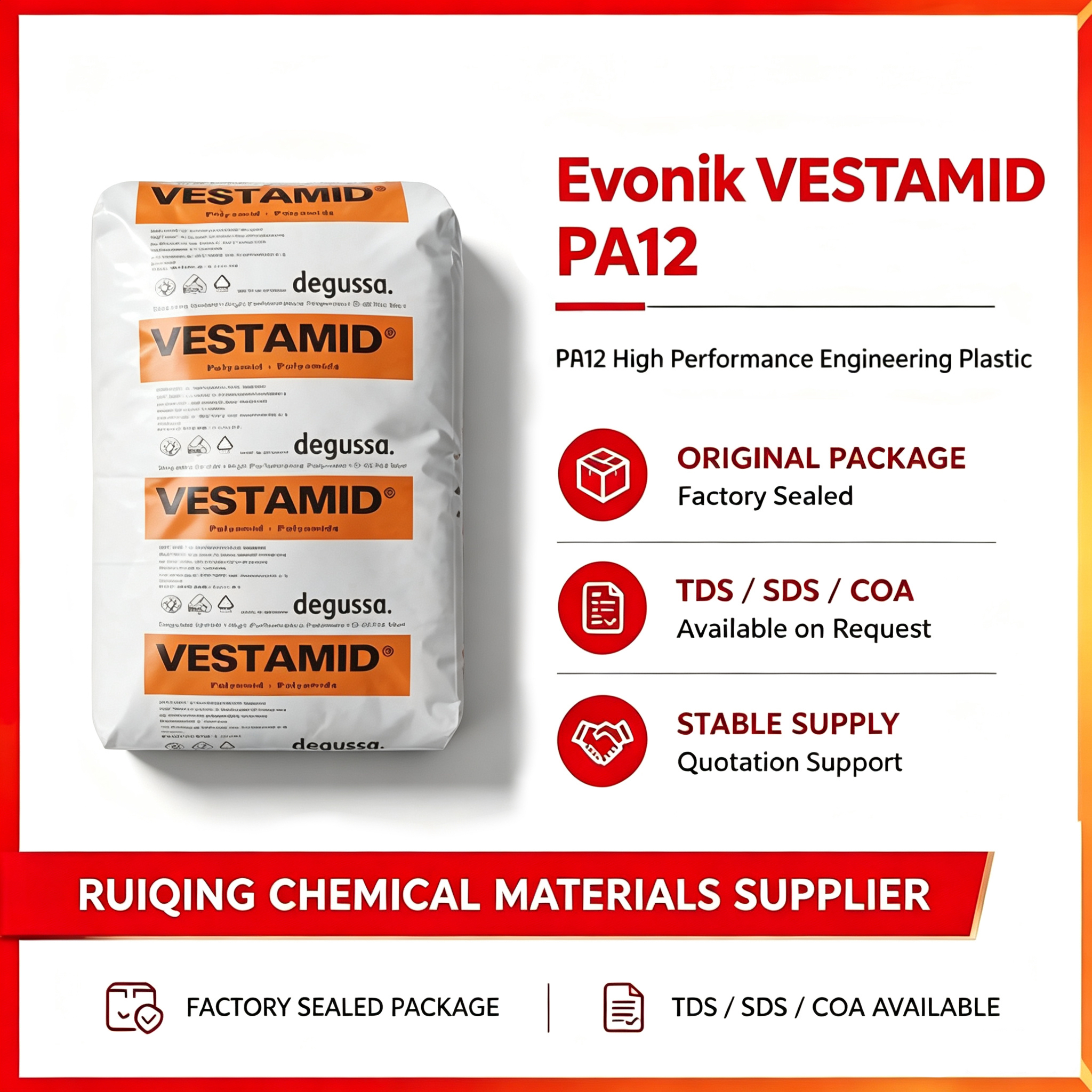
VESTAMID L1930 BK 9.7506 is a heat-stabilized polyamide 12 compound reinforced with approximately 30% milled glass fiber. Manufactured by Evonik Operations GmbH, this PA12-GD30 grade is designed for injection molding of rigid, dimensionally stable and particularly low-warpage precision components.
The reinforcement concept is one of the most important characteristics of VESTAMID L1930 BK 9.7506. Instead of using only conventional longer chopped glass fibers, the grade uses specialty short or milled glass fibers. This reduces the difference between shrinkage in the flow direction and shrinkage transverse to the flow direction.
Published ISO data shows approximately 0.5% molding shrinkage in both the parallel and normal directions. This balanced shrinkage behavior is a major advantage for precision components where distortion, twisting or warpage can create dimensional problems.
The PA12 base adds another important benefit: very low moisture uptake compared with many conventional polyamides. Published data lists water absorption of approximately 1.1% and humidity absorption of approximately 0.5%. This helps molded parts maintain dimensions and mechanical properties when ambient humidity changes.
Mechanical performance is also well balanced. Typical dry tensile modulus is approximately 3,800 MPa, with a yield stress of about 64 MPa. The material retains useful impact performance at room temperature and at -30°C, which is beneficial for precision mechanical components exposed to changing service temperatures.
As a semi-crystalline PA12 compound, VESTAMID L1930 BK 9.7506 also provides strong resistance to fuels, oils, greases and many other chemicals. This combination of dimensional stability, chemical resistance, rigidity and low warpage makes the grade suitable for automotive, electrical and industrial engineering applications.
Explore additional grades in our PA12 Polyamide 12 Product Category →.
For manufacturer information about the VESTAMID PA12 family, visit the Official Evonik VESTAMID Page →.
Key Features of VESTAMID L1930 BK 9.7506
| Feature | Benefit |
|---|---|
| 30% Milled Glass Fiber Reinforcement | Increases rigidity and supports balanced dimensional behavior |
| Low Warpage | Reduced shrinkage difference between flow and transverse directions |
| Heat Stabilized | Suitable for demanding engineering injection-molding applications |
| High Rigidity | Typical dry tensile modulus of approximately 3,800 MPa |
| Low Water Absorption | Helps reduce dimensional change when humidity varies |
| Balanced Mold Shrinkage | Approx. 0.5% in both principal directions in published ISO data |
| Dimensional Stability | Useful for close-tolerance precision parts |
| Chemical Resistance | Good resistance to fuels, oils, greases and many industrial chemicals |
| Useful Impact Performance | Retains toughness at room temperature and -30°C |
| Electrical Insulation | High volume resistivity supports insulating applications |
| Black Color | Supplied as a ready-colored black engineering compound |
| Injection Molding Grade | Designed for precision reinforced PA12 molded parts |
The defining advantage of VESTAMID L1930 BK 9.7506 is not simply the amount of glass reinforcement, but the more isotropic shrinkage behavior created by the milled-glass reinforcement system.
Typical Applications for VESTAMID L1930 BK 9.7506
VESTAMID L1930 BK 9.7506 is best suited to injection-molded parts where dimensional accuracy and low warpage are more important than maximizing stiffness alone.
| Application Area | Typical Use |
|---|---|
| Precision Gears | Low-warpage mechanical gears and transmission components |
| Automotive Sensors | Dimensionally stable gears, housings and sensor-related parts |
| Electrical Housings | Rigid insulating components requiring stable dimensions |
| Mechanical Engineering | Precision parts with tight tolerances |
| Industrial Equipment | Rigid molded components exposed to oils, greases or fuels |
| Automotive Components | Precision molded parts exposed to humidity and temperature changes |
| Small Technical Housings | Components where balanced shrinkage helps reduce distortion |
| Precision Injection Molding | Parts requiring low anisotropy and repeatable dimensions |
The L1930 family is especially attractive for precision molded parts where conventional glass-fiber-reinforced materials may create excessive directional shrinkage.
Typical Properties of VESTAMID L1930 BK 9.7506
Physical & Processing Properties
| Property | Typical Value | Test Method |
|---|---|---|
| Density | 1.24 g/cm³ | ISO 1183 |
| Water Absorption | 1.1% | Similar to ISO 62 |
| Humidity Absorption | 0.5% | Similar to ISO 62 |
| Melt Volume-Flow Rate (MVR) | 27 cm³/10 min | ISO 1133 |
| MVR Test Condition | 220°C / 10 kg | — |
| Molding Shrinkage – Parallel | 0.5% | ISO 294-4 / 2577 |
| Molding Shrinkage – Normal | 0.5% | ISO 294-4 / 2577 |
The equal published shrinkage values in both principal directions are central to the low-warpage performance of VESTAMID L1930 BK 9.7506.
Mechanical Properties
| Property | Typical Value | Test Method |
|---|---|---|
| Tensile Modulus | 3,800 MPa | ISO 527 |
| Yield Stress | 64 MPa | ISO 527 |
| Yield Strain | 4% | ISO 527 |
| Nominal Strain at Break | 12% | ISO 527 |
| Charpy Unnotched Impact, 23°C | 80 kJ/m² | ISO 179/1eU |
| Charpy Unnotched Impact, -30°C | 65 kJ/m² | ISO 179/1eU |
| Charpy Notched Impact, 23°C | 7 kJ/m² | ISO 179/1eA |
| Charpy Notched Impact, -30°C | 6 kJ/m² | ISO 179/1eA |
These properties show that VESTAMID L1930 BK 9.7506 combines reinforced stiffness with practical toughness for precision engineering components.
Thermal Properties
| Property | Typical Value | Test Method |
|---|---|---|
| Melting Temperature | 178°C | ISO 11357-1/-3 |
| Glass Transition Temperature | 39°C | ISO 11357-1/-2 |
| HDT @ 1.80 MPa | 130°C | ISO 75-1/-2 |
| HDT @ 0.45 MPa | 170°C | ISO 75-1/-2 |
| Vicat Softening Temperature B | 170°C | ISO 306 |
| Flammability @ 1.6 mm | HB | IEC 60695-11-10 / UL 94 equivalent classification context |
The reinforced structure gives VESTAMID L1930 BK 9.7506 useful thermal stability for many precision automotive and industrial parts.
Electrical Properties
| Property | Typical Value | Test Method |
|---|---|---|
| Volume Resistivity | 1 × 10¹³ Ω·m | IEC 62631-3-1 |
The high volume resistivity confirms that VESTAMID L1930 BK 9.7506 is an electrically insulating reinforced PA12 rather than a conductive or antistatic compound.
Why Choose VESTAMID L1930 BK 9.7506?
The principal reason to select VESTAMID L1930 BK 9.7506 is its low-warpage reinforcement concept.
In conventional chopped-glass-fiber compounds, fibers tend to align strongly in the melt-flow direction during injection molding. This can create significant differences between longitudinal and transverse shrinkage. Those differences may lead to twisting, bowing or dimensional distortion.
The specialty milled glass fibers used in this PA12-GD30 grade reduce that anisotropy. Published data lists approximately 0.5% molding shrinkage in both the parallel and normal directions, making the material especially attractive for precision gears, sensor components and small housings.
PA12’s low moisture absorption provides an additional benefit. Parts can maintain dimensions more consistently when service conditions move between dry and humid environments.
The material also offers resistance to fuels, oils and greases, which is valuable in automotive and industrial environments. For parts where dimensional precision and low warpage are more important than the maximum possible tensile modulus, VESTAMID L1930 BK 9.7506 can offer a more balanced solution than many conventional PA12-GF30 compounds.
Processing Guidelines for VESTAMID L1930 BK 9.7506
VESTAMID L1930 BK 9.7506 is intended for injection molding. Evonik’s official VESTAMID processing guide lists a general melt-processing temperature range of approximately 240–280°C for VESTAMID L1930.
| Processing Item | Typical / Recommended Guidance |
|---|---|
| Primary Processing Method | Injection Molding |
| General Processing Temperature | Approx. 240–280°C |
| Published ISO Test Melt Temperature | Approx. 250°C |
| Published ISO Test Mold Temperature | Approx. 80°C |
| Published ISO Injection Velocity | Approx. 200 mm/s |
| PA12 Mold Temperature Guidance | Approx. 30–100°C, depending on grade and part |
| Supply Condition | Dry pellets in moisture-proof packaging |
VESTAMID PA12 compounds are supplied in moisture-proof packaging. Evonik states that drying is normally necessary only when packaging has been damaged or material has been exposed to air long enough to absorb moisture. When drying is required, PA12 compounds are generally dried at approximately 80–100°C until the water content falls below about 0.1%.
Because VESTAMID L1930 BK 9.7506 contains 30% glass reinforcement, the processing equipment should be appropriate for reinforced engineering plastics.
For precision low-warpage parts, gate position, filling balance, injection speed, holding pressure and mold temperature should be carefully controlled. Even though the grade is designed to reduce anisotropic shrinkage, poor flow balance can still influence final dimensions.
VESTAMID L1930 BK 9.7506 vs. VESTAMID L1930 BK 9.7503
| Feature | VESTAMID L1930 BK 9.7506 | VESTAMID L1930 BK 9.7503 |
|---|---|---|
| Base Polymer | PA12-GD30 | PA12-GD30 |
| Reinforcement | 30% milled glass fiber | 30% milled glass fiber |
| Color Code | BK 9.7506 | BK 9.7503 |
| Low-Warpage Concept | Yes | Yes |
| Primary Processing | Injection Molding | Injection Molding |
| Main Selection Point | Specific black color / grade designation | Specific black color / grade designation |
| Technical Positioning | Low-warpage precision PA12-GD30 | Low-warpage precision PA12-GD30 |
Both grades belong to the same L1930 PA12-GD30 family and share the same basic low-warpage reinforcement concept. The main difference visible in the commercial designation is the black color code.
When replacing one with the other, confirm the required color code, approved grade designation and latest technical documentation before production qualification.
Related Products
VESTAMID L1930 BK 9.7503 – PA12-GD30 low-warpage reinforced grade with a different black color designation.
VESTAMID L1930 NC – Natural-color PA12-GD30 for low-warpage precision injection molding.
VESTAMID L1833 BK 9.7623 – PA12-GF23 with higher stiffness and easy mold release.
View More PA12 Polyamide 12 Materials →
Technical Documents for VESTAMID L1930 BK 9.7506
| Document Type | Description |
|---|---|
| TDS | Technical Data Sheet with physical, mechanical, thermal and electrical properties |
| SDS | Safety Data Sheet |
| COA | Batch-specific Certificate of Analysis where available |
| Compliance Documents | Relevant regulatory and material-compliance documentation subject to availability |
Need technical documentation for VESTAMID L1930 BK 9.7506?
📧 Email: ruiqingchem@gmail.com
📝 Online form: Contact Us →
Please state VESTAMID L1930 BK 9.7506 and the required document type when submitting your inquiry.
FAQ About VESTAMID L1930 BK 9.7506
Q1: What is VESTAMID L1930 BK 9.7506?
VESTAMID L1930 BK 9.7506 is a heat-stabilized PA12 compound reinforced with approximately 30% milled glass fiber. It is designed for low-warpage precision injection-molded components.
Q2: What does PA12-GD30 mean?
PA12 means polyamide 12. GD30 identifies a grade reinforced with approximately 30% milled or ground glass fiber, giving more balanced shrinkage behavior than many conventional chopped-glass-fiber compounds.
Q3: Why is VESTAMID L1930 BK 9.7506 considered low warpage?
The specialty short glass fibers reduce the difference between shrinkage parallel and transverse to the melt-flow direction. Published data lists approximately 0.5% shrinkage in both directions.
Q4: What is the density of VESTAMID L1930 BK 9.7506?
The typical density is approximately 1.24 g/cm³ according to ISO 1183.
Q5: What is the tensile modulus of VESTAMID L1930 BK 9.7506?
The typical dry tensile modulus is approximately 3,800 MPa according to ISO 527.
Q6: What is the MVR of VESTAMID L1930 BK 9.7506?
The published MVR is approximately 27 cm³/10 min at 220°C / 10 kg according to ISO 1133.
Q7: What is the HDT of VESTAMID L1930 BK 9.7506?
The typical heat deflection temperature is approximately 130°C at 1.80 MPa and 170°C at 0.45 MPa.
Q8: What processing temperature is recommended for VESTAMID L1930 BK 9.7506?
Evonik’s VESTAMID processing guide lists approximately 240–280°C as the general melt-processing range for VESTAMID L1930.
Q9: Is VESTAMID L1930 BK 9.7506 chemically resistant?
Yes. The PA12 base provides good resistance to fuels, oils, greases and many other chemicals, which supports automotive and industrial applications.
Q10: Can you provide VESTAMID L1930 BK 9.7506 TDS, SDS and COA?
Yes. Please request the required technical documents through our Contact Page → or email ruiqingchem@gmail.com.
Request VESTAMID L1930 BK 9.7506 Price & Technical Support
For pricing, availability, technical documents or grade-selection support for VESTAMID L1930 BK 9.7506, please provide:
- Required quantity
- Destination country or port
- Target application
- Part dimensions and tolerance requirements
- Warpage / shrinkage requirements
- Injection-molding conditions
- Required mechanical or thermal performance
- TDS, SDS or COA requirements
- Sample requirement, if applicable
📧 Email: ruiqingchem@gmail.com
📝 Send Inquiry →