描述
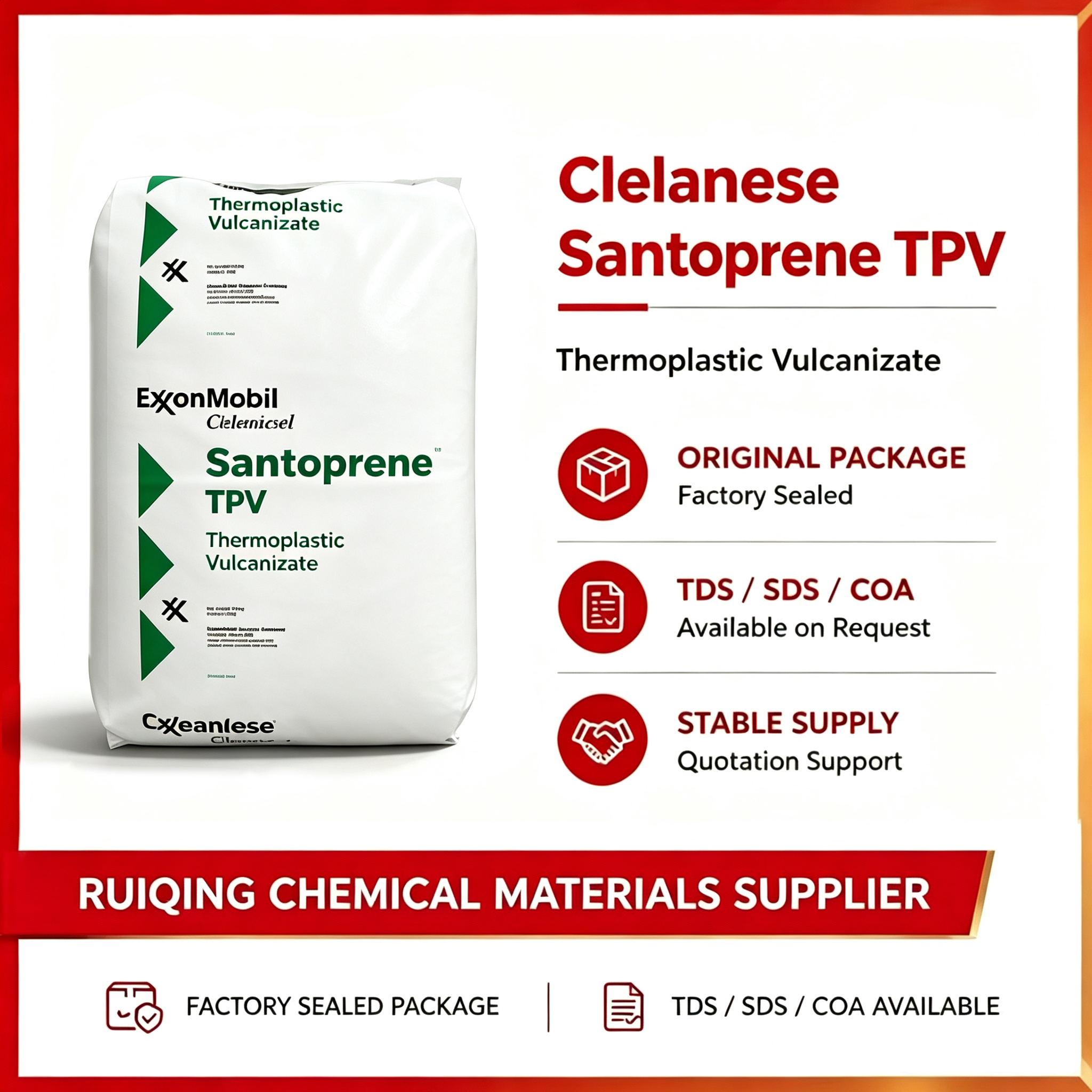
Santoprene 8211-75 is a Natural, high-flow thermoplastic vulcanizate from Celanese developed for flexible molded components that need more firmness and dimensional support while retaining substantial elastomeric deformation.
It belongs to the Santoprene 8211 family, which Celanese positions around two important characteristics:
Improved Flow for Easier Processability
and
Enhanced Colorability
Current Celanese portfolio data lists Santoprene 8211-75 at:
- 80 Shore A hardness
- Natural appearance
- 520% elongation at break
- 7.0 MPa tensile stress at break
- 3.8 MPa stress at 100% elongation
- 36% compression set
This combination makes Santoprene 8211-75 particularly interesting for applications where a softer TPV may deform too easily but a rigid thermoplastic would not provide enough flexibility.
The material is therefore well suited to components that must:
- Hold a defined geometry
- Bend during assembly
- Flex repeatedly
- Absorb impact
- Provide a protective surface
- Fill relatively thin or detailed molded sections
Its Natural formulation also allows manufacturers to develop custom-colored parts rather than being restricted to black.
For more TPV materials, visit our TPV Thermoplastic Vulcanizates Product Category →.
For current Santoprene portfolio information, see the Official Celanese Santoprene & Geolast Product Finder →.
Key Features of Santoprene 8211-75
| Feature | Engineering Benefit |
|---|---|
| 80 Shore A Hardness | Provides firmer elastomeric support |
| Improved Flow | Helps fill complex and thinner molded sections |
| Natural / Colorable | Supports light colors and custom color matching |
| Enhanced Colorability | Useful for visible consumer and technical products |
| 520% Elongation | Allows substantial deformation before failure |
| 7.0 MPa Tensile Strength | Provides useful strength for engineering parts |
| 3.8 MPa @100% Elongation | Gives greater resistance to stretching |
| 36% Compression Set | Supports selected sealing and interface applications |
| Shear-Dependent Flow | Apparent viscosity decreases as shear increases |
| Thermoplastic Processing | Enables conventional injection-molding production |
| Flexible Engineering Performance | Combines shape support with elastic movement |
| Detailed Mold Filling | Useful for ribs, lips, thin walls and complex geometry |
A Firm Flexible TPV for Engineering Components
One of the best ways to position Santoprene 8211-75 is as a firm flexible engineering material.
At approximately 80 Shore A, it is noticeably firmer than very soft TPV grades.
This can help components maintain:
- Wall shape
- Rib definition
- Edge geometry
- Protective structure
- Sealing-lip position
- Assembly retention
while still allowing the part to bend and recover.
This balance is useful in products where the designer wants more structural control without switching to a rigid polypropylene, ABS or engineering thermoplastic.
Typical Applications for Santoprene 8211-75
| Application Area | Typical Function |
|---|---|
| Protective Boots | Flexible covers over joints and connectors |
| Flexible Housings | Firm elastomeric protective structures |
| Grommets | Cable and tube protection |
| Cable Accessories | Strain relief and flexible interfaces |
| Technical Covers | Protective elastomeric surfaces |
| Molded Seals | Firm flexible sealing parts |
| Appliance Components | Colored functional elastomer parts |
| Automotive Components | Flexible technical molded parts |
| Protective Edges | Impact and contact protection |
| Flexible Collars | Retaining and protective structures |
| Thin-Wall Moldings | Detailed flexible parts |
| Multi-Cavity Parts | High-volume molded elastomer components |
Typical Properties of Santoprene 8211-75
Physical Properties
| Property | Typical Value |
|---|---|
| Material Family | TPV / TPE-V |
| Hardness | 80 Shore A |
| Appearance | Natural |
| Product Form | Pellets |
| Colorability | Enhanced |
| Flow Characteristic | Improved Flow |
The 75 in the grade designation should not be interpreted as its measured hardness. Celanese currently lists 80 Shore A as the typical value.
Mechanical Properties
| Property | Typical Value |
|---|---|
| Tensile Stress at 100% Elongation | 3.8 MPa |
| Tensile Stress at Break | 7.0 MPa |
| Elongation at Break | 520% |
| Compression Set | 36% |
| Shore A Hardness | 80 |
These current Product Finder values give Santoprene 8211-75 a useful combination of relatively high firmness and large elastic deformation.
80 Shore A for Better Shape Retention
The 80 Shore A hardness is one of the most important design features of Santoprene 8211-75.
In flexible engineering components, a material that is too soft may:
- Collapse under light force
- Distort during assembly
- Lose rib definition
- Provide insufficient support
- Feel excessively rubbery
Santoprene 8211-75 provides a firmer response while remaining elastomeric.
This makes it suitable for parts such as:
- Connector boots
- Protective sleeves
- Firm flexible covers
- Grommets
- Technical grips
- Protective edges
520% Elongation for Installation & Movement
Santoprene 8211-75 provides approximately:
520% elongation at break.
This substantial deformation capability allows flexible components to tolerate:
- Stretching during assembly
- Repeated bending
- Local deformation
- Pulling
- Expansion around mating components
- Impact deformation
A protective boot, for example, may need enough firmness to retain its shape but enough elongation to move with the component it protects.
That is exactly the type of balance this grade can provide.
7.0 MPa Tensile Strength
The current typical tensile stress at break is approximately:
7.0 MPa.
For a flexible TPV, this gives useful strength for components subjected to:
- Installation force
- Mechanical handling
- Stretching
- Repeated bending
- Pulling around rigid geometry
This makes Santoprene 8211-75 relevant to more mechanically functional components rather than only soft-touch surfaces.
3.8 MPa Stress at 100% Elongation
Santoprene 8211-75 provides approximately:
3.8 MPa stress at 100% elongation.
This property indicates relatively strong resistance to stretching.
For engineering design, that can provide:
- Better shape recovery
- Firmer tactile response
- Higher resistance to local deformation
- Stronger retention around another component
This is especially useful for grommets, boots and fitted protective covers.
Improved Flow for Thin-Wall Molding
The defining processing characteristic of Santoprene 8211-75 is improved flow for easier processability.
High flow is useful when the mold contains:
- Thin walls
- Narrow ribs
- Small openings
- Long flow paths
- Detailed surface patterns
- Thin flexible edges
A high-flow TPV can reach these areas more easily before cooling increases viscosity.
This can help reduce:
- Short shots
- Incomplete ribs
- Poor edge definition
- Excessive filling pressure
Thin Flexible Wall Design
Thin-wall elastomer parts can be difficult to mold because the material loses heat quickly as it enters the cavity.
Santoprene 8211-75 is useful where the designer needs thinner flexible sections but still wants a relatively firm finished part.
Potential applications include:
- Thin protective covers
- Connector boots
- Flexible membranes
- Cable-entry sections
- Housing edges
- Thin retaining collars
Its high-flow behavior gives mold designers more freedom to create these geometries.
Grommets & Cable Accessories
Santoprene 8211-75 is a strong candidate for grommet-style applications.
A grommet may need to:
- Stretch during installation
- Grip a cable or tube
- Protect against sharp edges
- Remain dimensionally stable
- Bend with cable movement
The combination of 80A hardness + 520% elongation + high flow is well suited to this type of component.
Potential uses include:
- Cable-entry grommets
- Wire protection
- Connector surrounds
- Flexible cable boots
- Strain-relief interfaces
Protective Boots
Protective boots around mechanical or electrical connections often require an unusual combination of properties.
They must be:
Flexible enough to move
but
firm enough not to collapse.
Santoprene 8211-75 can be evaluated for:
- Connector boots
- Protective joint covers
- Flexible sleeves
- Dust-protection covers
- Electrical interfaces
Its higher hardness can help maintain the molded profile during use.
Enhanced Colorability
Santoprene 8211-75 is supplied in Natural form and belongs to Celanese’s Enhanced Colorability portfolio.
This allows manufacturers to develop parts in colors such as:
- White
- Gray
- Blue
- Red
- Green
- Beige
- Brand-specific colors
- Functional identification colors
This can be particularly useful for:
- Appliances
- Electronics
- Consumer products
- Industrial identification systems
- Visible automotive components
Color-Coded Technical Components
Color does not need to be purely decorative.
In technical products, different colors can indicate:
- Component size
- Product family
- Connection type
- Functional area
- Maintenance category
- Safety identification
A Natural TPV such as Santoprene 8211-75 gives designers greater flexibility to use the elastomer itself as part of a visual identification system.
Surface Texture
Because Santoprene 8211-75 is often used in visible components, the tool surface can be designed to create different finished appearances.
Possible mold textures include:
- Fine matte
- Technical grain
- Smooth surfaces
- Grip patterns
- Decorative textures
High-flow behavior can help reproduce fine mold details when processing conditions are properly optimized.
Compression Set
Current Product Finder data lists approximately:
36% compression set.
This allows Santoprene 8211-75 to be considered for selected:
- Gaskets
- Housing interfaces
- Flexible seals
- Compression pads
However, this grade’s strongest positioning is not extremely low compression set.
Its more distinctive combination is:
80A firmness + high flow + Natural colorability + high elongation.
For highly demanding long-term static sealing applications, the required compression behavior should be checked against the application specification.
Automotive Flexible Components
Santoprene 8211-75 can be evaluated for automotive molded components requiring:
- Firm flexibility
- Complex geometry
- Good mold filling
- Custom color
- Repeated deformation
Potential examples include:
- Protective covers
- Interior flexible parts
- Cable interfaces
- Grommets
- HVAC-related flexible components
Final material selection should follow the applicable OEM specification where one exists.
Appliance Components
Appliance designs frequently combine:
- Rigid structural housings
- Flexible protective parts
- Seals
- Cable entries
- Decorative components
Santoprene 8211-75 can provide a useful balance of firmness and flexibility for visible or functional appliance components.
Natural colorability is particularly useful when the elastomer must match:
- White housings
- Gray equipment
- Brand colors
- Functional color schemes
Industrial Protective Components
The material can also be considered for industrial designs where flexible parts protect:
- Cables
- Connectors
- Moving joints
- Housings
- Equipment edges
The higher hardness helps the protective part maintain its geometry under normal handling.
Why Choose Santoprene 8211-75?
The main advantage of Santoprene 8211-75 is the combination of:
- 80 Shore A hardness
- 520% elongation
- 7.0 MPa tensile strength
- 3.8 MPa stress at 100% elongation
- 36% compression set
- Improved flow
- Natural appearance
- Enhanced colorability
- Flexible engineering behavior
- Detailed injection molding capability
This makes the grade particularly suitable for firm flexible technical components rather than extremely soft-touch parts.
Processing Guidelines for Santoprene 8211-75
Santoprene 8211-75 is particularly relevant to injection molding applications where improved flow is beneficial.
Important processing variables include:
- Melt temperature
- Mold temperature
- Injection speed
- Screw speed
- Gate dimensions
- Venting
- Runner balance
- Residence time
For production settings, use the latest grade-specific Celanese TDS rather than borrowing exact temperature values from neighboring 8211 grades.
High-Speed Filling
Because Santoprene TPV exhibits shear-dependent flow, a faster controlled fill can help reduce apparent viscosity.
This can improve:
- Thin-wall filling
- Surface reproduction
- Long flow paths
- Fine features
- Multi-cavity balance
The goal is not simply maximum speed, but a stable filling profile that creates enough shear without causing excessive temperature or pressure.
Shear-Dependent Flow
Santoprene 8211-75 exhibits shear-thinning behavior.
As shear rate rises:
apparent viscosity decreases.
This means molders can often improve flow through:
- Injection-speed optimization
- Screw-speed adjustment
- Gate optimization
- Runner design
instead of relying exclusively on higher melt temperature.
Gate Design
Gate dimensions are particularly important for high-flow TPV.
The gate should:
- Generate useful shear
- Avoid excessive pressure loss
- Fill the cavity quickly
- Minimize visible defects
For thin-wall components, gate placement should encourage the melt to reach the thinnest regions before freezing.
Mold Venting
Good venting helps air escape as the flexible melt advances through the cavity.
Insufficient venting may result in:
- Burn marks
- Short shots
- Poor detail reproduction
- Higher injection pressure
- Unstable filling
End-of-flow regions require particular attention.
Multi-Cavity Molding
Improved-flow TPV can also be useful for high-volume multi-cavity parts.
Typical examples include:
- Small grommets
- Flexible plugs
- Protective rings
- Cable components
Successful multi-cavity production requires:
- Balanced runners
- Uniform gates
- Stable mold temperature
- Consistent injection speed
Multi-Injection Molding
Santoprene 8211-75 can be considered in selected multi-material molding designs.
Potential features include:
- Flexible edges
- Protective zones
- Integrated elastomeric sections
However, Santoprene 8211-75 is not a dedicated B100 or B150 special bonding grade.
Where direct chemical adhesion to PC, ABS, PC/ABS or other engineering thermoplastics is essential, a dedicated bondable grade should be selected.
Material Compatibility
Processing equipment should be thoroughly purged when changing from polymers that are incompatible with TPV processing.
Special care should be taken with contamination from:
- POM / Acetal
- PVC
Clean processing is particularly important for Natural materials because contamination may become visible in the finished part.
Manufacturing-Stream Reprocessing
As a thermoplastic vulcanizate, Santoprene 8211-75 can support controlled manufacturing-stream recycling.
Possible clean scrap includes:
- Sprues
- Runners
- Start-up parts
- Selected rejected components
For Natural or custom-colored products, manufacturers should monitor:
- Color consistency
- Surface quality
- Contamination
- Mechanical-property retention
Related Products
We supply Santoprene TPV materials for different hardness, flow, color and processing requirements.
Typical product families include:
- Santoprene 8211 Series
- Santoprene High-Flow TPV
- Santoprene Enhanced Colorability TPV
- Santoprene Natural TPV
- Santoprene firm flexible TPV
- Santoprene injection-molding grades
- Santoprene grommet materials
- Santoprene protective-boot materials
- Santoprene flexible engineering materials
View More TPV Thermoplastic Vulcanizates →
Technical Documents for Santoprene 8211-75
| Document Type | Description |
|---|---|
| TDS | Physical, mechanical and processing data |
| SDS | Safety Data Sheet |
| Injection Molding Guide | Processing recommendations |
| High-Flow Processing Information | Thin-wall and complex-part molding guidance |
| Coloring Information | Natural TPV pigmentation guidance |
| Application Support | Grommet, protective boot and technical-part material selection |
| COA | Batch-specific quality information where available |
Need technical documents for Santoprene 8211-75?
📧 Email: ruiqingchem@gmail.com
📝 Online form: Contact Us →
FAQ About Santoprene 8211-75
Q1: What is Santoprene 8211-75?
Santoprene 8211-75 is a Natural high-flow TPV from Celanese designed for easier processing of firm flexible molded components.
Q2: What is the hardness of Santoprene 8211-75?
The current Celanese Product Finder lists approximately 80 Shore A.
Q3: Is Santoprene 8211-75 exactly 75 Shore A?
No. The grade designation contains 75, while the published typical hardness is approximately 80 Shore A.
Q4: What is the elongation at break?
Current Celanese data gives approximately 520%.
Q5: What is the tensile stress at break?
The typical value is approximately 7.0 MPa.
Q6: What is the stress at 100% elongation?
The typical value is approximately 3.8 MPa.
Q7: What is the compression set?
Current Product Finder data gives approximately 36%.
Q8: Is Santoprene 8211-75 a high-flow grade?
Yes. Celanese specifically describes the 8211 family as providing improved flow for easier processability.
Q9: What color is Santoprene 8211-75?
The standard grade is Natural.
Q10: Can Santoprene 8211-75 be colored?
Yes. It belongs to the Enhanced Colorability family.
Q11: Is Santoprene 8211-75 suitable for grommets?
Yes. Its 80A hardness, high elongation and improved flow make it a useful candidate for grommet-style components.
Q12: Is it suitable for protective boots?
Yes. Firm flexibility and high elongation make protective boots and flexible covers relevant application areas.
Q13: Can Santoprene 8211-75 be used for thin-wall molding?
Its improved-flow formulation makes it particularly relevant to thin and detailed flexible molded sections.
Q14: Can Santoprene 8211-75 be injection molded?
Yes. Molding is one of the principal processing routes listed by Celanese.
Q15: Is Santoprene 8211-75 a special bonding grade?
No. It should not be treated as a dedicated B100 or B150 engineering-plastic bonding grade.
Q16: What is the main advantage of Santoprene 8211-75?
Its strongest combination is 80 Shore A + 520% elongation + 7.0 MPa tensile strength + improved flow + Enhanced Colorability, making it well suited to firm flexible technical parts with complex molded geometry.
Request Santoprene 8211-75 Price & Technical Support
For pricing, availability or technical support for Santoprene 8211-75, please provide:
- Required quantity
- Destination country or port
- Application
- Required color
- Part wall thickness
- Grommet / boot / protective-cover application
- Required hardness
- Required flexibility
- Flow-length requirement
- Injection-molding conditions
- Operating temperature
- Chemical-contact environment
- TDS / SDS requirement
- COA requirement
- Sample requirement, if applicable
📧 Email: ruiqingchem@gmail.com