描述
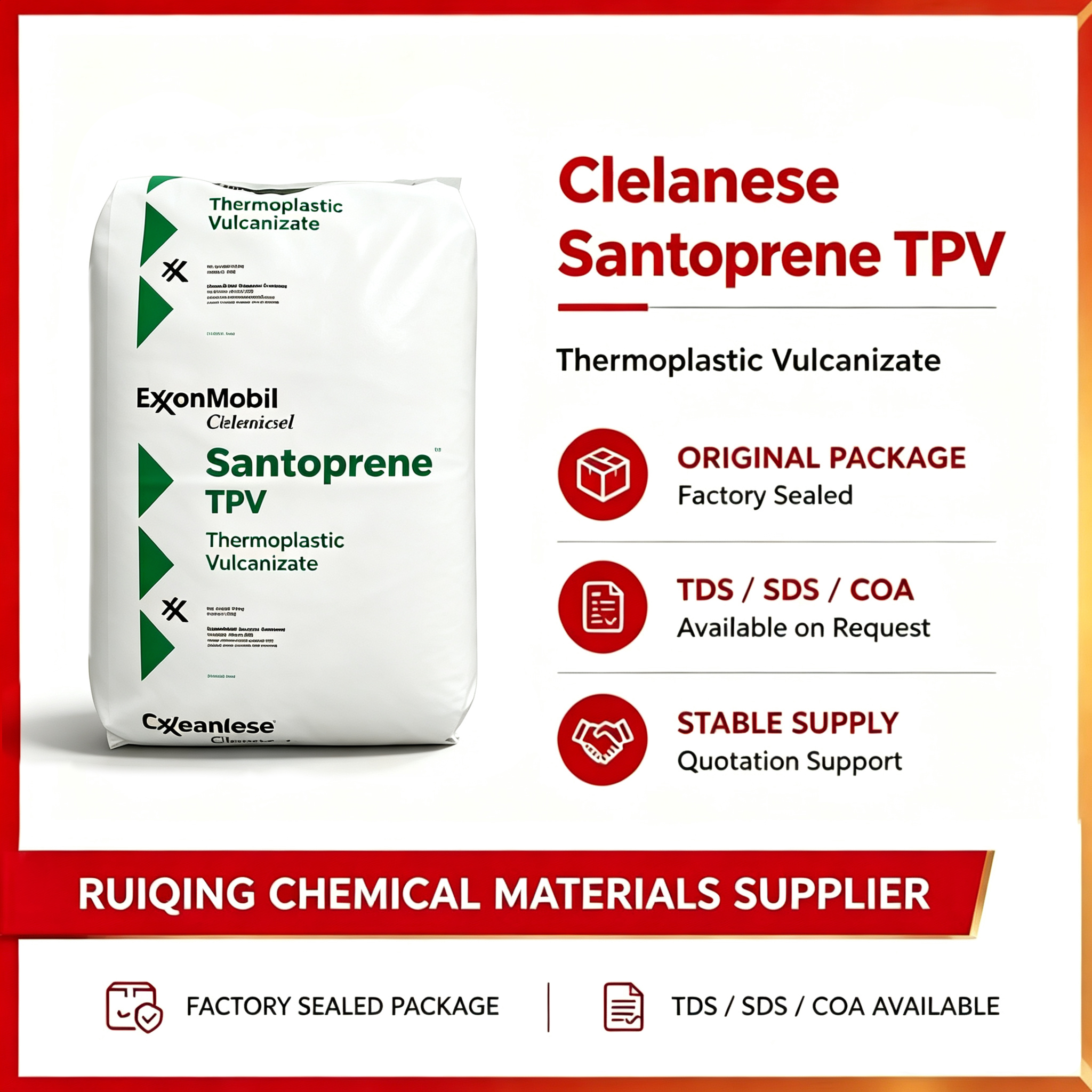
Santoprene 8121-90 is a thermoplastic vulcanizate grade from the Santoprene TPV family, developed for flexible engineering components that require a combination of rubber-like behavior and thermoplastic processing.
Santoprene TPV materials combine a dynamically vulcanized elastomeric phase with a thermoplastic continuous phase.
This structure allows Santoprene materials to provide many properties traditionally associated with vulcanized rubber while still being processed on conventional thermoplastic equipment.
Typical advantages of Santoprene TPV include:
- Rubber-like flexibility
- Elastic recovery
- Sealing performance
- Ozone resistance
- Weathering resistance
- Chemical and oil resistance
- High flex-fatigue resistance
- Thermoplastic processing
- Design flexibility
- Manufacturing scrap recovery
Celanese currently describes the Santoprene TPV family as suitable for demanding applications in automotive, building and construction, industrial, consumer, electrical and other engineered applications.
Santoprene materials can be processed by methods including injection molding, extrusion and blow molding, depending on the specific grade.
For Santoprene 8121-90, the exact grade-specific mechanical properties and processing conditions should be confirmed against the original or current technical data sheet because this grade is not presently shown in Celanese’s public all-grades Product Finder.
For more TPV products, visit our TPV Thermoplastic Vulcanizates Product Category →.
For the current Santoprene portfolio, see the Official Celanese Santoprene & Geolast Product Finder →.
Key Features of Santoprene 8121-90
| Feature | Engineering Benefit |
|---|---|
| TPV / TPE-V Construction | Combines elastomeric behavior with thermoplastic processing |
| Rubber-Like Flexibility | Supports flexible and deformable technical components |
| Elastic Recovery | Useful for seals and components subjected to repeated deformation |
| Thermoplastic Processing | Enables conventional molding equipment |
| Sealing Performance | Suitable for flexible interfaces and gasket applications |
| Ozone Resistance | Supports elastomeric components exposed to atmospheric ozone |
| Weathering Resistance | Useful for environmental exposure |
| Chemical Resistance | Relevant to industrial and sealing environments |
| Oil Resistance | Santoprene TPV family provides resistance to selected oils and fluids |
| Flex-Fatigue Resistance | Supports repeated bending and mechanical cycling |
| Electrical Insulation | TPV can provide useful electrical-insulation characteristics |
| Thermal Insulation | Suitable for selected flexible insulating applications |
| Complex Part Design | Thermoplastic molding enables integrated features |
| Manufacturing Efficiency | No secondary vulcanization step during normal molding |
| Manufacturing-Stream Recyclability | Clean process scrap may be reprocessed under controlled conditions |
Celanese currently identifies sealing performance, UV aging, ozone resistance, weathering resistance, chemical and oil resistance, elastic recovery and flex-fatigue resistance as core Santoprene TPV family attributes.
Typical Applications for Santoprene 8121-90
Santoprene 8121-90 can be positioned for flexible engineering applications where TPV processing and elastomeric performance are required.
| Application Area | Typical Use |
|---|---|
| Seals | Flexible molded sealing components |
| Gaskets | Compression interfaces |
| Grommets | Cable, tube and opening protection |
| Flexible Housings | Protective elastomeric components |
| Automotive Components | Flexible technical parts |
| Industrial Components | General-purpose elastomeric parts |
| Protective Bumpers | Soft impact-contact elements |
| Flexible Interfaces | Isolation between rigid components |
| Consumer Products | Flexible functional parts |
| Electrical Components | Selected insulating or protective parts |
| Construction Components | Flexible sealing and protective parts |
| Technical Molded Parts | Complex elastomeric geometries |
Santoprene TPV is widely used in automotive sealing, under-hood parts, consumer goods, electrical insulation, industrial parts and building applications.
Santoprene 8121-90 Material Structure
Santoprene 8121-90 belongs to the thermoplastic vulcanizate family.
A TPV contains vulcanized elastomer domains dispersed in a thermoplastic matrix.
This creates a material that behaves differently from both:
- Conventional rigid thermoplastics
- Traditional thermoset rubber
The rubber phase provides:
- Elasticity
- Recovery
- Flexibility
- Sealing capability
The thermoplastic phase provides:
- Melt processing
- Injection-molding capability
- Shorter cycle times
- Scrap recovery
- Complex part geometry
This combination is one of the main reasons Santoprene TPV has been used for decades in engineering seals and flexible components.
Sealing Performance
Sealing is one of the strongest application areas for Santoprene TPV.
Flexible seals often need to accommodate:
- Compression
- Tolerance variation
- Thermal movement
- Repeated deformation
- Vibration
- Assembly forces
Santoprene TPV can provide elastic behavior while also allowing the seal to be produced using conventional thermoplastic manufacturing equipment.
Potential applications for Santoprene 8121-90 include:
- Housing seals
- Gaskets
- Connector seals
- Flexible interfaces
- Protective sealing components
- Molded technical seals
Exact sealing performance should be evaluated using the grade-specific compression-set and hardness values from the original Santoprene 8121-90 TDS.
Automotive Applications
Santoprene TPV has a long history in automotive applications.
Celanese identifies Santoprene TPV for applications including:
- Weatherseals
- Glass encapsulation
- Steering boots
- Suspension boots
- Control cables
- Air ducts
- Plugs
- Bumpers
- Grommets
- Tubes
- Connectors
The Santoprene automotive portfolio includes both basic molding/extrusion grades and specialty grades designed for improved flow, bonding, surface appearance and extrusion performance.
Santoprene 8121-90 can therefore be positioned on the page as a legacy engineering TPV relevant to flexible automotive and technical molded components, while avoiding unsupported OEM approval claims.
Ozone & Weathering Resistance
Santoprene TPV is well known for ozone and weathering resistance.
These properties are valuable for flexible components exposed to:
- Outdoor air
- Sunlight
- Seasonal temperature changes
- Industrial environments
- Long-term atmospheric aging
Ozone resistance is particularly important for elastomeric components that remain under strain because ozone can promote surface cracking in some rubber systems.
Celanese lists UV aging, ozone and weathering resistance among the core technical attributes of the Santoprene TPV family.
Chemical & Oil Resistance
Santoprene TPV also provides resistance to many chemicals and oils.
This can make the material useful in environments involving:
- Water
- Detergents
- Cleaning fluids
- Automotive fluids
- Industrial fluids
- Selected oils
Actual compatibility depends on:
- Chemical type
- Concentration
- Temperature
- Exposure time
- Mechanical stress
Final application testing should use the exact fluid and operating conditions.
Flex-Fatigue Resistance
Santoprene TPV provides high flex-fatigue resistance.
This is important for components repeatedly exposed to:
- Bending
- Stretching
- Compression
- Folding
- Vibration
- Repeated movement
Potential applications include:
- Flexible seals
- Boots
- Grommets
- Bellows
- Protective interfaces
- Dynamic flexible components
Celanese lists high flex-fatigue resistance as a core Santoprene technical attribute.
Elastic Recovery
Elastic recovery is important when a component must return toward its original shape after deformation.
Typical examples include:
- Compression seals
- Flexible retaining features
- Protective bumpers
- Grommets
- Flexible clips
- Soft interfaces
Santoprene TPV is designed to combine elastic recovery with conventional thermoplastic processing.
Why Choose Santoprene 8121-90?
Santoprene 8121-90 is relevant when a customer needs a TPV that combines rubber-like behavior with efficient thermoplastic manufacturing.
Potential benefits include:
- Flexible elastomeric response
- Elastic recovery
- Sealing capability
- Ozone resistance
- Weathering resistance
- Chemical resistance
- Oil resistance
- Flex-fatigue resistance
- Conventional thermoplastic processing
- Complex molded geometry
- Reduced need for secondary rubber-curing operations
The grade is especially relevant to customers searching for an existing Santoprene 8121-90 specification, old drawing or legacy bill of materials.
Legacy Grade Considerations
Santoprene 8121-90 does not currently appear in the public Celanese all-grades Product Finder searched for this page.
This may indicate that the grade is:
- A legacy grade
- No longer publicly promoted
- Region-specific
- Replaced by another Santoprene grade
- Available only through historical documentation or existing supply channels
For customers replacing an existing Santoprene 8121-90 component, the most useful information is:
- Original TDS revision
- Original manufacturer
- Application
- Hardness requirement
- Color
- Mechanical requirements
- Compression-set requirement
- Processing method
- OEM specification, if applicable
These details help identify whether a current Santoprene grade can satisfy the same application.
Typical Properties of Santoprene 8121-90
Because a current Celanese grade-specific TDS for Santoprene 8121-90 was not located in the present public portfolio, this page does not substitute data from a nearby grade.
Physical Properties
| Property | Value |
|---|---|
| Material Type | TPV / TPE-V |
| Brand | Santoprene |
| Delivery Form | Pellets |
| Grade | 8121-90 |
| Hardness | Confirm from grade-specific TDS |
| Density | Confirm from grade-specific TDS |
| Appearance | Confirm from grade-specific TDS |
Mechanical Properties
| Property | Value |
|---|---|
| Tensile Stress at Break | Confirm from grade-specific TDS |
| Elongation at Break | Confirm from grade-specific TDS |
| Tensile Stress at 100% Elongation | Confirm from grade-specific TDS |
| Tear Strength | Confirm from grade-specific TDS |
| Compression Set | Confirm from grade-specific TDS |
This approach avoids incorrectly copying values from another Santoprene grade.
Processing Guidelines for Santoprene 8121-90
Santoprene TPV materials can be processed using conventional thermoplastic equipment.
Depending on the grade, Celanese lists processes including:
- Injection molding
- Blow molding
- Extrusion
- Physical foaming
- Chemical foaming
- Calendaring
For Santoprene 8121-90, exact processing conditions should come from the original grade-specific processing sheet.
Injection Molding Considerations
Important variables include:
- Melt temperature
- Mold temperature
- Injection speed
- Holding pressure
- Screw speed
- Back pressure
- Gate design
- Runner dimensions
- Mold venting
- Cooling time
Do not automatically use the processing settings published for Santoprene 8111-35 or the 8201/8211 families.
Shear-Dependent Flow
Santoprene TPV generally exhibits shear-thinning behavior.
As shear increases, apparent melt viscosity decreases.
This behavior can help TPV fill:
- Thin sections
- Small gates
- Narrow flow paths
- Detailed molded features
Machine settings should therefore balance:
- Temperature
- Shear
- Injection speed
- Gate dimensions
- Screw speed
rather than relying only on higher melt temperature.
Mold Design
Good mold design can improve:
- Filling
- Surface appearance
- Dimensional consistency
- Part release
- Cycle time
Important factors include:
- Adequate venting
- Suitable gate dimensions
- Balanced runner design
- Appropriate draft
- Smooth flow paths
- Controlled cooling
Flexible TPV parts may require more attention to part ejection than rigid thermoplastics.
Material Compatibility
When changing from other materials to Santoprene TPV, processing equipment should be properly purged.
Residual incompatible polymer can affect:
- Surface quality
- Flow
- Mechanical properties
- Color
- Processing stability
Clean processing is particularly important when a legacy specification must reproduce an existing component consistently.
Manufacturing-Stream Recycling
One of the advantages of Santoprene TPV is thermoplastic reprocessability.
Celanese states that Santoprene production scrap can be reworked, reducing manufacturing waste.
Controlled clean scrap can include:
- Sprues
- Runners
- Start-up material
- Trim
- Selected rejected parts
Regrind level should be controlled according to final product requirements.
Related Products
We supply Santoprene TPV grades for different hardness, flow, molding, extrusion and sealing requirements.
Typical product families include:
- Santoprene general-purpose TPV grades
- Santoprene injection-molding grades
- Santoprene high-flow TPV grades
- Santoprene sealing grades
- Santoprene automotive TPV grades
- Santoprene colorable TPV grades
- Santoprene extrusion grades
- Santoprene specialty bonding grades
- Santoprene legacy grades
View More TPV Thermoplastic Vulcanizates →
Technical Documents for Santoprene 8121-90
| Document Type | Description |
|---|---|
| Original TDS | Grade-specific physical, mechanical and processing properties |
| SDS | Safety Data Sheet |
| Legacy Grade Information | Historical Santoprene 8121-90 documentation |
| Processing Guide | Grade-specific molding or extrusion conditions |
| Replacement Grade Support | Current Santoprene grade-selection assistance |
| OEM Documentation | If applicable to the original application |
| COA | Batch-specific quality documentation where available |
Need technical documents or replacement-grade support for Santoprene 8121-90?
📧 Email: ruiqingchem@gmail.com
📝 Online form: Contact Us →
FAQ About Santoprene 8121-90
Q1: What is Santoprene 8121-90?
Santoprene 8121-90 is a Santoprene thermoplastic vulcanizate grade used for flexible elastomeric engineering components.
Q2: Is Santoprene 8121-90 a TPV?
Yes. Santoprene is Celanese’s thermoplastic vulcanizate product family.
Q3: Is Santoprene 8121-90 still a current Celanese grade?
The grade does not appear in the current publicly available Santoprene & Geolast Product Finder, so it should be treated as a legacy or non-current-public-portfolio grade unless Celanese confirms otherwise.
Q4: Is Santoprene 8121-90 exactly 90 Shore A?
The grade name contains 90, but the current measured hardness should not be assumed solely from the grade designation. Use the original grade-specific TDS.
Q5: What is the density of Santoprene 8121-90?
The exact density should be confirmed from the original or current grade-specific technical data sheet.
Q6: What is the tensile strength?
Use the grade-specific TDS rather than values from another 81xx Santoprene grade.
Q7: What is the elongation at break?
The exact Santoprene 8121-90 value should be confirmed from the original technical documentation.
Q8: Is Santoprene 8121-90 suitable for seals?
Santoprene TPV is widely used for sealing components, but the specific 8121-90 design should be checked against its grade-specific hardness and compression-set requirements.
Q9: Can Santoprene 8121-90 be used for gaskets?
It may be evaluated for gasket applications where its original grade-specific properties meet the design requirements.
Q10: Is Santoprene 8121-90 suitable for automotive applications?
Santoprene TPV has extensive automotive use, but an OEM approval for 8121-90 should only be claimed when confirmed by grade-specific documentation.
Q11: Does Santoprene TPV resist ozone?
Yes. Ozone resistance is one of the core technical attributes Celanese lists for the Santoprene TPV family.
Q12: Does Santoprene TPV resist weathering?
Yes. UV aging, ozone and weathering resistance are among the family-level Santoprene attributes.
Q13: Does Santoprene TPV have good flex-fatigue resistance?
Yes. Celanese lists high flex-fatigue resistance among Santoprene TPV’s main properties.
Q14: Can Santoprene 8121-90 be injection molded?
Santoprene TPV as a family supports injection molding, but the exact preferred conversion method for 8121-90 should be verified from its original TDS.
Q15: What processing temperature should be used?
Use the original Santoprene 8121-90 processing sheet. Do not copy the melt-temperature settings from Santoprene 8111-35 or a nearby grade.
Q16: Can you help identify a current replacement for Santoprene 8121-90?
Yes. Grade selection should be based on the original hardness, color, mechanical properties, compression set, application and processing method.
Request Santoprene 8121-90 Price & Technical Support
For pricing, availability, legacy-document support or replacement-grade selection for Santoprene 8121-90, please provide:
- Required quantity
- Destination country or port
- Existing application
- Original color
- Original hardness requirement
- Seal / gasket / automotive / industrial use
- Operating temperature
- Compression-set requirement
- Chemical-contact conditions
- Injection or extrusion process
- Existing drawing or old TDS
- OEM specification, if any
- TDS / SDS requirement
- COA requirement
- Sample requirement, if applicable
📧 Email: ruiqingchem@gmail.com