描述
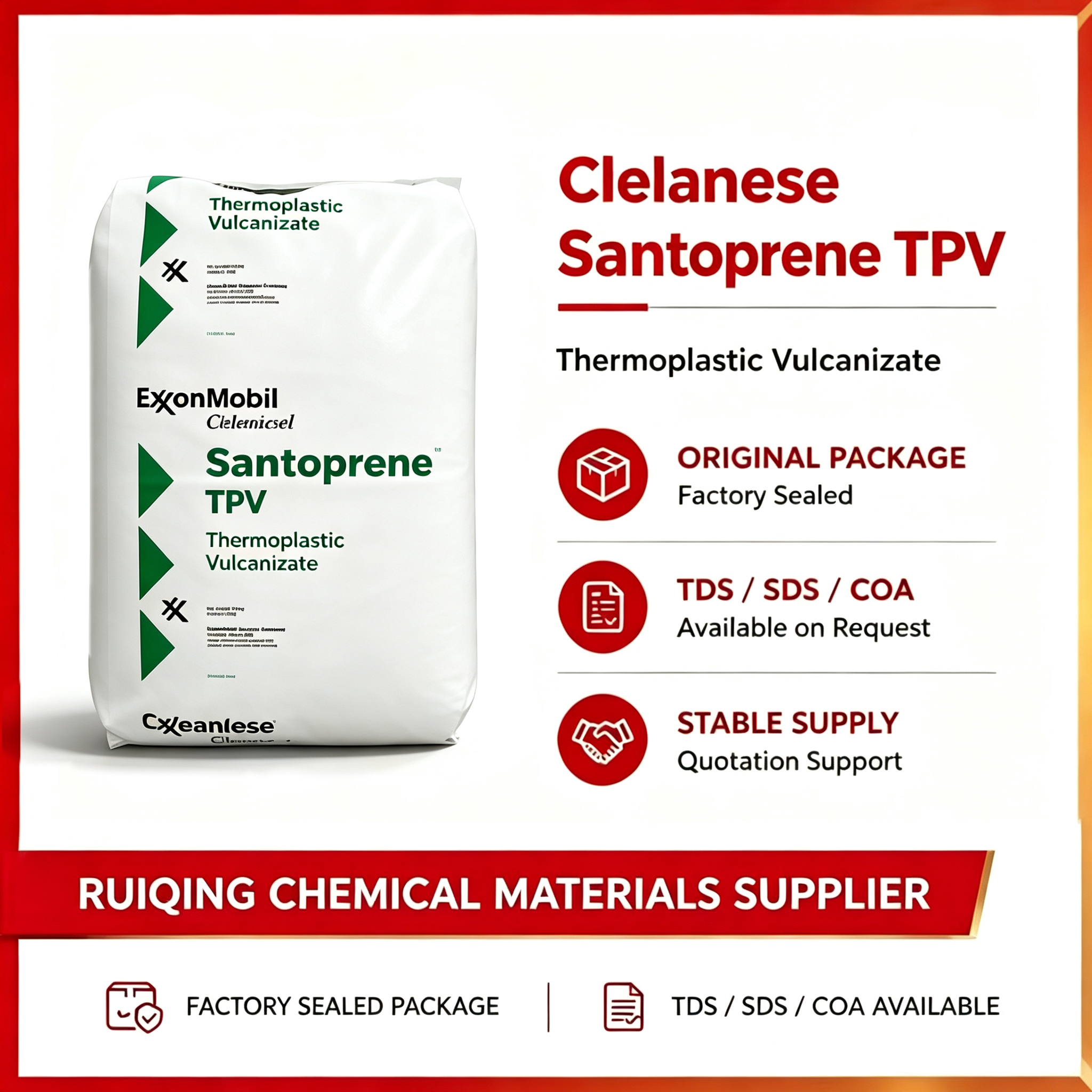
Santoprene 211-45 is a soft, natural and colorable thermoplastic vulcanizate from Celanese developed primarily for injection-molded applications requiring excellent elastomeric flexibility, environmental durability and efficient thermoplastic processing.
The grade has a typical hardness of approximately 49 Shore A, making it a soft Santoprene TPV suitable for seals, flexible molded components and applications where high compliance is important.
Current Celanese data lists approximately 340% elongation at break, 3.5 MPa tensile stress at break and approximately 1.4 MPa tensile stress at 100% elongation.
These values show that Santoprene 211-45 is designed more around softness, elasticity and sealing behavior than high structural stiffness.
Celanese specifically identifies excellent flex-fatigue resistance and excellent ozone resistance as key features of Santoprene 211-45. The grade is also specifically noted for use in sealing applications.
Low-temperature performance is another important strength. The current brittleness temperature is approximately -62°C, supporting cold-weather automotive, outdoor and industrial use.
Compression-set performance is also attractive for a soft TPV. Current Celanese data lists approximately 11% compression set at 23°C for 24 hours and approximately 35% at 125°C for 70 hours.
Santoprene 211-45 is polyolefin based and recyclable within the manufacturing stream. It is shear dependent and can be processed on conventional thermoplastic injection-molding equipment.
For more TPV products, visit our TPV Thermoplastic Vulcanizates Product Category →.
For the current Celanese TPV portfolio, see the Official Celanese Santoprene & Geolast Product Finder →.
Key Features of Santoprene 211-45
| Feature | Engineering Benefit |
|---|---|
| 49 Shore A Hardness | Provides soft, compliant elastomeric behavior |
| Natural / Colorable | Supports customized colors and appearance |
| 340% Elongation at Break | Provides high deformation capability |
| Excellent Flex-Fatigue Resistance | Supports repeatedly flexed parts |
| Excellent Ozone Resistance | Useful for automotive and outdoor environments |
| -62°C Brittleness Temperature | Excellent low-temperature flexibility |
| 11% Compression Set at 23°C / 24 h | Supports sealing force recovery |
| Good Chemical Resistance | Useful in many automotive and industrial applications |
| UL Recognized | Current Celanese data references E80017 |
| Injection Moldable | Suitable for complex flexible molded parts |
| Multi-Injection Moldable | Supports multi-material molding applications |
| Polyolefin Based | Combines elastomeric properties with thermoplastic processing |
| Manufacturing-Stream Recyclability | Controlled scrap can be recycled within production |
The strongest reason to select Santoprene 211-45 is its combination of soft 49A hardness, excellent flex-fatigue resistance, strong low-temperature flexibility and useful compression-set performance.
Typical Applications for Santoprene 211-45
Santoprene 211-45 is particularly suitable for soft elastomeric components requiring sealing performance and repeated deformation capability.
| Application Area | Typical Use |
|---|---|
| Seals | Soft static and dynamic sealing components |
| Gaskets | Flexible compression seals |
| Automotive Seals | Weather and technical sealing parts |
| Flexible Molded Parts | Components requiring high compliance |
| Grommets | Cable and mechanical protection |
| Plugs | Protective and sealing components |
| Bellows | Repeated-flex protective parts |
| Diaphragm-Type Parts | Cyclic deformation applications |
| Electrical Components | Flexible protective components |
| Industrial Parts | Soft sealing and damping components |
| Consumer Products | Soft-touch resilient parts |
| Color-Coded Components | Natural-base components requiring pigmentation |
The grade is especially useful where a soft TPV must maintain flexibility at low temperatures while resisting ozone and repeated flexing.
Typical Properties of Santoprene 211-45
Physical & Rheological Properties
| Property | Typical Value | Test Method |
|---|---|---|
| Density | 960 kg/m³ / 0.960 g/cm³ | ISO 1183 |
| Shore A Hardness, 15 s | 49 | ISO 48-4 / ISO 868 |
| Molding Shrinkage – Parallel | 4.1% | ISO 294-4 / ISO 2577 |
| Molding Shrinkage – Normal | 0.7% | ISO 294-4 / ISO 2577 |
| Resin Identification | TPV | ISO 1043 |
| Part Marking Code | >TPV< | ISO 11469 |
| Product Form | Pellets | Manufacturer information |
| Color | Natural / Colorable | Manufacturer information |
The molding shrinkage values are based on approximately 2.0 mm molded specimens measured after at least 24 hours.
Mechanical Properties
| Property | Typical Value | Test Method |
|---|---|---|
| Tensile Stress at 100% Elongation | 1.4 MPa | ISO 37 |
| Tensile Stress at Break | 3.5 MPa | ISO 527-1/-2 or ISO 37 |
| Elongation at Break | 340% | ISO 527-1/-2 or ISO 37 |
| Shore A Hardness, 15 s | 49 | ISO 48-4 / ISO 868 |
| Brittleness Temperature | -62°C | ASTM D746 |
| Low-Temperature Brittleness | -62°C | ISO 812 |
| Compression Set, 23°C / 24 h | 11% | ISO 815 |
| Compression Set, 125°C / 70 h | 35% | ISO 815 |
These properties highlight the grade’s focus on softness, elastic recovery and low-temperature flexibility.
Thermal Properties
| Property | Typical Value | Test Method |
|---|---|---|
| RTI Electrical, 1.5 mm | 100°C | UL 746B |
| RTI Electrical, 3.0 mm | 100°C | UL 746B |
| RTI Strength, 1.5 mm | 90°C | UL 746B |
| RTI Strength, 3.0 mm | 95°C | UL 746B |
Current heat-aging data also lists approximately -23% change in tensile strength, -26% change in tensile strain at break, and about +1 Shore A hardness change after 168 hours at 150°C.
Flammability & Electrical Properties
| Property | Typical Value / Rating | Test Method |
|---|---|---|
| Burning Behavior | HB | IEC 60695-11-10 |
| Thickness Tested | 1 mm | IEC 60695-11-10 |
| UL Recognition | Yes | UL 94 |
| FMVSS Classification | Class B | ISO 3795 / FMVSS 302 |
| Burning Rate @ 2 mm | 32 mm/min | ISO 3795 / FMVSS 302 |
| Relative Permittivity @ 60 Hz | 2.4 | IEC 62631-2-1 |
| Electric Strength, 2 mm | 30 kV/mm | ASTM D149 |
Santoprene 211-45 is UL recognized under files QMFZ2.E80017 and QMFZ8.E80017.
Automotive OEM References for Santoprene 211-45
Current Celanese Materials Database information lists the following automotive references:
| OEM | Specification / Reference | Additional Information |
|---|---|---|
| Ford | WSD-M2D378-A4 | — |
| Stellantis / Chrysler | MS-AR-100 BMN | Natural |
These references add useful application context for automotive seals and flexible molded components.
Why Choose Santoprene 211-45?
The main reason to choose Santoprene 211-45 is its soft elastomeric behavior combined with strong environmental durability.
At approximately 49 Shore A, the material is soft enough for flexible seals, gaskets and compliant molded parts.
Its approximately 340% elongation at break allows substantial deformation.
Excellent flex-fatigue resistance makes the material suitable for components that repeatedly bend, compress or move during service.
Excellent ozone resistance is valuable for automotive and outdoor applications where the elastomer may experience long-term atmospheric exposure.
The approximately -62°C brittleness temperature provides particularly strong low-temperature performance.
Compression set of approximately 11% at 23°C / 24 h is also useful for sealing applications where recovery after prolonged compression matters.
Another benefit is the natural / colorable formulation, which allows manufacturers to produce parts in application-specific colors.
For customers requiring a soft, colorable 49A TPV for sealing and flexible injection-molded components, Santoprene 211-45 is an important grade to evaluate.
Processing Guidelines for Santoprene 211-45
Current Celanese data lists injection molding and multi-injection molding as the grade-specific processing methods.
Current Grade-Specific Injection Conditions
| Processing Parameter | Celanese Guidance |
|---|---|
| Drying Recommended | Yes |
| Drying Temperature | 80°C |
| Drying Time | ≥3 hours in a dehumidified dryer |
| Processing Moisture Content | ≤0.08% |
| Maximum Regrind Level | 20% |
| Optimum Melt Temperature | 215°C |
| Minimum Melt Temperature | 190°C |
| Maximum Melt Temperature | 240°C |
| Optimum Mold Temperature | 30°C |
| Minimum Mold Temperature | 10°C |
| Maximum Mold Temperature | 50°C |
The latest Celanese database therefore gives a grade-specific melt window of approximately 190–240°C, with an optimum around 215°C.
Injection Molding Notes
Celanese recommends holding pressure at approximately 50–75% of actual injection pressure.
A relatively high screw speed of approximately 100–200 rpm is recommended.
Back pressure is not always required, but approximately 0.3–0.7 MPa may be used to improve melt homogeneity and shot consistency. Higher back pressure may be useful when processing masterbatch.
Processors should optimize:
- Injection speed
- Screw speed
- Holding pressure
- Back pressure
- Melt temperature
- Mold temperature
- Gate dimensions
- Runner design
- Venting
- Cooling time
- Part shrinkage
- Surface finish
Shear-Dependent Flow
Santoprene 211-45 has relatively high melt viscosity at low shear rates.
As shear rate increases, apparent viscosity decreases.
Celanese notes that increasing temperature has comparatively little influence on TPV melt viscosity, while smaller gates and higher shear rates can improve flow.
General Santoprene Processing Guidance
Celanese recommends approximately 3 hours of desiccant drying at 80°C.
The broader Santoprene TPV processing window is approximately 175–230°C.
Material Compatibility
Santoprene TPV is incompatible with acetal (POM) and PVC.
Equipment should be thoroughly purged when changing between these materials and Santoprene 211-45.
Related Products
We supply Santoprene TPV grades for different hardness, color, molding and application requirements.
Typical Santoprene product families include:
- Santoprene 101 Series
- Santoprene 111 Series
- Santoprene 201 Series
- Santoprene 211 Series
- Santoprene automotive grades
- Santoprene sealing grades
- Santoprene injection-molding grades
- Santoprene specialty TPV grades
View More TPV Thermoplastic Vulcanizates →
If you are unsure which grade fits your application, send us your required hardness, color, temperature, sealing requirement and molding process.
Technical Documents for Santoprene 211-45
| Document Type | Description |
|---|---|
| TDS | Current physical, mechanical, thermal, electrical and processing data |
| SDS | Safety Data Sheet |
| UL Information | QMFZ2.E80017 / QMFZ8.E80017 recognition |
| Automotive Specification Information | Ford and Stellantis / Chrysler references |
| Santoprene Product Finder | Celanese grade portfolio and positioning |
| Processing Guide | Injection-molding guidance |
| COA | Batch-specific quality information where available |
Need technical documents for Santoprene 211-45?
📧 Email: ruiqingchem@gmail.com
📝 Online form: Contact Us →
Please state Santoprene 211-45 and the required document type when submitting your inquiry.
FAQ About Santoprene 211-45
Q1: What is Santoprene 211-45?
Santoprene 211-45 is a soft, natural and colorable TPV from Celanese with approximately 49 Shore A hardness. It is intended primarily for flexible injection-molded and sealing applications.
Q2: What is the hardness of Santoprene 211-45?
The current Celanese value is approximately 49 Shore A.
Q3: What color is Santoprene 211-45?
The grade is supplied as natural / colorable, allowing customized pigmentation. The Celanese Product Finder also identifies 211-45 as Natural.
Q4: What is the elongation at break?
Current grade data lists approximately 340% elongation at break.
Q5: What is the tensile stress at break?
The typical tensile stress at break is approximately 3.5 MPa.
Q6: What is the tensile stress at 100% elongation?
The typical value is approximately 1.4 MPa.
Q7: What is the low-temperature performance?
The current brittleness temperature is approximately -62°C.
Q8: What is the compression set?
Current Celanese data lists approximately 11% at 23°C / 24 h and 35% at 125°C / 70 h.
Q9: Is Santoprene 211-45 suitable for sealing applications?
Yes. Celanese specifically identifies sealing applications as a key use for this grade.
Q10: Is Santoprene 211-45 resistant to ozone?
Yes. Excellent ozone resistance is one of its published key features.
Q11: Is Santoprene 211-45 suitable for repeated flexing?
Yes. Celanese recommends this grade for applications requiring excellent flex-fatigue resistance.
Q12: Can Santoprene 211-45 be injection molded?
Yes. Injection molding and multi-injection molding are specifically listed in current grade data.
Q13: Does Santoprene 211-45 require drying?
Current processing guidance recommends drying at approximately 80°C for at least 3 hours in a dehumidified dryer.
Q14: What injection melt temperature is recommended?
The latest grade-specific data lists approximately 215°C optimum, with a published melt-temperature range of approximately 190–240°C.
Q15: What mold temperature is recommended?
Current Celanese data lists approximately 30°C optimum, with a range of approximately 10–50°C.
Q16: Is Santoprene 211-45 UL recognized?
Yes. The grade is listed under UL files QMFZ2.E80017 and QMFZ8.E80017.
Request Santoprene 211-45 Price & Technical Support
For pricing, availability, technical documents or application support for Santoprene 211-45, please provide:
- Required quantity
- Destination country or port
- Automotive, industrial, appliance or consumer application
- Seal, gasket or flexible molded-part design
- Required Shore hardness
- Required color
- Continuous and peak operating temperature
- Minimum service temperature
- Compression-set requirement
- Chemical or fluid exposure
- Outdoor / ozone exposure
- Injection-molding process
- OEM specification requirement
- UL documentation requirement
- TDS, SDS or COA requirement
- Sample requirement, if applicable
📧 Email: ruiqingchem@gmail.com