描述
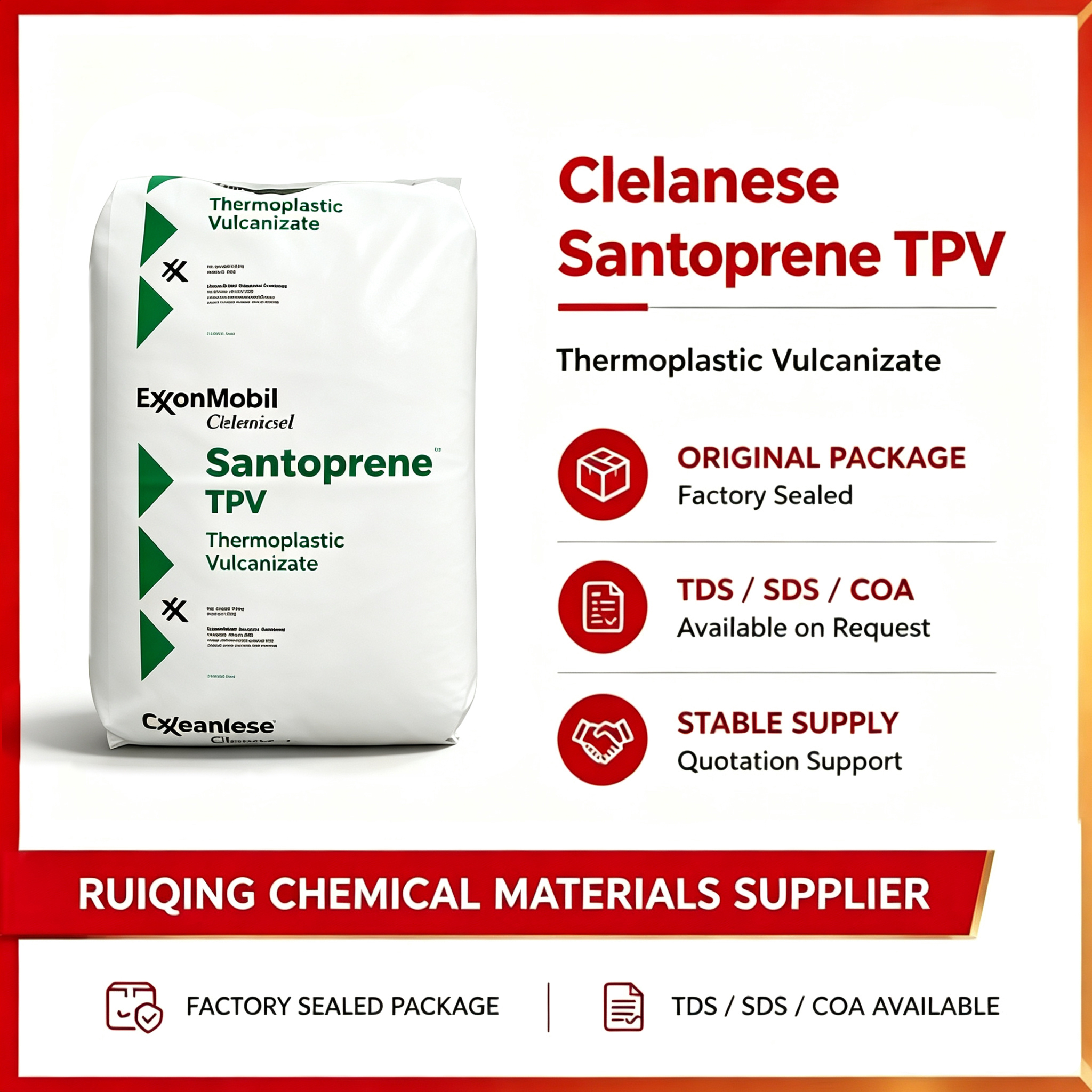
Santoprene 203-50 OG is a hard, colorable thermoplastic vulcanizate from Celanese designed for applications requiring a combination of elastomeric durability and conventional thermoplastic processing.
The grade is part of the Santoprene TPV family and is described as a versatile material combining good physical properties and chemical resistance for use across a wide range of applications.
Santoprene 203-50 OG is a shear-dependent TPV. This means its melt-flow behavior changes significantly with shear rate, an important consideration when optimizing injection speed, screw speed, gate design and extrusion conditions.
The material can be processed using conventional thermoplastic equipment rather than requiring a separate vulcanization stage.
Current Celanese-derived data lists the following processing methods for Santoprene 203-50 OG:
- Injection molding
- Multi-injection molding
- Extrusion
- Profile extrusion
- Sheet extrusion
- Blow molding
- Thermoforming
- Vacuum forming
Independent commercial listings also identify extrusion blow molding, profile extrusion, sheet extrusion and injection molding as applicable processes for this exact grade.
Two particularly important characteristics of Santoprene 203-50 OG are:
- Excellent ozone resistance
- Excellent thermal resistance
These properties make the grade useful for automotive, outdoor, industrial and technical components that may experience environmental aging or elevated temperatures.
The material is polyolefin based and is described as recyclable within the manufacturing stream.
For more TPV products, visit our TPV Thermoplastic Vulcanizates Product Category →.
For the current Santoprene TPV portfolio, see the Official Celanese Santoprene & Geolast Product Finder →.
Key Features of Santoprene 203-50 OG
| Feature | Engineering Benefit |
|---|---|
| Hard TPV Grade | Suitable for applications requiring a firm elastomeric response |
| Colorable | Supports customized appearance and identification |
| Excellent Ozone Resistance | Supports automotive and weather-exposed applications |
| Excellent Thermal Resistance | Useful for elevated-temperature technical environments |
| Good Chemical Resistance | Supports many industrial and automotive applications |
| Good Physical Properties | Provides durable mechanical performance |
| Shear-Dependent Flow | Allows flow optimization through processing conditions |
| Injection Moldable | Suitable for complex molded technical components |
| Extrudable | Suitable for profiles, sheets and continuous sections |
| Blow Moldable | Supports selected hollow components |
| Thermoformable | Provides additional design flexibility |
| Vacuum Formable | Supports formed technical applications |
| Polyolefin Based | Combines elastomeric performance with thermoplastic processing |
| Manufacturing-Stream Recyclability | Allows controlled process scrap recovery |
The defining characteristics of Santoprene 203-50 OG are its combination of high hardness, colorability, ozone resistance, thermal resistance and broad processing flexibility.
Typical Applications for Santoprene 203-50 OG
Santoprene 203-50 OG can be considered for a broad range of technical applications.
| Application Area | Typical Use |
|---|---|
| Automotive Components | Hard elastomeric technical parts |
| Under-Hood Parts | Components exposed to heat and environmental aging |
| Protective Covers | Durable elastomeric protection |
| Plugs & Grommets | Mechanical and cable protection |
| Extruded Profiles | Hard flexible profiles |
| Sheet Applications | Technical elastomeric sheets |
| Industrial Components | Chemical- and ozone-resistant parts |
| Electrical Components | Protective elastomeric components |
| Appliance Parts | Molded and extruded technical parts |
| Consumer Products | Firm resilient components |
| Blow-Molded Parts | Hollow technical TPV components |
| Thermoformed Components | Formed elastomeric parts |
| Color-Coded Parts | Applications requiring customized appearance |
Its combination of hardness, thermal resistance and ozone resistance makes it particularly relevant to demanding automotive and industrial applications.
Published Property Categories for Santoprene 203-50 OG
Current public Celanese-derived listings identify the following physical and mechanical property categories for Santoprene 203-50 OG:
Physical Properties
| Property | Published Status |
|---|---|
| Density | Published in grade data |
| Shore D Hardness | Published in grade data |
| Material Family | TPV |
| Filler | Unfilled |
| Colorability | Colorable |
| Polymer Base | Polyolefin based |
Mechanical Properties
| Property | Published Status |
|---|---|
| Tensile Strength at Yield | Published in grade data |
| Elongation at Yield | Published in grade data |
| Tear Strength | Published in grade data |
| Compression Set | Published in grade data |
| Brittleness Temperature | Published in grade data |
The publicly indexed Celanese-derived page confirms that these properties are part of the 203-50 OG technical dataset, but the numeric values are not exposed in the indexed text version.
For this reason, I would not copy the numeric values from standard Santoprene 203-50 into the 203-50 OG page unless the current OG TDS confirms they are identical.
Ozone Resistance
One of the most clearly documented characteristics of Santoprene 203-50 OG is its excellent ozone resistance.
Ozone resistance is important for elastomeric components that may be exposed to:
- Outdoor air
- Automotive environments
- Weathering
- Mechanical strain
- Long service periods
Traditional elastomers may develop surface cracking under ozone exposure, particularly when components remain stretched or compressed.
Santoprene TPV is designed to provide strong environmental durability, and excellent ozone resistance is specifically identified for the 203-50 OG grade.
Thermal Resistance
Santoprene 203-50 OG is also specifically described as offering excellent thermal resistance.
This characteristic expands its usefulness in applications such as:
- Automotive technical components
- Under-hood parts
- Industrial equipment
- Appliance components
- Electrical and electronic protection
- Elevated-temperature molded components
The exact continuous-use and short-term temperature limits should be selected from the current grade-specific technical data.
Chemical Resistance
Santoprene 203-50 OG combines good physical properties with good chemical resistance.
This can make the material suitable for applications exposed to selected:
- Automotive fluids
- Water
- Cleaning environments
- Industrial chemicals
- Oils and lubricants
- Outdoor contamination
Chemical resistance always depends on exposure temperature, concentration, duration and mechanical stress.
Processing Guidelines for Santoprene 203-50 OG
Santoprene 203-50 OG can be processed on conventional thermoplastic equipment.
Current published processing methods include:
- Injection molding
- Multi-injection molding
- Extrusion
- Profile extrusion
- Sheet extrusion
- Blow molding
- Thermoforming
- Vacuum forming
Shear-Dependent Flow
Santoprene 203-50 OG is specifically described as a shear-dependent TPV.
As shear rate increases, apparent viscosity typically decreases.
Important injection-molding variables therefore include:
- Injection speed
- Screw speed
- Melt temperature
- Mold temperature
- Back pressure
- Gate dimensions
- Runner design
- Venting
- Holding pressure
- Cooling time
For extrusion, important variables include:
- Barrel-zone temperature
- Adapter temperature
- Die temperature
- Screw speed
- Melt pressure
- Draw-down
- Cooling
- Profile geometry
- Surface finish
The exact grade-specific temperature settings should be taken from the current Santoprene 203-50 OG TDS or processing data, rather than copied directly from standard 203-50.
Why Choose Santoprene 203-50 OG?
The main reason to evaluate Santoprene 203-50 OG is its combination of a hard elastomeric response and broad manufacturing flexibility.
It offers the durability expected from a dynamically vulcanized TPV while retaining the ability to be processed on standard thermoplastic equipment.
Excellent ozone resistance supports weather-exposed and automotive components.
Excellent thermal resistance broadens its usefulness in elevated-temperature environments.
Good chemical resistance supports many industrial and automotive applications.
Its colorable formulation provides additional freedom for product appearance and component identification.
Injection molding, extrusion, blow molding, thermoforming and vacuum forming provide substantial manufacturing flexibility.
For applications requiring a hard, colorable Santoprene TPV with excellent ozone and thermal resistance, Santoprene 203-50 OG is a grade worth evaluating.
Related Products
We supply Santoprene TPV grades for different hardness, color, processing and application requirements.
Typical Santoprene families include:
- Santoprene 101 Series
- Santoprene 103 Series
- Santoprene 201 Series
- Santoprene 203 Series
- Santoprene automotive grades
- Santoprene extrusion grades
- Santoprene sealing grades
- Santoprene specialty TPV grades
View More TPV Thermoplastic Vulcanizates →
If you need grade selection support, send us your required hardness, operating temperature, color, processing method and application.
Technical Documents for Santoprene 203-50 OG
| Document Type | Description |
|---|---|
| TDS | Grade-specific physical, mechanical, thermal and processing information |
| SDS | Safety Data Sheet |
| Processing Information | Injection molding, extrusion, blow molding and thermoforming guidance |
| Santoprene Product Finder | Santoprene TPV portfolio information |
| COA | Batch-specific quality information where available |
| Grade Selection Support | Assistance according to hardness, temperature and application |
Need technical documents for Santoprene 203-50 OG?
📧 Email: ruiqingchem@gmail.com
📝 Online form: Contact Us →
Please state Santoprene 203-50 OG and the required document type when submitting your inquiry.
FAQ About Santoprene 203-50 OG
Q1: What is Santoprene 203-50 OG?
Santoprene 203-50 OG is a hard, colorable thermoplastic vulcanizate from Celanese with good physical properties, chemical resistance and broad thermoplastic processability.
Q2: Is Santoprene 203-50 OG a TPV?
Yes. It is classified as a thermoplastic vulcanizate elastomer, or TPV.
Q3: Is Santoprene 203-50 OG colorable?
Yes. Current grade information specifically describes it as a colorable TPV.
Q4: Is Santoprene 203-50 OG resistant to ozone?
Yes. Excellent ozone resistance is one of its published key features.
Q5: Does Santoprene 203-50 OG have good thermal resistance?
Yes. Excellent thermal resistance is specifically listed for this grade.
Q6: Is Santoprene 203-50 OG chemically resistant?
Current Celanese-derived information describes the grade as having good chemical resistance for a broad range of applications.
Q7: Can Santoprene 203-50 OG be injection molded?
Yes. Injection molding and multi-injection molding are listed processing methods.
Q8: Can Santoprene 203-50 OG be extruded?
Yes. Profile extrusion and sheet extrusion are both listed for the grade.
Q9: Can Santoprene 203-50 OG be blow molded?
Yes. Blow molding is included among the published processing methods.
Q10: Can Santoprene 203-50 OG be thermoformed?
Yes. Thermoforming is listed as a suitable process.
Q11: Can Santoprene 203-50 OG be vacuum formed?
Yes. Current material information includes vacuum forming among its processing options.
Q12: Is Santoprene 203-50 OG filled?
Current commercial grade information identifies it as unfilled.
Q13: Is Santoprene 203-50 OG the same as Santoprene 203-50?
They are listed separately in current Celanese material databases, so I would treat 203-50 OG as its own grade designation rather than automatically assuming all ordinary 203-50 properties are identical.
Q14: What is the hardness of Santoprene 203-50 OG?
The public indexed grade information confirms that Shore D hardness is part of the technical dataset, but the numeric value is not exposed in the currently accessible indexed data. Use the current grade-specific TDS when a certified hardness value is required.
Q15: What processing temperature should be used?
Use the current Santoprene 203-50 OG processing data or TDS for grade-specific temperatures. The grade is shear dependent, so final conditions should also be optimized according to machine, gate, die and part geometry.
Q16: Can I request the Santoprene 203-50 OG TDS and SDS?
Yes. Contact us and specify Santoprene 203-50 OG together with the required documentation.
Request Santoprene 203-50 OG Price & Technical Support
For pricing, availability, technical documents or application support for Santoprene 203-50 OG, please provide:
- Required quantity
- Destination country or port
- Application
- Required hardness
- Required color
- Injection molding or extrusion process
- Continuous and peak operating temperature
- Chemical or fluid exposure
- Outdoor / ozone exposure
- Required TDS / SDS / COA
- Sample requirements
📧 Email: ruiqingchem@gmail.com