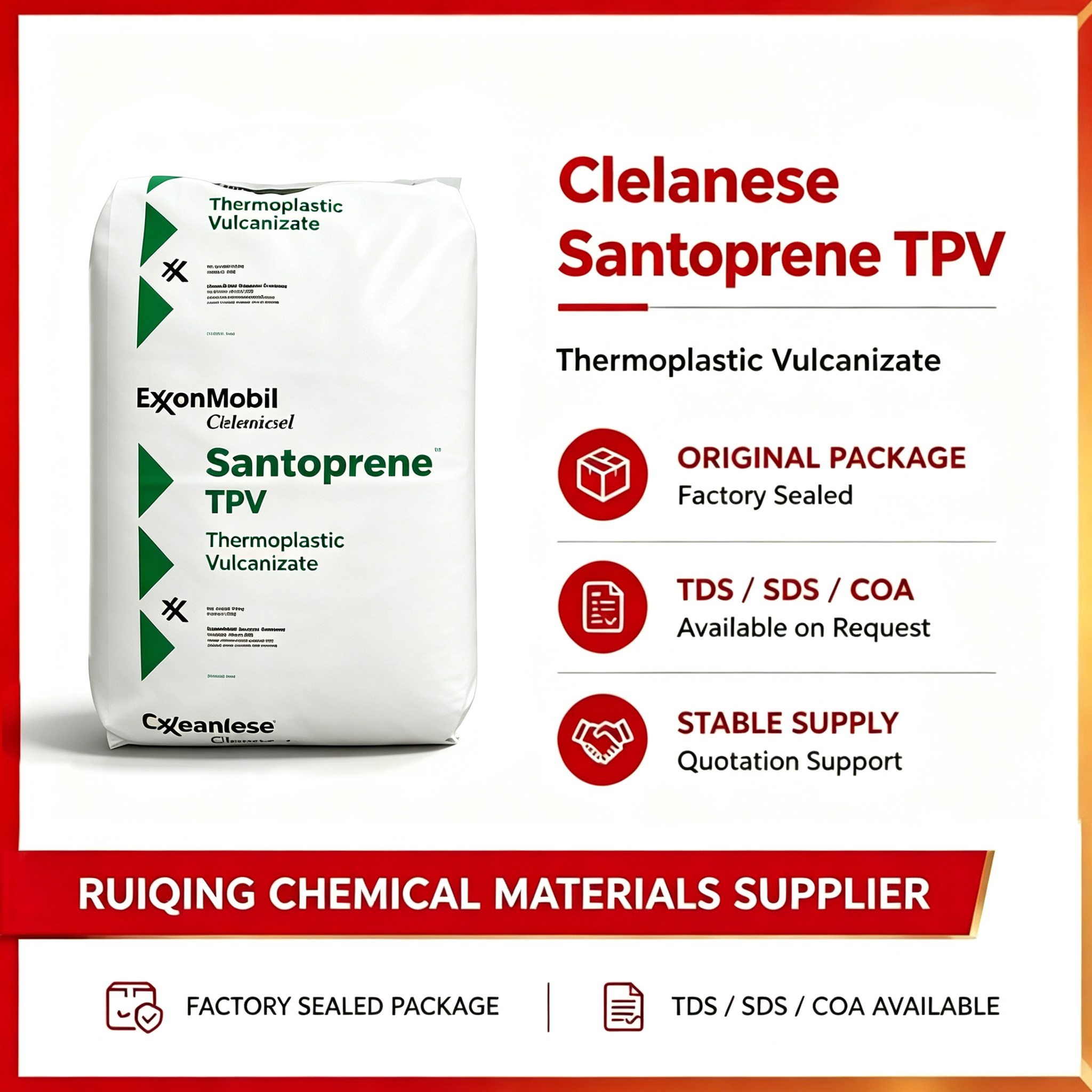
描述
Santoprene 191-70 PA is a soft black thermoplastic vulcanizate from Celanese specially formulated to bond to polyamide 6 (PA6) and polyamide 66 (PA66) compounds through 2K injection molding.
This bonding function is the central reason to select the grade.
In a conventional multi-material part, a rigid polyamide substrate and a soft elastomeric section may require mechanical locking, adhesives, primers or additional assembly steps. Santoprene 191-70 PA is designed to create direct adhesion to compatible PA6 and PA66 compounds during the two-component injection molding process.
Celanese specifically states that this grade is intended for 2K injection molding and is not recommended for cold insert processing.
That distinction is important. The adhesion mechanism depends strongly on the thermal and processing conditions created during overmolding. When the polyamide substrate is cold and already fully solidified, the bonding performance expected from a true 2K process may not be achieved.
The current Celanese Materials Database source, revised July 12, 2024, identifies this grade as PRELIMINARY. Therefore, the current published values represent the latest available development-stage grade data.
The grade retains the typical rubber-like behavior associated with Santoprene TPV while adding adhesion to engineering polyamides.
Celanese highlights excellent fatigue performance and UV resistance, stating that the grade has passed typical f1 weathering requirements, making it suitable for outdoor applications.
The current Shore A hardness is approximately 73, which gives the material a medium-firm elastomeric feel. This hardness level is well suited to overmolded seals, grip sections, protective surfaces, damping areas and flexible interfaces that need more support than very soft TPV.
Current grade data lists approximately 3 MPa tensile stress at 100% strain, 5 MPa stress at break, and 350% elongation at break.
Compression-set values are approximately 29% at 23°C for 24 hours, 50% at 70°C for 24 hours, and 54% at 125°C for 70 hours.
The material is shear dependent and can be processed on conventional thermoplastic injection-molding equipment.
It is also polyolefin based and Celanese states that the material is recyclable within the manufacturing stream.
For more TPV materials, visit our TPV Thermoplastic Vulcanizates Product Category →.
For broader Santoprene TPV information, visit the Official Celanese Santoprene TPV Page →.
Key Features of Santoprene 191-70 PA
| Feature | Engineering Benefit |
|---|---|
| Bonding to PA6 | Designed for direct adhesion to compatible polyamide 6 compounds in 2K molding |
| Bonding to PA66 | Designed for direct adhesion to compatible polyamide 66 compounds in 2K molding |
| 2K Injection Molding | Enables integration of rigid PA and soft TPV in one molded component |
| Shore A 73 | Medium-firm elastomeric feel suitable for seals, grips and flexible interfaces |
| 350% Elongation at Break | Supports deformation without brittle behavior |
| Good Fatigue Performance | Useful for parts undergoing repeated flexing or compression |
| UV Resistance | Suitable for outdoor designs; current data references typical f1 weathering performance |
| Shear-Dependent Flow | Flow improves as shear increases during injection molding |
| Polyolefin-Based TPV | Combines elastomeric behavior with thermoplastic processing |
| Manufacturing-Stream Recyclability | Controlled production scrap can be recyclable within the process stream |
The most important distinction of Santoprene 191-70 PA is that it is not merely a general-purpose 70A-class TPV. It is a polyamide-bonding overmolding grade.
Typical Applications for Santoprene 191-70 PA
Santoprene 191-70 PA is best suited to components where a soft TPV section must be integrated directly with a rigid PA6 or PA66 substrate.
| Application Area | Typical Design Function |
|---|---|
| 2K Overmolded Seals | Soft sealing lip molded directly onto a PA6 or PA66 carrier |
| Automotive Connectors | Flexible sealing or protective TPV sections around polyamide housings |
| Electrical Housings | Soft overmolded areas on rigid PA6/PA66 bodies |
| Outdoor Components | UV-resistant soft sections bonded to engineering-polyamide substrates |
| Protective Covers | Flexible impact or sealing areas integrated into rigid PA structures |
| Soft-Touch Grips | Elastomeric grip layer over a compatible polyamide frame |
| Vibration-Damping Components | Soft TPV zones integrated with rigid PA structural components |
| Grommets & Interfaces | Flexible sealing interfaces molded onto polyamide carriers |
| Automotive Under-Hood Parts | Multi-material parts requiring PA structure and TPV flexibility |
| Industrial Components | Integrated rigid/soft molded assemblies produced in a two-shot process |
The final application should be validated using the actual PA6 or PA66 compound because polyamide formulation, reinforcement, additives, mold design and processing temperature can influence adhesion.
Typical Properties of Santoprene 191-70 PA
Mechanical Properties
| Property | Typical Value | Test Method |
|---|---|---|
| Tensile Stress at 100% Strain | 3 MPa | ISO 527-1/-2 |
| Tensile Stress at 100% Elongation, Perpendicular | 3 MPa | ISO 37 |
| Stress at Break, Perpendicular | 5 MPa | ISO 527-1/-2 / ISO 37 |
| Elongation at Break, Perpendicular | 350% | ISO 527-1/-2 / ISO 37 |
| Shore A Hardness, 15 s | 73 | ISO 48-4 / ISO 868 |
| Compression Set, 23°C / 24 h | 29% | ISO 815 |
| Compression Set, 70°C / 24 h | 50% | ISO 815 |
| Compression Set, 125°C / 70 h | 54% | ISO 815 |
The mechanical profile shows that Santoprene 191-70 PA provides a relatively firm elastomeric response while maintaining substantial elongation.
Adhesion Performance
The current Celanese grade description does not publish one universal numerical bond-strength value for all PA6 and PA66 compounds.
Instead, Celanese specifies Santoprene 191-70 PA as being specially formulated to adhere to:
- Polyamide 6 compounds
- Polyamide 66 compounds
through a 2K injection molding process.
Bond strength depends strongly on PA formulation, reinforcement, additives, pigmentation, moisture level, substrate temperature, TPV melt temperature, delay between shots, mold temperature, gate design and injection speed.
For this reason, production qualification should be performed using the customer’s actual polyamide compound and final tool geometry.
UV & Outdoor Performance
Celanese states that Santoprene 191-70 PA provides UV resistance and has passed typical f1 weathering requirements.
This supports use in outdoor multi-material components where the TPV layer must maintain flexibility and surface performance under environmental exposure.
Why Choose Santoprene 191-70 PA?
The main reason to choose Santoprene 191-70 PA is direct TPV-to-polyamide bonding during 2K molding.
In many multi-material components, rigid PA6 or PA66 provides structure, dimensional stability and heat resistance, while the soft elastomer supplies sealing, grip, damping or impact protection.
The challenge is joining the two materials efficiently.
Traditional designs may rely on mechanical undercuts, separate gaskets, adhesive bonding, primers, fasteners or post-molding assembly.
Santoprene 191-70 PA is designed to allow the soft TPV phase to adhere directly to compatible PA6 or PA66 during a two-component molding cycle.
This can help reduce part count, assembly operations and secondary bonding steps.
The Shore A 73 hardness is well suited to technical overmolding. It is soft enough to function as an elastomer while firm enough to provide defined geometry around seals, grips and protective features.
The grade’s 350% elongation supports flexible movement, while UV resistance expands its usefulness to exposed applications.
Fatigue performance is also important because overmolded soft sections often experience repeated loading at the transition between rigid and flexible materials.
For applications requiring PA6/PA66 + TPV integration in a 2K injection-molding process, Santoprene 191-70 PA provides a targeted bonding solution.
Processing Guidelines for Santoprene 191-70 PA
The processing conditions for Santoprene 191-70 PA are particularly important because adhesion to polyamide is highly dependent on temperature and injection conditions.
Drying
| Processing Parameter | Celanese Guidance |
|---|---|
| Drying Temperature | 80°C |
| Drying Time | 4 hours |
| Dryer Type | Dehumidified dryer |
Celanese specifically recommends drying even unopened bags at approximately 80°C for 4 hours before processing.
Mold & Pressure Settings
| Processing Parameter | Celanese Guidance |
|---|---|
| Published Mold Temperature | 40°C |
| Recommended Mold Temperature | 40–45°C |
| Hold Pressure Range | 10–20 MPa |
| Back Pressure | Approx. 0.525 MPa |
| Screw Speed | 100–200 rpm |
| Recommended Cushion | 3–6 mm |
| Typical Filling Time | 0.5–2 seconds |
Fast injection is recommended for optimum adhesion.
Celanese states that a typical filling time of approximately 0.5–2 seconds should be targeted depending on part volume, runner and gate design, cavity location and injection pressure.
Melt Temperature for Adhesion
The most important processing values are the recommended melt temperatures for bonding to the polyamide substrate.
| Polyamide Substrate | Recommended Santoprene Melt Temperature |
|---|---|
| PA66 Compounds | Approx. 280°C |
| PA6 Compounds | Approx. 270–280°C |
These temperatures are substantially higher than the melt temperatures commonly associated with many standard Santoprene TPV grades.
The high temperature is intentional because adhesion to PA6 and PA66 is strongly driven by TPV melt temperature.
Machine Configuration
For 2K overmolding, Celanese recommends:
- General-purpose polyolefinic screw
- Compression ratio approximately 2:1 to 2.5:1
- L/D ratio approximately 16:1 to 22:1
- Shot size using approximately 40–80% of barrel capacity
Using 40–80% of barrel capacity typically corresponds to approximately 1.3–3 shots in the barrel, helping avoid excessive residence time.
Cold Insert Limitation
Santoprene 191-70 PA is not recommended for cold insert processing.
The grade is intended for a true 2K / two-shot overmolding process, where the polyamide substrate and TPV overmold are processed in a controlled thermal sequence.
Shear-Dependent Flow
Like other Santoprene TPV materials, Santoprene 191-70 PA is shear dependent.
As shear rate increases, apparent viscosity decreases.
Processors should therefore optimize injection speed, screw speed, gate size, runner design, back pressure, mold temperature, TPV melt temperature, PA substrate temperature and the time between first and second shot.
Design Considerations for PA6 & PA66 Overmolding
1. Select the Exact Polyamide Compound
Not every PA6 or PA66 compound has identical surface chemistry. Glass fibers, impact modifiers, lubricants, flame retardants, pigments and mold-release additives can influence adhesion.
2. Minimize Delay Between Shots
In a 2K process, minimizing delay helps retain substrate surface temperature and supports better interaction with the incoming TPV melt.
3. Use Sufficient TPV Melt Temperature
Current Celanese guidance gives approximately 280°C for PA66 and 270–280°C for PA6.
4. Use Fast Filling
Fast cavity filling helps preserve melt temperature and promotes intimate contact between Santoprene 191-70 PA and the polyamide surface.
5. Validate Actual Bond Strength
Bond strength should be tested on the actual molded assembly. Useful validation can include peel testing, pull testing, torsion testing, thermal cycling, humidity aging, UV aging, chemical exposure and repeated flexing.
Related Products
Santoprene 191-55 PA – Softer PA-bonding Santoprene TPV grade for 2K overmolding applications requiring greater compliance.
Santoprene 101 Series – General-purpose black Santoprene TPV grades for molding and extrusion.
Santoprene 121 Series – Specialty Santoprene TPV grades for automotive, bonding, weatherseal and application-specific requirements.
View More TPV Thermoplastic Vulcanizates →
Technical Documents for Santoprene 191-70 PA
| Document Type | Description |
|---|---|
| TDS | Current Celanese preliminary grade data and 2K processing recommendations |
| SDS | Safety Data Sheet |
| Processing Guidance | PA6 / PA66 overmolding conditions and injection setup |
| Bonding Evaluation | Application-specific PA6 / PA66 adhesion testing |
| COA | Batch-specific quality information where available |
Need technical documents for Santoprene 191-70 PA?
📧 Email: ruiqingchem@gmail.com
📝 Online form: Contact Us →
Please state Santoprene 191-70 PA, the polyamide substrate and the required document type when submitting your inquiry.
FAQ About Santoprene 191-70 PA
Q1: What is Santoprene 191-70 PA?
Santoprene 191-70 PA is a black TPV from Celanese specially formulated to bond to PA6 and PA66 compounds during 2K injection molding.
Q2: What is the hardness of Santoprene 191-70 PA?
The current preliminary Celanese data lists approximately Shore A 73.
Q3: Does Santoprene 191-70 PA bond to PA6?
Yes. The grade is specifically formulated for adhesion to compatible PA6 compounds through 2K injection molding.
Q4: Does Santoprene 191-70 PA bond to PA66?
Yes. Celanese also identifies PA66 compounds as a target substrate for this grade.
Q5: Can Santoprene 191-70 PA be used for cold insert overmolding?
No. The current Celanese grade data explicitly states that the material is not recommended for cold insert processing.
Q6: What melt temperature is recommended for PA6 bonding?
Celanese recommends approximately 270–280°C for adhesion to PA6 compounds.
Q7: What melt temperature is recommended for PA66 bonding?
Celanese recommends approximately 280°C for adhesion to PA66 compounds.
Q8: What is the elongation at break?
The current preliminary value is approximately 350%.
Q9: Does Santoprene 191-70 PA need drying?
Yes. Celanese recommends approximately 80°C for 4 hours in a dehumidified dryer, including unopened bags.
Q10: Is Santoprene 191-70 PA suitable for outdoor applications?
Yes. Celanese states that the grade provides UV resistance and has passed typical f1 weathering requirements.
Request Santoprene 191-70 PA Price & Technical Support
For pricing, availability, technical documents or application support for Santoprene 191-70 PA, please provide:
- Required quantity
- Destination country or port
- PA6 or PA66 substrate
- Exact polyamide grade
- Glass-fiber or mineral content
- 2K injection-molding machine configuration
- Required bond strength
- Part geometry
- TPV overmold thickness
- Outdoor / UV exposure
- Operating temperature
- Chemical exposure
- Required TDS or SDS
- Sample requirement, if applicable
📧 Email: ruiqingchem@gmail.com
📝 Send Inquiry →