描述
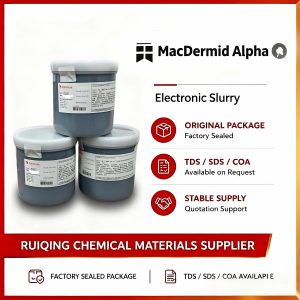
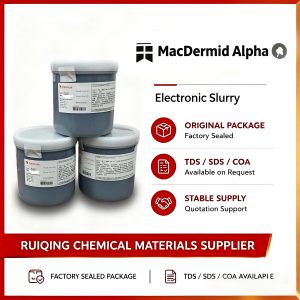
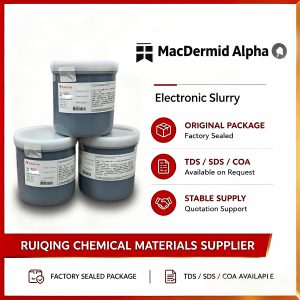
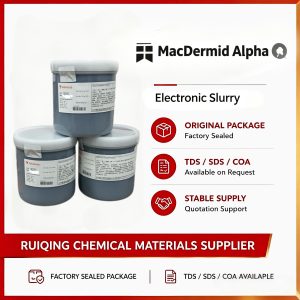
MacDermid Alpha Micromax 5707 High-Reliability Crossover Dielectric for Single-Layer Circuits
Type: Crossover Dielectric
Application: Single-Layer Circuits
Viscosity: 150–200 Pa.s
Shelf Life: 6 months
Micromax 5707 is a screen printable dielectric for use in single-layer circuits as a crossover between conductor lines. It is compatible with most silver/palladium and gold conductors and is positioned for high reliability. Prints up to 25 cm/s with a double wet squeegee pass to minimize pinholes.
Micromax 5707 from MacDermid Alpha is a screen printable crossover dielectric for use in single-layer circuits, where it serves as an insulator between conductor lines. It is compatible with most silver/palladium and gold conductors, and the TDS lists high reliability as a product benefit. The paste uses Micromax 8672 as the recommended solvent or thinner. It prints at speeds up to 25 cm/s, which supports higher throughput in thick film production.
The paste has a viscosity range of 150–200 Pa.s. Reported properties are based on 96% alumina substrates. Print individual dielectric layers with a 200 or 325 mesh stainless steel screen. The combined fired dielectric thickness should be at least 40 μm; three separate printings may be necessary with 325 mesh screens, while two fired layers achieve 40–45 μm using a 200 mesh screen. Recommended film thickness is 45–50 μm, with theoretical coverage of 60–70 cm²/g. To minimize pinholes, use a double wet squeegee pass. Allow the wet print to level 5–10 minutes at room temperature, then dry at 150°C for 10–15 minutes. Each dielectric print should be fired separately in a belt furnace, using a 60-minute cycle with a peak temperature of 850°C for 10 minutes. Store sealed at 5–30°C; unopened shelf life is 6 months.
Genuine MacDermid Alpha Micromax Imported Stock & Technical Support
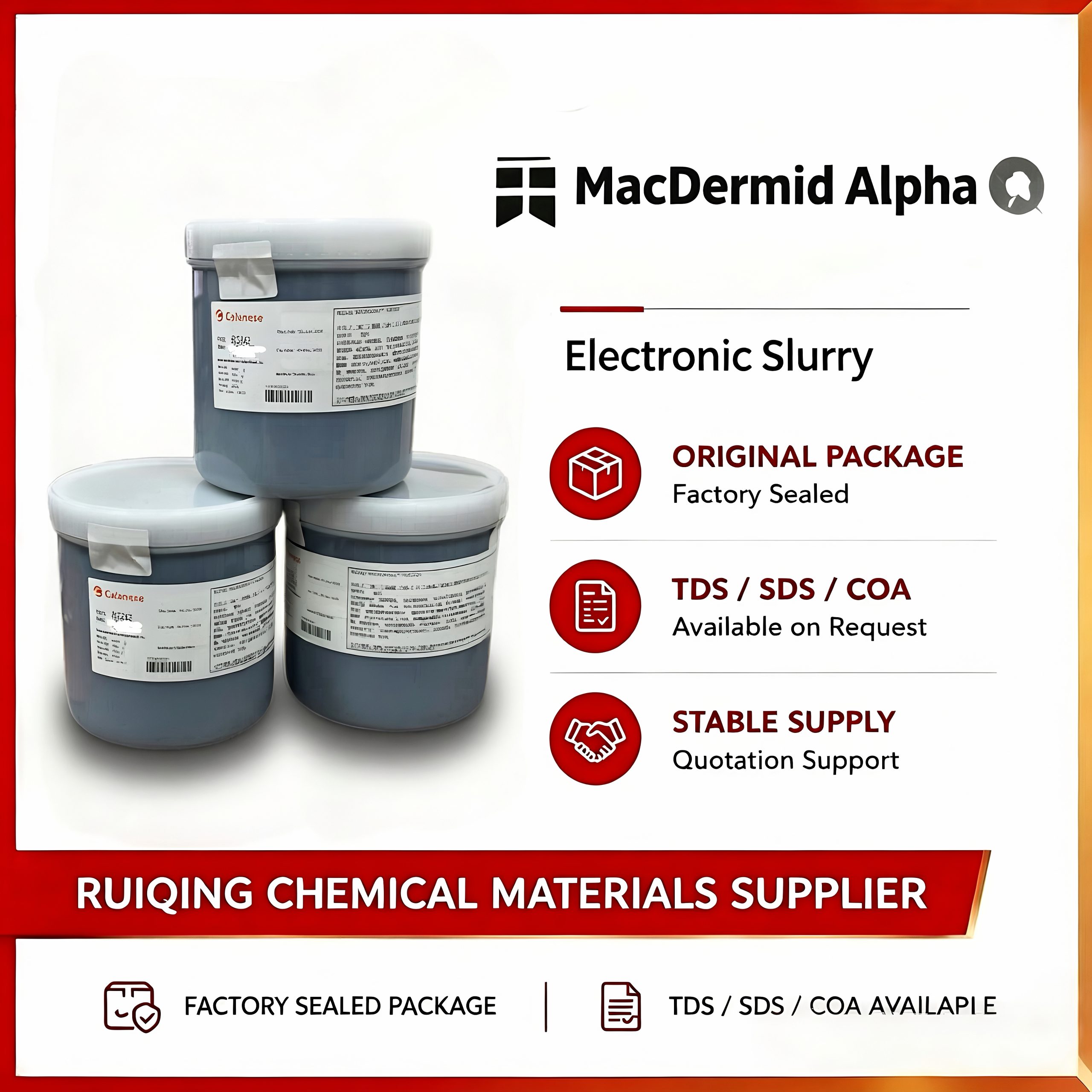
We hold regular stock of authentic MacDermid Alpha Micromax 5707 crossover dielectric paste. Original factory TDS and batch-specific COA are available on request for your single-layer circuit programs.
Request Sample, TDS & Quotation
Complete TDS, COA, and regulatory documentation available
Key Features of MacDermid Alpha Micromax 5707
- Screen printable crossover dielectric for single-layer circuits
- Compatible with most silver/palladium and gold conductors
- High reliability dielectric for interlayer insulation
- Print speeds up to 25 cm/s
- Double wet squeegee pass minimizes pinholes
- Minimum combined fired dielectric thickness 40 μm
- Two fired layers achieve 40–45 μm using a 200 mesh screen
- Viscosity 150–200 Pa.s for stable screen printing
- Drying: 150°C for 10–15 minutes
- Firing: 60-minute cycle, 850°C peak for 10 minutes
- Theoretical coverage 60–70 cm²/g
- Thinner Micromax 8672
Primary Applications
- Single-layer circuit crossovers — insulator between conductor lines
- Hybrid dielectric — per TDS application field
- Thick film circuits on alumina — reported properties based on 96% alumina substrates
- Circuits with Ag/Pd or gold conductors — compatible with most of these conductor systems
Full Technical Specifications
| Property | Typical Value | TDS Reference |
| Product Type | Crossover dielectric paste | TDS: Crossover Dielectric |
| Application | Hybrid dielectric | TDS: Hybrid dielectric |
| Solvent or Thinner | Micromax 8672 | TDS: Micromax 8672 |
| Viscosity | 150 to 200 Pa.s | TDS: Brookfield HAT, UC&SP, 10 rpm, 25°C |
| Mask Mesh | 200 to 325 | TDS: 200 to 325 |
| Drying Time | 10 to 15 minutes | TDS: 10 to 15 min |
| Drying Temperature | 150 °C | TDS: 150 °C |
| Theoretical Coverage | 60 to 70 cm²/g | TDS: 60 to 70 cm²/g |
| Recommended Film Thickness | 45 to 50 μm | TDS: 45 to 50 μm (3 fired layers, 325-mesh) |
| Minimum Fired Dielectric Thickness | 40 μm | TDS: at least 40 μm |
| Fired Thickness (200 mesh, 2 layers) | 40 to 45 μm | TDS: 2 fired layers, 200-mesh screen |
| Leveling Time | 5 to 10 minutes at room temperature | TDS: 5 to 10 min |
| Firing Profile | 60-minute cycle, 850°C peak for 10 minutes | TDS: 60 min cycle, 850°C for 10 min |
| Print Speed | Up to 25 cm/s | TDS: 25 cm/s |
| Substrate Compatibility | 96% alumina | TDS: 96% alumina |
| Conductor Compatibility | Most silver/palladium and gold conductors | TDS: Product benefits |
| Recommended Screen | 200 or 325 mesh stainless steel | TDS: 200 or 325 mesh |
| Squeegee | Double wet squeegee pass to minimize pinholes | TDS: double wet squeegee pass |
| Shelf Life | 6 months | TDS: 6 months |
| Storage Temperature | 5 – 30 °C | TDS: 5°C – 30°C |
Note: All listed values are typical and may vary by batch. Values based on MacDermid Alpha official TDS. Independent qualification testing is required prior to production use.
Recommended Processing Conditions
| Parameter | Recommended Value | TDS Reference |
| Mixing Prior to Use | Thoroughly mix to redisperse solids | TDS: thoroughly mix |
| Screen Mesh | 200 or 325 mesh stainless steel | TDS: 200 or 325 mesh |
| Squeegee | Double wet squeegee pass to minimize pinholes | TDS: double wet squeegee pass |
| Print Speed | Up to 25 cm/s | TDS: 25 cm/s |
| Number of Prints | Two layers with 200 mesh (40–45 μm) or three layers with 325 mesh to reach 40 μm minimum | TDS: 3 separate printings may be necessary |
| Leveling | 5–10 minutes at room temperature | TDS: 5-10 minutes |
| Drying | 150°C for 10–15 minutes | TDS: 10-15 minutes at 150°C |
| Firing | 60-minute cycle, 850°C peak for 10 minutes; each print fired separately in a belt furnace | TDS: 60 min cycle, 850°C for 10 min |
| Thinner | Micromax 8672 | TDS: Micromax 8672 |
Handling and Storage Recommendations
| Storage Rules | Store tightly sealed in a clean, stable environment at 5-30°C. | TDS: 5°C – 30°C |
| Shelf Life | 6 months in unopened containers from date of shipment. | TDS: 6 months |
| Pre-use Preparation | Thoroughly mix prior to use. Some settling of solids may occur during storage. | TDS: thoroughly mix |
| Transportation | Under normal shipping conditions, no temperature control is expected. For extended transport periods, confirm product suitability. | TDS: normal shipping conditions |
Official Technical Documentation
| Document Type | Document Introduction | Document Request |
| TDS | MacDermid Alpha Micromax 5707 original factory technical data sheet | Request TDS |
| COA | Batch-specific certificate of analysis | Request COA |
| SDS | Safety Data Sheet for handling and storage | Request SDS |
Frequently Asked Questions
Which conductors are compatible with 5707?
The TDS lists compatibility with most silver/palladium and gold conductors. This covers common thick film conductor systems used in single-layer circuit crossovers.
How thick should the fired dielectric be for 5707?
The combined fired dielectric thickness should be at least 40 μm. Using 200 mesh screens, two fired layers achieve 40–45 μm. Using 325 mesh screens, three separate printings may be necessary.
How fast can 5707 be printed?
It will print up to 25 cm/s. This is faster than some crossover dielectrics and supports higher throughput without needing extra print passes.
How should 5707 be fired?
Each dielectric print should be fired separately in a belt furnace. Use a 60-minute cycle with a peak temperature of 850°C for 10 minutes.
How does 5707 minimize pinholes?
The TDS recommends a double wet squeegee pass to minimize pinholes. This helps ensure consistent dielectric coverage over the conductor lines being crossed.
What thinner should be used with 5707?
Micromax 8672 is the listed solvent or thinner. Using the recommended thinner helps keep viscosity and print behavior consistent with the TDS values.
How should 5707 be stored?
Store tightly sealed at 5–30°C in a clean, stable environment. Unopened shelf life is 6 months from shipment. Some settling may occur, so mix thoroughly before reuse.
Get MacDermid Alpha Micromax 5707 Bulk Pricing and Technical Support
We supply authentic MacDermid Alpha Micromax 5707 crossover dielectric paste for single-layer circuit programs. Contact our team for bulk quotations, sample availability, technical documentation, and application support.
Inquire Bulk Price & Technical Support
Disclaimer: All technical data on this page are for general guidance only and are not product specifications. Buyers must carry out independent trials and verify suitability before bulk ordering. Actual values may vary between production lots.