描述
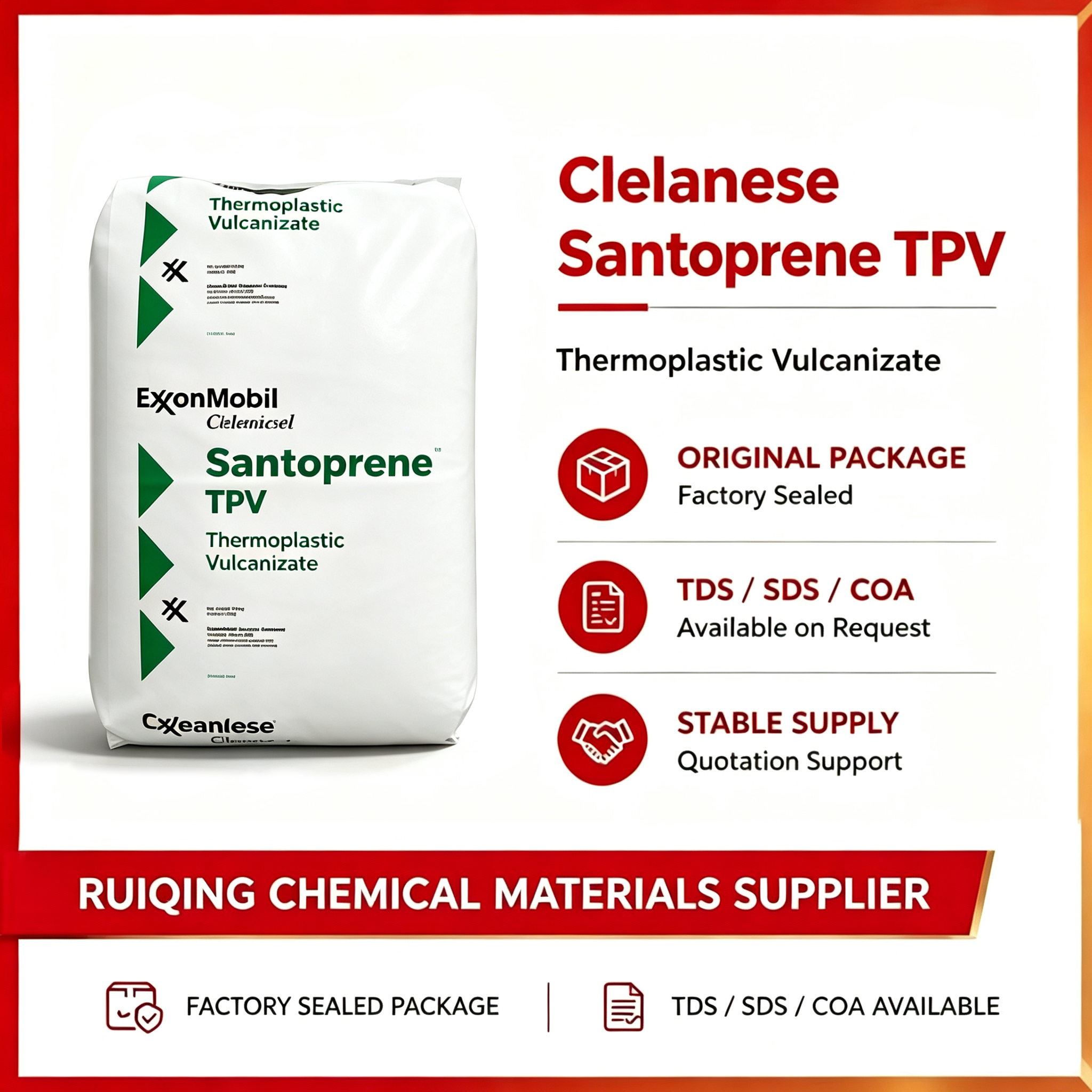
Santoprene 8221-60 is a Natural, UV-stabilized thermoplastic vulcanizate from Celanese designed for general-purpose extrusion and molding applications where environmental exposure and color flexibility are important.
Current Celanese portfolio data identifies the grade with:
- 64 Shore A hardness
- Natural appearance
- 470% elongation at break
- 5.7 MPa tensile stress at break
- 2.2 MPa stress at 100% elongation
- 32% compression set at 70°C / 22 h
- General-purpose extrusion and molding
- Added UV stability
The UV-stabilized formulation makes Santoprene 8221-60 especially interesting for parts that may experience sunlight or outdoor environmental exposure.
Instead of positioning this grade purely as another general-purpose soft elastomer, it is more useful to focus on applications such as:
- Outdoor sealing profiles
- Window and glazing components
- Building seals
- Flexible weather-exposed parts
- Colored exterior components
- Extruded profiles
- Molded flexible technical parts
The Natural base also allows customers to create lighter or customized colors instead of being limited to conventional black TPV.
For more TPV materials, visit our TPV Thermoplastic Vulcanizates Product Category →.
For current Santoprene portfolio information, see the Official Celanese Santoprene & Geolast Product Finder →.
Key Features of Santoprene 8221-60
| Feature | Engineering Benefit |
|---|---|
| 64 Shore A Hardness | Provides flexible but supportive elastomeric performance |
| Added UV Stability | Better suited to weather-exposed applications |
| Natural / Colorable | Supports custom colors and lighter finished parts |
| 470% Elongation | Allows substantial deformation and flexible installation |
| 5.7 MPa Tensile Strength | Provides useful strength for flexible technical parts |
| 2.2 MPa @100% Elongation | Supports medium-soft elastomeric behavior |
| 32% Compression Set | Suitable for many general sealing applications |
| Extrusion Capability | Useful for continuous sealing and profile production |
| Injection Molding | Suitable for molded flexible components |
| Thermoplastic Processing | Allows conventional plastics-processing equipment |
| Polyolefin-Based TPV | Combines rubber-like flexibility with thermoplastic processing |
| Natural Surface | Suitable for color matching and appearance-sensitive applications |
UV-Stabilized TPV for Outdoor Applications
The most important difference with Santoprene 8221-60 is its added UV stability. Celanese places the grade in its UV Natural TPV portfolio rather than treating it simply as an ordinary Natural TPV.
Outdoor elastomeric components may be exposed to:
- Sunlight
- Heat
- Rain
- Temperature cycling
- Atmospheric exposure
UV stabilization helps make the grade more relevant to these environments.
Potential applications include:
- Exterior sealing profiles
- Window systems
- Building components
- Outdoor equipment
- Weather-exposed flexible covers
Final outdoor life still depends on part design, color, exposure angle and environmental conditions.
Suitable for Outdoor Sealing Profiles
Extrusion is one of the primary processing routes identified for Santoprene 8221-60.
This makes the material relevant to continuous flexible profiles such as:
- Window seals
- Glazing profiles
- Construction seals
- Flexible edge profiles
- Protective strips
- Equipment sealing profiles
A TPV profile can combine rubber-like flexibility with continuous thermoplastic extrusion.
This can provide manufacturing advantages such as:
- Continuous production
- Fast cooling
- No conventional rubber vulcanization step
- Profile geometry flexibility
- Controlled reuse of suitable production scrap
Building & Glazing Applications
The combination of:
UV stabilization + Natural colorability + extrusion capability
makes Santoprene 8221-60 particularly interesting for building-related flexible components.
Potential applications include:
- Window gaskets
- Glazing seals
- Expansion-joint components
- Architectural profiles
- Flexible frame interfaces
- Protective building seals
Natural material can also be useful where black is visually unsuitable.
Finished profiles can potentially be developed in:
- White
- Gray
- Beige
- Brown
- Other architectural colors
with an appropriate compatible color system.
64 Shore A Flexible Sealing Behavior
Santoprene 8221-60 has a current published hardness of approximately:
64 Shore A.
This hardness provides a useful balance between softness and support.
A 64A material can conform to mating surfaces while retaining enough body for:
- Sealing lips
- Profile walls
- Gaskets
- Flexible edges
- Snap-in sealing geometries
This makes it relevant where extremely soft TPV would deform too easily but a very hard elastomer would not seal or flex sufficiently.
Typical Applications for Santoprene 8221-60
| Application Area | Typical Function |
|---|---|
| Window Seals | Flexible UV-exposed sealing profiles |
| Glazing Profiles | Elastomeric interfaces around glass |
| Construction Seals | Weather-exposed flexible components |
| Outdoor Equipment | Flexible environmental seals |
| Flexible Profiles | Continuous extruded elastomer sections |
| Gaskets | Molded or extruded sealing elements |
| Protective Edges | Flexible contact protection |
| Appliance Components | Flexible molded technical parts |
| Colored Exterior Parts | Natural TPV for customized color |
| General Molded Parts | Medium-soft flexible engineering components |
Typical Properties of Santoprene 8221-60
Physical & Mechanical Properties
| Property | Typical Value |
|---|---|
| Material Family | TPV / TPE-V |
| Shore A Hardness | 64 |
| Appearance | Natural |
| Elongation at Break | 470% |
| Tensile Stress at Break | 5.7 MPa |
| Tensile Stress at 100% Elongation | 2.2 MPa |
| Compression Set, 70°C / 22 h | 32% |
| UV Stabilization | Yes – Added UV Stability |
| Primary Processing | Injection Molding / Extrusion |
These are the current values shown for Santoprene 8221-60 in the Celanese Product Finder.
The 60 in the grade designation should therefore not be used as the exact measured hardness. The published typical hardness is 64 Shore A.
470% Elongation for Flexible Design
Santoprene 8221-60 provides approximately:
470% elongation at break.
This allows the material to tolerate substantial deformation.
For a seal or flexible profile, this can be useful during:
- Installation
- Stretching
- Compression
- Bending
- Assembly around corners
- Local movement
High elongation also gives designers more freedom when developing complex flexible profile geometries.
Tensile Strength
The current published tensile stress at break is approximately:
5.7 MPa.
This provides useful mechanical durability for flexible components that may experience:
- Pulling during installation
- Profile handling
- Stretching
- Repeated movement
- Assembly stress
The combination of 5.7 MPa strength and 470% elongation provides a useful balance for general-purpose elastomeric components.
Stress at 100% Elongation
Santoprene 8221-60 provides approximately:
2.2 MPa stress at 100% elongation.
This indicates a medium-soft response.
The material remains easy to flex while providing enough restoring force for:
- Sealing lips
- Profile sections
- Flexible interfaces
- Protective components
Compression Set
Current Celanese Product Finder data lists approximately:
32% compression set at 70°C / 22 hours.
Compression-set performance is important in sealing components because permanent deformation can reduce sealing pressure.
Santoprene 8221-60 can therefore be considered for general sealing designs including:
- Housing seals
- Window gaskets
- Construction seals
- Flexible interfaces
The final design should account for actual compression percentage, temperature and service duration.
Natural / Colorable Formulation
Santoprene 8221-60 is supplied in Natural form.
This is especially useful in markets where the finished elastomer must match the surrounding product.
Possible color directions include:
- White
- Light gray
- Dark gray
- Beige
- Brown
- Blue
- Brand-specific colors
This gives Santoprene 8221-60 broader appearance flexibility than standard black TPV.
Color Selection for Outdoor Use
For outdoor applications, color development should consider more than appearance.
Important factors include:
- Pigment UV stability
- Masterbatch carrier compatibility
- Outdoor color retention
- Heat absorption
- Surface appearance
If a light-colored exterior component is required, the entire pigment package should be evaluated for weathering performance.
The base grade’s UV stabilization does not automatically guarantee that every color formulation will provide identical outdoor durability.
Injection-Molded Outdoor Components
Although extrusion is a strong application direction, Santoprene 8221-60 can also be used for molding.
Potential molded components include:
- Outdoor gaskets
- Flexible caps
- Sealing rings
- Protective covers
- Equipment interfaces
- Flexible molded corners
Injection molding can be useful where the part requires more complex three-dimensional geometry than continuous extrusion can provide.
Extruded Profile Design
When developing an extruded Santoprene 8221-60 profile, engineers should consider:
- Wall thickness
- Lip thickness
- Compression geometry
- Die swell
- Cooling rate
- Puller speed
- Profile support
Complex hollow or thin-wall profiles may require careful die balancing.
The target should be stable profile geometry without excessive distortion after exiting the die.
Coextrusion Possibilities
Because Santoprene 8221-60 is a polyolefin-based TPV, it can also be evaluated in compatible multi-material profile constructions.
Potential designs may combine:
- Flexible TPV seal
- Firmer thermoplastic support
- Multiple functional profile zones
Actual adhesion and processing compatibility should be tested with the exact second material.
Santoprene 8221-60 should not be marketed as a dedicated chemical-bonding B100/B150 grade.
Weathering Considerations
UV stabilization is highly valuable, but long-term outdoor durability is affected by several factors:
- UV intensity
- Geographic location
- Temperature
- Moisture
- Part thickness
- Mechanical strain
- Color system
For critical exterior applications, accelerated weathering testing should be matched to the customer’s performance requirements.
Surface Appearance
Natural/colorable TPV can be useful in visible architectural or consumer applications.
Finished appearance can be influenced by:
- Tool or die surface
- Cooling rate
- Pigment dispersion
- Processing temperature
- Extrusion speed
For visible profiles, production trials should evaluate both mechanical properties and visual consistency.
Why Choose Santoprene 8221-60?
The key reason to select Santoprene 8221-60 is its combination of environmental positioning and general thermoplastic processability.
The grade provides:
- 64 Shore A hardness
- Natural appearance
- Added UV stability
- 470% elongation
- 5.7 MPa tensile strength
- 2.2 MPa stress at 100% elongation
- 32% compression set
- Injection molding capability
- Extrusion capability
- Custom color potential
- Flexible sealing performance
This makes the grade particularly relevant to outdoor seals, construction profiles, window systems and weather-exposed flexible components.
Processing Guidelines for Santoprene 8221-60
Celanese currently identifies injection molding and extrusion as processing routes for Santoprene 8221-60.
For production, the latest grade-specific TDS should be used to establish exact machine settings.
Injection Molding Priorities
Important parameters include:
- Melt temperature
- Mold temperature
- Injection speed
- Holding pressure
- Screw speed
- Gate dimensions
- Venting
Santoprene TPV exhibits shear-dependent flow, so injection-speed and gate design can have a significant influence on mold filling.
Extrusion Processing Priorities
For profile extrusion, important variables include:
- Barrel temperature profile
- Melt temperature
- Screw speed
- Die temperature
- Melt pressure
- Puller speed
- Cooling conditions
Consistent extrusion conditions help maintain:
- Profile dimensions
- Surface quality
- Lip geometry
- Final sealing performance
Shear-Dependent Processing
Like other Santoprene TPV materials, flow behavior is influenced by shear.
Increasing shear can reduce apparent melt viscosity.
This means flow can often be improved through:
- Screw-speed optimization
- Injection-speed adjustment
- Proper gate geometry
- Appropriate extrusion die design
rather than relying solely on increased processing temperature.
Material Compatibility
When changing from another polymer to Santoprene TPV, processing equipment should be thoroughly purged.
Particular attention should be given when the previous material is:
- POM / Acetal
- PVC
Clean material handling is especially important for Natural and light-colored products because contamination can become highly visible.
Manufacturing-Stream Reprocessing
Santoprene is a thermoplastic vulcanizate, so suitable clean process scrap can potentially be managed within controlled manufacturing streams.
Possible sources include:
- Sprues
- Runners
- Extrusion start-up material
- Profile trim
- Selected rejected parts
For colored or exterior-qualified components, regrind content should be controlled according to appearance and final performance requirements.
Related Products
We supply Santoprene TPV grades for different UV, weathering, hardness, extrusion and molding requirements.
Typical product families include:
- Santoprene 8221 Series
- Santoprene UV-Stabilized TPV
- Santoprene Natural TPV
- Santoprene Outdoor Seal Materials
- Santoprene Profile Extrusion Grades
- Santoprene Building & Construction TPV
- Santoprene Window Seal Materials
- Santoprene General-Purpose TPV
- Santoprene Injection-Molding Grades
View More TPV Thermoplastic Vulcanizates →
Technical Documents for Santoprene 8221-60
| Document Type | Description |
|---|---|
| TDS | Physical, mechanical and processing information |
| SDS | Safety Data Sheet |
| UV / Weathering Information | Outdoor material-selection support |
| Extrusion Guide | Profile extrusion recommendations |
| Injection Molding Guide | Mold-processing guidance |
| Coloring Information | Natural TPV color-development guidance |
| Application Support | Outdoor seal and profile material selection |
| COA | Batch-specific quality information where available |
Need technical documents for Santoprene 8221-60?
📧 Email: ruiqingchem@gmail.com
📝 Online form: Contact Us →
FAQ About Santoprene 8221-60
Q1: What is Santoprene 8221-60?
Santoprene 8221-60 is a Natural UV-stabilized TPV from Celanese designed for general-purpose extrusion and molding applications.
Q2: What is the hardness of Santoprene 8221-60?
The current Celanese Product Finder lists approximately 64 Shore A.
Q3: Is Santoprene 8221-60 exactly 60 Shore A?
No. The grade designation contains 60, while the current published typical value is 64 Shore A.
Q4: What is the elongation at break?
The typical published value is approximately 470%.
Q5: What is the tensile stress at break?
The typical value is approximately 5.7 MPa.
Q6: What is the stress at 100% elongation?
The typical value is approximately 2.2 MPa.
Q7: What is the compression set?
The current Product Finder lists approximately 32% at 70°C / 22 hours.
Q8: Is Santoprene 8221-60 UV stabilized?
Yes. Celanese specifically identifies the grade as having Added UV Stability.
Q9: What color is Santoprene 8221-60?
The standard grade is Natural.
Q10: Can Santoprene 8221-60 be colored?
Yes. Its Natural base makes it suitable for development of customized colors.
Q11: Can Santoprene 8221-60 be extruded?
Yes. Celanese specifically positions it for extrusion and molding.
Q12: Can Santoprene 8221-60 be injection molded?
Yes. Injection molding is included in its current processing positioning.
Q13: Is Santoprene 8221-60 suitable for outdoor seals?
Its added UV stability and flexible TPV properties make outdoor sealing and weather-exposed flexible components important application directions.
Q14: Can it be used for window or glazing profiles?
Yes. Its UV-stabilized Natural formulation and extrusion capability make window, glazing and construction profiles relevant applications subject to final application validation.
Q15: Is Santoprene 8221-60 an M300 automotive interior grade?
No. 8221-60 is a UV-stabilized general-purpose Natural TPV, while grades carrying the M300 suffix belong to a different specialized interior family.
Q16: What is the biggest advantage of Santoprene 8221-60?
Its most distinctive combination is 64 Shore A + Natural colorability + Added UV Stability + 470% elongation + extrusion and molding capability, making it particularly useful for flexible components exposed to outdoor environments.
Request Santoprene 8221-60 Price & Technical Support
For pricing, availability or technical support for Santoprene 8221-60, please provide:
- Required quantity
- Destination country or port
- Application
- Outdoor or indoor use
- Required color
- Window / glazing / construction application
- Seal or profile geometry
- Injection or extrusion process
- Wall thickness
- UV / weathering requirement
- Operating temperature
- Chemical-contact conditions
- TDS / SDS requirement
- COA requirement
- Sample requirement, if applicable
📧 Email: ruiqingchem@gmail.com