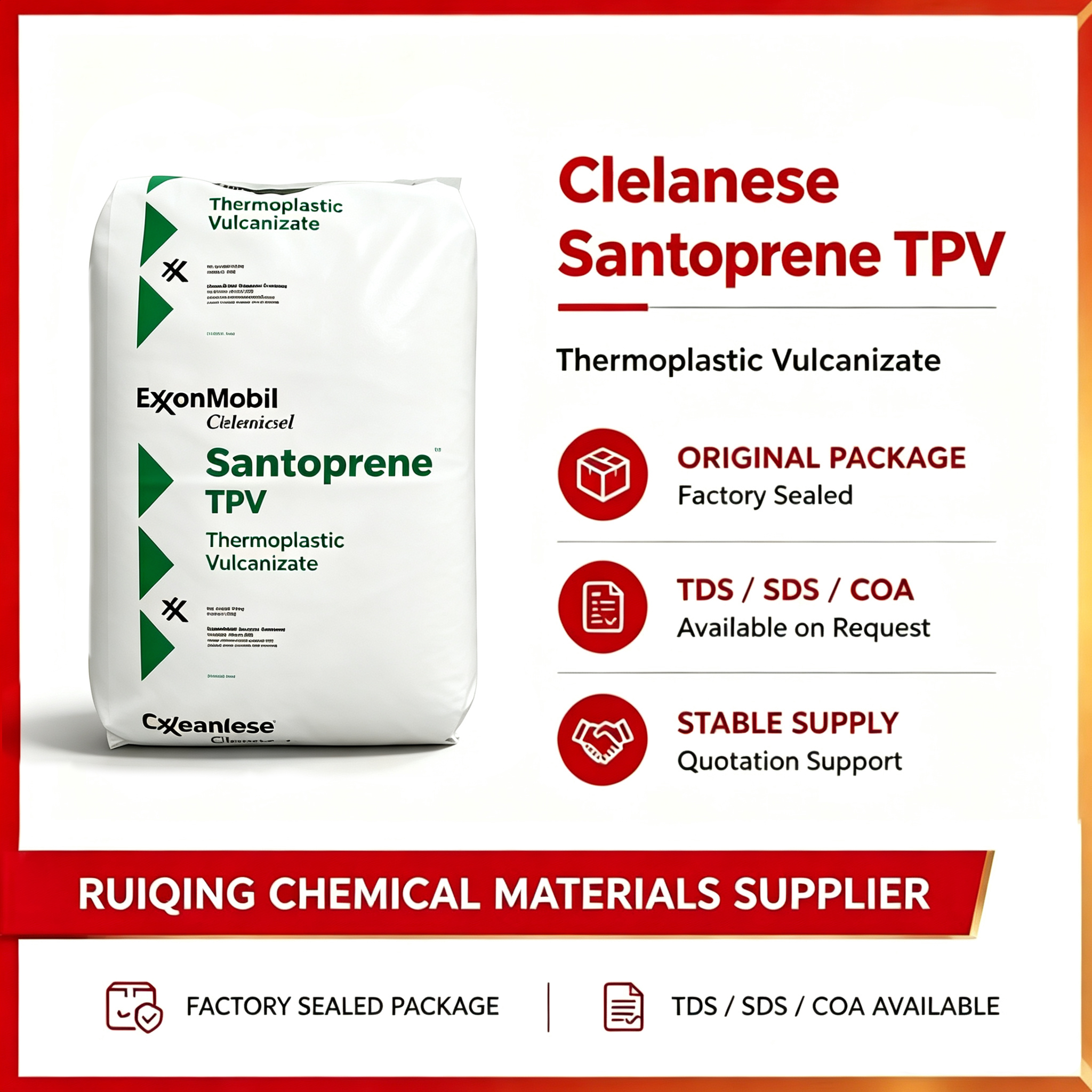
描述
Santoprene 8211-85M350 is a hard, colorable thermoplastic vulcanizate from Celanese developed specifically for automotive interior skin applications.
Unlike conventional general-purpose TPV grades, Santoprene 8211-85M350 is engineered around the surface requirements of visible interior components.
Its application profile emphasizes:
- Scratch resistance
- Mar resistance
- Abrasion resistance
- Low gloss
- Low emissions
- Comfortable tactile feel
- High-flow injection molding
- Colorability
- Compatibility with polypropylene-based structures
Current Celanese Product Finder data lists:
- 86 Shore A hardness
- Natural appearance
- 480% elongation at break
- 8.8 MPa tensile stress at break
- Improved flow
- Improved abrasion resistance
Celanese’s automotive grade selection guide separately places Santoprene 8211-85M350 in the Interior category and identifies improved scratch and mar resistance as its defining characteristic.
This makes the grade particularly relevant to interior parts where the TPV surface is visible and repeatedly touched, rubbed or contacted during vehicle use.
For more TPV materials, visit our TPV Thermoplastic Vulcanizates Product Category →.
For current Santoprene portfolio information, see the Official Celanese Santoprene & Geolast Product Finder →.
Key Features of Santoprene 8211-85M350
| Feature | Engineering Benefit |
|---|---|
| 86 Shore A Hardness | Provides a firm but still elastomeric interior surface |
| Improved Scratch Resistance | Helps visible surfaces withstand repeated contact |
| Improved Mar Resistance | Supports long-term interior appearance |
| Improved Abrasion Resistance | Helps reduce surface wear |
| Low Gloss | Supports modern automotive interior styling |
| Low Emissions | Suitable for enclosed cabin environments |
| Natural / Colorable | Allows interior color matching |
| High Flow | Supports large-area and detailed molded skins |
| 480% Elongation | Retains useful flexibility despite high hardness |
| 8.8 MPa Tensile Strength | Provides useful mechanical durability |
| PP Compatibility | Suitable for molding over selected rigid polypropylene substrates |
| Multi-Component Molding | Useful for integrated hard/soft interior structures |
| Comfort Touch | Provides a more tactile surface than rigid PP alone |
Designed for Automotive Interior Skins
The most important positioning of Santoprene 8211-85M350 is as an automotive interior skin material.
A molded interior skin often needs to satisfy several requirements at the same time:
- Good appearance
- Consistent color
- Controlled gloss
- Scratch resistance
- Resistance to fingernail or object contact
- Comfortable tactile response
- Compatibility with the rigid backing material
- Stable large-area molding
Santoprene 8211-85M350 was developed around this combination.
Rather than acting only as a flexible structural material, it functions as a visible functional surface.
Typical Applications for Santoprene 8211-85M350
| Automotive Interior Area | Typical Function |
|---|---|
| Door Panels | Flexible visible skin over rigid substrate |
| Center Consoles | Low-gloss soft-touch surface |
| Instrument Panel Areas | Decorative and tactile elastomeric skin |
| Interior Trim | Scratch-resistant flexible surface |
| Armrest Components | Comfortable contact surface |
| Console Inserts | Color-matched flexible detail |
| Protective Interior Surfaces | Mar- and abrasion-resistant skin |
| Soft-Touch Zones | Tactile areas around controls |
| Interior Storage Areas | Flexible contact surfaces |
| PP-Based Interior Parts | Molded elastomeric skin over rigid structure |
Typical Properties of Santoprene 8211-85M350
Physical Properties
| Property | Typical Value |
|---|---|
| Material Family | TPV / TPE-V |
| Density | Approx. 0.910 g/cm³ |
| Shore A Hardness | 86 |
| Appearance | Natural |
| Product Form | Pellets |
| Colorability | Easy Coloring / Colorable |
| Special Characteristic | High Flow |
The 85 contained in the grade designation should not be treated as the exact measured hardness. Current Celanese portfolio data gives approximately 86 Shore A.
Mechanical Properties
| Property | Typical Value |
|---|---|
| Tensile Stress at Break | 8.8 MPa |
| Elongation at Break | 480% |
| Shore A Hardness | 86 |
Celanese’s current Product Finder publishes these exact grade values.
No current Product Finder value is listed for 100% modulus or compression set for this grade, so those values should not be borrowed from neighboring 8211 grades.
86 Shore A for Firm Interior Surfaces
At approximately 86 Shore A, Santoprene 8211-85M350 provides a relatively firm surface.
This is useful in automotive interiors because a surface that is too soft may:
- Deform excessively
- Mark easily
- Feel unstable
- Show poor dimensional definition
The higher hardness helps provide:
- Surface support
- Defined molded geometry
- Better edge retention
- Firm tactile response
while the TPV still provides more flexibility than a rigid thermoplastic surface.
Scratch & Mar Resistance
One of the strongest differentiators of Santoprene 8211-85M350 is its improved resistance to scratch and mar damage.
Celanese specifically identifies this property in its automotive grade slate.
Automotive interior surfaces can be exposed to repeated contact from:
- Fingernails
- Keys
- Bags
- Clothing
- Seat-belt hardware
- Cleaning tools
- General passenger use
A scratch-resistant TPV helps preserve the visible appearance of the part over time.
Improved Abrasion Resistance
Celanese’s Product Finder also lists improved abrasion resistance for Santoprene 8211-85M350.
Abrasion resistance is particularly useful for:
- Door-contact areas
- Storage compartments
- Console edges
- Frequently touched surfaces
- Parts exposed to repeated rubbing
This gives the grade a stronger interior-surface positioning than a standard high-flow molding grade.
Low-Gloss Interior Appearance
Automotive interior materials increasingly require controlled gloss.
Excessive gloss can create:
- Reflections
- Visual mismatch
- An inexpensive appearance
- Greater visibility of surface defects
Santoprene 8211-85M350 is designed for low-gloss automotive interior surfaces.
The final gloss level also depends on:
- Tool texture
- Mold surface
- Color masterbatch
- Processing conditions
- Part geometry
This allows the material to be integrated into different interior styling concepts.
Comfort-Touch Surface
Santoprene 8211-85M350 is also intended to provide a more comfortable tactile response than a rigid PP surface.
This is useful in areas where occupants regularly make contact with the component.
Potential examples include:
- Door trim
- Armrest areas
- Center-console surfaces
- Control surrounds
- Storage-compartment edges
The relatively high 86A hardness means it does not behave like a very soft foam or gel.
Instead, it provides a firm soft-touch / comfort-touch elastomeric surface.
Low Emissions for Vehicle Interiors
Automotive cabin materials are often evaluated for emissions because the passenger compartment is an enclosed environment.
Santoprene 8211-85M350 was developed with low-emission performance, including concerns such as:
- Fogging
- Odor
- Interior volatile emissions
This is an important distinction from many generic TPV grades.
For OEM projects, final compliance should always be checked against the exact required test method and current customer specification.
Natural & Easy Coloring Formulation
Santoprene 8211-85M350 is supplied in a Natural / easy-coloring formulation.
This allows interior designers to develop colors such as:
- Black
- Charcoal
- Dark gray
- Light gray
- Beige
- Brown
- Blue
- Custom OEM interior colors
This is especially valuable because automotive interiors often require close matching between:
- PP substrate
- TPV skin
- Adjacent trim
- Painted components
- Textile or leather surfaces
Color Consistency
For automotive interior parts, color matching involves more than simply selecting a pigment.
The final appearance can depend on:
- Masterbatch carrier
- Pigment concentration
- Tool texture
- Part thickness
- Processing temperature
- Shear
- Gloss level
Production color trials should therefore be conducted on the actual molded geometry.
Designed for PP-Based Interior Structures
Santoprene 8211-85M350 was developed for use as a skin over rigid polypropylene substrates.
A typical construction can be:
Rigid PP structure + Santoprene 8211-85M350 visible skin
This allows the rigid component to provide:
- Structural stiffness
- Dimensional stability
- Mounting features
while the TPV surface provides:
- Tactile feel
- Scratch resistance
- Low gloss
- Color
- Surface protection
PP Compatibility
The grade’s polyolefin-based chemistry makes it suitable for integration with selected polypropylene constructions.
Potential benefits include:
- Simplified hard/soft material system
- Compatible polymer families
- Multi-component molding
- Manufacturing-stream recyclability
The exact PP substrate formulation should still be validated because additives, fillers and mold-release agents can influence interfacial performance.
Alternative to Soft-Touch Paint
One important commercial positioning for Santoprene 8211-85M350 is its use as an integrated material solution where a manufacturer might otherwise consider a soft-touch painted PP component.
Using a molded TPV skin can potentially reduce secondary operations such as:
- Surface coating
- Paint application
- Drying
- Additional handling
It can also integrate tactile properties directly into the molded component.
Whether it is economically preferable depends on:
- Part size
- Production volume
- Tooling
- Surface specification
- Manufacturing layout
High-Flow Performance
Santoprene 8211-85M350 is specifically described as a high-flow material.
This is important for automotive interior skins because such parts can involve:
- Large surface areas
- Thin molded layers
- Long flow paths
- Fine surface textures
- Complex geometry
High flow can help the melt reach distant cavity regions before excessive cooling occurs.
Large-Area Interior Molding
Large interior parts create different processing challenges from small seals or grommets.
Typical concerns include:
- Long flow length
- Flow-front balance
- Pressure loss
- Surface consistency
- Weld lines
- Texture reproduction
Santoprene 8211-85M350’s high-flow formulation is especially relevant to this type of molding.
Multi-Component Injection Molding
The grade can be processed on conventional:
- Single-component injection-molding equipment
- Multi-component injection-molding equipment
Multi-component molding allows a manufacturer to integrate:
rigid PP + TPV skin
within an automated molding process.
Potential advantages include:
- Reduced assembly
- Integrated surface function
- Consistent skin placement
- Fewer downstream operations
Injection Molding Guidelines
Current grade-specific Celanese processing data provides the following starting conditions:
| Processing Parameter | Recommended Value |
|---|---|
| Drying Recommended | Yes |
| Drying Temperature | 80°C |
| Drying Time | ≥3 hours |
| Maximum Processing Moisture | ≤0.08% |
| Optimum Melt Temperature | 200°C |
| Minimum Melt Temperature | 190°C |
| Maximum Melt Temperature | 215°C |
| Optimum Mold Temperature | 35°C |
| Minimum Mold Temperature | 20°C |
| Maximum Mold Temperature | 50°C |
These values are specifically associated with Santoprene 8211-85M350 and provide a much better starting point than generic TPV settings.
Drying & Material Preparation
Santoprene 8211-85M350 is considered relatively low in moisture sensitivity, but controlled drying can be used to ensure processing consistency.
A useful grade-specific starting point is:
80°C for at least 3 hours
with moisture controlled to:
≤0.08%
This can help support:
- Stable surface appearance
- Consistent molded texture
- Reliable cavity filling
- Reduced contamination-related defects
Melt Temperature
The recommended melt-temperature range is approximately:
190–215°C
with approximately:
200°C optimum
This window should be optimized according to:
- Part area
- Skin thickness
- Injection speed
- Gate size
- PP substrate
- Surface texture
Mold Temperature
The recommended mold-temperature range is:
20–50°C
with approximately:
35°C optimum
Mold temperature can influence:
- Surface gloss
- Texture replication
- Flow
- Cycle time
- Interface quality
For visible automotive interior surfaces, appearance requirements may justify tighter mold-temperature control than would be needed for a hidden technical part.
Shear-Dependent Flow
Santoprene 8211-85M350 is shear dependent.
As shear rate increases:
apparent melt viscosity decreases.
This is especially useful in large-area skin molding.
Flow can often be improved through:
- Injection-speed optimization
- Gate design
- Runner design
- Screw-speed adjustment
rather than simply increasing melt temperature.
Gate Design for Interior Skins
Gate design is critical because the finished surface is visible.
Poor gate placement may create:
- Flow marks
- Weld lines
- Gloss variation
- Uneven filling
- Surface defects
For large-area interior surfaces, gate location should be selected to balance:
- Flow distance
- Surface appearance
- Cavity pressure
- Weld-line location
Mold Texture & Gloss Control
The final appearance of Santoprene 8211-85M350 can be influenced strongly by mold texture.
Possible finishes include:
- Fine matte
- Grain
- Leather-like texture
- Technical texture
- Smooth low-gloss surface
Because automotive interiors often contain multiple adjacent materials, mold texture can help create visual consistency between the TPV skin and surrounding trim.
Scratch Resistance Depends on Surface Design
Material formulation is important, but finished-part scratch performance can also be affected by:
- Surface texture
- Pigment system
- Wall thickness
- Processing
- Test method
For this reason, final scratch and mar validation should be conducted on the production-intent molded surface.
480% Elongation
Despite the relatively high hardness, Santoprene 8211-85M350 maintains approximately:
480% elongation at break.
This supports:
- Complex molded geometry
- Local deformation
- Assembly movement
- Impact response
- Flexible skin behavior
The combination of high hardness and substantial elongation allows the material to function as a durable interior surface rather than a brittle decorative layer.
8.8 MPa Tensile Strength
Published tensile stress at break is approximately:
8.8 MPa.
This provides useful mechanical durability for molded interior skins and flexible trim components.
The material can therefore withstand handling and deformation during:
- Molding
- Assembly
- Vehicle use
- Service operations
Manufacturing-Stream Recycling
Santoprene 8211-85M350 is polyolefin based and can support controlled manufacturing-stream recycling.
Clean production scrap may include:
- Sprues
- Runners
- Start-up material
- Selected rejected parts
This can be especially useful in integrated PP/TPV manufacturing systems.
Final scrap-management practice should follow production-quality and appearance requirements.
Why Choose Santoprene 8211-85M350?
The main reason to select Santoprene 8211-85M350 is its specialized automotive interior surface performance.
Its strongest combination is:
- 86 Shore A hardness
- 480% elongation
- 8.8 MPa tensile strength
- Improved scratch resistance
- Improved mar resistance
- Improved abrasion resistance
- Low-gloss appearance
- Low-emission formulation
- Comfort-touch surface
- Natural / easy-coloring formulation
- High flow
- PP-substrate application
- Multi-component injection molding
This makes it especially suitable for visible automotive interior parts where appearance, feel and durability are all important.
Related Products
We supply Santoprene TPV materials for automotive interior, colorability, surface durability and molding requirements.
Typical product families include:
- Santoprene M350 Interior Grades
- Santoprene Automotive Interior TPV
- Santoprene Scratch-Resistant TPV
- Santoprene Low-Gloss TPV
- Santoprene Low-Emission TPV
- Santoprene Colorable TPV
- Santoprene High-Flow TPV
- Santoprene PP-Compatible Interior Materials
- Santoprene Multi-Component Molding Grades
View More TPV Thermoplastic Vulcanizates →
Technical Documents for Santoprene 8211-85M350
| Document Type | Description |
|---|---|
| TDS | Physical, mechanical and processing data |
| SDS | Safety Data Sheet |
| Automotive Interior Information | Interior skin and surface application guidance |
| Scratch & Mar Information | Surface-durability information |
| Injection Molding Guide | Grade-specific processing support |
| Coloring Information | Automotive interior color-development guidance |
| PP Substrate Information | Multi-material processing support |
| COA | Batch-specific quality documentation where available |
Need technical documents for Santoprene 8211-85M350?
📧 Email: ruiqingchem@gmail.com
📝 Online form: Contact Us →
Please state Santoprene 8211-85M350 and specify your automotive interior application, substrate, color and surface requirement.
FAQ About Santoprene 8211-85M350
Q1: What is Santoprene 8211-85M350?
Santoprene 8211-85M350 is a colorable automotive interior TPV from Celanese designed for molded skins and visible interior surfaces.
Q2: What is the hardness of Santoprene 8211-85M350?
The current published typical value is approximately 86 Shore A.
Q3: Is Santoprene 8211-85M350 a standard 8211 high-flow grade?
It has high-flow processing characteristics, but it is a specialized M350 automotive interior grade with improved surface durability.
Q4: What is the tensile strength?
The published tensile stress at break is approximately 8.8 MPa.
Q5: What is the elongation at break?
The current published value is approximately 480%.
Q6: Is Santoprene 8211-85M350 scratch resistant?
Yes. Celanese specifically identifies improved scratch and mar resistance for this automotive interior grade.
Q7: Does Santoprene 8211-85M350 have good abrasion resistance?
Yes. Celanese’s Product Finder specifically lists improved abrasion resistance.
Q8: Is Santoprene 8211-85M350 low gloss?
It is designed for low-gloss automotive interior surface applications.
Q9: Is Santoprene 8211-85M350 colorable?
Yes. It is supplied in a Natural / easy-coloring formulation.
Q10: Is it suitable for automotive door panels?
Yes. Automotive door-panel skins are a key application direction for this grade.
Q11: Can it be used for center consoles?
Yes. Center-console surfaces are another relevant automotive interior application.
Q12: Can Santoprene 8211-85M350 be molded over PP?
Yes. It was developed for interior skin applications over selected rigid polypropylene substrates. Final interfacial performance should be validated with the actual PP formulation.
Q13: Is Santoprene 8211-85M350 suitable for 2K molding?
Yes. Multi-component injection molding is an important processing route for integrated PP/TPV interior designs.
Q14: What melt temperature is recommended?
A grade-specific starting range is approximately 190–215°C, with about 200°C optimum.
Q15: What mold temperature is recommended?
A useful starting range is approximately 20–50°C, with about 35°C optimum.
Q16: What is the main advantage of Santoprene 8211-85M350?
Its biggest advantage is the combination of 86A hardness + high flow + colorability + low gloss + low emissions + improved scratch, mar and abrasion resistance for automotive interior surfaces.
Request Santoprene 8211-85M350 Price & Technical Support
For pricing, availability or technical support for Santoprene 8211-85M350, please provide:
- Required quantity
- Destination country or port
- Automotive interior application
- Door panel / center console / trim application
- PP substrate grade
- Required color
- Required gloss level
- Surface texture requirement
- Scratch requirement
- Mar-resistance requirement
- Abrasion requirement
- Fogging or odor requirement
- Skin thickness
- Single-shot or multi-component molding
- TDS / SDS requirement
- COA requirement
- Sample requirement, if applicable
📧 Email: ruiqingchem@gmail.com