描述
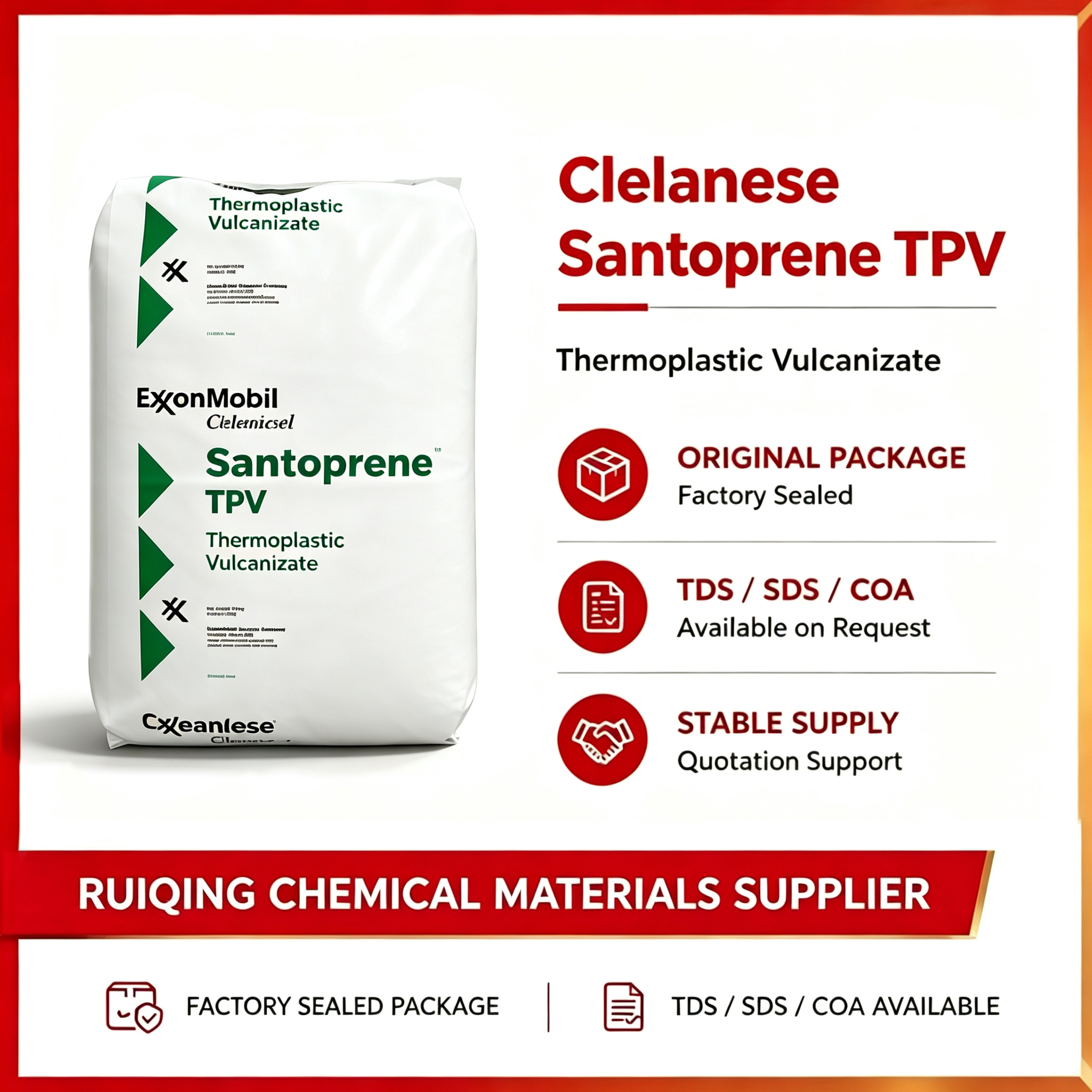
Santoprene 8111-35 is a soft, black, high-flow thermoplastic vulcanizate from Celanese developed especially for injection-molded sealing and flexible technical components.
The grade is designed to combine:
- Soft elastomeric behavior
- Excellent flow
- Conventional thermoplastic injection molding
- Low moisture sensitivity
- Ozone resistance
- Flex-fatigue resistance
- Chemical resistance
- Sealing performance
Current published grade-specific values include:
- 38 Shore A hardness
- 0.930 g/cm³ density
- 350% elongation at break
- 2.9 MPa tensile stress at break
- 1.0 MPa stress at 100% elongation
- 10% compression set at 23°C / 24 h
- 36% compression set at 125°C / 70 h
- -65°C low-temperature brittleness
The most distinctive feature of Santoprene 8111-35 is its high-flow injection-molding behavior.
This makes the grade particularly useful for:
- Thin molded features
- Complex sealing geometries
- Long flow paths
- Small flexible parts
- Multi-cavity molds
- Components where a softer TPV must fill detailed mold sections
Celanese also identifies the material as non-hygroscopic, meaning it requires little to no drying before normal processing compared with hygroscopic engineering polymers.
For more TPV products, visit our TPV Thermoplastic Vulcanizates Product Category →.
For the current Santoprene portfolio, see the Official Celanese Santoprene & Geolast Product Finder →.
Key Features of Santoprene 8111-35
| Feature | Engineering Benefit |
|---|---|
| 38 Shore A Hardness | Provides soft, flexible elastomeric behavior |
| High Flow | Helps fill difficult and detailed injection-molded geometries |
| Black Formulation | Suitable for technical seals and molded components |
| Non-Hygroscopic | Requires little to no drying before normal processing |
| 350% Elongation at Break | Provides substantial deformation capability |
| 2.9 MPa Tensile Stress at Break | Provides useful strength for soft TPV components |
| 1.0 MPa Stress at 100% Elongation | Confirms a soft, low-modulus material response |
| 10% Compression Set at 23°C | Supports flexible sealing performance |
| Excellent Ozone Resistance | Useful for atmospheric and exposed sealing applications |
| Excellent Flex-Fatigue Resistance | Suitable for repeatedly flexed components |
| Good Chemical Resistance | Useful for many industrial sealing environments |
| Low-Temperature Flexibility | Brittleness temperature around -65°C |
| Shear-Dependent Flow | Apparent viscosity decreases as shear increases |
| Injection Moldable | Suitable for complex high-volume flexible parts |
| Multi-Injection Moldable | Supports selected multi-material designs |
| Manufacturing-Stream Recyclability | Controlled production scrap can be reprocessed |
The combination of high flow + soft 38A hardness + non-hygroscopic behavior is what really separates Santoprene 8111-35 from many conventional general-purpose TPV grades.
Typical Applications for Santoprene 8111-35
Santoprene 8111-35 is particularly suitable for flexible injection-molded components.
| Application Area | Typical Use |
|---|---|
| Seals | Soft molded sealing components |
| Gaskets | Flexible compression interfaces |
| Grommets | Cable and tube protection |
| Flexible Housings | Soft protective components |
| Thin Molded Sections | High-flow flexible parts |
| Complex Molded Components | Detailed soft geometries |
| Multi-Cavity Parts | High-volume flexible components |
| Protective Bumpers | Soft contact and impact surfaces |
| Flexible Interfaces | Isolation between rigid parts |
| Industrial Seals | Chemical-resistant sealing components |
| Consumer Components | Flexible functional parts |
| Technical Elastomer Parts | General soft injection-molded TPV components |
Celanese specifically lists sealing applications as a primary use for Santoprene 8111-35.
Typical Properties of Santoprene 8111-35
Physical Properties
| Property | Typical Value | Test Method |
|---|---|---|
| Density | 930 kg/m³ / 0.930 g/cm³ | ISO 1183 |
| Shore A Hardness, 15 s | 38 | ISO 48-4 / ISO 868 |
| Appearance | Black | Manufacturer Information |
| Material Family | TPV / TPE-V | Manufacturer Information |
| Polymer Base | Polyolefin-Based TPV | Manufacturer Information |
| Moisture Behavior | Non-Hygroscopic | Manufacturer Information |
Current grade-specific data confirms 38 Shore A hardness and 0.930 g/cm³ density.
Mechanical Properties
| Property | Typical Value | Test Method |
|---|---|---|
| Tensile Stress at 100% Elongation | 1.0 MPa | ISO 37 |
| Tensile Stress at Break | 2.9 MPa | ISO 527-1/-2 or ISO 37 |
| Elongation at Break | 350% | ISO 527-1/-2 or ISO 37 |
| Compression Set, 23°C / 24 h | 10% | ISO 815 |
| Compression Set, 125°C / 70 h | 36% | ISO 815 |
| Shore A Hardness | 38 | ISO 48-4 / ISO 868 |
These values show that Santoprene 8111-35 is a soft, low-modulus material with strong elastic recovery at room temperature.
Low-Temperature Performance
Santoprene 8111-35 has published low-temperature brittleness data of approximately:
-65°C
according to both ASTM D746 and ISO 812 references.
This can be useful for components exposed to:
- Cold storage
- Winter outdoor conditions
- Automotive environments
- Refrigerated equipment
- Cold industrial environments
A low brittleness temperature helps the material retain flexibility at temperatures where harder or less elastic polymers may become brittle.
Compression-Set Performance
Compression-set performance is one of the most important properties for sealing applications.
Published Santoprene 8111-35 values include:
| Condition | Typical Compression Set |
|---|---|
| 23°C / 24 h | 10% |
| 125°C / 70 h | 36% |
The 10% room-temperature compression set is particularly useful for soft seals that must recover after being held under compression.
Potential applications include:
- Housing seals
- Gaskets
- Connector seals
- Soft compression interfaces
- Flexible closures
- Protective sealing parts
High-Flow Injection Molding
A defining feature of Santoprene 8111-35 is its high-flow behavior.
Current Celanese material-selection data explicitly classifies the grade as High Flow and lists both:
- Injection Molding
- Multi-Injection Molding
High-flow behavior can help with:
- Thin walls
- Small gates
- Long flow lengths
- Multiple cavities
- Fine sealing lips
- Complex details
- Lower filling pressure compared with less-flowable compounds
This makes the grade particularly relevant where a soft material must fill a mold that would be difficult for a higher-viscosity elastomer.
Non-Hygroscopic Behavior
Another important advantage of Santoprene 8111-35 is that it is described as non-hygroscopic.
Celanese notes that the material requires little to no drying before processing.
This can simplify production by reducing:
- Drying time
- Dryer energy consumption
- Material handling steps
- Risk of production delays caused by drying
However, material exposed to condensation, wet storage conditions or contamination should still be handled appropriately before molding.
Excellent Ozone Resistance
Celanese explicitly lists excellent ozone resistance as a key feature of Santoprene 8111-35.
This is useful in sealing applications exposed to:
- Outdoor atmosphere
- Electrical equipment
- Industrial environments
- Long-term environmental aging
Ozone can cause cracking in some elastomer systems, especially when components are held under strain.
The ozone resistance of Santoprene TPV helps support long-term sealing performance.
Excellent Flex-Fatigue Resistance
Santoprene 8111-35 is recommended for applications requiring excellent flex-fatigue resistance.
This makes it useful for components exposed to repeated:
- Bending
- Compression
- Recovery
- Stretching
- Folding
- Mechanical cycling
Potential examples include:
- Flexible sealing lips
- Repeated-motion gaskets
- Flexible housings
- Snap-over components
- Dynamic interfaces
Chemical Resistance
Celanese describes Santoprene 8111-35 as combining good physical properties with chemical resistance for difficult injection-molding applications.
This can support use in environments involving:
- Water
- Aqueous solutions
- Detergents
- Oils and fluids, depending on type
- Cleaning agents
- Selected industrial chemicals
Final chemical compatibility should be checked against the exact chemical, concentration, temperature and exposure duration.
Heat-Aging Performance
Santoprene 8111-35 also has grade-specific heat-aging data.
| Property | Aging Condition | Typical Change |
|---|---|---|
| Tensile Strength | 150°C / 168 h | -21% |
| Tensile Strain at Break | 150°C / 168 h | -18% |
| Shore A Hardness | 150°C / 168 h | +3 points |
These values provide useful information for evaluating material-property retention after elevated-temperature exposure.
The data should not be interpreted as a universal 150°C continuous-service temperature.
Why Choose Santoprene 8111-35?
The main reason to select Santoprene 8111-35 is the combination of softness, high flow and excellent processing behavior.
The grade provides:
- 38 Shore A hardness
- 0.930 g/cm³ density
- 350% elongation
- 2.9 MPa tensile stress at break
- 1.0 MPa stress at 100% elongation
- 10% compression set at 23°C / 24 h
- -65°C low-temperature brittleness
- High-flow molding
- Non-hygroscopic behavior
- Excellent ozone resistance
- Excellent flex-fatigue resistance
- Good chemical resistance
- Injection and multi-injection molding capability
For customers requiring a soft black TPV that can fill difficult injection-molded geometries, Santoprene 8111-35 is a particularly relevant grade to evaluate.
Processing Guidelines for Santoprene 8111-35
The current Celanese material-selection information lists:
- Injection Molding
- Multi-Injection Molding
- High Flow
Because the grade is non-hygroscopic, it generally requires little to no drying under normal storage conditions.
Drying
| Processing Parameter | Guidance |
|---|---|
| Routine Drying | Little to no drying normally required |
| Material Condition | Keep clean and protected from condensation |
| If Material Becomes Wet | Dry according to current Celanese processing guidance |
This is an important difference from hygroscopic engineering plastics such as PA or some polyester materials.
Injection Molding Optimization
For Santoprene 8111-35, optimize:
- Melt temperature
- Mold temperature
- Injection speed
- Injection pressure
- Holding pressure
- Screw speed
- Back pressure
- Gate dimensions
- Runner geometry
- Mold venting
- Cooling time
Because the grade is designed for difficult injection molding, mold design and shear conditions are especially important.
Shear-Dependent Flow
Santoprene 8111-35 is shear dependent.
Celanese explicitly describes this grade as a shear-dependent TPV.
As shear rate increases:
apparent melt viscosity decreases.
This characteristic helps the material fill:
- Thin sections
- Narrow gates
- Detailed sealing lips
- Long flow paths
- Small cavities
This is one of the reasons the grade performs well in demanding injection-molding applications.
Gate & Runner Design
For high-flow TPV molding, gate and runner design should provide:
- Adequate shear
- Balanced filling
- Limited pressure loss
- Good venting
- Consistent cavity packing
Suitable design is especially important in:
- Multi-cavity molds
- Thin parts
- Small sealing components
- Long flow-length geometries
Mold Venting
Poor venting can lead to:
- Burn marks
- Short shots
- Surface defects
- Increased injection pressure
Vents should be positioned near:
- End-of-fill areas
- Weld lines
- Thin sections
- Air traps
Good venting can improve both filling and surface quality.
Low Moisture Sensitivity
Because Santoprene 8111-35 is non-hygroscopic, moisture management is simpler than with many engineering thermoplastics.
This can improve:
- Start-up speed
- Material handling
- Production efficiency
- Energy consumption
This processing advantage should be highlighted strongly in the page because it is genuinely grade-specific.
Material Compatibility
As with other Santoprene TPV materials, production equipment should be thoroughly purged when changing between incompatible polymers.
Special care should be taken around:
- POM / Acetal
- PVC
Good purging helps prevent contamination and processing instability.
Manufacturing-Stream Recyclability
Santoprene 8111-35 is polyolefin based and described as recyclable within the manufacturing stream.
Clean process scrap may include:
- Sprues
- Runners
- Start-up scrap
- Selected rejected molded parts
Regrind levels should be controlled according to the final part’s performance and appearance requirements.
Related Products
We supply Santoprene TPV grades for different flow, hardness, molding and sealing requirements.
Typical product families include:
- Santoprene 8111 Series
- Santoprene high-flow TPV grades
- Santoprene soft TPV grades
- Santoprene black TPV grades
- Santoprene injection-molding grades
- Santoprene sealing grades
- Santoprene flex-fatigue-resistant grades
- Santoprene ozone-resistant TPV grades
- Santoprene multi-injection molding grades
View More TPV Thermoplastic Vulcanizates →
For material-selection support, send us your required hardness, flow requirement, seal geometry and injection-molding conditions.
Technical Documents for Santoprene 8111-35
| Document Type | Description |
|---|---|
| TDS | Physical, mechanical and processing data |
| SDS | Safety Data Sheet |
| Injection Molding Guide | High-flow TPV processing guidance |
| Processing Information | Mold, gate and shear recommendations |
| Chemical Resistance Information | Application compatibility information |
| Santoprene Product Finder | Celanese portfolio information |
| COA | Batch-specific quality information where available |
Need technical documents for Santoprene 8111-35?
📧 Email: ruiqingchem@gmail.com
📝 Online form: Contact Us →
Please state Santoprene 8111-35 and specify whether you require TDS, SDS, processing information, chemical-resistance information or COA.
FAQ About Santoprene 8111-35
Q1: What is Santoprene 8111-35?
Santoprene 8111-35 is a soft, black, high-flow thermoplastic vulcanizate from Celanese designed for difficult injection-molding and sealing applications.
Q2: What is the hardness of Santoprene 8111-35?
The current published value is approximately 38 Shore A.
Q3: Is the “35” in Santoprene 8111-35 the actual Shore A hardness?
No. The current measured typical value is approximately 38 Shore A.
Q4: What is the density?
The typical density is approximately 0.930 g/cm³.
Q5: What is the elongation at break?
Typical elongation at break is approximately 350%.
Q6: What is the tensile stress at break?
The typical value is approximately 2.9 MPa.
Q7: What is the tensile stress at 100% elongation?
The typical value is approximately 1.0 MPa.
Q8: What is the compression set?
Published values include approximately 10% at 23°C / 24 h and 36% at 125°C / 70 h.
Q9: What is the low-temperature brittleness?
The published value is approximately -65°C.
Q10: Is Santoprene 8111-35 high flow?
Yes. Celanese’s current material-selection data classifies it as High Flow.
Q11: Is Santoprene 8111-35 suitable for difficult injection molding?
Yes. Celanese specifically describes the grade as intended for difficult injection-molding applications.
Q12: Does Santoprene 8111-35 require drying?
Normally very little or no drying is required because the material is non-hygroscopic.
Q13: Does Santoprene 8111-35 resist ozone?
Yes. Excellent ozone resistance is one of the grade’s listed key features.
Q14: Does Santoprene 8111-35 have good flex-fatigue resistance?
Yes. Celanese specifically recommends it for applications requiring excellent flex-fatigue resistance.
Q15: Can Santoprene 8111-35 be used for seals?
Yes. Sealing applications are specifically listed for this grade.
Q16: Can Santoprene 8111-35 be multi-injection molded?
Yes. Current Celanese material-selection data lists both Injection Molding and Multi-Injection Molding.
Request Santoprene 8111-35 Price & Technical Support
For pricing, availability, technical documents or application support for Santoprene 8111-35, please provide:
- Required quantity
- Destination country or port
- Seal / gasket / flexible-part application
- Required Shore hardness
- Thin-wall or difficult-fill requirement
- Flow requirement
- Operating temperature
- Chemical-contact environment
- Low-temperature requirement
- Injection-molding conditions
- Part dimensions
- TDS / SDS requirement
- COA requirement
- Sample requirement, if applicable
📧 Email: ruiqingchem@gmail.com