描述
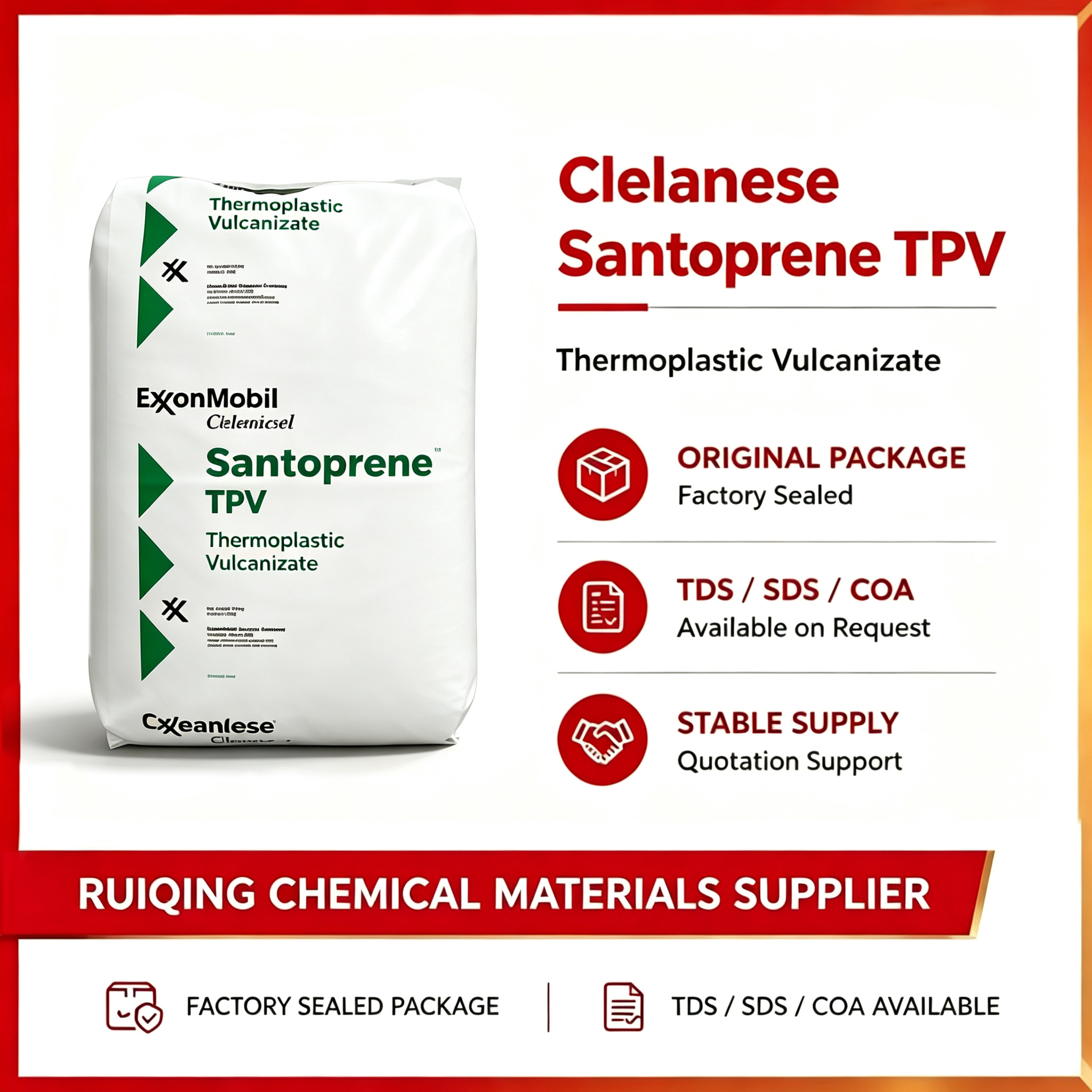
Santoprene 251-80W232 is a soft, natural and colorable flame-retardant thermoplastic vulcanizate from Celanese developed for applications requiring elastomeric flexibility together with UL 94 vertical flame resistance.
The grade belongs to the Santoprene flame-retardant TPV family and is particularly relevant to electrical, wire-and-cable, appliance, telecom and technical applications.
Celanese’s Product Finder lists the material at approximately 86 Shore A hardness, with around 550% elongation at break, 9.0 MPa tensile stress at break and approximately 3.9 MPa tensile stress at 100% elongation.
This gives Santoprene 251-80W232 a useful combination of firmness, elasticity and mechanical strength.
The grade is formulated with non-ether brominated flame retardants and is specifically described as not containing metal deactivators.
Santoprene 251-80W232 provides UL 94 V-0 flame performance, which is one of the most important reasons to select this grade for electrical and technical components. Published grade information lists V-0 performance at both 1.5 mm and 3.0 mm.
The grade is also recommended for applications requiring:
- Excellent flex-fatigue resistance
- Excellent ozone resistance
- Good fluid resistance
- Flame-retardant performance
Santoprene 251-80W232 is shear dependent and can be processed using conventional thermoplastic equipment.
Current Celanese processing data lists:
- Injection molding
- Multi-injection molding
- Extrusion
- Sheet extrusion
- Coextrusion
- Blow molding
- Thermoforming
For more TPV products, visit our TPV Thermoplastic Vulcanizates Product Category →.
For the current Celanese TPV portfolio, see the Official Celanese Santoprene & Geolast Product Finder →.
Key Features of Santoprene 251-80W232
| Feature | Engineering Benefit |
|---|---|
| 86 Shore A Hardness | Provides a firm but flexible elastomeric response |
| UL 94 V-0 | Supports applications requiring vertical-flame resistance |
| 550% Elongation at Break | Maintains high deformation capability |
| 9.0 MPa Tensile Stress at Break | Provides useful mechanical strength |
| 3.9 MPa Stress at 100% Elongation | Provides firmer mechanical support |
| Good Fluid Resistance | Useful in automotive, electrical and industrial environments |
| Excellent Flex-Fatigue Resistance | Supports parts exposed to repeated bending and movement |
| Excellent Ozone Resistance | Supports long-term outdoor and environmental durability |
| Natural / Colorable | Allows customized product colors |
| Electrical UL Recognition | Includes applicable UL plastics and wire/cable listings |
| Injection Moldable | Suitable for complex molded components |
| Extrudable / Coextrudable | Suitable for wire, cable, sheet and profile applications |
| Blow Moldable | Supports selected hollow parts |
| Thermoformable | Broadens manufacturing options |
| Shear-Dependent Flow | Allows processing flow to improve with increasing shear |
The strongest reason to select Santoprene 251-80W232 is its combination of 86A elastomeric properties and UL 94 V-0 flame resistance.
Typical Applications for Santoprene 251-80W232
Santoprene 251-80W232 is particularly useful in electrical and technical applications requiring flexibility and flame resistance.
| Application Area | Typical Use |
|---|---|
| Wire & Cable | Flexible insulation, jacketing and protective components |
| Cable Boots | Flame-retardant flexible cable protection |
| Strain Reliefs | Flexible molded electrical components |
| Electrical Connectors | Elastomeric connector housings and seals |
| Grommets | Cable and mechanical protection |
| Flexible Housings | Electrical and electronic protection |
| Telecommunications Equipment | Flexible components requiring flame resistance |
| Data & Communication Cable | Protective flexible parts |
| Appliance Wiring | Flexible flame-retardant components |
| Automotive Electrical Parts | Electrical-system boots, covers and interfaces |
| Industrial Electrical Equipment | Tough elastomeric protection |
| Submersible Pump Cable Components | Flexible water-resistant cable components |
| Fiber-Optic Cable Parts | Flexible protective components |
| Heat-Tracer Cable Components | Flame-resistant flexible protection |
Celanese specifically lists Santoprene TPV flame-retardant grades, including 251-80W232, for a broad range of wire-and-cable applications such as low-voltage power cable, robotic wire, communications cable, instrumentation wire, fiber optics, flexible cords and appliance wires.
Typical Properties of Santoprene 251-80W232
Physical & Rheological Properties
| Property | Typical Value | Test Method |
|---|---|---|
| Density | 1310 kg/m³ / 1.310 g/cm³ | ISO 1183 |
| Shore A Hardness, 15 s | 86 | ISO 48-4 / ISO 868 |
| Resin Identification | TPV | ISO 1043 |
| Part Marking Code | >TPV< | ISO 11469 |
| Product Form | Pellets | Manufacturer information |
| Appearance | Natural / Colorable | Manufacturer information |
The latest Celanese Materials Database revision dated 2025-04-21 lists approximately 1.310 g/cm³ density.
Mechanical Properties
| Property | Typical Value | Test Method |
|---|---|---|
| Tensile Stress at 100% Elongation | 3.9 MPa | ISO 527-1/-2 or ISO 37 |
| Tensile Stress at Break | 9.0 MPa | ISO 527-1/-2 or ISO 37 |
| Elongation at Break | 550% | ISO 527-1/-2 or ISO 37 |
| Shore A Hardness | 86 | ISO 48-4 / ISO 868 |
| Compression Set, 23°C | 31% | ISO 815 |
| Compression Set, 70°C / 24 h | 40% | ISO 815 |
| Low-Temperature Brittleness | Approx. -57°C | Published Celanese electrical grade data |
The combination of 86 Shore A hardness and 550% elongation provides a strong balance between firmness and elastomeric flexibility.
Thermal Properties
| Property | Typical Value | Test Method |
|---|---|---|
| RTI Electrical, 1.5 mm | 90°C | UL 746B |
| RTI Strength, 1.5 mm | 85°C | UL 746B |
| RTI Strength, 3.0 mm | 90°C | UL 746B |
These UL Relative Thermal Index values provide useful design information for electrical and wire-and-cable applications.
Flame Retardant Performance
The most important technical differentiator of Santoprene 251-80W232 is its flame-retardant performance.
UL 94 & Flammability
| Property | Typical Value | Test Method |
|---|---|---|
| UL 94 @ 1.5 mm | V-0 | UL 94 |
| UL 94 @ 3.0 mm | V-0 | UL 94 |
| UL Recognition | Yes | UL 94 |
| Limiting Oxygen Index | 27% | ISO 4589-2 / ASTM D2863 |
| Hot Wire Ignition, 1.5 mm | PLC 3 | UL 746A |
Published Santoprene 251-80W232 grade data confirms V-0 at both 1.5 mm and 3.0 mm and an oxygen index around 27%.
This thickness-specific information is important because UL 94 performance depends on actual wall thickness and component design.
Electrical Properties
| Property | Typical Value | Test Method |
|---|---|---|
| Electric Strength, 2 mm | 28 kV/mm | ASTM D149 |
| Comparative Tracking Index | PLC 0 | UL 746A |
| Arc Resistance Performance Level | PLC 6 | UL 746B |
| High-Amperage Arc Ignition, 1.5 mm | PLC 0 | UL 746A |
| High-Voltage Arc Tracking Rate | PLC 2 | UL 746A |
These electrical characteristics make the grade particularly relevant to insulation, protective components and flexible electrical applications.
UL Wire & Cable Recognition
Santoprene 251-80W232 is listed under multiple UL categories.
Published Celanese grade information identifies:
- QMFZ2.E80017 – Plastics – Component
- QMFZ8.E80017 – Plastics Certified for Canada – Component
- QMTT2.E86313 – Polymeric Materials for Use in Wire, Cable and Flexible Lighting Products – Component
The dedicated Celanese electrical-material guide also identifies Santoprene 251-80W232 as a recommended UL-certified wire-and-cable grade.
This makes the grade especially relevant for customers developing:
- Power cables
- Robotic cables
- Data cables
- Communication cables
- Flexible cords
- Appliance wires
- Instrumentation cables
- Fiber-optic protection
- Submersible pump cable components
Flame-Retardant Formulation
Santoprene 251-80W232 contains non-ether brominated flame retardants.
Celanese also states that the grade does not contain metal deactivators.
This distinction is important.
The W232 suffix in this family should be associated primarily with the flame-retardant formulation.
It should not be confused with the W236 potable-water grades, where the key differentiator is protection against copper and other metal-catalyzed degradation.
For Santoprene 251-80W232, the main material-selection drivers are therefore:
- UL 94 V-0 flame resistance
- Electrical performance
- Wire-and-cable suitability
- Flex-fatigue resistance
- Ozone resistance
Flex-Fatigue & Ozone Resistance
Celanese specifically recommends Santoprene 251-80W232 for applications requiring excellent flex-fatigue resistance and excellent ozone resistance.
These properties are useful for electrical components that repeatedly experience:
- Bending
- Twisting
- Cable movement
- Vibration
- Compression
- Mechanical cycling
For cable boots, strain reliefs, grommets and flexible electrical housings, repeated-flex durability is particularly important.
Excellent ozone resistance also helps support long-term service in outdoor and industrial environments.
Why Choose Santoprene 251-80W232?
The main reason to choose Santoprene 251-80W232 is its combination of high elastomeric flexibility and flame resistance.
At approximately 86 Shore A, the grade is firm enough to provide dimensional support for cable, electrical and technical components.
Its approximately 550% elongation at break allows extensive elastic deformation.
The typical 9.0 MPa tensile stress at break provides useful mechanical strength.
Its UL 94 V-0 rating at 1.5 mm and 3.0 mm makes it particularly relevant where vertical-flame resistance is required.
The grade’s electrical characteristics and dedicated QMTT2 wire-and-cable recognition further strengthen its position for cable and electrical applications.
Excellent flex-fatigue and ozone resistance support components exposed to repeated movement or environmental aging.
For customers requiring a natural/colorable 86A flame-retardant TPV with UL 94 V-0 performance for wire, cable or electrical applications, Santoprene 251-80W232 is an important grade to evaluate.
Processing Guidelines for Santoprene 251-80W232
Current Celanese Materials Database information lists:
- Injection molding
- Multi-injection molding
- Extrusion
- Sheet extrusion
- Coextrusion
- Blow molding
- Thermoforming
Current Grade-Specific Injection Conditions
The current database revision dated 2025-04-21 gives:
| Processing Parameter | Celanese Guidance |
|---|---|
| Drying Recommended | Yes |
| Drying Temperature | 80°C |
| Drying Time | ≥3 hours in a dehumidified dryer |
| Processing Moisture Content | ≤0.08% |
| Maximum Regrind Level | 20% |
| Optimum Melt Temperature | 200°C |
| Minimum Melt Temperature | 190°C |
| Maximum Melt Temperature | 210°C |
| Optimum Mold Temperature | 30°C |
| Minimum Mold Temperature | 10°C |
| Maximum Mold Temperature | 50°C |
For a newly published page, I recommend using these newer grade-specific values rather than older processing sheets.
Injection Molding Notes
Celanese recommends holding pressure at approximately 50–75% of actual injection pressure.
A relatively high screw speed of approximately 100–200 rpm is recommended.
Back pressure is not always necessary, but approximately 0.3–0.7 MPa can be used to improve melt homogeneity and maintain consistent shot size.
Higher back pressure may be useful when using masterbatch.
Processors should optimize:
- Injection speed
- Screw speed
- Holding pressure
- Back pressure
- Gate dimensions
- Runner design
- Melt temperature
- Mold temperature
- Venting
- Cooling time
- Part thickness
- Surface appearance
Extrusion Conditions
| Processing Parameter | Published Guidance |
|---|---|
| Drying Temperature | 82°C |
| Drying Time | 3 hours |
For extrusion and coextrusion, processors should optimize:
- Barrel-zone temperature
- Adapter temperature
- Die temperature
- Screw speed
- Melt pressure
- Draw-down
- Cooling
- Profile dimensions
- Surface finish
Shear-Dependent Flow
Santoprene 251-80W232 is shear dependent.
It has relatively high melt viscosity at low shear rates, while viscosity decreases as shear rate increases.
Current processing information also notes a broad Santoprene TPV processing window of approximately 175–230°C, although the latest grade-specific injection recommendation for 251-80W232 is narrower at 190–210°C.
Material Compatibility
Santoprene TPV is incompatible with acetal (POM) and PVC.
Equipment should therefore be thoroughly purged when changing between these materials and Santoprene 251-80W232.
Related Products
We supply Santoprene TPV grades for different flame-retardancy, hardness, wire-and-cable, electrical and processing requirements.
Typical Santoprene product families include:
- Santoprene 251 Series
- Santoprene flame-retardant TPV grades
- Santoprene wire-and-cable grades
- Santoprene electrical grades
- Santoprene telecom grades
- Santoprene flexible insulation grades
- Santoprene general-purpose grades
- Santoprene specialty TPV grades
View More TPV Thermoplastic Vulcanizates →
If you need grade-selection support, send us your required UL flame rating, wall thickness, Shore hardness, electrical requirement and processing method.
Technical Documents for Santoprene 251-80W232
| Document Type | Description |
|---|---|
| TDS | Current physical, mechanical, flame-retardant, electrical and processing data |
| SDS | Safety Data Sheet |
| UL 94 Information | V-0 at 1.5 mm and 3.0 mm |
| UL Wire & Cable Information | QMTT2.E86313 recognition |
| UL Plastics Information | QMFZ2.E80017 / QMFZ8.E80017 |
| Electrical Data | Dielectric strength, CTI and arc-resistance information |
| Processing Guide | Injection molding, extrusion and coextrusion guidance |
| Santoprene Product Finder | Celanese grade portfolio and positioning |
| COA | Batch-specific quality information where available |
Need technical documents for Santoprene 251-80W232?
📧 Email: ruiqingchem@gmail.com
📝 Online form: Contact Us →
Please state Santoprene 251-80W232 and whether you require TDS, SDS, UL 94, wire-and-cable certification or other technical information.
FAQ About Santoprene 251-80W232
Q1: What is Santoprene 251-80W232?
Santoprene 251-80W232 is a natural, colorable flame-retardant thermoplastic vulcanizate from Celanese designed for applications requiring elastomeric flexibility and UL 94 vertical-flame resistance.
Q2: What is the hardness of Santoprene 251-80W232?
The typical hardness is approximately 86 Shore A.
Q3: Is Santoprene 251-80W232 UL 94 V-0?
Yes. Published grade data lists UL 94 V-0 at 1.5 mm and 3.0 mm.
Q4: What is the elongation at break?
The typical elongation at break is approximately 550%.
Q5: What is the tensile stress at break?
The typical value is approximately 9.0 MPa.
Q6: What is the tensile stress at 100% elongation?
The typical value is approximately 3.9 MPa.
Q7: What is the density?
The latest Celanese Materials Database revision lists approximately 1.310 g/cm³.
Q8: What is the compression set?
Published grade data lists approximately 31% at 23°C and 40% at 70°C / 24 h.
Q9: What flame-retardant system does it use?
Celanese describes the grade as containing non-ether brominated flame retardants.
Q10: Does Santoprene 251-80W232 contain metal deactivators?
No. Current grade information states that it does not contain metal deactivators.
Q11: Is Santoprene 251-80W232 suitable for wire and cable?
Yes. The grade is listed under UL QMTT2 E86313 and appears in Celanese’s recommended wire-and-cable application portfolio.
Q12: What is its low-temperature performance?
Celanese’s electrical-material guide lists approximately -57°C low-temperature brittleness.
Q13: Can Santoprene 251-80W232 be injection molded?
Yes. Injection molding and multi-injection molding are listed processing methods.
Q14: Can Santoprene 251-80W232 be extruded?
Yes. Extrusion, sheet extrusion and coextrusion are currently listed processing methods.
Q15: What injection melt temperature is recommended?
The latest Celanese database gives approximately 200°C optimum, with a grade-specific range of approximately 190–210°C.
Q16: What mold temperature is recommended?
Current grade-specific data lists approximately 30°C optimum, with a range of approximately 10–50°C.
Request Santoprene 251-80W232 Price & Technical Support
For pricing, availability, technical documents or application support for Santoprene 251-80W232, please provide:
- Required quantity
- Destination country or port
- Wire, cable, electrical, telecom, appliance or automotive application
- Required UL flame rating
- Minimum wall thickness
- Required Shore hardness
- Required color
- Electrical / dielectric requirement
- Low-temperature requirement
- Continuous and peak operating temperature
- Fluid or chemical exposure
- Injection-molding, extrusion or coextrusion process
- UL wire-and-cable documentation requirement
- TDS, SDS or COA requirement
- Sample requirement, if applicable
📧 Email: ruiqingchem@gmail.com