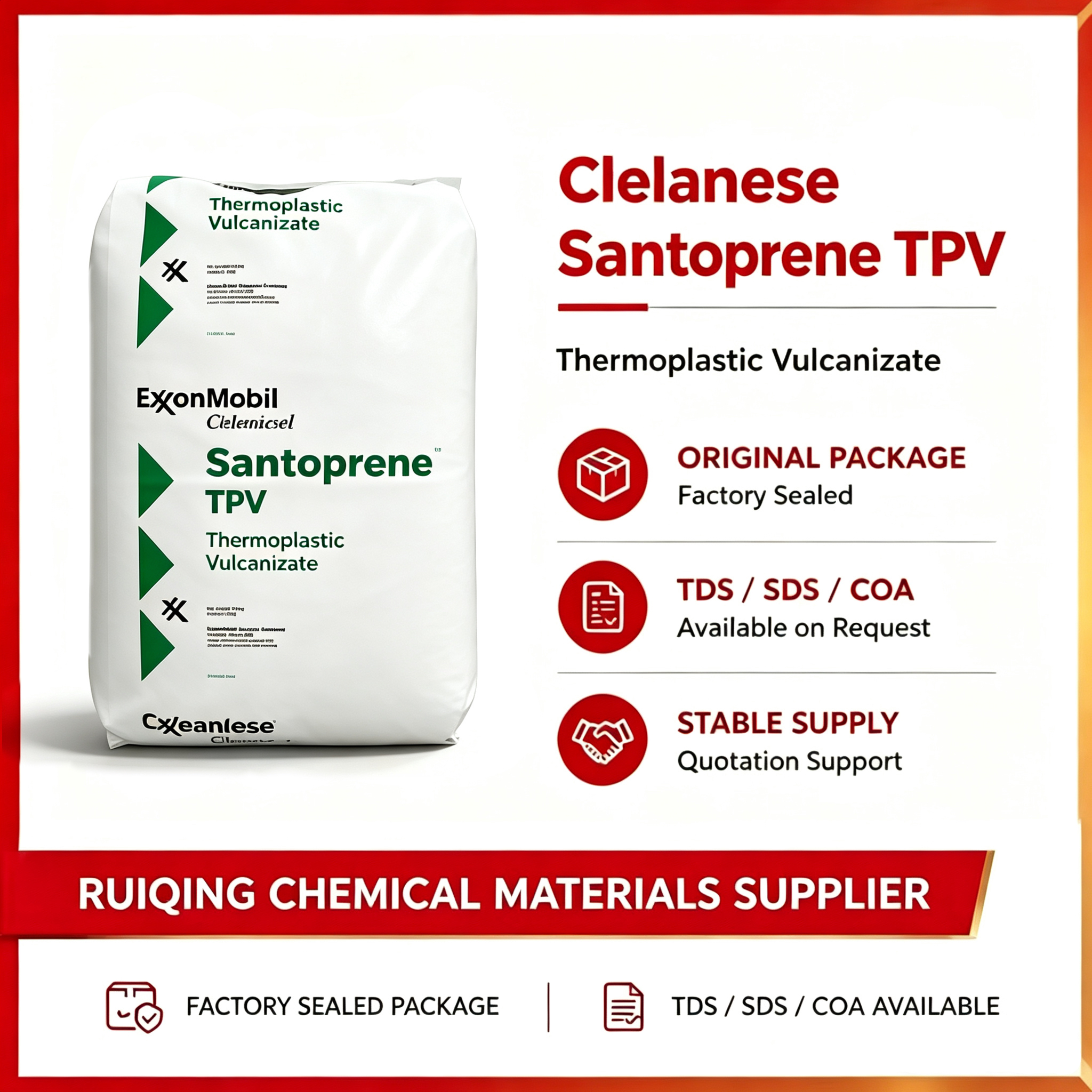
描述
Santoprene 191-85 PA is a hard, black thermoplastic vulcanizate (TPV) from Celanese specially formulated to bond to polyamide 6 (PA6) and polyamide 66 (PA66) compounds through a 2K injection molding process.
This makes the grade fundamentally different from a general-purpose Santoprene TPV. Its main technical purpose is to provide a rubber-like layer that can be directly overmolded onto compatible PA6 or PA66 substrates in a two-component molding process.
Celanese specifically states that Santoprene 191-85 PA adheres to polyamide 6 and 6.6 compounds while retaining the excellent fatigue performance associated with Santoprene TPV.
The manufacturer also highlights UV resistance, making the grade suitable for outdoor applications. The current grade sheet states that it passed typical f1 weathering requirements.
The Shore A hardness is approximately 84, so Santoprene 191-85 PA is considerably firmer than soft 50A-70A TPV grades. This higher hardness is useful where the overmolded elastomer must provide grip, sealing, vibration control or impact protection while still maintaining shape and support.
Current Celanese data lists approximately 400% elongation at break, 6.9 MPa stress at break and 4.2 MPa tensile stress at 100% elongation.
The grade also provides documented compression-set data at room and elevated temperatures.
For processing, the current Celanese datasheet focuses specifically on 2K overmolding onto PA6 and PA66. Celanese recommends a mold temperature around 40-45°C, fast injection, high screw speed and sufficiently high TPV melt temperature to promote bonding.
Adhesion is especially dependent on melt temperature:
- Approx. 280°C for adhesion to PA66 compounds
- Approx. 270-280°C for adhesion to PA6 compounds
This elevated melt-temperature requirement is a key distinction from many conventional Santoprene grades and reflects the role of Santoprene 191-85 PA as an adhesion-modified TPV for engineering-plastic overmolding.
Celanese explicitly states that Santoprene 191-85 PA is not recommended for the cold insert process. The material is intended for hot 2K injection overmolding rather than molding onto a fully cold polyamide insert.
The current Celanese sheet for this grade is marked PRELIMINARY and was revised on 2024-05-23.
For more TPV products, visit our TPV Thermoplastic Vulcanizates Product Category →.
For Celanese Santoprene materials, visit the Official Celanese Santoprene TPV Product Page →.
Key Features of Santoprene 191-85 PA
| Feature | Engineering Benefit |
|---|---|
| Adhesion to PA6 | Supports direct 2K overmolding onto compatible polyamide 6 compounds |
| Adhesion to PA66 | Supports direct 2K overmolding onto compatible polyamide 66 compounds |
| Shore A 84 | Firmer elastomeric response for structural soft-touch components |
| 400% Elongation at Break | Maintains substantial flexibility despite higher hardness |
| 6.9 MPa Stress at Break | Useful strength for overmolded technical components |
| Excellent Fatigue Performance | Supports repeated flexing and cyclic loading |
| UV Resistance | Suitable for outdoor applications |
| Typical f1 Weathering Performance | Supports weather-exposed use |
| 2K Injection Molding | Designed for two-component polyamide overmolding |
| Shear-Dependent Flow | Flow improves with increased shear rate |
| Polyolefin-Based TPV | Retains thermoplastic processability |
| Manufacturing-Stream Recyclability | Controlled production scrap can be recyclable within the manufacturing stream |
The defining feature of Santoprene 191-85 PA is its direct adhesion to PA6 and PA66 compounds in 2K molding.
Typical Applications for Santoprene 191-85 PA
Santoprene 191-85 PA is particularly suitable for parts that combine a rigid or semi-rigid polyamide substrate with an elastomeric TPV surface.
| Application Area | Typical Use |
|---|---|
| PA6 Overmolded Components | Soft-touch or sealing layer directly bonded to PA6 |
| PA66 Overmolded Components | TPV overmolding on PA66 engineering parts |
| Automotive Handles & Grips | Elastomeric grip surfaces on polyamide structures |
| Outdoor Components | UV-exposed overmolded parts |
| Integrated Seals | Directly molded sealing lips and flexible edges on PA parts |
| Protective Covers | Impact- and vibration-damping outer layers |
| Tool & Equipment Grips | Ergonomic TPV overmolding on rigid polyamide |
| Electrical & Technical Housings | Flexible edges, seals and soft-touch zones |
| Automotive Interior / Exterior Parts | 2K molded polyamide/TPV assemblies |
| Industrial Components | Multi-material parts requiring fatigue resistance |
The grade is especially useful where manufacturers want to reduce adhesives or secondary assembly by creating the polyamide/TPV bond directly during molding.
Typical Properties of Santoprene 191-85 PA
Product Identification
| Property | Typical Value | Test Method |
|---|---|---|
| Resin Identification | TPV | ISO 1043 |
| Part Marking Code | >TPV< | ISO 11469 |
| Color | Black | Manufacturer information |
| Grade Status | Preliminary | Celanese Materials Database |
| Primary Process | 2K Injection Molding | Manufacturer information |
Mechanical Properties
| Property | Typical Value | Test Method |
|---|---|---|
| Tensile Stress at 100% Elongation, Perpendicular | 4.2 MPa | ISO 37 |
| Stress at Break, Perpendicular | 6.9 MPa | ISO 527-1/-2 or ISO 37 |
| Elongation at Break, Perpendicular | 400% | ISO 527-1/-2 or ISO 37 |
| Shore A Hardness, 15 s | 84 | ISO 48-4 / ISO 868 |
| Compression Set, 23°C / 24 h | 34% | ISO 815 |
| Compression Set, 70°C / 24 h | 64% | ISO 815 |
| Compression Set, 125°C / 70 h | 62% | ISO 815 |
The first two compression-set values use a Type B test piece at 15% compression according to the current Celanese sheet.
The combination of Shore A 84 hardness and 400% elongation gives Santoprene 191-85 PA a useful balance of firmness and elastomeric deformation.
Adhesion Performance
Celanese does not publish a single numerical peel-strength value in the current preliminary grade sheet. Instead, the manufacturer identifies the grade as being specially formulated to bond to PA6 and PA66 compounds through 2K injection molding.
Adhesion depends strongly on the polyamide formulation, surface condition, melt temperature, substrate temperature, injection speed, gate design, interface pressure and moisture control.
For production qualification, adhesion should therefore be checked with the exact PA6 or PA66 compound used in the final part.
Why Choose Santoprene 191-85 PA?
The strongest reason to choose Santoprene 191-85 PA is its ability to combine TPV elastomeric behavior with direct bonding to engineering polyamides.
PA6 and PA66 are widely used in automotive, industrial, electrical and mechanical components because of their strength, temperature resistance and dimensional performance. Many designs, however, also require a flexible sealing lip, grip surface, damping zone or protective layer.
A general-purpose TPV may not adhere adequately to PA6 or PA66 without primers, adhesives or mechanical locking features.
Santoprene 191-85 PA is formulated specifically to address this challenge in a 2K molding process.
The grade can be injected directly onto the polyamide component, allowing the rigid substrate and elastomeric function to be integrated into one molded assembly.
This can support:
- Fewer assembly steps
- Reduced adhesive use
- Lower part count
- Integrated sealing functions
- Greater design freedom
- Better tactile surfaces
- Faster high-volume production
The Shore A 84 hardness also makes Santoprene 191-85 PA useful where the elastomeric section needs to remain relatively firm rather than very soft.
Its 400% elongation provides substantial deformability, while the 6.9 MPa stress-at-break value supports mechanically demanding overmolded parts.
UV resistance and typical f1 weathering performance further extend the grade into outdoor and vehicle-exterior applications.
Processing Guidelines for Santoprene 191-85 PA
Santoprene 191-85 PA is designed primarily for 2K injection molding onto PA6 and PA66 compounds.
Pre-Drying
| Processing Parameter | Celanese Guidance |
|---|---|
| Drying Temperature | 80°C |
| Drying Time | 4 hours |
| Dryer Type | Dehumidified dryer |
Celanese states that unopened bags should be dried at 80°C for 4 hours before processing.
Injection Molding Conditions
| Processing Parameter | Celanese Guidance |
|---|---|
| Recommended Mold Temperature | 40-45°C |
| Datasheet Mold Temperature | 40°C |
| Hold Pressure Range | 10-20 MPa |
| Back Pressure | 0.525 MPa |
| Screw Speed | 100-200 rpm |
| Cushion | 3-6 mm |
| Barrel Utilization per Shot | 40-80% |
| Typical Filling Time | 0.5-2 seconds |
Celanese recommends a fast injection time to promote adhesion.
The manufacturer states that typical cavity filling should occur in approximately 0.5-2 seconds, depending on part volume, runner/gate design, cavity location and injection pressure.
A small cushion of approximately 3-6 mm is recommended for effective cavity packing.
Screw Design
For 2K overmolding, Celanese recommends a general-purpose polyolefinic screw with approximately:
- Compression ratio: 2:1 to 2.5:1
- L/D ratio: 16:1 to 22:1
A screw speed of approximately 100-200 rpm is recommended.
PA6 & PA66 Adhesion Temperature
Adhesion is strongly driven by TPV melt temperature.
| Polyamide Substrate | Recommended TPV Melt Temperature |
|---|---|
| PA6 compounds | 270-280°C |
| PA66 compounds | Approx. 280°C |
This is one of the most important processing points for Santoprene 191-85 PA.
Using insufficient melt temperature can reduce interfacial bonding, while excessive residence time at elevated temperature should also be avoided.
Cold Insert Process
Santoprene 191-85 PA is not recommended for cold insert molding.
The grade is intended for 2K injection molding, where the process conditions maintain the interface temperature needed to develop adhesion to the polyamide substrate.
2K Overmolding Design Considerations
Successful PA/TPV bonding depends on both material selection and part design.
For Santoprene 191-85 PA, useful design and processing points include:
- Keep the PA bonding surface clean
- Avoid release-agent contamination
- Minimize moisture
- Use sufficient TPV melt temperature
- Use fast filling to retain interfacial heat
- Position gates to promote flow across the bond area
- Avoid unnecessary weld lines in critical bonding zones
- Provide adequate interface area
- Control polyamide cooling before TPV injection
- Validate adhesion with the exact production PA formulation
Glass fiber, mineral filler, impact modifiers, lubricants, flame retardants and other additives in PA6/PA66 can influence adhesion.
Technical Documents for Santoprene 191-85 PA
| Document Type | Description |
|---|---|
| TDS | Current Celanese preliminary technical data for mechanical properties and 2K processing |
| SDS | Safety Data Sheet |
| Processing Guide | Santoprene injection-molding guidance |
| 2K Overmolding Guidance | PA6 / PA66 adhesion and processing recommendations |
| COA | Batch-specific quality information where available |
The current Celanese grade sheet for Santoprene 191-85 PA is marked PRELIMINARY, revised 2024-05-23.
Need technical documents?
📧 Email: ruiqingchem@gmail.com
📝 Online form: Contact Us →
Please state Santoprene 191-85 PA and the required document type when submitting your inquiry.
FAQ About Santoprene 191-85 PA
Q1: What is Santoprene 191-85 PA?
Santoprene 191-85 PA is a hard black TPV from Celanese specially formulated for adhesion to PA6 and PA66 compounds in 2K injection molding.
Q2: What is the Shore hardness?
The current Celanese preliminary datasheet lists approximately Shore A 84.
Q3: Can Santoprene 191-85 PA bond directly to PA6?
Yes. The grade is specifically formulated to adhere to compatible PA6 compounds during 2K injection molding.
Q4: Can it bond to PA66?
Yes. Celanese also specifies adhesion to compatible PA66 compounds.
Q5: What melt temperature is recommended for PA6 adhesion?
Celanese recommends approximately 270-280°C for adhesion to PA6 compounds.
Q6: What temperature is recommended for PA66 adhesion?
For PA66 compounds, Celanese recommends approximately 280°C.
Q7: Can Santoprene 191-85 PA be used for cold insert molding?
No. Celanese specifically states that the grade is not recommended for the cold insert process.
Q8: What is the elongation at break?
Current Celanese data lists approximately 400% elongation at break.
Q9: Does Santoprene 191-85 PA need drying?
Yes. Celanese recommends drying at 80°C for 4 hours in a dehumidified dryer.
Q10: Is Santoprene 191-85 PA suitable for outdoor applications?
Yes. Celanese highlights UV resistance and states that the grade passed typical f1 weathering requirements.
Request Santoprene 191-85 PA Price & Technical Support
For pricing, availability, technical documents or application support for Santoprene 191-85 PA, please provide:
- Required quantity
- Destination country or port
- PA6 or PA66 substrate grade
- Filled or unfilled polyamide
- Glass-fiber content, if applicable
- 2K injection-molding machine configuration
- Required adhesion level
- Outdoor / UV exposure
- Part geometry and interface area
- Processing temperature
- TDS or SDS requirement
- Sample requirement, if applicable
📧 Email: ruiqingchem@gmail.com
📝 Send Inquiry →