描述
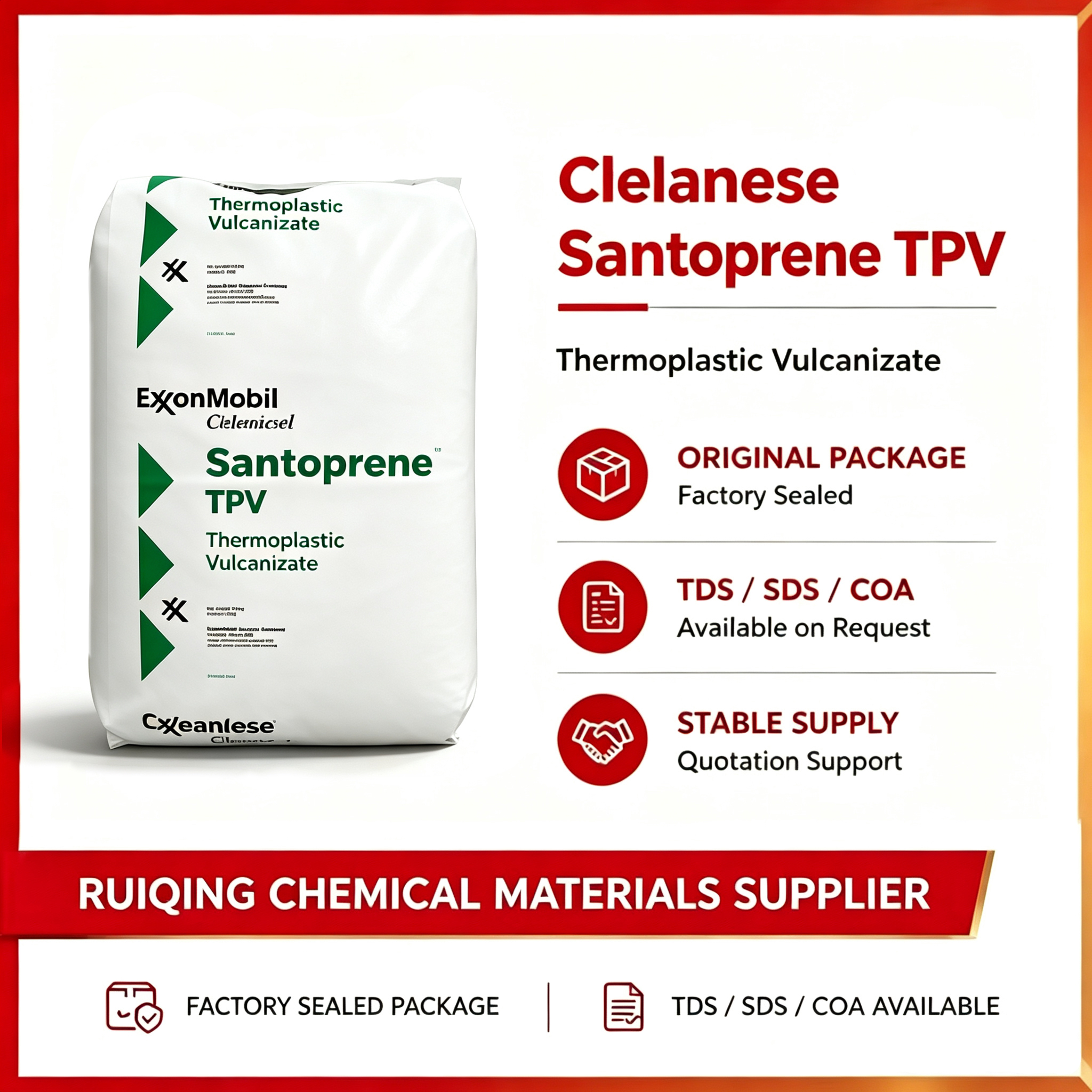
Santoprene 121-80W175 is a black, UV-resistant thermoplastic vulcanizate (TPV) from Celanese developed specifically for thin-wall and complex profile extrusion applications.
The grade combines the rubber-like flexibility and recovery of a vulcanized elastomer with the processing advantages of a thermoplastic. It is polyolefin based and can be processed on conventional thermoplastics equipment.
The strongest positioning of Santoprene 121-80W175 is not simply its hardness. Celanese designed this grade to provide excellent definition in thin-wall profile sections while supporting long extrusion runs with reduced material build-up on screen packs and narrow die sections.
Current Celanese grade information states that the material can produce thin-wall features down to approximately 0.33 mm (0.013 in) radius. This makes it particularly useful for automotive weatherseals, glazing profiles, exterior trim seals and other profiles where small lips, narrow channels or detailed section geometry must remain well defined during continuous extrusion.
The grade also offers improved UV resistance, making it more suitable than a standard non-UV-stabilized TPV for exterior and weather-exposed applications.
Celanese additionally highlights excellent flex-fatigue resistance and excellent ozone resistance. These properties are important for dynamic sealing components that undergo repeated bending, compression and environmental exposure over long service periods.
The current Shore A hardness is approximately 85, positioning Santoprene 121-80W175 as a relatively firm elastomer within the Santoprene TPV range.
Despite this higher hardness, the grade maintains approximately 470% elongation at break, demonstrating substantial flexibility and extensibility.
Current Celanese data also lists approximately 9.13 MPa tensile stress at break, 4.43 MPa tensile stress at 100% elongation, and approximately 31 kN/m initial tear resistance.
This balance of hardness, elongation, tensile strength and tear resistance is well suited to profile sections that need both dimensional support and elastomeric deformation.
The material density is approximately 0.955 g/cm³ in the current 2025 Celanese Materials Database sheet.
Because the material is polyolefin based, this relatively low density can support lightweight component design compared with many denser rubber compounds.
Santoprene 121-80W175 is primarily an extrusion-focused grade. Celanese lists extrusion, sheet extrusion, coextrusion and thermoforming as processing methods, and the product description also identifies vacuum forming as a suitable process.
The grade is shear dependent. As shear rate increases, the apparent melt viscosity decreases, so screw speed, die geometry and processing shear are important variables during extrusion.
Celanese recommends desiccant drying and provides a broad Santoprene TPV processing window of approximately 175–230°C.
For more TPV products, visit our TPV Thermoplastic Vulcanizates Product Category →.
For the manufacturer’s current portfolio, see the Official Celanese Santoprene & Geolast Product Finder →.
Key Features of Santoprene 121-80W175
| Feature | Engineering Benefit |
|---|---|
| Shore A 85 | Firm elastomeric response for profile and sealing applications |
| UV Stabilized | Improved durability in exterior and weather-exposed applications |
| Excellent Flex-Fatigue Resistance | Supports repeated bending and cyclic deformation |
| Excellent Ozone Resistance | Helps resist cracking during outdoor and automotive service |
| Thin-Wall Extrusion Capability | Designed for detailed, narrow and complex profile sections |
| 0.33 mm Profile Definition | Supports very small radii and fine profile geometry |
| Reduced Die Build-Up | Helps maximize continuous extrusion run length |
| 470% Elongation at Break | High deformability despite relatively high hardness |
| 9.13 MPa Stress at Break | Strong mechanical performance for extruded TPV |
| 31 kN/m Tear Resistance | Helps protect thin lips and profile edges from tearing |
| Good Chemical Resistance | Supports automotive and industrial sealing environments |
| Coextrusion Capability | Suitable for multi-material sealing profile designs |
| Polyolefin Based | Low density and conventional thermoplastic processing |
| Manufacturing-Stream Recyclability | Controlled process scrap can be recyclable within production |
The most important value of Santoprene 121-80W175 is the combination of UV resistance, extrusion stability and fine profile definition.
Typical Applications for Santoprene 121-80W175
Santoprene 121-80W175 is particularly suited to automotive and industrial profile extrusion.
| Application Area | Typical Use |
|---|---|
| Automotive Weatherseals | Exterior seals exposed to UV, ozone and repeated flexing |
| Glass Run Channels | Detailed sealing profiles around automotive glass systems |
| Window & Door Profiles | Flexible profile sections requiring weather resistance |
| Automotive Exterior Trim Seals | UV-resistant elastomeric sealing and trim components |
| Seals & Gaskets | Profile-extruded sealing sections |
| Thin-Wall Profiles | Detailed sections with narrow lips and small radii |
| Complex Extrusions | Multi-channel or geometrically detailed profiles |
| Coextruded Profiles | Soft TPV layer combined with compatible rigid substrates |
| Sheet Applications | Extruded TPV sheet for formed parts |
| Thermoformed Components | Shaped elastomeric sheets and technical parts |
| Vacuum-Formed Components | Formed TPV parts requiring flexibility and UV resistance |
| Outdoor Industrial Profiles | Weather-exposed seals and protective sections |
The grade is especially attractive for continuous extrusion lines where profile quality and long run length are more important than very high melt flow.
Typical Properties of Santoprene 121-80W175
Physical Properties
| Property | Typical Value | Test Method |
|---|---|---|
| Density | 955 kg/m³ / 0.955 g/cm³ | ISO 1183 |
| Shore A Hardness, 15 s | 85 | ISO 48-4 / ISO 868 |
| Resin Identification | TPV | ISO 1043 |
| Part Marking Code | >TPV< | ISO 11469 |
| Color | Black | Manufacturer information |
| Product Form | Pellets | Manufacturer information |
| Special Characteristic | UV stabilized / weather resistant | Manufacturer information |
The current 2025 Celanese sheet lists a density of approximately 0.955 g/cm³. Older sheets may show slightly different values, so the current grade data should be used for new technical documentation.
Mechanical Properties
| Property | Typical Value | Test Method |
|---|---|---|
| Tensile Stress at 100% Elongation, Perpendicular | 4.43 MPa | ISO 37 |
| Tensile Stress at Break, Perpendicular | 9.13 MPa | ISO 527-1/-2 or ISO 37 |
| Elongation at Break, Perpendicular | 470% | ISO 527-1/-2 or ISO 37 |
| Shore A Hardness | 85 | ISO 48-4 / ISO 868 |
| Compression Set, 70°C / 24 h | 39% | ISO 815 |
| Compression Set, 125°C / 70 h | 55% | ISO 815 |
| Initial Tear Resistance, Die C | 31 kN/m | ISO 34-1 |
The combination of approximately 470% elongation and 31 kN/m tear resistance is useful for extruded lips, corners and narrow profile sections that must flex without tearing.
Heat Aging Properties
| Property | Typical Change | Test Condition |
|---|---|---|
| Tensile Strength Change | -15% | 150°C / 168 h, ISO 188 |
| Tensile Strain-at-Break Change | -13% | 150°C / 168 h, ISO 188 |
| Shore A Hardness Change | 0 | 150°C / 168 h, ISO 188 |
These heat-aging data provide additional context for automotive and industrial profile applications exposed to elevated temperatures.
Flammability Properties
| Property | Typical Value | Test Method |
|---|---|---|
| FMVSS Classification | Class B | ISO 3795 / FMVSS 302 |
| Burning Rate @ 2 mm | 27.5 mm/min | ISO 3795 / FMVSS 302 |
This grade is not positioned as a flame-retardant TPV. Its main strengths are UV resistance, profile extrusion performance, ozone resistance and mechanical durability.
Thin-Wall Extrusion Performance of Santoprene 121-80W175
The distinguishing feature of Santoprene 121-80W175 is its extrusion behavior.
Celanese designed the material for thin-wall and complex profiles where conventional TPV grades may suffer from poor edge definition, material build-up or reduced line stability.
The manufacturer specifically states that the grade can provide excellent definition down to approximately 0.33 mm radius.
This is important for:
- Thin sealing lips
- Fine weatherseal edges
- Small profile radii
- Narrow channels
- Complex multi-cavity profiles
- Glass-run-channel geometries
- Decorative or functional exterior trim seals
The formulation is also designed to maximize run length with minimal material build-up on screen packs and narrow sections of extrusion dies.
Longer clean production runs can help reduce:
- Die cleaning frequency
- Screen-pack changes
- Line interruptions
- Scrap during restart
- Profile-quality variation
For manufacturers running high-volume automotive extrusion lines, this processing stability can be as important as the mechanical-property table.
Automotive OEM References for Santoprene 121-80W175
Current Celanese Materials Database information lists the following automotive references:
| OEM | Specification / Reference |
|---|---|
| GAC | QJ/GAC 1240.022 |
| General Motors | GMW15812P-TPV(EPDM+PP)-Type 7E |
| IVECO | IVECO 5244 / EMP80 |
| Li Auto | Q/LiA5310057, 2021 (V2) |
| Renault | FRM 18-27-144 / special part approval context |
| SAIC Motor | SMTC 5 320 024 |
| Stellantis | MS-AR-100 DGV |
| Volkswagen Group | VW 50123 |
| Volkswagen Group | VW TL 527 03 |
These references are particularly relevant when evaluating Santoprene 121-80W175 for automotive weatherseals, glazing systems, exterior profiles and other OEM-specific components.
Why Choose Santoprene 121-80W175?
The main reason to choose Santoprene 121-80W175 is that it is not simply a high-hardness black TPV.
It is an extrusion-specialized, UV-resistant TPV designed around profile quality.
A complex automotive weatherseal may contain narrow lips, fine corners and multiple profile sections. During long production runs, material can accumulate on screen packs or narrow die sections and gradually reduce profile quality.
Santoprene 121-80W175 is designed to minimize this problem and support longer extrusion runs.
The Shore A 85 hardness provides sufficient stiffness for profile stability while maintaining elastomeric behavior.
The 470% elongation allows the profile to flex significantly during installation and service.
The 9.13 MPa tensile stress at break and 31 kN/m tear resistance provide additional mechanical durability.
UV stabilization and excellent ozone resistance support automotive exterior use and other outdoor environments.
Flex-fatigue resistance is particularly important for seals that repeatedly bend as doors, windows or movable assemblies open and close.
Chemical resistance broadens the potential service environment.
The polyolefin-based TPV construction also provides thermoplastic processability, allowing extrusion and coextrusion without the separate vulcanization process associated with conventional thermoset EPDM profiles.
For customers requiring a firm black TPV for UV-resistant, thin-wall, complex and long-run profile extrusion, Santoprene 121-80W175 is a highly targeted grade.
Processing Guidelines for Santoprene 121-80W175
The current Celanese grade sheet lists:
- Extrusion
- Sheet extrusion
- Coextrusion
- Thermoforming
The manufacturer description also identifies vacuum forming.
General Processing Conditions
| Processing Parameter | Celanese Guidance |
|---|---|
| Drying Temperature | 80°C |
| Drying Time | 3 hours |
| General Processing Window | 175–230°C |
| Maximum Drawdown | 15% |
| Recommended Screw Speed Reference | 100–200 rpm |
| Optional Back Pressure | 0.3–0.7 MPa |
Celanese recommends desiccant drying for 3 hours at 80°C.
The material has a broad processing window of approximately 175–230°C.
For extrusion, the manufacturer specifically states do not exceed 15% drawdown.
Shear-Dependent Flow Behavior
Santoprene 121-80W175 is shear dependent.
As shear rate increases, apparent melt viscosity decreases. For profile extrusion, this means line performance can be strongly influenced by:
- Screw design
- Screw speed
- Melt temperature
- Screen-pack condition
- Adapter geometry
- Die geometry
- Die temperature
- Extrusion pressure
- Drawdown
- Cooling rate
The objective should be a stable melt and balanced die flow rather than simply increasing temperature to improve flow.
Die and Screen-Pack Considerations
Because the grade is designed to minimize build-up on screen packs and narrow die sections, processors should still maintain clean extrusion equipment, stable melt temperature, consistent feed, correct filtration, proper die balance and controlled drawdown.
Material Compatibility
Celanese states that Santoprene TPV is incompatible with acetal (POM) and PVC.
Production equipment should be purged carefully when changing from these materials to Santoprene 121-80W175.
Santoprene 121-80W175 vs. Santoprene 121-73W175
| Feature | Santoprene 121-80W175 | Santoprene 121-73W175 |
|---|---|---|
| Material Family | TPV | TPV |
| Color | Black | Black |
| UV Stabilized | Yes | Yes |
| Main Processing Focus | Thin-wall / complex profile extrusion | Thin-wall / complex profile extrusion |
| Shore A Hardness | 85 | 78 |
| Flex-Fatigue Resistance | Excellent | Excellent |
| Ozone Resistance | Excellent | Excellent |
| Fine Profile Definition | Designed for fine thin-wall profiles | Designed for fine thin-wall profiles |
| Main Selection Difference | Firmer profile and higher hardness | Softer and more compliant profile |
Both grades belong to the UV-resistant W175 profile-extrusion family.
Choose Santoprene 121-80W175 when the profile requires a firmer Shore A 85 response and stronger dimensional support.
Choose Santoprene 121-73W175 when greater compliance is preferred while retaining the same UV-resistant thin-wall extrusion concept.
Related Products
Santoprene 121-73W175 – Softer UV-resistant black TPV for thin-wall and complex profile extrusion.
Santoprene 121-67W175 – Lower-hardness W175 series TPV for more flexible profile applications.
Santoprene 121-58W175 – Softer UV-resistant W175 TPV for sealing profiles requiring greater compliance.
View More TPV Thermoplastic Vulcanizates →
Technical Documents for Santoprene 121-80W175
| Document Type | Description |
|---|---|
| TDS | Current Celanese physical, mechanical, aging, flammability and processing data |
| SDS | Safety Data Sheet for applicable Santoprene black grades |
| Automotive Specification Information | GM, VW, Stellantis, GAC, SAIC, IVECO and related references |
| Santoprene Product Finder | Celanese grade selection and application guide |
| Processing Information | Extrusion, coextrusion, thermoforming and drying guidance |
| COA | Batch-specific quality information where available |
Need technical documents for Santoprene 121-80W175?
📧 Email: ruiqingchem@gmail.com
📝 Online form: Contact Us →
Please state Santoprene 121-80W175 and the required document type when submitting your inquiry.
FAQ About Santoprene 121-80W175
Q1: What is Santoprene 121-80W175?
Santoprene 121-80W175 is a black UV-resistant TPV from Celanese designed for thin-wall and complex profile extrusion applications.
Q2: What is the hardness of Santoprene 121-80W175?
The current Celanese grade sheet lists approximately Shore A 85.
Q3: What is the elongation at break?
Current data lists approximately 470% elongation at break.
Q4: What is the tensile stress at break?
The current value is approximately 9.13 MPa.
Q5: Is Santoprene 121-80W175 UV resistant?
Yes. Celanese specifically describes the grade as UV resistant and designed for improved UV resistance.
Q6: Is Santoprene 121-80W175 suitable for thin-wall extrusion?
Yes. This is one of its main design features. Celanese states that it can provide profile definition down to approximately 0.33 mm radius.
Q7: What is the tear resistance?
Current Celanese data lists approximately 31 kN/m initial tear resistance, Die C.
Q8: What processing methods can be used?
The current grade sheet lists extrusion, sheet extrusion, coextrusion and thermoforming, while Celanese also identifies vacuum forming in the grade description.
Q9: What processing temperature is recommended?
Celanese gives a broad Santoprene TPV processing window of approximately 175–230°C and recommends drying for 3 hours at 80°C.
Q10: What is the difference between Santoprene 121-80W175 and 121-73W175?
Both are black UV-resistant TPV grades for thin-wall and complex profile extrusion. 121-80W175 is firmer at Shore A 85, while 121-73W175 is softer at approximately Shore A 78.
Request Santoprene 121-80W175 Price & Technical Support
For pricing, availability, technical documents or application support for Santoprene 121-80W175, please provide the required quantity, destination country or port, application, profile design, required Shore hardness, minimum wall thickness, minimum profile radius, UV or outdoor exposure requirement, ozone resistance requirement, extrusion or coextrusion process, line speed and drawdown requirement, die and profile dimensions, OEM specification requirement, TDS/SDS/COA requirement and sample requirement if applicable.
📧 Email: ruiqingchem@gmail.com
📝 Send Inquiry →