描述
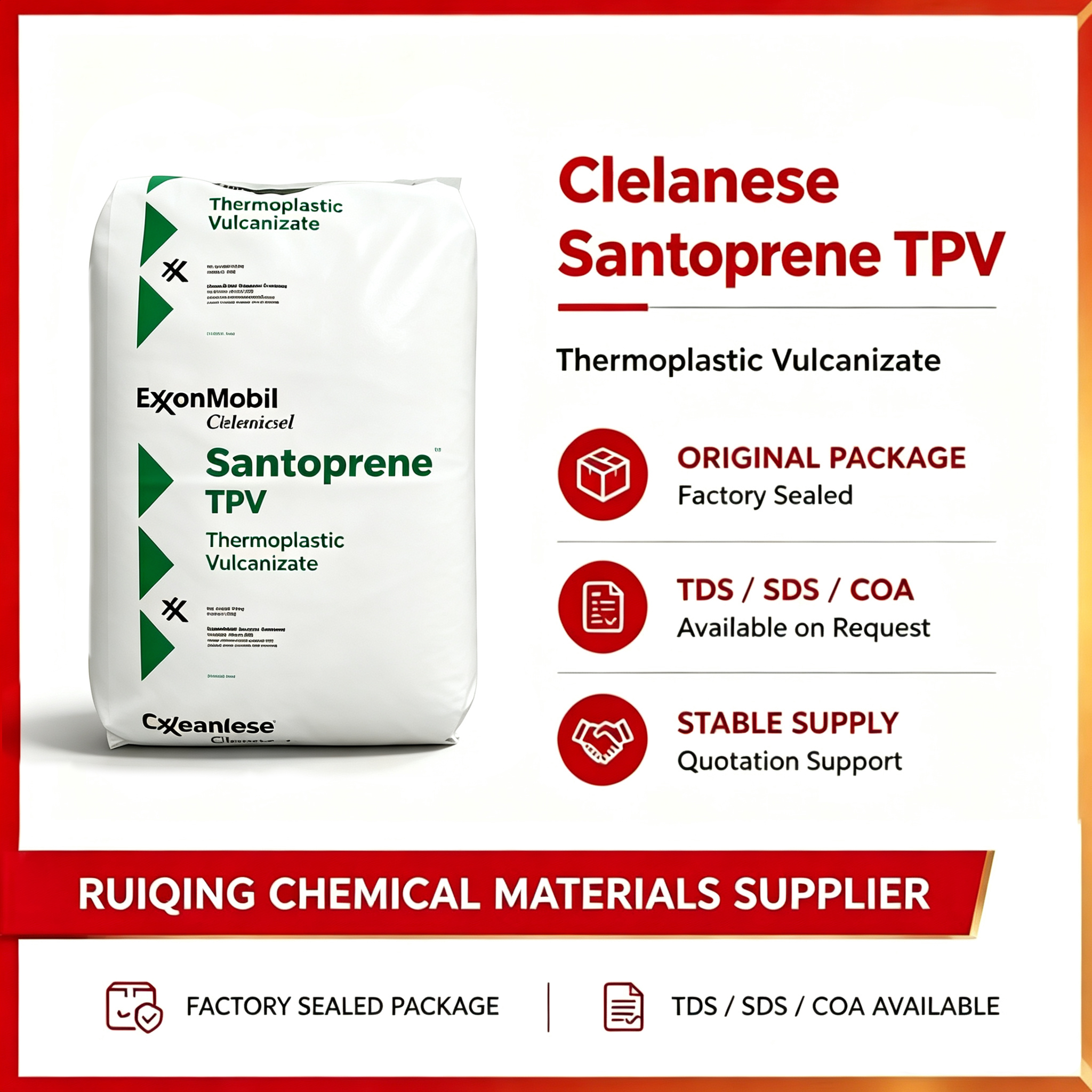
Santoprene 121-70B265 is a black thermoplastic vulcanizate (TPV) from Celanese engineered specifically for automotive glass run channel corner molding and weather-seal end-cap applications.
This is not a general-purpose 70 Shore A TPV. Its formulation is focused on three functions that are critical in automotive weather-seal assemblies: low coefficient of friction, bonding to TPV and vulcanized EPDM, and efficient injection molding of complex corner geometries.
Celanese states that Santoprene 121-70B265 combines built-in low-friction properties with good bonding to both TPV and EPDM rubber. The grade is intended to replace thermoset EPDM in selected automotive glass run channel corner-molding applications where shorter molding cycles and thermoplastic processing can improve manufacturing efficiency.
A major application advantage is that the low-friction function is built into the material. Celanese highlights retention of low friction after heat aging without surface bleeding. This is particularly useful in glass run channels, where the molded corner or end cap must allow window glass to move smoothly while maintaining appearance and sealing performance.
The grade also provides improved heat-aging performance compared with conventional low-friction TPV concepts and is designed to deliver excellent surface aesthetics in complex injection-molded shapes.
Current Celanese data lists a Shore A hardness of approximately 70, a compression set of approximately 36% at 70°C for 24 hours, a tear strength of approximately 22 kN/m, and a low-temperature brittleness value of approximately -65°C.
The density is approximately 0.913 g/cm³, making the material lighter than many conventional elastomer systems.
The grade is UV stabilized or stable to weather, which is important because automotive weather seals are exposed to sunlight, temperature cycling, moisture and outdoor environments over long service periods.
Santoprene 121-70B265 is designed for injection molding and multi-injection molding. Celanese provides grade-specific processing conditions centered around an optimum melt temperature of approximately 220°C and an optimum mold temperature of approximately 50°C.
For bonding to EPDM sponge profiles, Celanese recommends fast injection speed and high melt temperature in a warm mold. These conditions increase surface interaction between the TPV melt and the EPDM profile and help maximize interfacial bonding.
The grade also carries a General Motors specification reference: GMW15825P-TPV(EPDM + PP) Type 5.
For more TPV materials, visit our TPV Thermoplastic Vulcanizates Product Category →.
For Celanese’s broader TPV grade selection, see the Official Celanese Santoprene & Geolast Product Finder →.
Key Features of Santoprene 121-70B265
| Feature | Engineering Benefit |
|---|---|
| Shore A 70 | Balanced firmness for automotive corner moldings and end caps |
| Built-In Low Friction | Helps reduce glass sliding resistance in glass run channels |
| Low Friction Retention After Heat Aging | Maintains functional sliding behavior during long-term thermal exposure |
| No Surface Bleeding | Supports clean appearance and stable surface properties |
| Bonds to Vulcanized EPDM | Suitable for overmolding onto automotive EPDM weather-seal profiles |
| Bonds to TPV | Supports TPV-to-TPV corner molding and end-cap integration |
| Improved Heat-Aging Performance | Supports long-term automotive exterior use |
| Excellent Flowability | Helps fill complex corner-molding geometries |
| Excellent Surface Aesthetics | Useful for visible automotive sealing components |
| -65°C Brittleness Temperature | Strong cold-weather performance |
| UV / Weather Stabilized | Suitable for exterior automotive sealing environments |
| Injection Molding Grade | Designed for efficient molded corners and end caps |
| Shorter Cycle Potential vs Thermoset EPDM | Supports faster production compared with cured EPDM molding |
The defining advantage of Santoprene 121-70B265 is its combination of low friction, EPDM/TPV bonding and automotive corner-molding processability.
Typical Applications for Santoprene 121-70B265
Santoprene 121-70B265 is a highly specialized automotive sealing grade.
| Application Area | Typical Use |
|---|---|
| Glass Run Channel Corner Molding | Molded corners joining extruded automotive window channels |
| Weather-Seal End Caps | Molded end caps on TPV or EPDM weather seals |
| EPDM Overmolding | Injection molding directly onto vulcanized EPDM profiles |
| TPV Overmolding | Molding onto compatible TPV extruded profiles |
| Automotive Window Seals | Low-friction sealing components around moving glass |
| Door Weather Seals | Molded joining elements and end pieces |
| Complex Automotive Corners | High-flow injection molded shapes requiring good surface appearance |
| Multi-Injection Components | Multi-material sealing components requiring controlled bonding |
The strongest application fit is automotive glass run channel and weather-seal molding, rather than generic industrial sealing.
Typical Properties of Santoprene 121-70B265
Physical Properties
| Property | Typical Value | Test Method |
|---|---|---|
| Density | 913 kg/m³ / 0.913 g/cm³ | ISO 1183 |
| Shore A Hardness, 15 s | 70 | ISO 48-4 / ISO 868 |
| Resin Identification | TPV | ISO 1043 |
| Part Marking Code | >TPV< | ISO 11469 |
| Color | Black | Manufacturer information |
| Delivery Form | Pellets | Manufacturer information |
| Special Characteristic | UV stabilized / stable to weather | Manufacturer information |
Mechanical Properties
| Property | Typical Value | Test Method |
|---|---|---|
| Shore A Hardness | 70 | ISO 48-4 / ISO 868 |
| Compression Set, 70°C / 24 h | 36% | ISO 815 |
| Tear Strength, Normal | 22 kN/m | ISO 34-1 |
| Low-Temperature Brittleness | -65°C | ISO 812 |
The -65°C brittleness result gives Santoprene 121-70B265 strong low-temperature capability for vehicle applications operating in cold climates.
Flammability
| Property | Typical Value | Test Method |
|---|---|---|
| Burning Rate @ 2 mm | 30 mm/min | ISO 3795 / FMVSS 302 |
Bonding & Surface Performance
Celanese identifies several important grade-level functional characteristics that are not expressed as a single numerical property:
- Good bonding to vulcanized EPDM rubber
- Good bonding to TPV
- Built-in low coefficient of friction
- Retention of low friction after heat aging
- No surface bleeding
- Excellent flowability
- Excellent molded surface aesthetics
- Improved heat-aging performance
These properties are central to the intended use of Santoprene 121-70B265 in glass run channel corner molding.
Why Choose Santoprene 121-70B265?
The main reason to choose Santoprene 121-70B265 is that it solves several problems at the same time in automotive weather-seal production.
A glass run channel is not simply a flexible seal. The window glass must slide through the channel repeatedly while the seal maintains low friction, dimensional stability, appearance and weather resistance.
The molded corner also needs to bond reliably to the extruded profile.
Traditional thermoset EPDM corner molding can require a vulcanization step and relatively long cycle times. Celanese developed Santoprene 121-70B265 as a thermoplastic alternative for selected applications.
Because it is injection moldable, production can be faster and easier to automate than conventional thermoset rubber molding.
The built-in low-friction functionality is another major advantage. A separate flocking or lubricating surface treatment may not always be necessary depending on the system design.
The material also retains low-friction behavior after heat aging without surface bleeding, reducing the risk of visible oily deposits or changing surface characteristics.
Bonding is equally important. Santoprene 121-70B265 is specifically formulated to adhere to both vulcanized EPDM and TPV.
This allows manufacturers to use one molded corner grade with different weather-seal profile constructions.
Its high shear-thinning behavior helps the material flow into complex geometries. Automotive corner molds often have thin sections, changing cross-sections and small radii, so good flowability can improve mold filling and surface appearance.
The UV/weather stabilization and -65°C low-temperature performance support long-term exterior service.
For automotive manufacturers or Tier 1 weather-seal suppliers requiring a 70 Shore A low-friction TPV for EPDM/TPV corner molding, Santoprene 121-70B265 is a highly targeted grade.
Processing Guidelines for Santoprene 121-70B265
Santoprene 121-70B265 is designed primarily for:
- Injection molding
- Multi-injection molding
- EPDM profile overmolding
- TPV profile overmolding
- Automotive corner molding
- Weather-seal end-cap molding
Grade-Specific Injection Conditions
| Processing Parameter | Celanese Guidance |
|---|---|
| Drying | Recommended |
| Datasheet Drying Temperature | 65°C |
| Drying Time | ≥3 hours in a dehumidified dryer |
| Processing Moisture Content | ≤0.08% |
| Maximum Regrind Level | 20% |
| Optimum Melt Temperature | 220°C |
| Minimum Melt Temperature | 210°C |
| Maximum Melt Temperature | 230°C |
| Optimum Mold Temperature | 50°C |
| Minimum Mold Temperature | 40°C |
| Maximum Mold Temperature | 60°C |
| Recommended Screw Speed | 100–200 rpm |
| Holding Pressure | Approx. 50–75% of actual injection pressure |
| Optional Back Pressure | Approx. 0.3–0.7 MPa |
| EPDM Bonding Injection Speed | Approx. 60–100 mm/s |
Celanese’s grade table lists drying at 65°C for at least 3 hours, while its additional processing note recommends desiccant drying for approximately 3 hours at 80°C. For production, the latest grade-specific TDS and local Celanese processing guidance should be followed.
EPDM Bonding Recommendations
For good bonding to an EPDM sponge profile, Celanese recommends:
- Fast injection speed, approximately 60–100 mm/s
- High melt temperature
- Warm mold
- Moderate injection pressure
- Low holding pressure to minimize profile deformation
- Accurate positioning of the EPDM profile in the mold
- Longer cooling time than a typical TPV molding cycle
The longer cooling time helps initiate recrystallization at the TPV/EPDM contact interface.
Shear-Dependent Melt Behavior
Santoprene 121-70B265 has relatively high melt viscosity at low shear rates.
As shear rate increases, viscosity decreases. Therefore:
- Smaller gates can increase shear and improve flow
- Higher screw speed can improve melt homogeneity
- High injection speed can improve filling and interfacial bonding
- Increasing temperature alone has relatively limited effect on melt viscosity
Material Compatibility
Celanese states that Santoprene TPV is incompatible with acetal (POM) and PVC.
Processing equipment should be thoroughly purged when switching between these materials and Santoprene 121-70B265.
Santoprene 121-70B265 vs. Santoprene 121-70B230
| Feature | Santoprene 121-70B265 | Santoprene 121-70B230 |
|---|---|---|
| Material Family | TPV | TPV |
| Color | Black | Black |
| Hardness | Shore A 70 | Approx. Shore A 74 |
| Main Function | Low-friction auto corner molding | Low-friction bonding TPV |
| EPDM Bonding | Yes | Yes |
| TPV Bonding | Yes | Yes |
| Auto Corner Molding | Yes | Yes |
| Compression Set @70°C | 36% | Approx. 44% |
| Low-Friction Function | Built in | Built in |
| Main Selection Difference | Optimized 70A low-friction corner/end-cap grade with improved heat-aging performance | Slightly harder bonding grade with different property balance |
Automotive OEM Reference
Current Celanese grade data lists:
| OEM | Specification |
|---|---|
| General Motors | GMW15825P-TPV(EPDM + PP) Type 5 |
Related Products
Santoprene 121-65B200 – Black bonding TPV with improved adhesion to TPV and EPDM.
Santoprene 121-70B230 – Black low-friction bonding TPV for TPV/EPDM applications and automotive corner molding.
Santoprene 121-80B265 – Harder black low-friction TPV for automotive corner molding requiring approximately Shore A 82.
View More TPV Thermoplastic Vulcanizates →
Technical Documents for Santoprene 121-70B265
| Document Type | Description |
|---|---|
| TDS | Current Celanese physical, mechanical and processing data |
| SDS | Safety Data Sheet |
| Automotive Specification Information | General Motors GMW15825P Type 5 reference |
| Santoprene Product Finder | Grade comparison and application positioning |
| Injection Molding Guide | Processing and bonding guidance |
| COA | Batch-specific quality information where available |
Need technical documents for Santoprene 121-70B265?
📧 Email: ruiqingchem@gmail.com
📝 Online form: Contact Us →
Please state Santoprene 121-70B265 and the required document type when submitting your inquiry.
FAQ About Santoprene 121-70B265
Q1: What is Santoprene 121-70B265?
Santoprene 121-70B265 is a black low-friction TPV from Celanese developed for automotive glass run channel corner molding and weather-seal end caps.
Q2: What is the hardness of Santoprene 121-70B265?
The current Celanese value is approximately Shore A 70.
Q3: Can Santoprene 121-70B265 bond to EPDM?
Yes. Celanese specifically states that the grade adheres to vulcanized EPDM rubber.
Q4: Can Santoprene 121-70B265 bond to TPV?
Yes. The grade is also designed to bond to compatible TPV weather-seal profiles.
Q5: What is the low-temperature performance?
The current low-temperature brittleness value is approximately -65°C according to ISO 812.
Q6: What is the compression set?
Current Celanese data lists approximately 36% at 70°C for 24 hours.
Q7: What is the tear strength?
The current tear-strength value is approximately 22 kN/m.
Q8: What is the recommended melt temperature?
The current grade-specific injection range is approximately 210–230°C, with an optimum around 220°C.
Q9: What injection speed is recommended for EPDM bonding?
Celanese recommends a fast injection speed of approximately 60–100 mm/s when bonding onto EPDM sponge profiles.
Q10: What is the main advantage over thermoset EPDM corner molding?
Santoprene 121-70B265 provides thermoplastic injection-molding processability, built-in low friction, bonding to EPDM/TPV and the potential for shorter processing cycles than conventional thermoset EPDM corner molding.
Request Santoprene 121-70B265 Price & Technical Support
For pricing, availability, technical documents or application support for Santoprene 121-70B265, please provide:
- Required quantity
- Destination country or port
- Automotive weather-seal application
- Glass run channel, corner molding or end-cap design
- EPDM or TPV profile material
- Required Shore hardness
- Bonding requirement
- Friction requirement
- Mold design and gate location
- Injection molding machine size
- Operating temperature range
- OEM specification requirement
- TDS, SDS or COA requirement
- Sample requirement, if applicable
📧 Email: ruiqingchem@gmail.com
📝 Send Inquiry →