描述
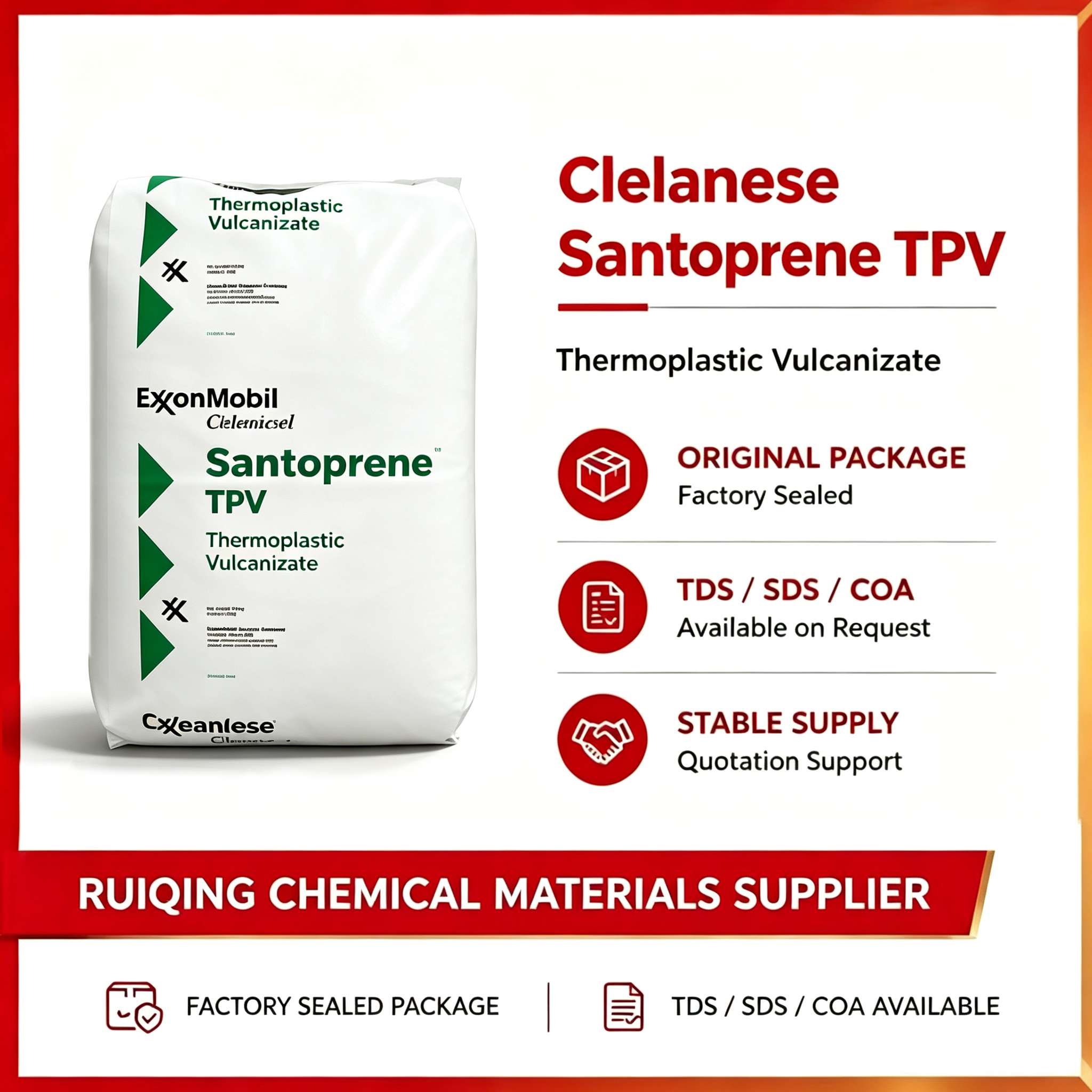
Santoprene 121-58W175 is a soft, black, UV-resistant thermoplastic vulcanizate (TPV) from Celanese developed specifically for thin-wall and complex profile extrusion.
The grade combines rubber-like flexibility and elastic recovery with the processing advantages of thermoplastics. It is polyolefin based, shear dependent and designed to run on conventional thermoplastic extrusion equipment.
What distinguishes Santoprene 121-58W175 from a standard general-purpose TPV is its combination of UV stabilization, profile-extrusion performance and long-run processing stability.
Celanese specifically states that the grade is designed to produce thin-wall sections with excellent definition, including radii down to approximately 0.33 mm, while helping maximize extrusion run length with minimal material build-up on screen packs and narrow die sections.
This makes the material especially attractive for weather seals, automotive exterior profiles, glazing seals and other long continuous extrusions where dimensional definition and stable processing are important.
The current Celanese Materials Database describes Santoprene 121-58W175 as having:
- Excellent flex-fatigue resistance
- Excellent ozone resistance
- Improved UV resistance
- Good physical properties
- Good chemical resistance
- Strong low-temperature performance
- Optimized thin-wall / complex-profile extrusion behavior
The current Shore A hardness is approximately 61, placing it in the medium-soft TPV range.
Current mechanical data lists approximately 1.99 MPa tensile stress at 100% elongation, 5.09 MPa tensile stress at break, 460% elongation at break and approximately 21 kN/m tear strength.
The grade also maintains strong low-temperature flexibility, with both ASTM brittleness temperature and ISO low-temperature brittleness reported at approximately -60°C.
Compression set is approximately 27% at 70°C for 24 hours and 43% at 125°C for 70 hours.
These properties make the grade useful for sealing profiles that must remain flexible after long-term compression, weather exposure and repeated movement.
The current grade data also lists a continuous upper temperature resistance of 135°C for 1,000 hours according to SAE J2236.
Electrical data includes a relative permittivity of approximately 2.7 at 60 Hz and electric strength of approximately 26 kV/mm at 2 mm.
The density is approximately 0.970 g/cm³, which is typical of polyolefin-based Santoprene TPV and supports lightweight profile design.
Celanese’s current grade sheet lists extrusion and sheet extrusion under the exact grade characteristics. The same sheet also contains general injection-molding guidance, but the primary positioning of Santoprene 121-58W175 is clearly extrusion-focused.
For more TPV products, visit our TPV Thermoplastic Vulcanizates Product Category →.
For the broader Santoprene portfolio, see the Official Celanese Santoprene & Geolast Product Finder →.
Key Features of Santoprene 121-58W175
| Feature | Engineering Benefit |
|---|---|
| Shore A 61 | Soft sealing behavior with enough support for continuous profiles |
| UV Resistant | Improved outdoor durability and weathering performance |
| Excellent Ozone Resistance | Suitable for exposed automotive and construction seals |
| Excellent Flex-Fatigue Resistance | Supports repeated movement and cyclic deformation |
| Thin-Wall Extrusion | Designed for profile sections with fine detail |
| 0.33 mm Radius Capability | Supports excellent definition in narrow profile geometry |
| Low Die / Screen Build-Up | Helps extend extrusion run length |
| 460% Elongation at Break | High deformability for seals and flexible profiles |
| -60°C Brittleness Temperature | Strong low-temperature flexibility |
| 21 kN/m Tear Strength | Useful resistance to edge damage and tearing |
| Good Chemical Resistance | Supports demanding automotive and outdoor service |
| Polyolefin Based | Low density and conventional thermoplastic processing |
| Automotive OEM References | Broad qualification history across global vehicle manufacturers |
| Manufacturing-Stream Recyclability | Controlled process scrap can be recycled within the manufacturing stream |
The defining advantage of Santoprene 121-58W175 is its combination of UV durability and profile-extrusion precision.
Typical Applications for Santoprene 121-58W175
Santoprene 121-58W175 is particularly well suited to continuous sealing profiles and weather-exposed elastomeric parts.
| Application Area | Typical Use |
|---|---|
| Automotive Weather Seals | Door, window, body and exterior sealing profiles |
| Automotive Exterior Trim | Flexible UV-exposed trim and profile components |
| Glazing Seals | Window and door sealing profiles |
| Building & Construction Seals | Weather-resistant architectural profiles |
| Thin-Wall Profiles | Fine-section continuous extrusions |
| Complex Profile Extrusion | Multi-lip, narrow-radius or detailed seals |
| Outdoor Sealing Systems | UV- and ozone-exposed sealing components |
| Sheet Extrusion | Flexible TPV sheet for fabricated sealing applications |
| Industrial Seals | Flexible profiles requiring weather and fatigue resistance |
| Consumer / Appliance Profiles | Extruded flexible components where UV stability is beneficial |
Celanese has also published a glazing-seal solution showcase using Santoprene 121-58W175 as a reference TPV for durable sealing and weathering performance in residential window and door systems.
Typical Properties of Santoprene 121-58W175
Physical Properties
| Property | Typical Value | Test Method |
|---|---|---|
| Density | 970 kg/m³ / 0.970 g/cm³ | ISO 1183 |
| Shore A Hardness, 15 s | 61 | ISO 48-4 / ISO 868 |
| Resin Identification | TPV | ISO 1043 |
| Part Marking Code | >TPV< | ISO 11469 |
| Color | Black | Manufacturer information |
| Delivery Form | Pellets | Manufacturer information |
| UV Stabilization | Yes | Manufacturer classification |
The density below 1.0 g/cm³ helps reduce profile mass compared with many denser elastomer systems.
Mechanical Properties
| Property | Typical Value | Test Method |
|---|---|---|
| Tensile Stress at 100% Elongation, Perpendicular | 1.99 MPa | ISO 37 |
| Tensile Stress at Break, Perpendicular | 5.09 MPa | ISO 527-1/-2 or ISO 37 |
| Elongation at Break, Perpendicular | 460% | ISO 527-1/-2 or ISO 37 |
| Tear Strength, Normal | 21 kN/m | ISO 34-1 |
| Brittleness Temperature | -60°C | ASTM D746 |
| Low-Temperature Brittleness | -60°C | ISO 812 |
| Compression Set, 70°C / 24 h | 27% | ISO 815 |
| Compression Set, 125°C / 70 h | 43% | ISO 815 |
The combination of 61 Shore A hardness and 460% elongation gives Santoprene 121-58W175 a useful balance between softness and strength for sealing profiles.
Thermal & Aging Properties
| Property | Typical Value | Test Method |
|---|---|---|
| Continuous Upper Temperature Resistance, 1000 h | 135°C | SAE J2236 |
| Change in Tensile Strength, 150°C / 168 h | -21% | ISO 188 |
| Change in Tensile Strain at Break, 150°C / 168 h | +7.7% | ISO 188 |
| Change in Shore A Hardness, 150°C / 168 h | -3 | ISO 188 |
These aging values provide additional context for elevated-temperature automotive and industrial use.
Electrical Properties
| Property | Typical Value | Test Method |
|---|---|---|
| Relative Permittivity @ 60 Hz | 2.7 | IEC 62631-2-1 |
| Electric Strength, Short Time, 2 mm | 26 kV/mm | ASTM D149 |
Although the grade is primarily selected for sealing and extrusion performance, these electrical values can be useful in technical profile design.
Automotive OEM References for Santoprene 121-58W175
Current Celanese Materials Database documentation lists multiple automotive references for Santoprene 121-58W175.
| OEM | Specification / Reference |
|---|---|
| BAIC | BAS-491 |
| BMW | GS93042 |
| Ford | WSS-M2D378-B1 |
| GAC | QJ/GAC 1240.022 |
| General Motors | GMW15812P-TPV(EPDM+PP)-Type 4E |
| Li Auto | Q/LiA5310057 2021 (V2) |
| Mercedes-Benz | DBL5562 |
| Renault | FRM 18-27-030 / special part approval context |
| SAIC Motor | SMTC 5 320 024 |
| Stellantis | 55248_02 EMP60 and additional group references |
| Volkswagen Group | TL 526 41C |
| Volkswagen Group | VW 50123 |
| Volkswagen Group | VW 52703 / TL 527 03 |
This broad approval history is particularly relevant to automotive sealing suppliers and Tier 1 processors evaluating materials for weather seals and exterior profiles.
Why Choose Santoprene 121-58W175?
The main reason to choose Santoprene 121-58W175 is that it is not just a UV-stabilized 60A-class TPV. It is specifically tuned for profile extrusion quality and process stability.
Long automotive or architectural seals can be challenging to extrude.
Thin lips, small radii and narrow die sections can suffer from poor definition, melt build-up or inconsistent surface quality.
Celanese designed Santoprene 121-58W175 to improve performance in exactly these conditions.
The grade can reproduce thin-wall sections and profile features down to approximately 0.33 mm radius while helping reduce material build-up on screen packs and narrow die passages.
That can help processors maintain longer continuous production runs with fewer interruptions.
UV stability is another key advantage.
Weather seals and outdoor profiles may spend years exposed to sunlight, ozone, heat and temperature cycling.
Santoprene 121-58W175 combines improved UV resistance with excellent ozone resistance, making it a strong candidate for exterior sealing systems.
The 460% elongation and excellent flex-fatigue resistance support repeated movement in door seals, glazing systems and dynamic profiles.
The -60°C brittleness temperature provides strong cold-weather capability.
Compression-set performance also supports long-term sealing because the material must recover after being compressed against glass, metal or plastic mating surfaces.
For customers producing black UV-resistant weather seals, thin-wall profiles or complex extrusions, Santoprene 121-58W175 offers a more targeted solution than a basic general-purpose TPV.
Processing Guidelines for Santoprene 121-58W175
The current Celanese grade sheet identifies extrusion and sheet extrusion as the main processing methods for Santoprene 121-58W175.
Grade-Specific Extrusion Conditions
| Processing Parameter | Celanese Guidance |
|---|---|
| Drying Temperature | 82°C |
| Drying Time | 3 hours in a dehumidified dryer |
| Melt Temperature Range | 177–204°C |
| General Santoprene TPV Processing Window | 175–230°C |
| Maximum Drawdown | 15% |
Celanese recommends desiccant drying for approximately 3 hours at 80–82°C.
The grade-specific extrusion melt range of 177–204°C is the best starting point for this material.
The broader 175–230°C range is general Santoprene TPV processing guidance, not the preferred exact-grade extrusion range.
Profile Extrusion Optimization
For thin-wall and complex profile extrusion, processors should pay particular attention to:
- Die temperature
- Melt temperature
- Screw speed
- Melt pressure
- Screen-pack condition
- Drawdown ratio
- Cooling rate
- Profile support
- Line speed
- Dimensional stability
Celanese specifically states that drawdown should not exceed 15% for this grade.
Keeping drawdown low helps preserve the profile definition for which Santoprene 121-58W175 is designed.
Shear-Dependent Flow
Santoprene TPV is shear dependent.
As shear rate increases, apparent viscosity decreases.
This behavior can improve flow through narrow die sections, but screw speed, die design and melt temperature must be balanced carefully to maintain dimensional control and surface quality.
Material Compatibility
Celanese states that Santoprene TPV is incompatible with acetal (POM) and PVC.
Extrusion equipment should be properly purged before processing Santoprene 121-58W175 after either of these materials.
Injection-Molding Note
The current Celanese database sheet also contains generic injection-molding recommendations, including:
- Holding pressure around 50–75% of actual injection pressure
- Screw speed around 100–200 rpm
- Optional back pressure around 0.3–0.7 MPa
However, the grade’s current Characteristics section lists Extrusion and Sheet Extrusion, and its product positioning is profile-extrusion focused. For a molding project, confirm the latest Celanese processing recommendation before production qualification.
Santoprene 121-58W175 vs. Santoprene 121-67W175
| Feature | Santoprene 121-58W175 | Santoprene 121-67W175 |
|---|---|---|
| Material Family | TPV | TPV |
| Color | Black | Black |
| UV Stabilized | Yes | Yes |
| Product Positioning | Profile extrusion / UV | Profile extrusion / UV |
| Shore A Hardness | 61 | Approx. 72 |
| Elongation at Break | 460% | Approx. 432% |
| Tensile Stress at Break | 5.1 MPa | Approx. 6.8 MPa |
| Tensile Stress @ 100% Elongation | 2.0 MPa | Approx. 2.9 MPa |
| Compression Set, 70°C | 27% | Approx. 29% |
| Main Selection Difference | Softer, more compliant profile | Firmer, stronger profile |
Choose Santoprene 121-58W175 when the sealing profile needs greater softness and compliance.
Choose Santoprene 121-67W175 when a firmer UV-stabilized W175 profile grade is preferred.
Related Products
Santoprene 121-67W175 – Firmer black UV-stabilized profile-extrusion TPV with approximately Shore A 72 hardness.
Santoprene 121-73W175 – Higher-hardness black UV-stabilized TPV for automotive and exterior profile applications.
Santoprene 121-60E400 – High-resilience black TPV designed for demanding static and dynamic sealing applications with improved elastic recovery.
View More TPV Thermoplastic Vulcanizates →
Technical Documents for Santoprene 121-58W175
| Document Type | Description |
|---|---|
| TDS | Current Celanese mechanical, thermal, electrical and extrusion data |
| SDS | Safety Data Sheet |
| Automotive Approval Information | OEM specification references for automotive sealing applications |
| Santoprene Product Finder | Grade comparison and positioning |
| Processing Guide | Santoprene extrusion and general TPV processing guidance |
| COA | Batch-specific quality information where available |
Need technical documents for Santoprene 121-58W175?
📧 Email: ruiqingchem@gmail.com
📝 Online form: Contact Us →
Please state Santoprene 121-58W175 and the required document type when submitting your inquiry.
FAQ About Santoprene 121-58W175
Q1: What is Santoprene 121-58W175?
Santoprene 121-58W175 is a soft black UV-resistant TPV from Celanese developed for thin-wall and complex profile extrusion.
Q2: What is the Shore hardness of Santoprene 121-58W175?
The current Celanese value is approximately Shore A 61.
Q3: Is Santoprene 121-58W175 UV resistant?
Yes. Celanese specifically classifies the grade as UV resistant and designed for improved UV stability.
Q4: What is the elongation at break?
Current grade data lists approximately 460% elongation at break.
Q5: What is the tensile stress at break?
The current value is approximately 5.09 MPa.
Q6: What is the low-temperature performance?
Both the ASTM brittleness temperature and ISO low-temperature brittleness are approximately -60°C.
Q7: What applications are recommended?
The strongest applications include automotive weather seals, exterior trim, glazing seals, building profiles and other UV-exposed thin-wall or complex extrusions.
Q8: What extrusion temperature should be used?
The current grade-specific melt-temperature range is approximately 177–204°C.
Q9: Does Santoprene 121-58W175 require drying?
Celanese recommends desiccant drying for approximately 3 hours at 80–82°C before processing.
Q10: What is the difference between Santoprene 121-58W175 and 121-67W175?
Both are black UV-stabilized W175 profile-extrusion TPVs. 121-58W175 is softer at Shore A 61, while 121-67W175 is firmer at approximately Shore A 72 and provides higher tensile stress.
Request Santoprene 121-58W175 Price & Technical Support
For pricing, availability, technical documents or application support for Santoprene 121-58W175, please provide:
- Required quantity
- Destination country or port
- Automotive, glazing, construction or industrial application
- Weather seal or profile geometry
- Required Shore hardness
- Minimum wall thickness
- Smallest profile radius
- UV / outdoor exposure
- Continuous and peak temperature
- Minimum service temperature
- Compression-set requirement
- Extrusion line and die type
- Required automotive OEM specification
- TDS, SDS or COA requirement
- Sample requirement, if applicable
📧 Email: ruiqingchem@gmail.com
📝 Send Inquiry →