描述
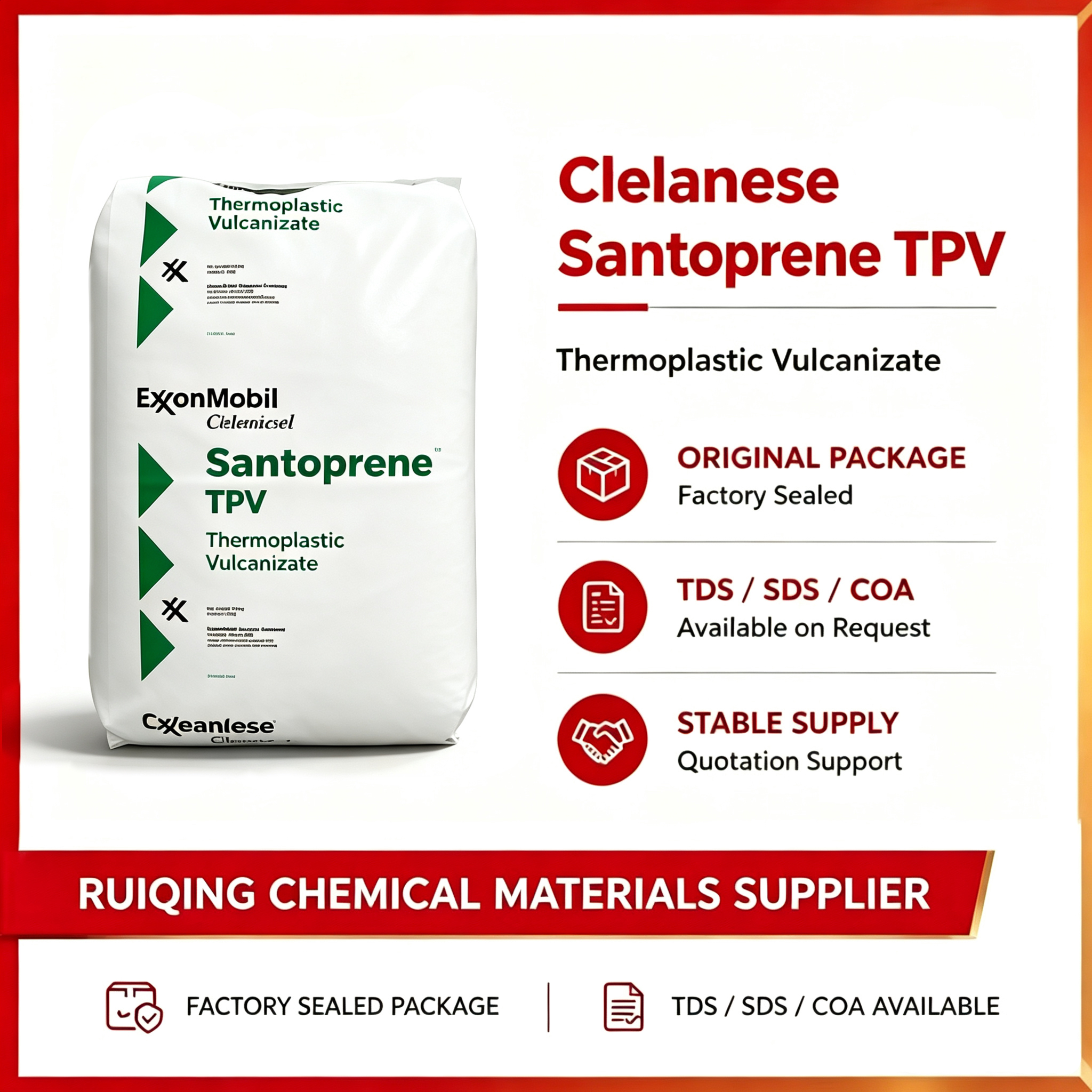
Santoprene 121-25W228 is a specialty thermoplastic vulcanizate (TPV) from Celanese developed for foamed dynamic automotive weather seals.
Celanese publicly introduced the grade as a material designed to provide a uniform foam structure, superior mechanical properties and predictable sealing performance compared with foamed EPDM profiles.
This positioning is important because dynamic vehicle weatherseals operate very differently from simple static gaskets. A dynamic seal around a door, window or moving body interface must repeatedly compress, recover and maintain contact while exposed to temperature changes, vibration, water, UV, ozone and long-term mechanical cycling.
A foamable TPV such as Santoprene 121-25W228 allows designers to combine a soft cellular cross-section with thermoplastic manufacturing technology.
The goal is not simply to make a lighter seal. The foam structure must remain sufficiently uniform to give predictable compression behavior along the full length of an extruded profile.
Celanese specifically emphasizes this uniform foam structure as one of the key benefits of Santoprene 121-25W228.
That is especially valuable in automotive weatherseals because large variations in cell structure can lead to inconsistent sealing force, localized deformation, uneven appearance and variable closing effort.
Compared with traditional foamed EPDM systems, Santoprene TPV offers another major difference: it behaves like rubber in service but processes like a thermoplastic.
Celanese describes the Santoprene TPV platform as a ready-to-use thermoplastic vulcanizate that can simplify manufacturing, reduce part weight and allow in-process recycling during conversion.
The current Celanese Santoprene portfolio supports both physical foaming and chemical foaming, in addition to extrusion, injection molding, blow molding and calendaring.
For this grade specifically, commercial product listings identify profile extrusion, extrusion, injection molding and multi-injection molding among the supported technologies.
A current distributor listing reports a density of approximately 0.927 g/cm³ for Santoprene 121-25W228 before any final part-density reduction achieved through foaming.
Because this is a relatively new specialty grade, publicly accessible current grade-level data are more limited than for long-established Santoprene 101-series materials. For that reason, this page does not copy tensile, hardness, compression-set or processing-temperature values from neighboring Santoprene grades.
That distinction is important for engineering selection. A foamable weatherseal grade should be evaluated using its own current Celanese technical data rather than numbers transferred from a visually similar grade name.
For more TPV materials, visit our TPV Thermoplastic Vulcanizates Product Category →.
For current Santoprene family information, visit the Official Celanese Santoprene TPV Page →.
Celanese also specifically introduced Santoprene 121-25W228 as an automotive innovation for foamed dynamic weatherseals in its K 2025 materials announcement →.
Key Features of Santoprene 121-25W228
| Feature | Engineering Benefit |
|---|---|
| Designed for Foamed Dynamic Weatherseals | Targets moving automotive sealing systems rather than generic molded elastomer applications |
| Uniform Foam Structure | Helps support consistent compression and sealing behavior along extruded profiles |
| Predictable Sealing Performance | Supports stable seal function in dynamic vehicle applications |
| Mechanical Performance | Celanese positions the grade for stronger performance than conventional foamed EPDM profile concepts |
| Low-Density Design Potential | Foaming can reduce profile mass and material use |
| TPV Thermoplastic Processing | Eliminates the separate curing step associated with traditional thermoset rubber processing |
| Extrusion Compatibility | Suitable for continuous weatherseal and profile manufacturing |
| Foaming Compatibility | Santoprene TPV platform supports physical and chemical foaming technologies |
| In-Process Recycling Potential | TPV production scrap can potentially be melted and reprocessed within controlled manufacturing streams |
| Automotive Focus | Specifically developed for automotive weatherseal systems |
| EPDM Replacement Potential | Designed to offer an alternative to heavier and more difficult-to-recycle traditional EPDM constructions |
| Integrated-System Potential | Can support multi-material thermoplastic weatherseal architectures |
The defining feature of Santoprene 121-25W228 is not simply softness or hardness. Its value lies in controlled foaming and dynamic sealing performance.
Typical Applications for Santoprene 121-25W228
Santoprene 121-25W228 is primarily an automotive weatherseal material.
| Application Area | Typical Use |
|---|---|
| Dynamic Door Weatherseals | Compressible profiles around vehicle doors |
| Window Sealing Systems | Flexible sealing sections around movable glass |
| Glass Run Channels | Foamed sealing sections in window-guidance systems |
| Body Sealing Profiles | Lightweight profiles around moving body closures |
| Semi-Dynamic Weatherseals | Sealing interfaces with repeated contact or movement |
| Coextruded Automotive Profiles | Foamed TPV section combined with compatible solid TPV or thermoplastic layers |
| Lightweight Seal Systems | Profiles intended to reduce mass versus metal-reinforced or dense rubber designs |
| EPDM Replacement Projects | Thermoplastic redesign of conventional foamed EPDM weatherseal constructions |
The grade is particularly relevant where the customer is trying to move from a conventional foamed EPDM weatherseal architecture to a thermoplastic, recyclable profile system.
Typical Properties of Santoprene 121-25W228
Publicly Available Grade-Level Data
| Property | Current Publicly Available Information | Source Context |
|---|---|---|
| Polymer Type | TPV | Celanese / distributor listing |
| Filler | Unfilled | Current distributor listing |
| Density | 0.927 g/cm³ | ISO 1183 distributor listing |
| Primary Application | Foamed dynamic automotive weatherseals | Celanese |
| Foam Structure | Designed for uniform foam structure | Celanese |
| Sealing Performance | Designed for predictable sealing performance | Celanese |
| Processing | Profile extrusion, extrusion, injection molding, multi-injection molding | Current distributor listing |
| Family Foaming Methods | Physical and chemical foaming | Celanese Santoprene platform |
| Delivery Form | Pellets | Celanese Santoprene family |
Important Data Note
At the time of writing, Celanese’s current public launch information does not expose a complete downloadable table of hardness, tensile strength, elongation, compression set, melt temperature and processing-window values for Santoprene 121-25W228.
Those values should therefore be taken from the current grade-specific Celanese TDS or material card, not copied from another 121-series grade.
This matters because specialty weatherseal grades can use different formulations, foaming packages, rheology control and stabilization systems even when their grade numbers appear similar.
Why Choose Santoprene 121-25W228?
The strongest reason to evaluate Santoprene 121-25W228 is the opportunity to redesign a conventional EPDM weatherseal around a thermoplastic foamed profile.
Traditional EPDM weatherseals have a long history in the automotive industry, but they also bring manufacturing and recycling challenges.
Thermoset EPDM normally requires rubber mixing, shaping and vulcanization. Once crosslinked, the material cannot simply be remelted like a conventional thermoplastic.
Santoprene TPV takes a different approach. The rubber phase is dynamically vulcanized within a thermoplastic matrix, so the finished compound behaves elastomerically in service while remaining thermoplastically processable.
For a weatherseal manufacturer, this can simplify the production flow.
Celanese also emphasizes that Santoprene TPV scrap generated during manufacturing can be melted and remolded, reducing waste compared with many thermoset-rubber processes.
Another advantage is weight reduction.
Celanese’s current weatherseal platform highlights opportunities to reduce the weight of conventional EPDM/metal weatherseal systems by redesigning the profile architecture with thermoplastic solutions.
For Santoprene 121-25W228, foaming adds another mass-reduction mechanism because a controlled cellular structure lowers the amount of polymer required per unit volume.
But the challenge with foaming is consistency.
A weatherseal is only effective when it delivers a predictable compression force over its entire geometry. Poor cell control can result in localized soft spots, high-density zones or unstable dimensions.
This is why Celanese’s emphasis on a uniform foam structure is technically important.
The company also describes the grade as providing predictable sealing performance, directly connecting the foam morphology to the function of the finished seal.
For OEMs and Tier suppliers, this can support more stable door-closing effort, water sealing, wind-noise control and dimensional repeatability.
Santoprene 121-25W228 vs. Foamed EPDM Weatherseals
| Design Consideration | Santoprene 121-25W228 TPV | Conventional Foamed EPDM |
|---|---|---|
| Material Type | Thermoplastic vulcanizate | Thermoset rubber |
| Primary Positioning | Foamable dynamic weatherseal TPV | Traditional automotive weatherseal rubber |
| Processing | Thermoplastic extrusion / foaming | Rubber extrusion + vulcanization |
| Reprocessing of Clean Production Scrap | Potentially melt-processable | Limited because cured EPDM cannot be remelted |
| Foam Control | Grade designed for uniform foam structure | Depends on EPDM compound and curing/foaming system |
| Sealing | Designed for predictable dynamic sealing | Established traditional solution |
| Weight Reduction Potential | Strong through thermoplastic redesign + foaming | Conventional baseline |
| Multi-Material Integration | Strong potential with TPV-based coextrusion | Often more complex |
| End-of-Life Recycling Potential | Thermoplastic route offers better potential where infrastructure exists | More difficult for crosslinked rubber |
| Production Simplification | No traditional rubber curing stage | Requires vulcanization |
Celanese specifically positions Santoprene 121-25W228 as an alternative offering more uniform foam structure, strong mechanical performance and more predictable sealing compared with foamed EPDM profiles.
This does not mean every existing EPDM profile can be converted without redesign. Cross-section geometry, extrusion tooling, foaming technology, seal force and interface design should all be validated during development.
Processing Guidelines for Santoprene 121-25W228
Because this is a specialty foaming grade, processing should start from the current Celanese grade-specific material card.
Supported Processing Routes
Publicly available product information identifies:
- Profile extrusion
- General extrusion
- Injection molding
- Multi-injection molding
The broader Santoprene TPV platform also supports:
- Physical foaming
- Chemical foaming
- Blow molding
- Calendaring
For Santoprene 121-25W228, profile extrusion combined with controlled foaming is the most application-relevant process.
Key Process Variables for Foamed Weatherseal Extrusion
When developing a profile with Santoprene 121-25W228, engineers should control:
- Melt temperature
- Extruder screw design
- Screw speed
- Melt pressure
- Foaming-agent level or physical blowing-gas conditions
- Die temperature
- Die pressure
- Extrudate swell
- Draw-down ratio
- Cell nucleation
- Cooling rate
- Line speed
- Profile dimensions
- Final foam density
- Compression load deflection
- Surface quality
- Seal-force consistency
The relationship between melt rheology and foaming is particularly important.
A melt that expands too quickly can create oversized or irregular cells. Insufficient expansion can produce a profile that is too dense and too stiff.
Die design must also account for TPV elastic recovery and foam expansion after the material exits the die.
For dynamic weatherseals, process development should focus not only on appearance but also on functional metrics such as compression force, recovery, water sealing, dimensional stability and durability after thermal cycling.
Engineering Advantages for Automotive Weatherseals
1. Lower Weight
Foamed TPV can reduce the mass of the elastomeric portion of a weatherseal.
Weight reduction is particularly valuable in electric vehicles, where every kilogram can influence range and energy efficiency.
2. Thermoplastic Manufacturing
Santoprene TPV eliminates the conventional vulcanization stage used with thermoset EPDM.
This can simplify manufacturing and potentially shorten processing routes.
3. Scrap Rework Potential
Clean Santoprene TPV manufacturing scrap can potentially be remelted and reprocessed under controlled conditions.
This can reduce process waste.
4. Consistent Foam Structure
Santoprene 121-25W228 is specifically designed to provide a uniform cellular structure.
This supports more consistent mechanical response along a weatherseal profile.
5. Predictable Seal Force
A more stable foam structure can contribute to predictable compression and recovery characteristics.
This is essential for dynamic door and window seals.
6. Potential for Integrated Thermoplastic Systems
TPV weatherseal systems can be designed with solid TPV, foamed TPV and compatible thermoplastic carrier sections in one integrated architecture.
This can reduce the need for separate metal reinforcement or complex secondary assembly in suitable designs.
Related Products
Santoprene 121-60E400 – High-resilience TPV used by Celanese in current semi-dynamic and dynamic automotive weatherseal systems.
Santoprene ECO-R Weatherseal Grades – TPV grades containing post-consumer recycled content for automotive weatherseal systems and circular-economy programs.
Santoprene 121-Series TPV – Specialty Santoprene materials covering weatherseal, bonding, surface, UV and other automotive requirements.
View More TPV Thermoplastic Vulcanizates →
Technical Documents for Santoprene 121-25W228
| Document Type | Description |
|---|---|
| TDS / Material Card | Current grade-specific mechanical, rheological and processing data |
| SDS | Safety Data Sheet |
| Processing Information | Foaming and profile-extrusion guidance |
| Automotive Documentation | Application-specific material or OEM documentation where available |
| Regulatory Information | REACH, RoHS and other current declarations where applicable |
| COA | Batch-specific quality information where available |
Need technical documents for Santoprene 121-25W228?
📧 Email: ruiqingchem@gmail.com
📝 Online form: Contact Us →
Please include Santoprene 121-25W228 and your required document type in the inquiry.
FAQ About Santoprene 121-25W228
Q1: What is Santoprene 121-25W228?
Santoprene 121-25W228 is a Celanese thermoplastic vulcanizate developed for foamed dynamic automotive weatherseals.
Q2: What is the main advantage of Santoprene 121-25W228?
Its key advantage is a formulation designed to provide uniform foam structure, strong mechanical performance and predictable sealing behavior compared with conventional foamed EPDM profiles.
Q3: Is Santoprene 121-25W228 intended for automotive applications?
Yes. Celanese specifically introduced the grade for automotive dynamic weatherseal systems.
Q4: Can Santoprene 121-25W228 be foamed?
Yes. Foaming is central to the grade’s application positioning. Celanese’s Santoprene platform supports both physical and chemical foaming.
Q5: What is the density of Santoprene 121-25W228?
A current Celanese distributor listing reports approximately 0.927 g/cm³ according to ISO 1183.
Q6: What processing methods are listed?
Current commercial product information lists profile extrusion, extrusion, injection molding and multi-injection molding.
Q7: Can Santoprene 121-25W228 replace foamed EPDM?
It is specifically designed as a thermoplastic alternative for foamed dynamic weatherseals. Actual replacement requires profile, tooling, foam-density and seal-performance validation.
Q8: Is Santoprene 121-25W228 recyclable?
Santoprene TPV is thermoplastically processable, and Celanese states that manufacturing scrap can be reworked. End-of-life recycling depends on part design, separation and available recycling infrastructure.
Q9: What is the Shore hardness of Santoprene 121-25W228?
A current public Celanese grade-level hardness value was not located in the available launch information. The exact value should be taken from the latest Celanese TDS or material card rather than inferred from the grade name.
Q10: Where can I obtain the Santoprene 121-25W228 TDS and SDS?
Contact us with the grade name and required documents. We can provide technical-document and grade-selection support for Santoprene 121-25W228.
Request Santoprene 121-25W228 Price & Technical Support
For pricing, availability, samples or technical support for Santoprene 121-25W228, please provide:
- Required quantity
- Destination country or port
- Vehicle weatherseal application
- Dynamic or semi-dynamic seal type
- Profile cross-section
- Target finished foam density
- Compression-load requirement
- Existing EPDM material or specification
- Physical or chemical foaming process
- Extruder size and profile line information
- Coextrusion requirement
- Surface / appearance requirement
- OEM specification requirement
- TDS, SDS, COA or regulatory-document requirement
- Sample requirement
📧 Email: ruiqingchem@gmail.com
📝 Send Inquiry →