描述
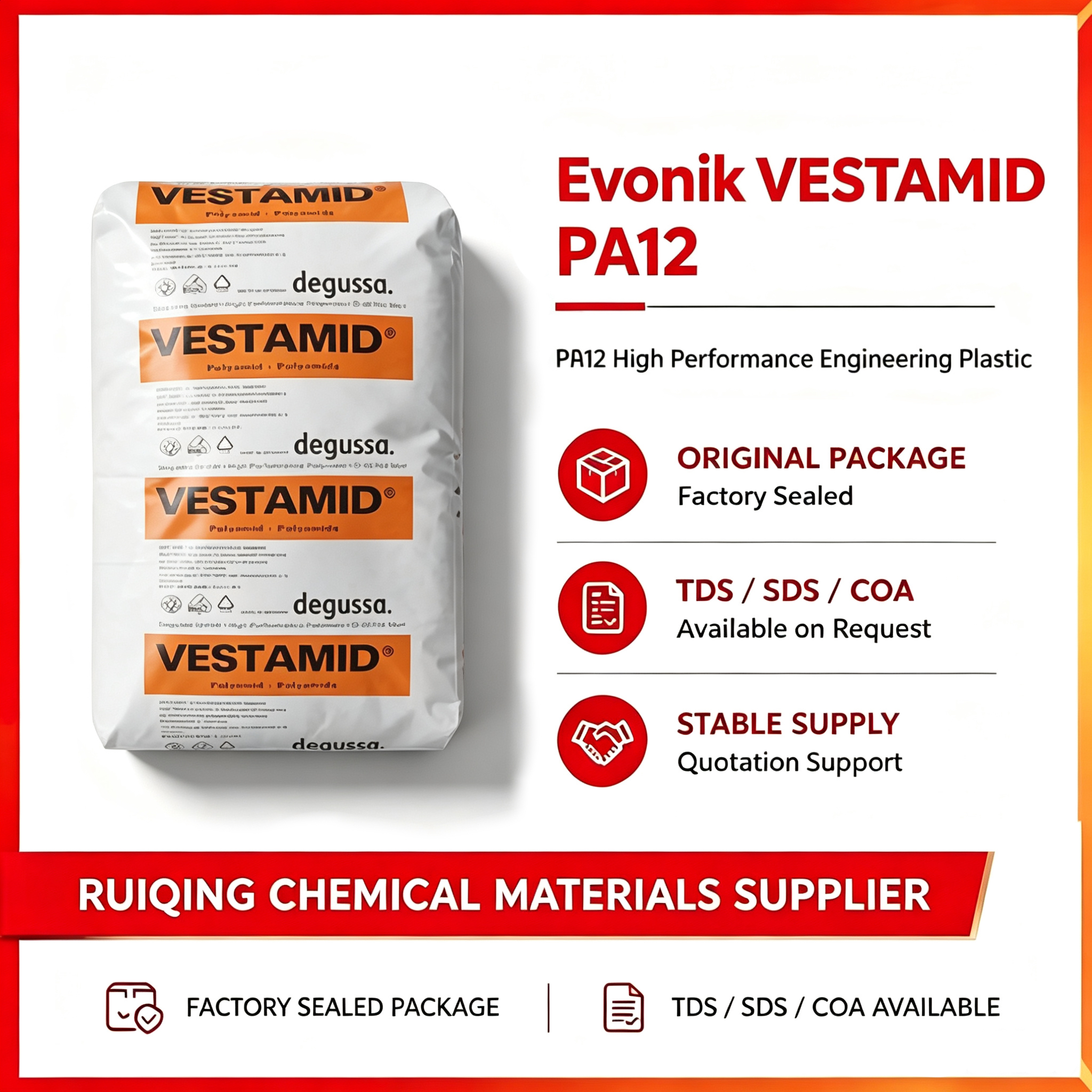
VESTAMID L2123 is a high-viscosity, plasticized polyamide 12 compound from Evonik Operations GmbH developed primarily for extrusion of flexible tubing and hoses, especially for automotive applications.
The grade is particularly distinguished by its optimized cold-temperature impact resistance. This makes VESTAMID L2123 especially suitable for air brake tubing, coils and other automotive pneumatic lines that must remain tough when exposed to low ambient temperatures.
Current material data identifies the grade as a PA12-I material, while Evonik’s historical product nomenclature describes L2123 as PA12-P, EHL, 22-004. In practical product positioning, it is a plasticized PA12 with an impact-modified / high-cold-impact performance profile.
The high melt viscosity of VESTAMID L2123 is important for tube extrusion because the polymer must maintain stable geometry after exiting the die. Evonik specifically highlights good dimensional control during pipe extrusion, which helps processors maintain outside diameter and wall thickness during production.
The material also benefits from the inherent characteristics of PA12. Moisture absorption is low, dimensional changes with humidity are limited, and the semi-crystalline polymer provides good resistance to fuels, oils, alcohols and many other industrial chemicals.
Another advantage is its low coefficient of friction. This can help reduce abrasion and sliding resistance in tubing and hose assemblies, while the high impact strength supports applications exposed to vibration, movement and mechanical shock.
VESTAMID L2123 is heat stabilized, light stabilized and UV stabilized. It also contains lubricant / processing aid and plasticizer, supporting extrusion of flexible automotive tubing.
Explore additional materials in our PA12 Polyamide 12 Product Category →.
For manufacturer information about the VESTAMID PA12 portfolio, visit the Official Evonik VESTAMID Page →.
Key Features of VESTAMID L2123
| Feature | Benefit |
|---|---|
| High Viscosity | Provides melt strength and dimensional control during pipe and tube extrusion |
| Plasticized PA12 | Offers greater flexibility than rigid unplasticized PA12 grades |
| Impact Modified | Delivers very high toughness for automotive tubing |
| Optimized Cold-Impact Strength | Maintains useful impact resistance at sub-zero temperatures |
| Heat Stabilized | Supports demanding automotive and industrial environments |
| Light / UV Stabilized | Suitable for components exposed to light and weather |
| Low Moisture Absorption | Helps maintain tube dimensions under changing humidity |
| Low Coefficient of Friction | Supports low-friction tubing and hose applications |
| Good Chemical Resistance | Useful with fuels, diesel, oils, alcohols and many industrial media |
| Processing Aid / Lubricant | Supports stable extrusion behavior |
| High Elongation | Provides flexibility for tube bending and assembly |
| Pipe / Tube Extrusion Grade | Specifically developed for flexible automotive tubing |
The combination of high viscosity and unusually strong cold-impact performance is the defining characteristic of VESTAMID L2123.
Typical Applications for VESTAMID L2123
VESTAMID L2123 is primarily intended for automotive pipe, tube and hose extrusion.
| Application Area | Typical Use |
|---|---|
| Air Brake Lines | Flexible tubing and coils for commercial-vehicle air brake systems |
| Automotive Pneumatic Lines | Pressure and control tubing requiring low-temperature toughness |
| Flexible Tubing | Semi-rigid and flexible PA12 tubes |
| Coiled Tubing | Spiral or coiled lines that require recovery and toughness |
| Automotive Hoses | Flexible hose structures requiring fuel/oil resistance |
| Industrial Pneumatics | Tubing exposed to pressure, vibration and temperature changes |
| Profile Extrusion | Flexible technical profiles requiring high melt strength |
| Automotive Fluid Systems | Selected tubing applications requiring PA12 chemical resistance |
Older Evonik product overviews specifically position L2123 for air brake line systems and describe the grade as having increased low-temperature impact strength.
Typical Properties of VESTAMID L2123
Physical & Rheological Properties
| Property | Typical Value | Test Method |
|---|---|---|
| Density | 1.03 g/cm³ | ISO 1183 |
| Humidity Absorption | 0.6% | Similar to ISO 62 |
| Melt Volume-Flow Rate (MVR) | 160 cm³/10 min | ISO 1133 |
| MVR Test Condition | 230°C / 21.6 kg | — |
| Molding Shrinkage – Parallel | 0.7% | ISO 294-4 / 2577 |
| Molding Shrinkage – Normal | 1.4% | ISO 294-4 / 2577 |
| Melt Density | 860 kg/m³ | — |
| Specific Heat Capacity of Melt | 2,900 J/(kg·K) | — |
The MVR test for VESTAMID L2123 uses a relatively high 21.6 kg load, so the numerical value should not be compared directly with grades tested under lower-load conditions.
Mechanical Properties
| Property | Typical Value (Dry / Conditioned) | Test Method |
|---|---|---|
| Tensile Modulus | 395 / 370 MPa | ISO 527 |
| Yield Stress | 25 / 22 MPa | ISO 527 |
| Yield Strain | 32 / 31% | ISO 527 |
| Nominal Strain at Break | >50 / >50% | ISO 527 |
| Tensile Creep Modulus, 1 h, Conditioned | 130 MPa | ISO 899-1 |
| Tensile Creep Modulus, 1000 h, Conditioned | 100 MPa | ISO 899-1 |
| Charpy Impact Strength, 23°C | No Break / No Break | ISO 179/1eU |
| Charpy Impact Strength, -30°C | No Break / No Break | ISO 179/1eU |
| Charpy Notched Impact, 23°C | 115 kJ/m² dry | ISO 179/1eA |
| Charpy Notched Impact, -30°C | 13 / 8 kJ/m² | ISO 179/1eA |
The very high 23°C notched impact value and the useful -30°C result clearly demonstrate the cold-impact positioning of VESTAMID L2123.
Thermal & Flammability Properties
| Property | Typical Value | Test Method |
|---|---|---|
| Melting Temperature | 171°C | ISO 11357-1/-3 |
| HDT @ 1.80 MPa | 45°C | ISO 75-1/-2 |
| HDT @ 0.45 MPa | 80°C | ISO 75-1/-2 |
| Vicat Softening Temperature B | 120°C | ISO 306 |
| CTE – Parallel | 180 × 10⁻⁶/K | ISO 11359-1/-2 |
| CTE – Normal | 170 × 10⁻⁶/K | ISO 11359-1/-2 |
| Flammability @ approx. 1.6 mm | HB | IEC 60695-11-10 |
Electrical Properties
| Property | Typical Value | Test Method |
|---|---|---|
| Volume Resistivity | 1 × 10¹⁰ Ω·m | IEC 62631-3-1 |
| Relative Permittivity, 100 Hz | 10 | IEC 62631-2-1 |
| Relative Permittivity, 1 MHz | 3.6 | IEC 62631-2-1 |
| Dissipation Factor, 100 Hz | 2000 × 10⁻⁴ | IEC 62631-2-1 |
| Dissipation Factor, 1 MHz | 1100 × 10⁻⁴ | IEC 62631-2-1 |
| Comparative Tracking Index (CTI) | 600 | IEC 60112 |
These values show that VESTAMID L2123 remains electrically insulating while providing the flexibility and impact resistance required for automotive tubing.
Why Choose VESTAMID L2123?
The main reason to choose VESTAMID L2123 is its combination of flexibility, high melt viscosity and excellent low-temperature impact resistance.
Air brake tubing can be exposed to harsh conditions. The line must withstand vibration, bending, pressure cycles and low outdoor temperatures without becoming brittle. A standard rigid PA12 grade may not provide the same level of low-temperature flexibility and impact resistance.
The plasticized formulation gives L2123 a low tensile modulus of approximately 395 MPa while retaining very high impact strength. This allows tubing to flex during installation and vehicle movement.
High melt viscosity is equally important during manufacturing. Stable extrusion helps the tube retain its geometry before cooling and calibration. Evonik specifically identifies good dimensional control during pipe extrusion as a characteristic of the grade.
Low moisture absorption further improves consistency. The tubing changes relatively little with humidity, helping maintain dimensions and performance in real-world automotive service.
Finally, PA12 chemical resistance makes VESTAMID L2123 suitable for environments where the line may encounter oils, fuel-related media, brake fluids, hydrocarbons or road chemicals.
Processing Guidelines for VESTAMID L2123
VESTAMID L2123 is primarily a pipe / tube and profile extrusion grade. Current material data also lists injection molding for production of standardized test specimens and selected molded applications.
| Processing Item | Published / Practical Guidance |
|---|---|
| Primary Processing | Pipe / Tube Extrusion, Profile Extrusion |
| Additional Processing | Injection Molding |
| ISO Test Melt Temperature | 220°C |
| ISO Test Mold Temperature | 60°C |
| ISO Test Injection Velocity | 200 mm/s |
| ISO Test Holding Pressure | 70 MPa |
| Published Rheology Temperatures | 220°C, 230°C and 240°C |
| Supply Condition | Ready-to-process pellets in moisture-proof packaging |
For extrusion, barrel and die temperatures should be optimized around the line design, throughput, tube diameter and wall thickness rather than copied directly from injection-molding test conditions.
Current rheological data for VESTAMID L2123 is published at 220°C, 230°C and 240°C, which provides a useful starting reference when setting up extrusion trials.
VESTAMID compounds are supplied in moisture-proof packaging. Material from intact packaging can normally be processed directly. If pellets have absorbed moisture after exposure to ambient air, drying should be performed before production.
For air brake tubing, dimensional control is critical. Die design, vacuum calibration, cooling-bath temperature, puller speed and wall-thickness control should therefore be optimized together.
VESTAMID L2123 vs. VESTAMID L2121 NC
| Feature | VESTAMID L2123 | VESTAMID L2121 NC |
|---|---|---|
| Base Polymer | Plasticized / impact-modified PA12 | Plasticized PA12 |
| Viscosity | High | High |
| Tensile Modulus | Approx. 395 MPa | Approx. 700 MPa |
| Notched Impact, 23°C | Approx. 115 kJ/m² | Approx. 40 kJ/m² |
| Notched Impact, -30°C | Approx. 13 kJ/m² dry | Approx. 7 kJ/m² |
| Primary Application | Air brake lines and cold-impact tubing | Fuel, vacuum, hydraulic and general semi-rigid tubing |
| Main Advantage | Higher flexibility and optimized cold-impact strength | Higher stiffness and broad fluid-line use |
Choose VESTAMID L2123 when excellent cold-impact strength and flexible air-brake-line performance are the main priorities.
Choose VESTAMID L2121 NC when a somewhat stiffer plasticized PA12 is preferred for general fuel, vacuum, hydraulic and semi-rigid tubing.
Related Products
VESTAMID L2121 NC – High-viscosity plasticized PA12 for fuel, vacuum, hydraulic and semi-rigid tubing.
VESTAMID L2124 – High-viscosity plasticized PA12 for fuel, vacuum and hydraulic lines.
VESTAMID X7293 – Impact-modified high-viscosity PA12 family grade for demanding automotive tubing.
View More PA12 Polyamide 12 Materials →
Technical Documents for VESTAMID L2123
| Document Type | Description |
|---|---|
| TDS | Technical Data Sheet with rheological, mechanical, thermal and electrical properties |
| SDS | Safety Data Sheet |
| COA | Batch-specific Certificate of Analysis where available |
| Chemical Resistance Data | Resistance information for fuels, diesel, oils, alcohols and other media |
| Compliance Documents | Relevant automotive and regulatory documentation subject to availability |
Need technical documentation for VESTAMID L2123?
📧 Email: ruiqingchem@gmail.com
📝 Online form: Contact Us →
Please state VESTAMID L2123 and the required document type when submitting your inquiry.
FAQ About VESTAMID L2123
Q1: What is VESTAMID L2123?
VESTAMID L2123 is a high-viscosity, plasticized and impact-modified PA12 compound from Evonik for extrusion of flexible automotive tubing and hoses.
Q2: What is the main application of VESTAMID L2123?
The grade is particularly suited to air brake tubing and coils, as well as other flexible automotive pneumatic-line applications requiring high cold-impact strength.
Q3: Is VESTAMID L2123 a high-viscosity PA12?
Yes. VESTAMID L2123 is specifically characterized as a high melt viscosity PA12 grade designed to provide good dimensional control during pipe extrusion.
Q4: What is the density of VESTAMID L2123?
The typical density is approximately 1.03 g/cm³ according to ISO 1183.
Q5: What is the tensile modulus of VESTAMID L2123?
The typical tensile modulus is approximately 395 MPa dry and 370 MPa conditioned according to ISO 527.
Q6: How good is the low-temperature impact resistance?
The typical dry Charpy notched impact strength is approximately 13 kJ/m² at -30°C, while unnotched specimens are reported as no break at -30°C.
Q7: What is the melting temperature of VESTAMID L2123?
The typical melting temperature is approximately 171°C according to ISO 11357.
Q8: What processing temperature should be used for VESTAMID L2123?
The product-specific ISO test specimens use a melt temperature of 220°C, and current rheological data is published at 220°C, 230°C and 240°C. The final tube-extrusion temperature profile should be optimized for the actual extrusion line and tube dimensions.
Q9: Is VESTAMID L2123 resistant to fuels and oils?
Yes. The PA12 base provides broad resistance to fuels, diesel, motor oils, alcohols, hydrocarbons and many other automotive and industrial media.
Q10: Can you provide VESTAMID L2123 TDS, SDS and COA?
Yes. Please request the required technical documents through our Contact Page → or email ruiqingchem@gmail.com.
Request VESTAMID L2123 Price & Technical Support
For pricing, availability, technical documents or grade-selection support for VESTAMID L2123, please provide:
- Required quantity
- Destination country or port
- Target tube or hose application
- Tube outside diameter and wall thickness
- Working pressure
- Minimum operating temperature
- Fluid or gas medium
- Extrusion line information
- TDS, SDS or COA requirements
- Sample requirement, if applicable
📧 Email: ruiqingchem@gmail.com
📝 Send Inquiry →