描述
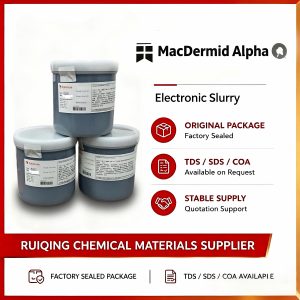
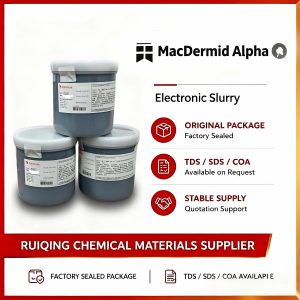
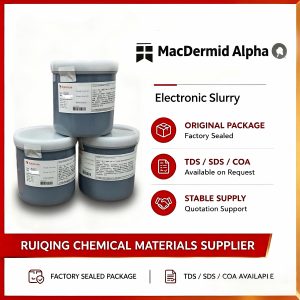
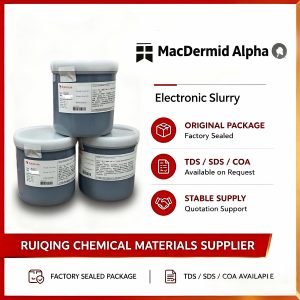
MacDermid Alpha Micromax 5029 High Print Thickness Silver for Smartcard Antenna
Type: Polymer Silver Ink
Application: Smartcard, RFID Antenna
Solids: 79.5–81.5%
Shelf Life: 6 months
Micromax 5029 is a polymer silver composition for printing coils or antennas in smartcards and RFID tags. It builds high print thickness in a single pass, carries 79.5–81.5% solids, and reaches 4–8 mΩ/sq after lamination at 25μm line thickness on PVC.
Micromax 5029 from MacDermid Alpha is a polymer silver composition developed for smartcard and RFID tag production. It is designed to print coils or antennas on flexible and rigid substrates, including polyester, PVC, polycarbonate, ABS, and polyimide. Normally only one print pass is required to reach the target thickness, which simplifies antenna processing and reduces intermediate handling.
The paste carries 79.5–81.5% solids and a viscosity range of 35–50 Pa.s. For 200 mesh stainless steel screens with 15μm emulsion, printed line thickness reaches 20–30μm; a 62T polyester screen with 20μm emulsion gives 18–22μm. After lamination, resistivity sits at 4–8 mΩ/sq at 25μm line thickness on 160μm PVC. Drying is 15–30 minutes at 50–60°C peak for PVC, or 2–5 minutes at 120–130°C peak for polyester. Store sealed at 5–30°C; unopened shelf life is 6 months.
Genuine MacDermid Alpha Micromax Imported Stock & Technical Support
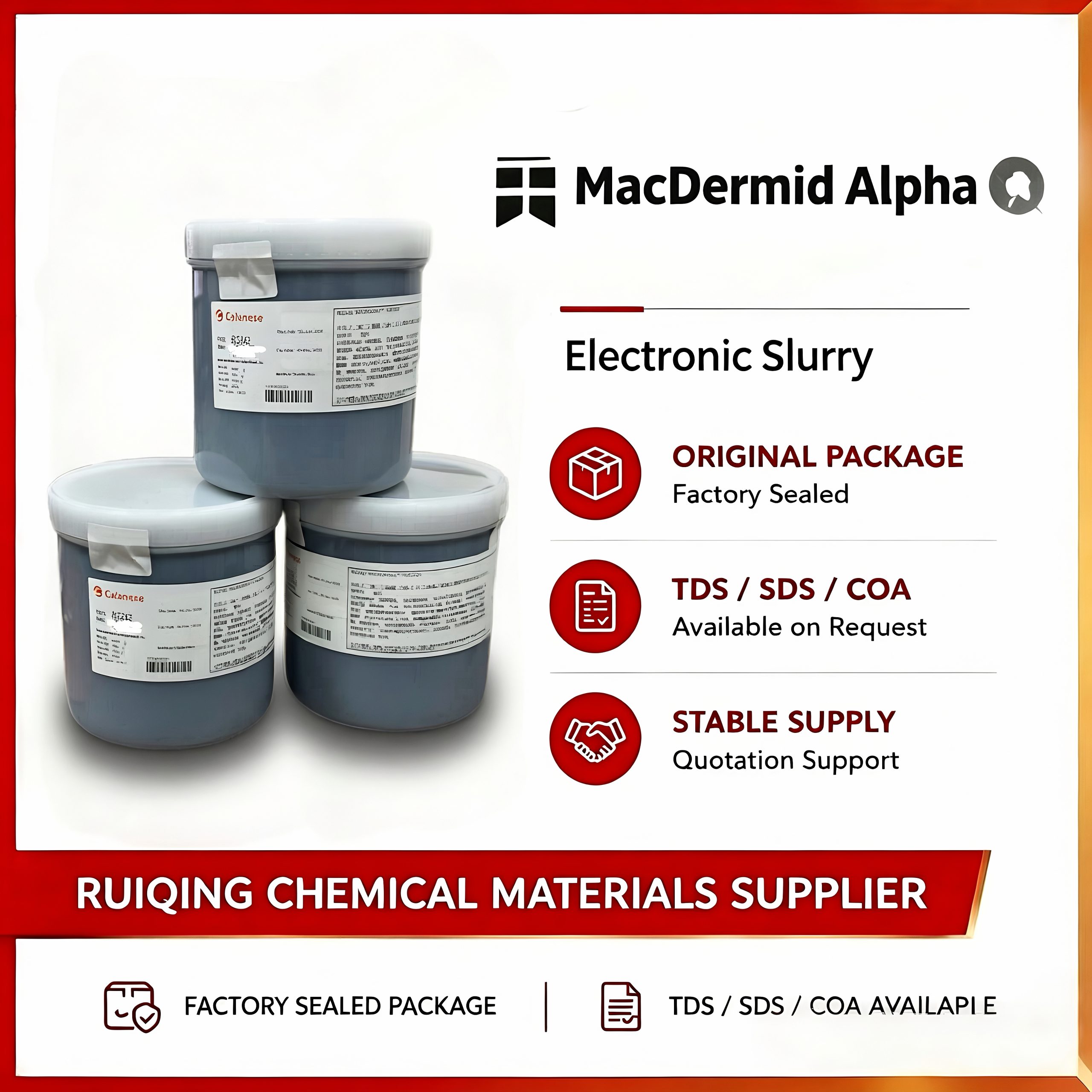
We hold regular stock of authentic MacDermid Alpha Micromax 5029 polymer silver ink. Original factory TDS and batch-specific COA are available on request for your smartcard and RFID antenna programs.
Request Sample, TDS & Quotation
Complete TDS, COA, and regulatory documentation available
Key Features of MacDermid Alpha Micromax 5029
- Polymer silver ink developed for smartcard and RFID antenna printing
- High print thickness achievable in a single print pass
- Higher solids (79.5–81.5%) for lowest resistivity after lamination
- Excellent conductivity: 4–8 mΩ/sq after lamination at 25μm on PVC
- Viscosity 35–50 Pa.s for stable screen printing
- Screen build: 200 mesh stainless steel / 15μm emulsion for 20–30μm lines
- Screen build: 62T polyester / 20μm emulsion for 18–22μm lines
- Printing speed 30–60 cm/s with low squeegee pressure
- Adheres to polyester, PVC, polycarbonate, ABS, and polyimide
- Compatible with standard card lamination processes
- Screen clean-up with ethylene glycol diacetate
- Thinning not normally required; Micromax 3610 available for minor adjustments
Primary Applications
- Smartcard antennas — coils for contactless card inlays
- RFID tag antennas — silver traces for RFID inlay production
- Single-print thick tracks — designs that need 18–30μm line thickness in one pass
- Lamination-based card builds — processes where resistivity drop after lamination is planned
Full Technical Specifications
| Property | Typical Value | TDS Reference |
| Product Type | Polymer silver ink | TDS: Polymer Silver |
| Application | Membrane switch conductor (per TDS table); described for smartcard / RFID coils and antennas | TDS: Membrane switch conductor |
| Solvent or Thinner | Micromax 3610 | TDS: Micromax 3610 |
| Solid Content | 79.5 to 81.5 % | TDS: 79.5 to 81.5 % |
| Viscosity | 35 to 50 Pa.s | TDS: 35 to 50 Pa.s |
| Mask Mesh | 200 | TDS: 200 |
| Mask Emulsion | 15 μm | TDS: 15 μm |
| Theoretical Coverage | 60 to 80 cm²/g | TDS: 60 to 80 cm²/g |
| Substrate Compatibility | Polyester, PVC, polycarbonate, ABS, polyimide | TDS: Polyester, PVC, Polycarbonate, ABS, Polymide |
| Screen Types | 200 mesh stainless steel or 62T polyester | TDS: 200 mesh stainless steel or 62T polyester screen |
| Printing Methods | Reel-to-reel, semi-automatic, manual | TDS: Reel to reel, semi-automatic or manual |
| Printing Speed | 30 to 60 cm/s | TDS: 30-60 cm/s |
| Typical Line Thickness (200 mesh stainless / 15μm emulsion) | 20 to 30 μm | TDS: 20-30μm |
| Typical Line Thickness (62T polyester / 20μm emulsion) | 18 to 22 μm | TDS: 18-22μm |
| Resistivity After Lamination | 4 to 8 mΩ/sq (25μm line thickness, 160μm PVC substrate) | TDS: After Lamination 4 – 8 (mΩ/sq) |
| Drying (PVC substrates, conveyor oven) | 15–30 minutes, peak temperature 50–60°C | TDS: 15-30 minutes, 50-60°C |
| Drying (Polyester substrates, conveyor oven) | 2–5 minutes, peak temperature 120–130°C | TDS: 2-5 minutes, 120-130°C |
| Lamination | Compatible with standard card lamination processes; significantly reduces achieved resistance | TDS: standard card lamination processor |
| Thinning | Not normally required; Micromax 3610 for minor adjustment | TDS: thinning is not normally required |
| Clean-up Solvent | Ethylene glycol diacetate | TDS: Ethylene glycol dicateate |
| Room Temperature for Printing | 20 to 23 °C | TDS: 20°C – 23°C |
| Shelf Life | 6 months | TDS: 6 months |
| Storage Temperature | 5 – 30 °C | TDS: 5°C – 30°C |
Note: All listed values are typical and may vary by batch. Values based on MacDermid Alpha official TDS. Independent qualification testing is required prior to production use.
Recommended Processing Conditions
| Parameter | Recommended Value | TDS Reference |
| Mixing Prior to Use | Slow, gentle hand stirring 1–2 minutes with a clean burr-free spatula; avoid air entrapment | TDS: 1-2 minutes, slow gentle hand stirring |
| Screen Mesh | 200 mesh stainless steel, or 62T–77T polyester | TDS: 200 mesh stainless steel or 62T polyester |
| Screen Emulsion | 15 μm (stainless); 20–25 μm (polyester) | TDS: 15 μm / 20-25 μm |
| Number of Prints | One print for standard thickness; multiple prints with intermediate drying for very thick tracks | TDS: Normally only one print is needed |
| Printing Speed | 30–60 cm/s with low squeegee pressure | TDS: 30-60 cm/s |
| Fine Line Design | For lines ≤150μm, use thinner print screens | TDS: 150μm or less |
| Drying (PVC, conveyor) | 15–30 minutes at 50–60°C peak | TDS: 15-30 minutes, 50-60°C |
| Drying (Polyester, conveyor) | 2–5 minutes at 120–130°C peak | TDS: 2-5 minutes, 120-130°C |
| Thinning | Not normally required; Micromax 3610 for minor adjustment | TDS: thinning is not normally required |
| Clean-up Solvent | Ethylene glycol diacetate | TDS: Ethylene glycol dicateate |
Handling and Storage Recommendations
| Storage Rules | Store tightly sealed in a clean, stable environment at 5-30°C. | TDS: 5°C – 30°C |
| Shelf Life | 6 months in unopened containers from date of shipment. | TDS: 6 months |
| Pre-use Preparation | Bring material to 20–23°C before printing. Thoroughly mix prior to use. Some settling of solids may occur during storage. | TDS: 20°C – 23°C |
| Contamination Control | Keep paste, screens, and tools free of metal contamination. Dust and lint can contribute to poor yields. | TDS: free of metal contamination |
| Transportation | Under normal shipping conditions, no temperature control is expected. For extended transport periods, confirm product suitability. | TDS: normal shipping conditions |
Official Technical Documentation
| Document Type | Document Introduction | Document Request |
| TDS | MacDermid Alpha Micromax 5029 original factory technical data sheet | Request TDS |
| COA | Batch-specific certificate of analysis | Request COA |
| SDS | Safety Data Sheet for handling and storage | Request SDS |
Frequently Asked Questions
What makes 5029 suitable for smartcard and RFID antennas?
The TDS positions 5029 as a polymer silver composition for printing coils or antennas in smartcards and RFID tags. It builds high print thickness in a single pass, which suits antenna designs that need thicker tracks in fewer process steps.
How does lamination change the resistivity of 5029?
The TDS states that standard card lamination significantly reduces achieved resistance. After lamination, resistivity is 4–8 mΩ/sq at 25μm line thickness on 160μm PVC substrate.
Do I need more than one print pass with 5029?
Normally one print is enough to reach the target thickness. For very thick tracks, multiple prints can be used, with an intermediate drying stage in between.
Which screen builds work best for 5029?
Two TDS-documented builds: 200 mesh stainless steel with 15μm emulsion for 20–30μm lines, or 62T polyester with 20μm emulsion for 18–22μm lines. Stainless steel screens give higher definition and thicker prints at a given mesh count.
Why is a warm-up period important before printing 5029?
The TDS notes optimum printing characteristics are achieved at 20–23°C. Bring the container to this range before printing so the rheology and print thickness behave as expected.
Can 5029 be thinned with generic solvent?
Thinning is not normally required. Use the Micromax-recommended thinner for small viscosity adjustments or to replace evaporation loss. Too much thinner, or a non-recommended thinner, can change rheology and print characteristics.
How should 5029 be stored between production runs?
Keep containers tightly sealed at 5–30°C in a clean, stable environment. Unopened shelf life is 6 months from shipment. Some settling may occur, so mix thoroughly before reuse.
Get MacDermid Alpha Micromax 5029 Bulk Pricing and Technical Support
We supply authentic MacDermid Alpha Micromax 5029 polymer silver ink for smartcard and RFID antenna programs. Contact our team for bulk quotations, sample availability, technical documentation, and application support.
Inquire Bulk Price & Technical Support
Disclaimer: All technical data on this page are for general guidance only and are not product specifications. Buyers must carry out independent trials and verify suitability before bulk ordering. Actual values may vary between production lots.