描述
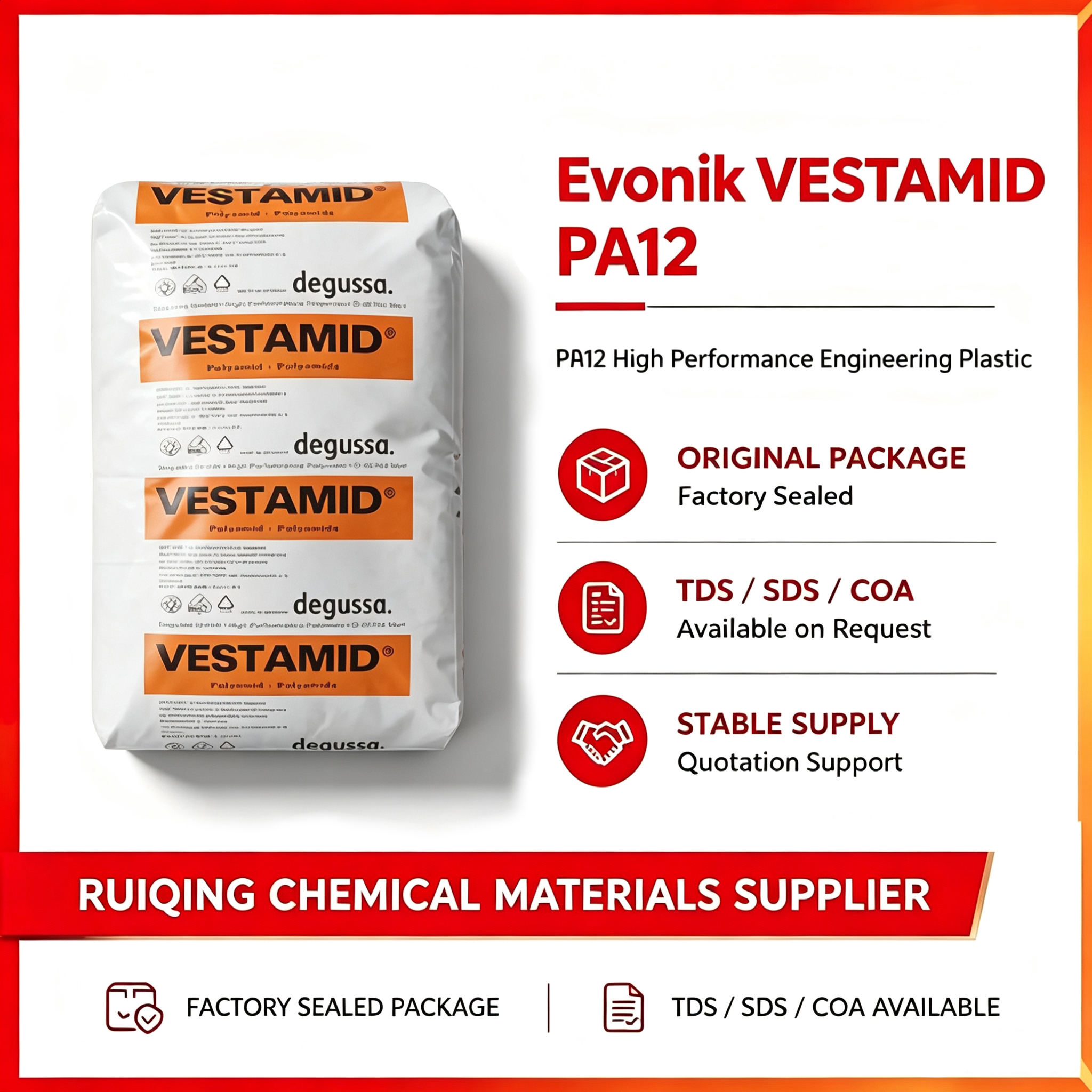
VESTAMID L1833 BK 9.7623 is a 23% glass fiber reinforced, easily demoldable and heat-stabilized polyamide 12 compound manufactured by Evonik Operations GmbH. The grade is designed for injection molding and combines the dimensional stability and low moisture uptake of PA12 with significantly increased stiffness and heat resistance from glass fiber reinforcement.
A particularly important feature of VESTAMID L1833 BK 9.7623 is its mold-release behavior. The formulation contains a release agent, allowing molded parts to separate efficiently from the tool and supporting short injection-molding cycle times. This makes the grade attractive for serial production where both part performance and production efficiency matter.
The 23% glass fiber loading provides a useful balance between rigidity, strength and impact behavior. Typical dry tensile modulus is approximately 5,500 MPa, while the material retains strong unnotched and notched Charpy impact performance at both room temperature and -30°C.
PA12 also absorbs relatively little moisture compared with many conventional polyamides. For VESTAMID L1833 BK 9.7623, published water absorption is approximately 1.2% and humidity absorption approximately 0.6%. This contributes to stable dimensions and more consistent mechanical properties when environmental humidity changes.
The grade is supplied in black pellet form and is intended for injection-molded components in automotive and general industrial applications. Its combination of stiffness, impact strength, heat resistance, low shrinkage and good electrical insulation makes it suitable for precision engineering components, housings, structural parts and other demanding molded applications.
Explore additional materials in our PA12 Polyamide 12 Product Category →.
For manufacturer information about the VESTAMID PA12 family, visit the Official Evonik VESTAMID Page →.
Key Features of VESTAMID L1833 BK 9.7623
| Feature | Benefit |
|---|---|
| 23% Glass Fiber Reinforcement | Increases stiffness, mechanical strength and dimensional control |
| Heat Stabilized | Supports demanding engineering applications at elevated temperatures |
| Easy Mold Release | Helps improve production efficiency and shorten injection-molding cycle times |
| High Tensile Modulus | Approx. 5,500 MPa dry for rigid structural components |
| Low Water Absorption | Helps reduce dimensional changes caused by humidity |
| Good Dimensional Stability | Suitable for precision molded parts |
| Strong Impact Performance | Retains useful impact strength at room and sub-zero temperatures |
| Low Mold Shrinkage | Supports controlled dimensions in molded components |
| Electrical Insulation | High volume resistivity and CTI 600 support insulating applications |
| High Heat Deflection Temperature | HDT reaches approximately 160°C at 1.80 MPa |
| Black Pellets | Supplied as a ready-colored engineering compound |
| Injection Molding Grade | Developed for efficient production of reinforced PA12 components |
The combination of glass fiber reinforcement and low moisture absorption allows VESTAMID L1833 BK 9.7623 to deliver relatively stable mechanical and dimensional performance across changing environmental conditions.
Typical Applications for VESTAMID L1833 BK 9.7623
VESTAMID L1833 BK 9.7623 is suitable for injection-molded parts that require higher stiffness than unreinforced PA12 while still benefiting from the moisture resistance and impact behavior of polyamide 12.
| Application Area | Typical Use |
|---|---|
| Automotive Components | Rigid precision parts, housings, brackets and functional molded components |
| Industrial Equipment | Structural molded parts requiring stiffness and chemical resistance |
| Electrical Components | Insulating housings and components requiring dimensional stability |
| Precision Engineering | Parts with tight dimensional requirements under changing humidity |
| Mechanical Components | Rigid technical parts exposed to repeated handling or vibration |
| Pump & Valve Components | Selected housings and structural parts where PA12 chemical resistance is beneficial |
| General Industrial Moldings | High-performance injection-molded components requiring easy demolding |
| Series Production Parts | Components where short cycle time and reliable mold release are important |
Evonik identifies automotive and general industry as key application sectors for the L1833 family, while the material’s easy-release formulation makes it particularly suitable for efficient injection molding.
Typical Properties of VESTAMID L1833 BK 9.7623
Physical & Processing Properties
| Property | Typical Value | Test Method |
|---|---|---|
| Density | 1.17 g/cm³ | ISO 1183 |
| Water Absorption | 1.2% | Similar to ISO 62 |
| Humidity Absorption | 0.6% | Similar to ISO 62 |
| Melt Volume-Flow Rate (MVR) | 41 cm³/10 min | ISO 1133 |
| MVR Test Condition | 275°C / 5 kg | — |
| Molding Shrinkage – Parallel | 0.3% | ISO 294-4 / 2577 |
| Molding Shrinkage – Normal | 0.6% | ISO 294-4 / 2577 |
The relatively low mold shrinkage of VESTAMID L1833 BK 9.7623 is useful for precision parts where dimensional consistency is an important design requirement.
Mechanical Properties
| Property | Typical Value (Dry / Conditioned) | Test Method |
|---|---|---|
| Tensile Modulus | 5,500 / 4,650 MPa | ISO 527 |
| Yield Stress | 106 / 100 MPa | ISO 527 |
| Yield Strain | 4 / 5% | ISO 527 |
| Nominal Strain at Break | 7 / 7% | ISO 527 |
| Charpy Unnotched Impact, 23°C | 90 / 81 kJ/m² | ISO 179/1eU |
| Charpy Unnotched Impact, -30°C | 95 / 83 kJ/m² | ISO 179/1eU |
| Charpy Notched Impact, 23°C | 25 / 18 kJ/m² | ISO 179/1eA |
| Charpy Notched Impact, -30°C | 16 / 13 kJ/m² | ISO 179/1eA |
These values show that VESTAMID L1833 BK 9.7623 combines meaningful stiffness from glass fiber reinforcement with useful impact strength, including at -30°C.
Thermal Properties
| Property | Typical Value | Test Method |
|---|---|---|
| Melting Temperature | 178°C | ISO 11357-1/-3 |
| Glass Transition Temperature | 40°C | ISO 11357-1/-2 |
| HDT @ 1.80 MPa | 160°C | ISO 75-1/-2 |
| HDT @ 0.45 MPa | 175°C | ISO 75-1/-2 |
| Vicat Softening Temperature B | 175°C | ISO 306 |
| CTE – Parallel | 70 × 10⁻⁶/K | ISO 11359-1/-2 |
| Flammability @ 1.6 mm | HB | IEC 60695-11-10 |
The 160°C HDT at 1.80 MPa makes VESTAMID L1833 BK 9.7623 significantly more suitable for heat-loaded structural applications than many unreinforced PA12 grades.
Electrical Properties
| Property | Typical Value (Dry / Conditioned) | Test Method |
|---|---|---|
| Volume Resistivity | 1 × 10¹³ / 2.3 × 10¹² Ω·m | IEC 62631-3-1 |
| Relative Permittivity, 100 Hz | 2.6 | IEC 62631-2-1 |
| Relative Permittivity, 1 MHz | 2.3 | IEC 62631-2-1 |
| Dissipation Factor, 1 MHz | 158 × 10⁻⁴ | IEC 62631-2-1 |
| Electric Strength | 49 kV/mm conditioned | IEC 60243-1 |
| Comparative Tracking Index (CTI) | 600 | IEC 60112 |
These values confirm that VESTAMID L1833 BK 9.7623 is an electrically insulating glass-fiber reinforced PA12 rather than a conductive or antistatic grade.
Why Choose VESTAMID L1833 BK 9.7623?
The main reason to select VESTAMID L1833 BK 9.7623 is its balance of stiffness, heat resistance, dimensional stability and production efficiency.
Unreinforced PA12 is valued for its low moisture absorption and good toughness, but it may not provide enough rigidity for highly loaded structural parts. Reinforcing PA12 with 23% glass fiber increases modulus and strength while preserving useful impact performance.
The easy-mold-release formulation is another important differentiator. For high-volume injection molding, difficult demolding can increase cycle time, raise the risk of part deformation and reduce productivity. The release-agent package in this grade is specifically intended to support efficient mold release.
The material’s low water absorption also improves dimensional consistency. This is especially useful in automotive, electrical and industrial parts that may experience changing humidity during service.
For applications where 30% or higher glass fiber is not necessary, the 23% reinforcement level can provide a balanced option between stiffness and impact behavior.
Processing Guidelines for VESTAMID L1833 BK 9.7623
VESTAMID L1833 BK 9.7623 is designed for injection molding. Evonik’s official VESTAMID processing guide lists a general melt-processing temperature range of approximately 240–280°C for VESTAMID L1833.
| Processing Item | Typical / Recommended Guidance |
|---|---|
| Primary Processing Method | Injection Molding |
| General Processing Temperature | Approx. 240–280°C |
| ISO Test Melt Temperature | Approx. 240°C |
| ISO Test Mold Temperature | Approx. 80°C |
| ISO Test Injection Velocity | Approx. 200 mm/s |
| Material Supply Condition | Dry pellets in moisture-proof packaging |
| Mold Release | Release agent incorporated in the compound |
The product is supplied in moisture-proof bags and is described as ready for processing. If the packaging has been opened or damaged and the pellets have absorbed moisture, the material should be dried according to Evonik’s general VESTAMID processing recommendations before molding.
Because the material contains 23% glass fiber, injection-molding equipment should be appropriate for reinforced engineering plastics. Tool design, gate position, injection speed, holding pressure and mold temperature should be optimized for the actual part geometry.
The integrated mold-release functionality of VESTAMID L1833 BK 9.7623 can help support shorter molding cycles, but actual cycle time will depend on part thickness, mold design and cooling conditions.
VESTAMID L1833 BK 9.7623 vs. VESTAMID L-GF30 BK 9.7506
| Feature | VESTAMID L1833 BK 9.7623 | VESTAMID L-GF30 BK 9.7506 |
|---|---|---|
| Base Polymer | PA12 | PA12 |
| Glass Fiber Content | 23% | 30% |
| Tensile Modulus | Approx. 5,500 MPa dry | Approx. 6,800 MPa dry |
| Yield Stress | Approx. 106 MPa dry | Approx. 114 MPa dry |
| HDT @ 0.45 MPa | Approx. 175°C | Approx. 175°C |
| Main Feature | Easy mold release + balanced stiffness | Higher glass-fiber reinforcement and stiffness |
| Primary Processing | Injection molding | Injection molding |
| Best Fit | Efficient production of rigid precision parts | Parts requiring higher structural stiffness |
Choose VESTAMID L1833 BK 9.7623 when easy demolding, balanced stiffness and good impact behavior are important.
Choose VESTAMID L-GF30 BK 9.7506 when higher reinforcement and greater stiffness are the main priorities.
Related Products
VESTAMID L-GF30 BK 9.7506 – 30% glass fiber reinforced PA12 for higher-stiffness structural components.
VESTAMID L-GF15 – 15% glass fiber reinforced PA12 for rigid and tough molded parts.
VESTAMID L1930 BK 9.7506 – Reinforced PA12-family grade for demanding engineering applications.
View More PA12 Polyamide 12 Materials →
Technical Documents for VESTAMID L1833 BK 9.7623
| Document Type | Description |
|---|---|
| TDS | Technical Data Sheet with physical, mechanical, thermal and electrical properties |
| SDS | Safety Data Sheet |
| COA | Batch-specific Certificate of Analysis where available |
| Compliance Documents | Relevant regulatory and material compliance documentation subject to availability |
Need technical documents for VESTAMID L1833 BK 9.7623?
📧 Email: ruiqingchem@gmail.com
📝 Online form: Contact Us →
Please state VESTAMID L1833 BK 9.7623 and the required document type when submitting your inquiry.
FAQ About VESTAMID L1833 BK 9.7623
Q1: What is VESTAMID L1833 BK 9.7623?
VESTAMID L1833 BK 9.7623 is a heat-stabilized PA12 compound reinforced with approximately 23% glass fiber. It is designed for injection molding and includes a release agent for efficient demolding.
Q2: How much glass fiber does VESTAMID L1833 BK 9.7623 contain?
The grade contains approximately 23% glass fiber, which increases stiffness, strength and dimensional stability compared with unreinforced PA12.
Q3: What are the main applications of VESTAMID L1833 BK 9.7623?
Typical applications include automotive parts, industrial components, electrical housings and other rigid precision injection-molded parts.
Q4: What is the density of VESTAMID L1833 BK 9.7623?
The typical density is approximately 1.17 g/cm³ according to ISO 1183.
Q5: What is the tensile modulus of VESTAMID L1833 BK 9.7623?
The typical tensile modulus is approximately 5,500 MPa dry and 4,650 MPa conditioned according to ISO 527.
Q6: What is the heat deflection temperature of VESTAMID L1833 BK 9.7623?
The typical HDT is approximately 160°C at 1.80 MPa and 175°C at 0.45 MPa.
Q7: What is the MVR of VESTAMID L1833 BK 9.7623?
The typical MVR is approximately 41 cm³/10 min at 275°C / 5 kg according to ISO 1133.
Q8: What processing temperature is recommended for VESTAMID L1833 BK 9.7623?
Evonik’s general VESTAMID processing guide lists approximately 240–280°C for the L1833 family. Actual settings should be optimized for the mold and part design.
Q9: Why is VESTAMID L1833 BK 9.7623 described as easily demoldable?
The compound contains a mold-release additive. This helps parts release efficiently from the mold and can support shorter molding cycles in serial production.
Q10: Can you provide VESTAMID L1833 BK 9.7623 TDS, SDS and COA?
Yes. Please request the required technical documents through our Contact Page → or email ruiqingchem@gmail.com.
Request VESTAMID L1833 BK 9.7623 Price & Technical Support
For pricing, availability, technical documents or grade-selection support for VESTAMID L1833 BK 9.7623, please provide:
- Required quantity
- Destination country or port
- Target application
- Part dimensions or design requirements
- Injection-molding conditions
- Required mechanical / thermal performance
- TDS, SDS or COA requirements
- Sample requirement, if applicable
📧 Email: ruiqingchem@gmail.com
📝 Send Inquiry →