描述
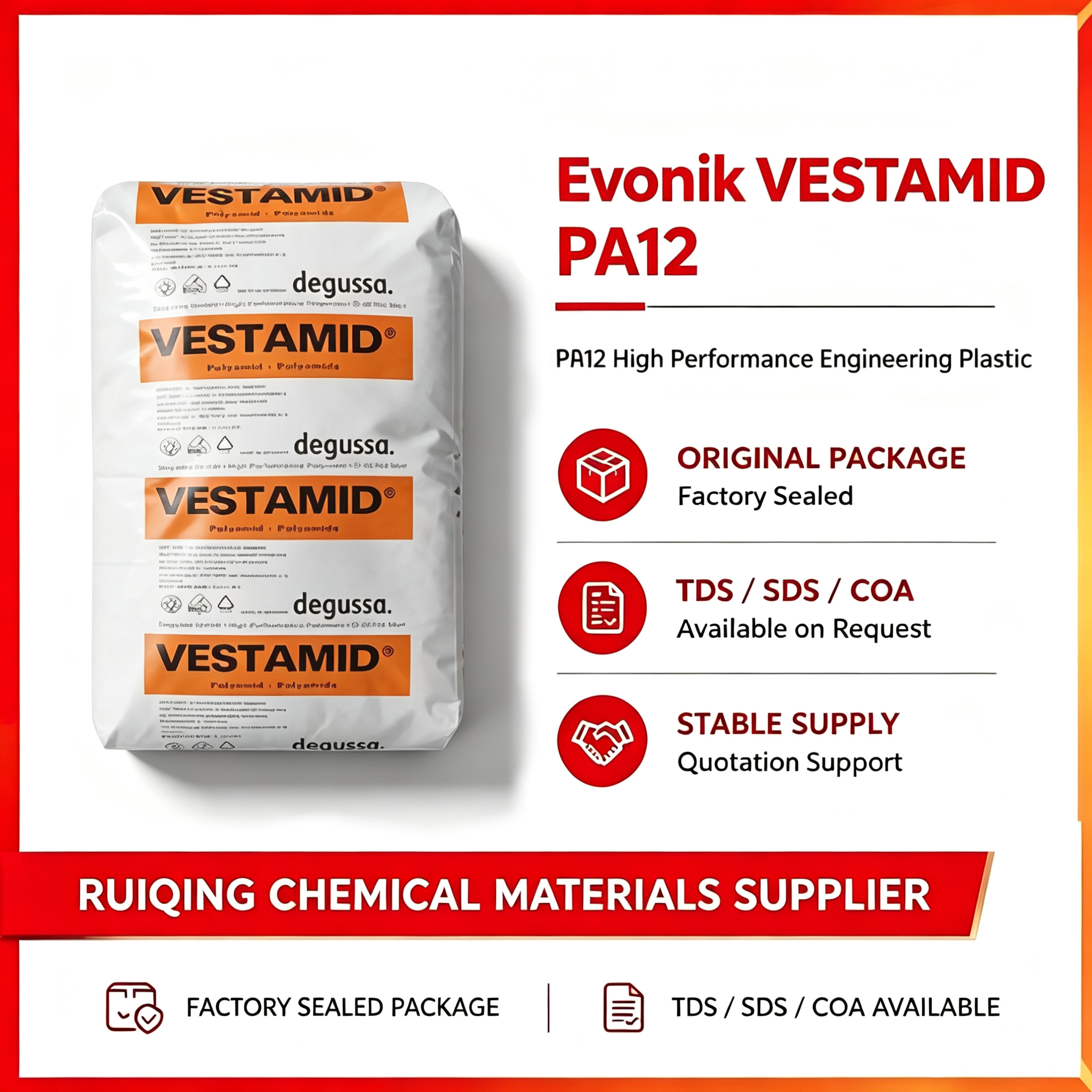
VESTAMID X7166 is a low-viscosity, self-extinguishing polyamide 12 compound from Evonik Operations GmbH developed for electrical, electronic and cable applications.
The grade is heat stabilized and contains a non-migrating flame-retardant system that is free of halogen and phosphorus. This makes VESTAMID X7166 particularly useful where customers want flame-retardant PA12 without relying on conventional halogenated flame-retardant systems.
The material is classified as PA12 FR(30) in current material databases. The designation FR(30) is a resin classification code and should not be interpreted as meaning that the compound contains 30% flame retardant.
A major commercial advantage is the combination of flame retardancy with low viscosity. VESTAMID X7166 is suitable for both injection molding and wire/cable extrusion coating, allowing one material family to support thin electrical components, cable jackets and insulation-related applications.
According to current Evonik-derived data, the grade meets UL 94 V-2 performance. The current UL Yellow Card lists V-2 down to 0.75 mm, while current Evonik/MDC data also reports V-2 at approximately 0.8 mm in IEC 60695-11-10 testing.
This level of flame performance is particularly relevant to electrical connectors, cable systems, telecommunications components and other parts where self-extinguishing behavior is required but a V-0 rating is not mandatory.
The material also offers strong electrical insulation characteristics. Current grade-specific data lists a relative permittivity of 3.6 at 1 MHz, volume resistivity around 1 × 10¹² Ω·m, electric strength around 28 kV/mm and CTI 600.
The CTI 600 value is especially useful for electrical applications because it indicates strong resistance to surface tracking under standardized test conditions.
The low viscosity of VESTAMID X7166 also supports thin-wall molding and wire coating. Current MVR is approximately 108 cm³/10 min under a 2.16 kg test load; public regional data shows that this value has been reported under different melt-temperature conditions, so the test condition should always accompany the MVR value.
Current mechanical data shows a dry tensile modulus of approximately 1,890 MPa, yield stress of approximately 47 MPa and nominal strain at break around 20%.
The grade retains useful low-temperature impact behavior, including approximately 80 kJ/m² unnotched Charpy at -30°C and approximately 5 kJ/m² notched Charpy at -30°C.
For more PA12 materials, visit our PA12 Polyamide 12 Product Category →.
For manufacturer cable-material information, see the Official Evonik VESTAMID Cable Sheathing Guide →.
Key Features of VESTAMID X7166
| Feature | Engineering Benefit |
|---|---|
| Low Viscosity | Supports thin-wall injection molding and wire/cable coating |
| Self-Extinguishing PA12 | Improves fire behavior compared with standard unmodified PA12 |
| UL 94 V-2 | Suitable for many electrical and electronic components |
| Halogen-Free Flame Retardant | Avoids halogenated flame-retardant chemistry |
| Phosphorus-Free Flame Retardant | Supports phosphorus-free material specifications |
| Non-Migrating Flame Retardant | Helps maintain stable flame-retardant performance |
| Heat Stabilized | Supports electrical and cable processing/service conditions |
| High CTI 600 | Excellent tracking resistance for electrical insulation |
| Electrical Insulation | High volume resistivity and useful dielectric strength |
| PA12 Moisture Stability | Lower moisture sensitivity than shorter-chain polyamides |
| Injection Molding | Suitable for molded electrical/electronic parts |
| Wire/Cable Extrusion Coating | One of the grade’s main commercial applications |
The defining advantage of VESTAMID X7166 is its combination of low viscosity, PA12 durability and halogen-/phosphorus-free flame retardancy.
Typical Applications for VESTAMID X7166
VESTAMID X7166 is especially suited to electrical and cable applications where flame resistance and processability are both important.
| Application Area | Typical Use |
|---|---|
| Wire Extrusion Coating | Flame-retardant PA12 coating around electrical wire |
| Cable Sheathing | Outer or functional PA12 cable layers |
| Electrical Components | Molded insulating and connector parts |
| Electronic Components | Thin molded housings and functional parts |
| Telecommunications | Cable and connector applications |
| Industrial Wiring | Durable flame-retardant cable protection |
| Aerospace Electrical Systems | Selected wire and cable components subject to application qualification |
| Building & Construction Electrical Parts | Components requiring PA12 and V-2 flame behavior |
| Thin-Wall Injection Moldings | Low-viscosity molded parts with electrical functionality |
Evonik’s current material descriptions place the strongest emphasis on the electronic and cable industry, particularly wire extrusion coating.
Typical Properties of VESTAMID X7166
Physical & Rheological Properties
| Property | Typical Value | Test Method |
|---|---|---|
| Density | 1.07 g/cm³ | ISO 1183 |
| Water Absorption | 1.3% | Similar to ISO 62 |
| Humidity Absorption | 0.6% | Similar to ISO 62 |
| MVR | 108 cm³/10 min | ISO 1133 |
| MVR Test Load | 2.16 kg | ISO 1133 |
| Molding Shrinkage – Parallel | 0.7% | ISO 294-4 / 2577 |
| Molding Shrinkage – Normal | 0.8% | ISO 294-4 / 2577 |
| Melt Density | 860 kg/m³ | Manufacturer data |
| Structure | Semi-crystalline | Manufacturer information |
| Color | Natural Color | Manufacturer information |
A regional Daicel-Evonik page also publishes MVR values of 79 cm³/10 min at 190°C / 2.16 kg and 108 cm³/10 min at 230°C / 2.16 kg. Because public databases show different reported test temperatures for the 108 value, always retain the test condition together with the MVR when communicating flow data.
Mechanical Properties
| Property | Typical Dry Value | Test Method |
|---|---|---|
| Tensile Modulus | 1,890 MPa | ISO 527 |
| Yield Stress | 47 MPa | ISO 527 |
| Yield Strain | 5.8% | ISO 527 |
| Nominal Strain at Break | 20% | ISO 527 |
| Charpy Impact Strength, 23°C | 57 kJ/m² | ISO 179/1eU |
| Charpy Impact Strength, -30°C | 80 kJ/m² | ISO 179/1eU |
| Charpy Notched Impact, 23°C | 3 kJ/m² | ISO 179/1eA |
| Charpy Notched Impact, -30°C | 5 kJ/m² | ISO 179/1eA |
Thermal & Flammability Properties
| Property | Typical Value | Test Method |
|---|---|---|
| Melting Temperature | 178°C | ISO 11357-1/-3 |
| Glass Transition Temperature | 41°C | ISO 11357-1/-2 |
| HDT @ 1.80 MPa | 50°C | ISO 75-1/-2 |
| HDT @ 0.45 MPa | 140°C | ISO 75-1/-2 |
| Vicat Softening Temperature B | 150°C | ISO 306 |
| Flame Class | V-2 | IEC 60695-11-10 / UL 94 |
| V-2 Thickness, current UL listing | 0.75 mm minimum | UL Yellow Card |
| V-2 Thickness, Evonik/MDC data | Approx. 0.8 mm | IEC 60695-11-10 |
| Oxygen Index | 34% | ISO 4589-1/-2 |
| UL Yellow Card | Available | UL |
Electrical Properties
| Property | Typical Dry Value | Test Method |
|---|---|---|
| Relative Permittivity, 1 MHz | 3.6 | IEC 62631-2-1 |
| Dissipation Factor, 1 MHz | 0.034 | IEC 62631-2-1 |
| Volume Resistivity | 1 × 10¹² Ω·m | IEC 62631-3-1 |
| Electric Strength | 28 kV/mm | IEC 60243-1 |
| Comparative Tracking Index | 600 | IEC 60112 |
Why Choose VESTAMID X7166?
The main reason to choose VESTAMID X7166 is its balanced performance for flame-retardant electrical and cable applications.
Standard PA12 provides low moisture absorption, toughness, chemical resistance and dimensional stability, but it does not automatically provide the flame behavior required by many electrical products.
VESTAMID X7166 uses a non-migrating flame retardant that Evonik identifies as free from both halogen and phosphorus. That makes the grade especially useful where material-selection rules restrict traditional flame-retardant chemistry.
The low-viscosity formulation is another important differentiator. Wire coating requires fast and uniform melt flow through a crosshead die, while small electrical components often contain thin walls and complex flow paths.
Electrical tracking resistance adds further value. CTI 600 supports demanding insulation design and can help designers when creepage-distance performance is important.
The PA12 base resin also helps keep moisture uptake relatively low compared with PA6 or PA66. This improves dimensional stability and helps electrical properties remain more predictable under changing humidity.
For customers seeking halogen-free, phosphorus-free PA12 with UL 94 V-2 performance and good wire-coating flow, VESTAMID X7166 is a highly application-specific grade.
Processing Guidelines for VESTAMID X7166
VESTAMID X7166 can be processed by injection molding, profile extrusion, wire/cable extrusion, coating and other extrusion methods.
Because the compound contains a flame retardant, temperature control is especially important.
| Processing Parameter | Published Guidance |
|---|---|
| Recommended Melt Temperature | 210–230°C |
| Maximum Melt Temperature | Do not exceed 260°C |
| General Evonik X7166 Processing Window | 200–240°C |
| ISO Test Melt Temperature | 220°C |
| ISO Test Mold Temperature | 80°C |
| ISO Test Injection Velocity | 200 mm/s |
| ISO Test Holding Pressure | 70 MPa |
The grade-specific recommendation of 210–230°C should be preferred as the starting point, while the broader Evonik processing guide lists approximately 200–240°C for X7166.
The manufacturer specifically warns that the melt temperature should not exceed 260°C because of the flame-retardant system.
For wire/cable coating, processors should optimize extruder-zone temperature, crosshead temperature, die temperature, line speed, draw-down ratio, coating thickness, conductor preheating, cooling profile, surface quality and concentricity.
For injection molding, optimize melt temperature, mold temperature, injection speed, holding pressure and gate design.
The material is supplied as cylindrical pellets in moisture-proof bags. Evonik states that material can be processed directly after opening intact packaging. Shelf life is at least two years when stored dry below 30°C in original undamaged packaging.
VESTAMID X7166 vs. VESTAMID X7167
| Feature | VESTAMID X7166 | VESTAMID X7167 |
|---|---|---|
| Base Polymer | PA12 FR(30) | PA12 FR(30) |
| Flame-Retardant System | Halogen- and phosphorus-free | Halogen- and phosphorus-free |
| Viscosity | Low | High |
| Primary Market | Electrical, electronics, cable | Aircraft, railway and ship interiors |
| Fire Positioning | UL 94 V-2 | V-2 plus FAR 25.853 / ABD 0031 positioning |
| MVR | High-flow / low-viscosity | Approx. 4.1 cm³/10 min @230°C/2.16 kg |
| Tensile Modulus | Approx. 1,890 MPa | Approx. 1,700 MPa dry |
| Nominal Strain at Break | Approx. 20% | >50% |
| Main Processing Focus | Wire coating + injection molding | Extrusion + injection molding |
| Main Selection Reason | High flow for cable/electrical parts | High viscosity and transport-interior fire requirements |
Choose VESTAMID X7166 when the priority is low viscosity, wire/cable processing and electrical/electronic flame-retardant applications.
Choose VESTAMID X7167 when the application requires a high-viscosity FR PA12 with explicit positioning for aircraft interiors, rail vehicles or ships.
Related Products
VESTAMID X7167 – High-viscosity halogen- and phosphorus-free flame-retardant PA12 for aircraft, railway and ship interior applications.
VESTAMID X7229 – Plasticized flame-retardant PA12 with halogen- and phosphorus-free flame-retardant technology.
VESTAMID LX9057 OR E20081 – Flame-retardant PA12 for electrical and electronic applications.
View More PA12 Polyamide 12 Materials →
Technical Documents for VESTAMID X7166
| Document Type | Description |
|---|---|
| TDS | Physical, mechanical, thermal, electrical and flame-retardant data |
| SDS | Safety Data Sheet |
| UL Yellow Card | Current UL 94 V-2 certification information |
| Cable Sheathing Guide | Evonik wire and cable material-selection information |
| Processing Guide | Injection molding and extrusion guidance |
| COA | Batch-specific quality information where available |
Need technical documents for VESTAMID X7166?
📧 Email: ruiqingchem@gmail.com
📝 Online form: Contact Us →
Please state VESTAMID X7166 and the required document type when submitting your inquiry.
FAQ About VESTAMID X7166
Q1: What is VESTAMID X7166?
VESTAMID X7166 is a low-viscosity, heat-stabilized, self-extinguishing PA12 from Evonik containing a non-migrating flame retardant that is free from halogen and phosphorus.
Q2: What does PA12 FR(30) mean?
PA12 FR(30) is the resin classification used for this flame-retardant PA12 grade. FR(30) should not be interpreted as 30% flame-retardant content.
Q3: What flame rating does VESTAMID X7166 have?
The grade is rated UL 94 V-2. The current UL Yellow Card lists V-2 at a minimum thickness of approximately 0.75 mm.
Q4: Is VESTAMID X7166 halogen free?
Yes. Evonik explicitly describes the flame-retardant system as halogen free.
Q5: Is VESTAMID X7166 phosphorus free?
Yes. The grade is also specifically described as phosphorus free.
Q6: What is the main application of VESTAMID X7166?
The main applications are wire extrusion coating, cable sheathing, electrical components and electronic parts.
Q7: What is the tensile modulus?
The current dry tensile modulus is approximately 1,890 MPa according to ISO 527.
Q8: What is the CTI?
The current Comparative Tracking Index is approximately 600, making the grade attractive for electrical-insulation designs.
Q9: What processing temperature is recommended?
Evonik’s grade-specific recommendation is approximately 210–230°C, and melt temperature should not exceed 260°C. The broader processing guide lists approximately 200–240°C.
Q10: What is the difference between VESTAMID X7166 and X7167?
X7166 is the low-viscosity grade focused on electrical and cable applications. X7167 is high viscosity and is positioned more strongly for aircraft, railway and ship interior components.
Request VESTAMID X7166 Price & Technical Support
For pricing, availability, technical documents or application support for VESTAMID X7166, please provide:
- Required quantity
- Destination country or port
- Wire, cable or injection-molded application
- Required UL 94 thickness
- Cable diameter
- Coating thickness
- Electrical insulation requirement
- CTI requirement
- Operating temperature
- Color requirement
- Extrusion or injection-molding equipment information
- TDS, SDS, UL Yellow Card or COA requirement
- Sample requirement, if applicable
📧 Email: ruiqingchem@gmail.com
📝 Send Inquiry →