描述
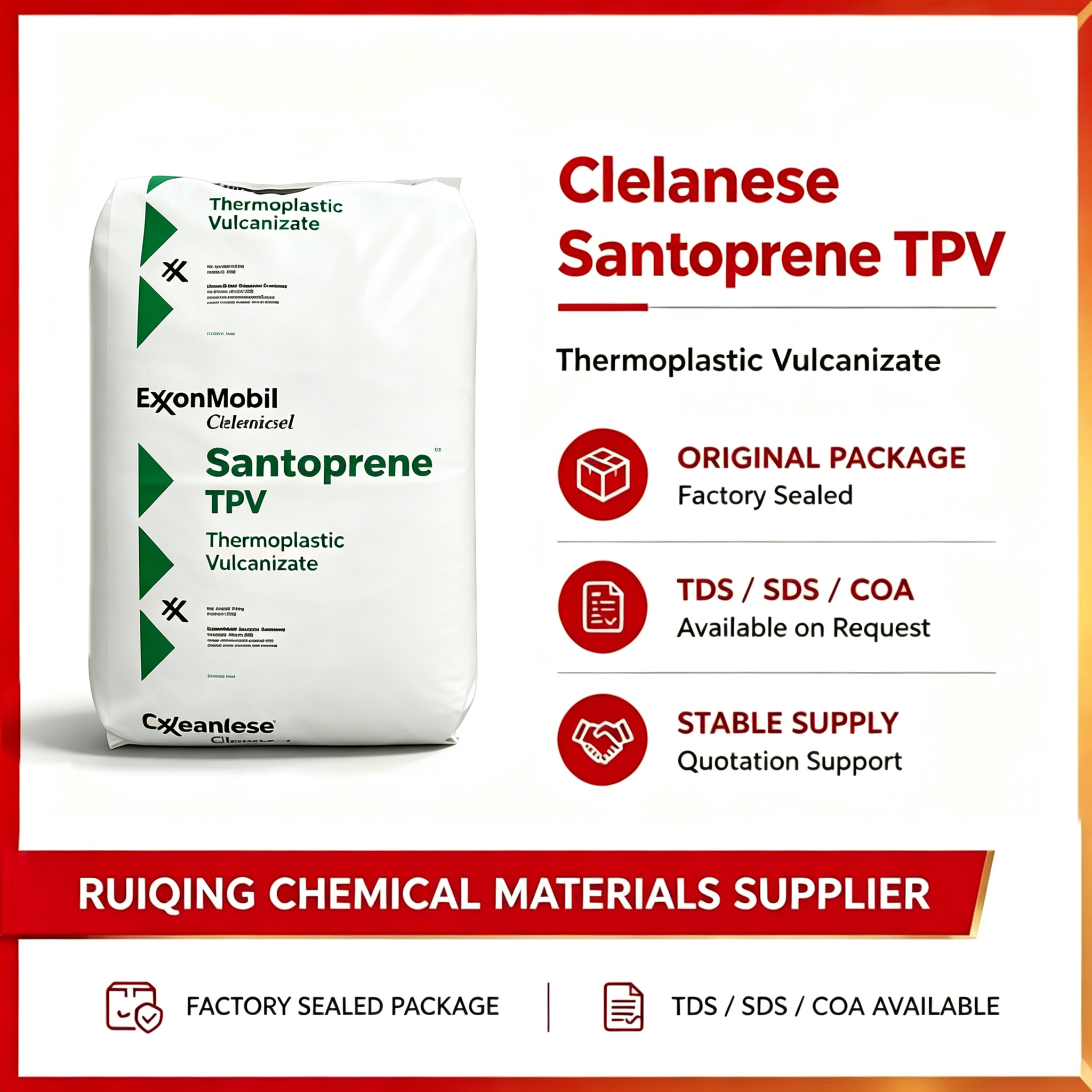
Santoprene 8211-55B100 is a soft, Natural and colorable thermoplastic vulcanizate from Celanese specially developed for hard/soft overmolding applications requiring direct adhesion between TPV and selected rigid thermoplastics.
Unlike a conventional general-purpose TPV, the defining feature of Santoprene 8211-55B100 is its B100 bonding technology.
Celanese currently lists the grade with:
- 53 Shore A hardness
- Natural appearance
- 600% elongation at break
- Injection-molding capability
- Special bonding capability
- Adhesion to PC, styrenics and PP
Celanese also identifies B100 grades as capable of bonding to engineering thermoplastics such as PC, ABS and PS, while B100 formulations additionally support PP bonding.
This makes Santoprene 8211-55B100 particularly useful for products that combine:
rigid substrate + flexible soft-touch surface
in a single molded component.
Typical examples include:
- Rigid PC housing + soft TPV grip
- ABS component + flexible sealing edge
- PP structure + soft contact surface
- PC/ABS housing + impact-protection zone
- Rigid control surface + tactile elastomer layer
For more TPV materials, visit our TPV Thermoplastic Vulcanizates Product Category →.
For current Santoprene portfolio information, see the Official Celanese Santoprene & Geolast Product Finder →.
Key Features of Santoprene 8211-55B100
| Feature | Engineering Benefit |
|---|---|
| 53 Shore A Hardness | Provides a soft elastomeric feel for overmolded surfaces |
| Natural / Colorable | Supports light colors and brand-specific color designs |
| 600% Elongation | Allows extensive deformation without immediate rupture |
| B100 Bonding Technology | Provides adhesion to selected rigid thermoplastics |
| PC Bonding | Suitable for soft overmolding onto polycarbonate components |
| ABS Bonding | Useful for consumer and automotive hard/soft components |
| PC/ABS Compatibility | Suitable for many molded housing applications |
| Styrenics Bonding | Supports selected PS-based rigid substrates |
| PP Bonding Capability | Distinguishing feature of the B100 family |
| 2K Molding | Enables integrated hard/soft parts in one molding cycle |
| Insert Molding | Suitable for overmolding previously produced rigid parts |
| Soft-Touch Performance | Useful for hand-contact and ergonomic surfaces |
| Good Surface Appearance | Relevant to visible consumer and automotive parts |
| UL 94 HB Positioning | Suitable where an HB-class material is acceptable |
| Thermoplastic Processing | Allows conventional injection-molding equipment |
What Makes the B100 Technology Important?
The B100 designation is the key part of Santoprene 8211-55B100.
This material is not simply selected according to hardness.
Its main purpose is to solve a common multi-material design problem:
How can a soft TPV be molded directly onto a rigid engineering plastic without relying only on mechanical locking or secondary adhesive?
The B100 formulation is engineered to improve interfacial adhesion between Santoprene TPV and selected thermoplastic substrates.
This can allow a designer to combine:
- Structural rigidity
- Soft tactile feel
- Flexible sealing
- Impact protection
- Vibration isolation
- Ergonomic grip
within one finished molded component.
Bonding to PC
Polycarbonate is commonly used where components require:
- High toughness
- Dimensional stability
- Impact resistance
- Good appearance
Santoprene 8211-55B100 can be used as a soft overmolding material on selected PC grades.
Typical PC + TPV designs may include:
- Electronic housings
- Tool components
- Control surfaces
- Protective edges
- Hand-contact zones
Actual adhesion should be confirmed using the exact PC formulation.
Bonding to ABS
ABS is widely used in:
- Consumer electronics
- Appliances
- Automotive interiors
- Handheld equipment
- Industrial housings
Santoprene 8211-55B100 is specifically positioned for bonding to ABS-type engineering thermoplastics.
This makes it useful for parts requiring:
- Soft grips
- Flexible edges
- Integrated gaskets
- Protective surfaces
- Tactile contact zones
PC/ABS Overmolding
PC/ABS blends are common in durable housings and automotive components.
Celanese’s specialty application material identifies the B100 grade as bondable to engineering thermoplastics including PC, ABS, PC/ABS, ASA and PMMA.
This allows Santoprene 8211-55B100 to be evaluated for:
- Instrument housings
- Consumer electronics
- Automotive controls
- Appliance interfaces
- Protective soft-touch surfaces
PP Bonding – An Important B100 Advantage
One of the most valuable characteristics of the B100 family is PP bonding capability.
Celanese explicitly states that B100 grades can bond to PP in addition to selected engineering thermoplastics.
This is especially useful because polypropylene is extensively used in:
- Automotive parts
- Appliances
- Consumer products
- Household components
- Industrial housings
Possible PP + Santoprene 8211-55B100 designs include:
- PP handle + soft grip
- PP housing + flexible sealing edge
- PP structural component + tactile surface
- PP insert + elastomeric interface
The actual PP formulation remains important because fillers, lubricants and mold-release additives can affect adhesion.
Natural & Colorable Bonding Grade
Santoprene 8211-55B100 is supplied in Natural form.
This is a major advantage for visible hard/soft components because the elastomer does not have to remain black.
Possible finished colors include:
- White
- Light gray
- Dark gray
- Blue
- Red
- Green
- Beige
- Brand-specific colors
This makes the grade particularly useful for consumer applications where appearance is part of the product design.
Soft-Touch Applications
At approximately 53 Shore A, Santoprene 8211-55B100 provides a distinctly soft tactile surface.
This is suitable for products where the user directly touches the elastomer.
Typical benefits include:
- Comfortable grip
- Reduced slipperiness
- Softer edge feel
- Improved tactile differentiation
- Impact cushioning
- Better ergonomic response
Potential products include:
- Hand tools
- Controls
- Handles
- Electronic devices
- Consumer products
- Appliance components
Typical Applications for Santoprene 8211-55B100
| Application Area | Typical Function |
|---|---|
| Soft-Touch Grips | Elastomeric surface over rigid substrate |
| Electronic Housings | Flexible protective edges and tactile areas |
| Automotive Interior Parts | Soft interfaces and control surfaces |
| Appliance Components | Colored hard/soft molded parts |
| Tool Handles | Ergonomic overmolding |
| Control Knobs | Soft tactile surface |
| Protective Corners | Flexible impact protection |
| Integrated Seals | Molded flexible sealing regions |
| Rigid Housing Edges | Soft protective interface |
| PP Components | Direct soft overmolding |
| PC Components | Bonded tactile or sealing zones |
| ABS Components | Integrated hard/soft structures |
| Multi-Material Components | 2K or insert-molded assemblies |
Typical Properties of Santoprene 8211-55B100
Physical Properties
| Property | Typical Value |
|---|---|
| Material | TPV / TPE-V |
| Shore A Hardness | Approx. 53 |
| Appearance | Natural |
| Product Form | Pellets |
| Colorability | Colorable |
| Special Function | Bondable TPV |
| Primary Technology | B100 |
The current Celanese Product Finder lists Santoprene 8211-55B100 at approximately 53 Shore A, despite the 55 contained in the grade designation.
Mechanical Flexibility
Elongation at Break
Current Celanese portfolio data lists approximately:
600% elongation at break
for Santoprene 8211-55B100.
This high elongation is useful in overmolded parts because the soft section may need to:
- Stretch
- Bend
- Compress
- Wrap around rigid geometry
- Absorb impact
- Deform during assembly
while remaining bonded to the hard substrate.
Why High Elongation Matters in Overmolding
Bonding performance alone is not sufficient for a good hard/soft component.
The elastomer also needs to tolerate deformation without cracking or tearing away from the substrate.
The approximately 600% elongation of Santoprene 8211-55B100 supports designs with:
- Thin soft layers
- Flexible edges
- Raised grip patterns
- Sealing lips
- Local impact zones
- Stretchable interfaces
2K / Two-Shot Molding
Santoprene 8211-55B100 is especially well suited to two-shot molding.
A typical 2K process uses:
- A rigid substrate molded in the first cavity
- Transfer or rotation of the mold
- Injection of Santoprene 8211-55B100 as the second material
- Formation of a bonded hard/soft component
Potential benefits include:
- Reduced assembly
- No separate adhesive application
- Better part integration
- Cleaner appearance
- Repeatable soft-layer placement
- Automated high-volume production
Insert Molding
The grade can also be used for insert-molding applications.
A previously molded rigid component can be placed inside the tool before Santoprene 8211-55B100 is injected around it.
This process can be useful when:
- The rigid substrate is manufactured separately
- Different resin processing conditions are required
- A two-shot molding machine is unavailable
- Complex rigid inserts are used
Successful bonding depends strongly on processing conditions and substrate preparation.
Substrate Surface Condition
For reliable bonding, the rigid substrate should be:
- Clean
- Dry
- Free from grease
- Free from excessive mold-release residue
- Free from dust
- Free from contamination
Surface contamination can significantly reduce adhesion.
For production qualification, bond strength should always be evaluated using the actual commercial substrate grade.
Why Exact Substrate Grade Matters
Two plastics with the same polymer name do not necessarily provide the same bonding performance.
For example, different ABS grades may contain different:
- Lubricants
- Mold-release agents
- Impact modifiers
- Flame retardants
- Fillers
- UV stabilizers
The same applies to:
- PC
- PC/ABS
- PP
- PMMA
- ASA
Therefore, Santoprene 8211-55B100 should be tested with the exact substrate resin intended for production.
Surface Appearance
B100 specialty bonding grades are also intended for applications where good finished-part appearance is important.
This matters in:
- Consumer electronics
- Automotive interiors
- Appliances
- Handheld products
Important molding factors include:
- Flow direction
- Gate location
- Mold texture
- Injection speed
- Interface design
- Color masterbatch quality
A well-designed process can provide a clean transition between the rigid and soft materials.
Mechanical Interlocking
Even when direct adhesion is available, part designers can improve robustness by incorporating mechanical locking features.
Examples include:
- Through-holes
- Undercuts
- Grooves
- Slots
- Retaining ribs
- Wrap-around geometry
This is particularly useful in areas exposed to high peel loads.
Chemical adhesion and mechanical interlocking can work together to improve finished-part durability.
Peel Load vs Shear Load
Overmolded interfaces generally perform differently depending on how the load is applied.
Designs dominated by shear loading are often more favorable than designs that continuously peel the elastomer away from the substrate edge.
Part geometry should therefore minimize concentrated peel forces when possible.
Useful approaches include:
- Larger bond area
- Rounded transitions
- Wrapped edges
- Mechanical locking
- Reduced edge peeling
Flammability
Celanese application information identifies Santoprene 8211-55B100 as UL 94 HB.
This means it should be positioned as an HB material, not as a V-0 flame-retardant TPV.
For electrical applications requiring a specific current recognition, verify the exact finished construction and thickness requirements.
5G & Electronics Applications
Celanese has also included Santoprene 8211-55B100 in material guidance for connectivity applications.
In that guidance, the grade is identified as:
- UL 94 HB
- Bondable to PP
- Bondable to engineering thermoplastics including PC, ABS, PC/ABS, ASA and PMMA
This makes the grade relevant to selected electronic and connectivity components requiring:
- Soft protective surfaces
- Flexible interfaces
- Integrated sealing
- Impact protection
- Multi-material construction
Why Choose Santoprene 8211-55B100?
The strongest reason to select Santoprene 8211-55B100 is not simply its hardness.
Its value comes from combining:
- 53 Shore A softness
- 600% elongation
- Natural / colorable appearance
- PC bonding
- ABS bonding
- PC/ABS bonding
- Styrenics bonding
- PP bonding
- 2K molding
- Insert molding
- Soft-touch performance
- Good surface appearance
- Thermoplastic processing
For products that need both rigid structural support and an integrated soft elastomeric surface, Santoprene 8211-55B100 is a specialized material option.
Processing Guidelines for Santoprene 8211-55B100
Santoprene 8211-55B100 is particularly suitable for:
- Two-Shot Injection Molding
- Multi-Injection Molding
- Insert Molding
- Conventional Injection Molding
- Selected Coextrusion Designs
For bonding applications, processing should be optimized for the interface rather than only for cavity filling.
Key Processing Factors for Bond Strength
Important variables include:
- TPV melt temperature
- Rigid substrate temperature
- Mold temperature
- Injection speed
- Injection pressure
- Contact pressure
- Gate position
- Bonding area
- Substrate cleanliness
- Residence time
Poor control of any one of these variables can reduce adhesion.
Interface Temperature
The interface must remain warm enough for the B100 material to interact effectively with the rigid substrate.
In two-shot molding, the first-shot substrate often retains heat.
This can improve:
- Surface wetting
- Interfacial contact
- Bond formation
In cold-insert molding, process optimization becomes especially important because the rigid insert has already cooled.
Injection Speed
A sufficiently fast injection speed can help:
- Maintain melt temperature
- Improve surface wetting
- Increase interface contact
- Fill thin soft layers
- Improve appearance
Because Santoprene TPV exhibits shear-thinning behavior, increased shear also reduces apparent viscosity.
Gate Location
The gate should encourage the molten TPV to flow across the substrate surface rather than immediately freeze at the interface.
Good gate design can improve:
- Bond coverage
- Flow balance
- Surface appearance
- Filling of thin regions
For large overmolded areas, flow length and pressure drop should be considered during tool design.
Shear-Dependent Flow
Santoprene 8211-55B100 is a thermoplastic elastomer with shear-dependent melt behavior.
As shear increases:
apparent viscosity decreases.
This helps the material flow into:
- Thin grip layers
- Sealing lips
- Detailed textures
- Narrow channels
- Complex hard/soft geometries
Mold Release Agents
Excessive use of mold-release agents on the rigid substrate should be avoided.
Mold-release residue can act as a barrier between:
Santoprene 8211-55B100 → rigid substrate
and significantly reduce adhesion.
For critical bonding applications, production trials should be conducted without unnecessary surface contaminants.
Coloring Santoprene 8211-55B100
Because the standard grade is Natural, custom colors can be developed.
When selecting masterbatch, evaluate:
- Carrier compatibility
- Pigment loading
- Dispersion
- Thermal stability
- Surface appearance
- Adhesion retention
Color additives can affect interface chemistry, so final bond testing should be performed after the production color formulation has been established.
Coextrusion Possibilities
Bondable TPV can also be considered for selected coextrusion structures where a soft functional material must be integrated with another compatible thermoplastic.
Potential applications include:
- Flexible profile surfaces
- Soft edges
- Protective interfaces
- Functional sealing sections
Exact substrate compatibility and extrusion temperatures should be validated before commercial production.
Related Products
We supply Santoprene TPV materials for different bonding, hardness, color and processing requirements.
Typical product families include:
- Santoprene B100 Bonding Grades
- Santoprene Bondable TPV
- Santoprene Natural Bonding Grades
- Santoprene 2K Overmolding Grades
- Santoprene Insert-Molding Grades
- Santoprene Soft-Touch TPV
- Santoprene PC / ABS Bonding Materials
- Santoprene PP Bonding Materials
- Santoprene Engineering-Thermoplastic Overmolding Grades
View More TPV Thermoplastic Vulcanizates →
Technical Documents for Santoprene 8211-55B100
| Document Type | Description |
|---|---|
| TDS | Physical and mechanical property information |
| SDS | Safety Data Sheet |
| Bonding Guide | Substrate and hard/soft molding information |
| 2K Molding Guide | Two-shot processing recommendations |
| Insert Molding Information | Guidance for cold-insert applications |
| Substrate Compatibility Information | PC, ABS, PC/ABS, ASA, PMMA and PP evaluation |
| Coloring Information | Natural-grade color-development guidance |
| COA | Batch-specific quality documentation where available |
Need technical documents for Santoprene 8211-55B100?
📧 Email: ruiqingchem@gmail.com
📝 Online form: Contact Us →
Please provide your rigid substrate grade when requesting bonding support.
FAQ About Santoprene 8211-55B100
Q1: What is Santoprene 8211-55B100?
Santoprene 8211-55B100 is a Natural, colorable specialty bonding TPV from Celanese designed for hard/soft overmolding applications.
Q2: What is the hardness of Santoprene 8211-55B100?
The current Celanese Product Finder lists approximately 53 Shore A.
Q3: What does B100 mean in Santoprene 8211-55B100?
B100 identifies a special bonding formulation designed for adhesion to selected engineering thermoplastics and PP.
Q4: What is the elongation at break?
Celanese currently lists approximately 600% elongation at break.
Q5: Is Santoprene 8211-55B100 Natural or Black?
It is Natural / colorable.
Q6: Can Santoprene 8211-55B100 bond to PC?
Yes. PC is one of the explicitly listed substrate families for B100 bonding applications.
Q7: Can it bond to ABS?
Yes. ABS is included among the engineering thermoplastics identified for B100 applications.
Q8: Can Santoprene 8211-55B100 bond to PC/ABS?
Yes. Celanese’s application guidance includes PC/ABS among the engineering thermoplastics associated with this grade.
Q9: Can Santoprene 8211-55B100 bond to PP?
Yes. PP bonding is one of the important features of the B100 family.
Q10: Can it bond to PMMA?
Celanese application guidance includes PMMA among the relevant engineering thermoplastic substrates.
Q11: Is Santoprene 8211-55B100 suitable for 2K molding?
Yes. Two-shot / 2K overmolding is a primary application direction for this type of specialty bonding TPV.
Q12: Can it be used for insert molding?
Yes. It can be evaluated for overmolding onto pre-molded rigid inserts, with final bonding dependent on substrate and processing conditions.
Q13: Is Santoprene 8211-55B100 suitable for soft-touch applications?
Yes. Its approximately 53 Shore A hardness and specialty bonding capability make it well suited to soft-touch hard/soft constructions.
Q14: Is Santoprene 8211-55B100 flame retardant?
It is not a V-0 flame-retardant grade. Celanese application guidance identifies it as UL 94 HB.
Q15: Does every ABS or PC grade give the same adhesion?
No. Adhesion depends on the exact substrate formulation, additives, mold design and processing conditions. Production testing should be performed with the actual rigid resin.
Q16: What is the biggest advantage of Santoprene 8211-55B100?
Its strongest advantage is the combination of soft 53A TPV performance + Natural colorability + 600% elongation + bonding to PC/ABS-type engineering plastics and PP.
Request Santoprene 8211-55B100 Price & Technical Support
For pricing, availability or technical support for Santoprene 8211-55B100, please provide:
- Required quantity
- Destination country or port
- Application
- Rigid substrate material
- Exact substrate grade
- PC / ABS / PC-ABS / PP / PMMA / ASA application
- Two-shot or insert-molding process
- Required color
- Soft-touch requirement
- Bond-strength requirement
- Overmold thickness
- Part geometry
- Surface-texture requirement
- Operating temperature
- TDS / SDS requirement
- Bonding documentation requirement
- COA requirement
- Sample requirement, if applicable
📧 Email: ruiqingchem@gmail.com