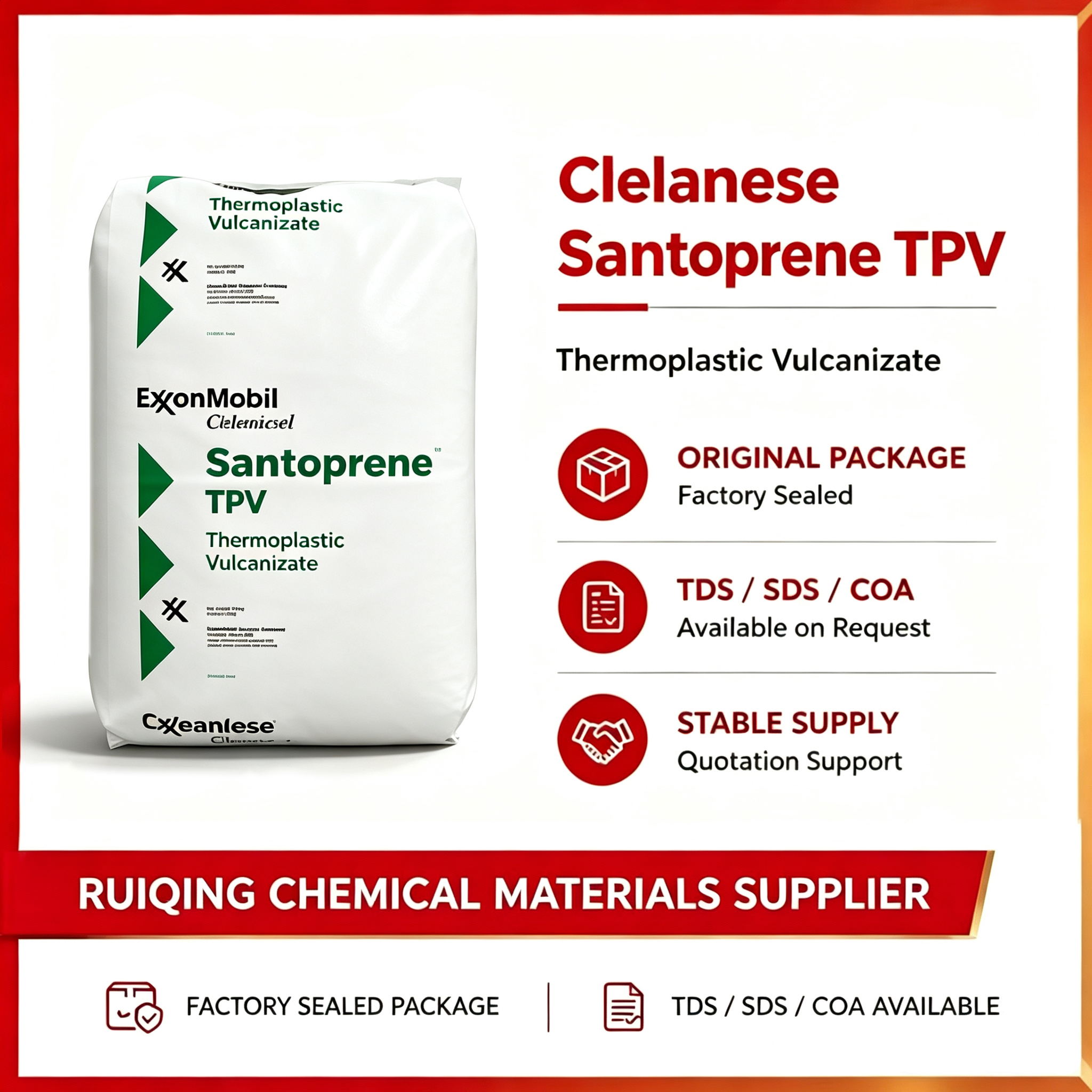
描述
Santoprene 8201-90 is a high-hardness, natural and colorable thermoplastic vulcanizate from Celanese developed for flexible engineering parts that require significantly greater stiffness and tensile strength while retaining elastomeric deformation.
With a published hardness of approximately 94 Shore A, Santoprene 8201-90 provides a distinctly firm elastomeric response.
At the same time, the material retains approximately 620% elongation at break, allowing it to bend, stretch and deform far more than conventional rigid engineering plastics.
Its most important published mechanical characteristics include:
- 94 Shore A hardness
- 13.0 MPa tensile stress at break
- 7.1 MPa stress at 100% elongation
- 620% elongation at break
- 52% compression set at 70°C / 22 h
- 0.940 g/cm³ density
This combination makes Santoprene 8201-90 particularly suitable for components that need to behave more like a firm flexible engineering material than a conventional soft rubber.
The Natural formulation also allows manufacturers to produce:
- White parts
- Gray parts
- Color-coded components
- Custom consumer colors
- Brand-matched molded parts
Santoprene 8201-90 can be processed using conventional thermoplastic equipment for injection molding, extrusion, blow molding, thermoforming and vacuum forming.
For more TPV materials, visit our TPV Thermoplastic Vulcanizates Product Category →.
For current Celanese Santoprene portfolio information, see the Official Santoprene & Geolast Product Finder →.
Key Engineering Features of Santoprene 8201-90
| Feature | Engineering Value |
|---|---|
| 94 Shore A Hardness | Provides a firm elastomeric response and good dimensional support |
| 13.0 MPa Tensile Strength | Suitable for mechanically demanding flexible parts |
| 620% Elongation | Allows extensive deformation before break |
| 7.1 MPa Stress at 100% Strain | Provides strong resistance to stretching |
| Natural / Colorable | Supports custom-colored technical and consumer components |
| Non-Hygroscopic | Simplifies material handling and preparation |
| Excellent Ozone Resistance | Useful for exposed elastomeric components |
| Excellent Flex-Fatigue Resistance | Supports repeatedly bent and flexed parts |
| Chemical Resistance | Suitable for many industrial and consumer environments |
| Low-Temperature Flexibility | Brittleness temperature approximately -54°C |
| Broad Processing Capability | Supports molding, extrusion, blow molding and thermoforming |
| Shear-Dependent Flow | Flow improves significantly with increasing shear |
| Polyolefin-Based TPV | Combines elastomer performance with thermoplastic processing |
| Manufacturing-Stream Recyclability | Clean process scrap can be reprocessed under controlled conditions |
Typical Applications for Santoprene 8201-90
Because Santoprene 8201-90 is relatively firm, it can be used where a component must retain shape while still providing flexibility.
| Application Area | Typical Use |
|---|---|
| Flexible Technical Housings | Protective components requiring structural support |
| Strain Reliefs | Cable and connector protection |
| Appliance Components | Firm flexible functional parts |
| Flexible Grips | Durable tactile surfaces |
| Technical Seals | Firmer sealing geometries |
| Protective Covers | Flexible impact-contact parts |
| Consumer Products | Colored engineering elastomer components |
| Profile Extrusion | Firm flexible continuous sections |
| Sheet Extrusion | High-hardness flexible sheet |
| Cable Accessories | Protective and insulating flexible components |
| Industrial Parts | Repeatedly flexed technical interfaces |
| Blow-Molded Parts | Flexible hollow products |
| Thermoformed Components | Formed flexible engineering parts |
The grade is particularly useful where the designer wants more body, strength and shape retention than a very soft elastomer, without changing to a fully rigid thermoplastic.
Typical Properties of Santoprene 8201-90
Physical Properties
| Property | Typical Value | Test Method |
|---|---|---|
| Density | 0.940 g/cm³ | ISO 1183 |
| Specific Gravity | 0.938–0.940 | ASTM D792 / ISO 1183 |
| Shore A Hardness, 15 s | 94 | ISO 868 |
| Appearance | Natural | Manufacturer Information |
| Product Form | Pellets | Manufacturer Information |
| Polymer Family | TPV / TPE-V | Manufacturer Information |
| Moisture Behavior | Non-Hygroscopic | Manufacturer Information |
The number 90 in the product name should not be treated as the exact measured hardness. Published grade data gives approximately 94 Shore A.
Mechanical Performance
Elastomer Properties
| Property | Typical Value |
|---|---|
| Tensile Stress at 100% Elongation | 7.1 MPa |
| Tensile Stress at Break | 13.0 MPa |
| Elongation at Break | 620% |
| Compression Set, 70°C / 22 h | 52% |
| Tear Strength | Approx. 48 kN/m |
| Hardness | 94 Shore A |
The mechanical profile is one of the strongest selling points of Santoprene 8201-90.
The material combines high tensile resistance with unusually large elongation, making it useful for parts that must withstand both mechanical load and large deformation.
High Tensile Strength for a Flexible TPV
The published tensile stress at break is approximately:
13.0 MPa
This level of tensile performance makes Santoprene 8201-90 useful for components exposed to:
- Pulling
- Stretching
- Installation stress
- Bending
- Repeated deformation
- Mechanical contact
Potential examples include:
- Cable strain reliefs
- Protective sleeves
- Technical covers
- Flexible retaining components
- Firm elastomeric interfaces
High Stress at 100% Elongation
Santoprene 8201-90 provides approximately:
7.1 MPa stress at 100% elongation
This is an important design property because it indicates that the material provides significant resistance even when stretched to twice its original length.
For product designers, this means Santoprene 8201-90 can provide:
- Firmer tactile response
- Better shape support
- Greater resistance to stretching
- Stronger snap-over behavior
- More robust flexible structures
High Elongation
Despite its high hardness, Santoprene 8201-90 provides approximately:
620% elongation at break
This allows the material to withstand substantial deformation before rupture.
Potential benefits include:
- Easier assembly over rigid components
- Flexible installation
- High deformation tolerance
- Reduced cracking risk under repeated movement
- Improved part design freedom
This combination of hardness and elongation is particularly useful for flexible engineering parts where both shape stability and movement are required.
Low-Temperature Performance
Published grade-specific brittleness temperature is approximately:
-54°C
This provides useful low-temperature flexibility for:
- Outdoor equipment
- Cable applications
- Automotive components
- Cold-environment consumer products
- Industrial flexible parts
Brittleness temperature is useful for material screening but should not be interpreted as the guaranteed minimum continuous-use temperature.
Heat-Aging Stability
Santoprene 8201-90 has published heat-aging data after:
150°C for 168 hours
Typical changes include:
| Property | Change |
|---|---|
| Tensile Strength | +1% |
| Elongation at Break | -15% |
| Shore A Hardness | +1 point |
| Mass | -7% |
The relatively small tensile-strength and hardness changes demonstrate useful property retention under the specified accelerated-aging condition.
This does not mean that 150°C is the recommended continuous operating temperature.
Compression-Set Behavior
Published compression set is approximately:
52% at 70°C / 22 hours
Because Santoprene 8201-90 is a very firm TPV, its strongest applications are not necessarily long-term highly compressed soft seals.
The material is often better suited to:
- Firm sealing lips
- Protective interfaces
- Technical gaskets
- Flexible housing components
- Functional molded parts
where strength and shape support are important together with elastomeric movement.
Natural Color & Custom Coloring
A major advantage of Santoprene 8201-90 is its Natural / easy-coloring formulation.
This is valuable for visible technical products where black TPV is not desired.
Possible colors include:
- White
- Light gray
- Dark gray
- Blue
- Red
- Green
- Beige
- Brand-specific colors
Applications may include:
- Appliances
- Kitchen products
- Consumer electronics
- Stationery
- Industrial identification components
- Colored flexible housings
Compatible masterbatch should be evaluated for:
- Color consistency
- Mechanical-property retention
- Surface finish
- Flow
- Weather resistance
- Thermal stability
Consumer & Appliance Applications
Historical grade documentation identifies applications such as:
- Appliance components
- Flexible grips
- Kitchenware
- Mobile-device components
- Stationery
- Strain reliefs
These applications benefit from the combination of:
firm flexibility + high strength + colorability + thermoplastic manufacturing
For visible products, Santoprene 8201-90 also allows texture to be designed directly into the mold or extrusion surface.
Strain Relief Applications
The mechanical profile of Santoprene 8201-90 makes it particularly relevant to strain relief components.
A strain relief must often withstand:
- Cable bending
- Pulling forces
- Repeated movement
- Local deformation
- Mechanical fatigue
The grade’s high flex-fatigue resistance and 620% elongation can support this type of repeated mechanical movement.
Potential uses include:
- Power-cable entry points
- Connector boots
- Appliance cables
- Electronic-device cables
- Flexible protective sleeves
Flex-Fatigue Resistance
Santoprene 8201-90 is intended for applications requiring excellent resistance to repeated flexing.
Potential component motions include:
- Bending
- Folding
- Stretching
- Twisting
- Compression
- Recovery
This is useful for flexible technical components that experience thousands of movement cycles during service.
Ozone Resistance
The grade is also designed for excellent ozone resistance.
Ozone resistance is particularly valuable for elastomeric parts exposed to:
- Atmospheric air
- Electrical equipment
- Exterior environments
- Mechanical strain
This helps reduce the risk of ozone-induced cracking over time.
Chemical Resistance
Santoprene 8201-90 provides good chemical resistance for a broad range of applications.
Potential contact environments include:
- Water
- Detergents
- Dilute acids
- Dilute alkalis
- Cleaning agents
- Selected oils and fluids
Chemical compatibility should be checked against:
- Exact chemical
- Concentration
- Temperature
- Exposure duration
- Mechanical stress
Electrical Performance
Santoprene 8201-90 also has useful published electrical data.
| Electrical Property | Typical Result |
|---|---|
| Comparative Tracking Index (CTI) | PLC 0 |
| High Amp Arc Ignition (HAI) | PLC 0 |
| High Voltage Arc Resistance (HVAR) | PLC 5 |
| Hot-Wire Ignition, 1.6 mm | PLC 3 |
| Hot-Wire Ignition, 3.0 mm | PLC 2 |
This can support selected applications such as:
- Strain reliefs
- Cable accessories
- Protective electrical parts
- Flexible housings
Relative Temperature Index
Published grade data includes:
| Property | Typical Value |
|---|---|
| RTI Electrical | 100°C |
| RTI Strength, 1.1 mm | 90°C |
| RTI Strength, 1.6 mm | 95°C |
| RTI Strength, 3.0 mm | 95°C |
For applications requiring current certification, the relevant listing should be checked against the finished component and current certification database.
Flammability
Published Santoprene 8201-90 data gives:
| Thickness | UL 94 Classification |
|---|---|
| 1.1 mm | HB |
| 1.6 mm | HB |
| 3.0 mm | HB |
Therefore, Santoprene 8201-90 should be positioned as an HB general-purpose TPV, not as a V-0 flame-retardant compound.
Why Choose Santoprene 8201-90?
The strongest design advantage of Santoprene 8201-90 is its ability to provide a firm engineering response while retaining substantial elastomeric deformation.
Key performance points include:
- 94 Shore A hardness
- 13.0 MPa tensile strength
- 7.1 MPa stress at 100% elongation
- 620% elongation
- 0.940 g/cm³ density
- -54°C brittleness temperature
- Natural / colorable formulation
- Non-hygroscopic behavior
- Excellent ozone resistance
- Excellent flex-fatigue resistance
- Broad molding and extrusion capability
- Blow molding capability
- Thermoforming capability
For applications requiring a high-hardness flexible material with better tensile strength than a very soft elastomer, Santoprene 8201-90 is a relevant engineering TPV.
Processing Guidelines for Santoprene 8201-90
Santoprene 8201-90 supports:
- Injection Molding
- Multi-Injection Molding
- Extrusion
- Coextrusion
- Profile Extrusion
- Sheet Extrusion
- Blow Molding
- Extrusion Blow Molding
- Injection Blow Molding
- Thermoforming
- Vacuum Forming
Material Preparation
Santoprene 8201-90 is non-hygroscopic and normally requires little to no drying under suitable storage conditions.
If drying is desired, a published starting condition is:
80°C for approximately 3 hours using a desiccant dryer.
Injection Molding Conditions
| Processing Parameter | Recommended Range |
|---|---|
| Maximum Moisture | 0.08% |
| Maximum Regrind | 20% |
| Rear Barrel Temperature | 191–204°C |
| Middle Barrel Temperature | 196–210°C |
| Front Barrel Temperature | 196–210°C |
| Nozzle Temperature | 210–221°C |
| Melt Temperature | 199–216°C |
| Mold Temperature | 24–52°C |
| Injection Rate | Fast |
| Back Pressure | 0.345–0.689 MPa |
| Screw Speed | 100–200 rpm |
| Clamp Pressure | 41–69 MPa |
| Cushion | 3.18–6.35 mm |
These conditions make a practical starting point for injection-molding trials.
Screw Configuration
| Parameter | Recommended Range |
|---|---|
| Screw L/D Ratio | 16:1–20:1 |
| Compression Ratio | 2.0:1–2.5:1 |
| Vent Depth | Approx. 0.025 mm |
Good screw design helps maintain consistent melt temperature and shear.
Fast Injection & Shear-Thinning
Santoprene 8201-90 is shear dependent.
As shear rate increases, apparent melt viscosity decreases.
This is why fast injection can improve filling of:
- Thin sections
- Ribs
- Narrow gates
- Long flow paths
- Detailed molded components
Processors should optimize shear before simply increasing melt temperature.
Extrusion Conditions
For extrusion, published grade-specific guidance gives:
| Processing Parameter | Recommended Range |
|---|---|
| Extrusion Melt Temperature | 196–224°C |
| Die Temperature | 196–224°C |
Santoprene 8201-90 can be extruded into:
- Flexible profiles
- Protective strips
- Technical sections
- Sheet
- Coextruded structures
Sheet Extrusion & Thermoforming
One useful capability of Santoprene 8201-90 is its compatibility with sheet extrusion followed by thermoforming or vacuum forming.
This allows the material to be considered for:
- Protective flexible covers
- Formed sheets
- Flexible liners
- Technical skins
- Consumer-product components
Important variables include:
- Sheet thickness
- Heating uniformity
- Forming temperature
- Draw ratio
- Tool geometry
- Cooling
Blow Molding
The grade is also compatible with:
- Blow molding
- Extrusion blow molding
- Injection blow molding
This makes Santoprene 8201-90 suitable for selected hollow flexible products where higher hardness and flexibility are required together.
Mold & Gate Design
For injection molding, good gate design should provide sufficient shear and balanced cavity filling.
Important design factors include:
- Gate size
- Runner balance
- Venting
- Flow length
- Wall thickness
- Draft angle
- Ejection system
Because Santoprene 8201-90 is relatively firm, component ejection is generally easier than with extremely soft TPV, but correct draft remains important.
Material Compatibility
Santoprene TPV is incompatible with:
- POM / Acetal
- PVC
Processing equipment should be thoroughly purged when switching between these polymers and Santoprene 8201-90.
Regrind & Production Scrap
Published processing guidance allows approximately:
20% maximum regrind
as a starting manufacturing reference.
Potential clean process scrap includes:
- Sprues
- Runners
- Profile trim
- Sheet trim
- Start-up material
- Selected rejected components
For colored parts, regrind should also be monitored for:
- Color shift
- Contamination
- Surface appearance
Related Products
We supply Santoprene TPV materials for different hardness, color, molding and extrusion requirements.
Typical product families include:
- Santoprene 8201 Series
- Santoprene Enhanced Colorability TPV
- Santoprene Natural TPV
- Santoprene high-hardness TPV
- Santoprene injection-molding grades
- Santoprene profile extrusion grades
- Santoprene sheet extrusion grades
- Santoprene blow-molding grades
- Santoprene flexible engineering materials
View More TPV Thermoplastic Vulcanizates →
Technical Documents for Santoprene 8201-90
| Document Type | Description |
|---|---|
| TDS | Physical, mechanical, electrical and processing data |
| SDS | Safety Data Sheet |
| Injection Molding Guide | Machine and mold-design guidance |
| Extrusion Guide | Profile and sheet extrusion information |
| Thermoforming Information | Sheet forming guidance |
| Electrical Data | RTI, CTI and related information |
| Coloring Information | Natural TPV pigmentation guidance |
| COA | Batch-specific quality information where available |
Need technical information for Santoprene 8201-90?
📧 Email: ruiqingchem@gmail.com
📝 Online form: Contact Us →
FAQ About Santoprene 8201-90
Q1: What is Santoprene 8201-90?
Santoprene 8201-90 is a high-hardness, natural and colorable TPV from Celanese for general-purpose molding, extrusion and flexible engineering applications.
Q2: What is the hardness of Santoprene 8201-90?
The published typical hardness is approximately 94 Shore A.
Q3: Is Santoprene 8201-90 exactly 90 Shore A?
No. The model designation contains 90, while the published measured hardness is approximately 94 Shore A.
Q4: What is the density of Santoprene 8201-90?
The typical density is approximately 0.940 g/cm³.
Q5: What is its tensile strength?
The typical tensile stress at break is approximately 13.0 MPa.
Q6: What is its elongation at break?
The published typical value is approximately 620%.
Q7: What is the tensile stress at 100% elongation?
The typical value is approximately 7.1 MPa.
Q8: What is the compression set?
The published value is approximately 52% at 70°C / 22 hours.
Q9: Is Santoprene 8201-90 colorable?
Yes. It is supplied in a Natural / easy-coloring formulation.
Q10: Is Santoprene 8201-90 non-hygroscopic?
Yes. It is described as non-hygroscopic and normally requires little to no drying under proper storage conditions.
Q11: What is the low-temperature brittleness?
Published grade data gives approximately -54°C.
Q12: Can Santoprene 8201-90 be injection molded?
Yes. Injection molding and multi-injection molding are supported.
Q13: Can Santoprene 8201-90 be extruded?
Yes. Profile extrusion, sheet extrusion, coextrusion and general extrusion are supported.
Q14: Can Santoprene 8201-90 be thermoformed?
Yes. Both thermoforming and vacuum forming are listed processing methods.
Q15: What injection-molding temperature is recommended?
A published grade-specific melt-temperature range is approximately 199–216°C, with mold temperatures around 24–52°C.
Q16: Is Santoprene 8201-90 flame retardant?
It is not a V-0 flame-retardant grade. Published testing gives UL 94 HB.
Request Santoprene 8201-90 Price & Technical Support
For pricing, availability or technical support for Santoprene 8201-90, please provide:
- Required quantity
- Destination country or port
- Application
- Required color
- Injection / extrusion / blow-molding / thermoforming process
- Part dimensions
- Tensile-strength requirement
- Hardness requirement
- Flexibility requirement
- Operating temperature
- Chemical-contact environment
- Electrical requirements
- TDS / SDS requirement
- COA requirement
- Sample requirement, if applicable
📧 Email: ruiqingchem@gmail.com