描述
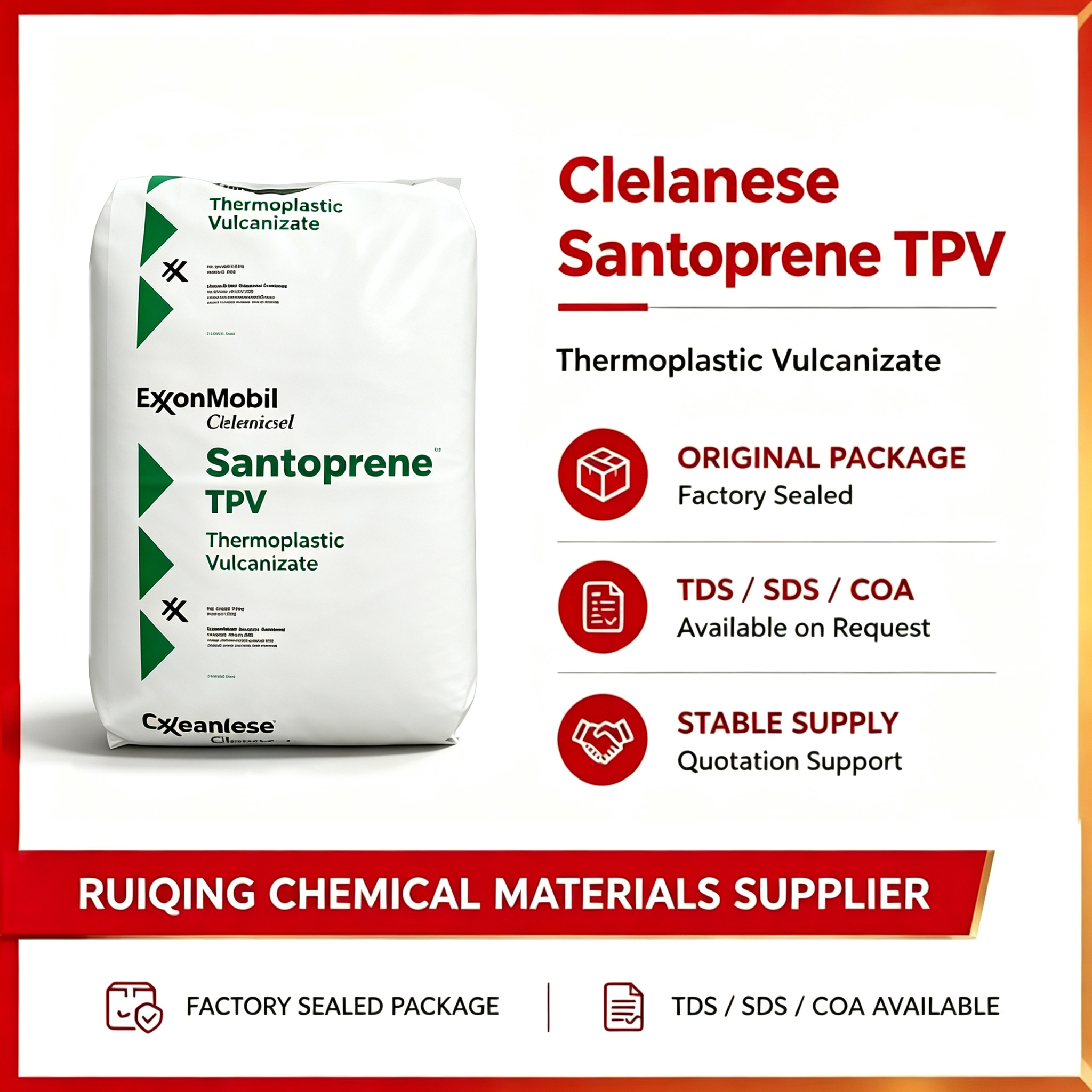
Santoprene 8201-60 is a natural, colorable thermoplastic vulcanizate from Celanese designed as a general-purpose TPV for extrusion and molding applications.
The grade combines rubber-like flexibility with conventional thermoplastic processing and is particularly useful where manufacturers need:
- A natural base for custom coloring
- Moderate elastomeric softness
- Good elongation
- Flexible sealing performance
- Injection molding
- Extrusion
- Blow molding
- Good ozone resistance
- Good flex-fatigue resistance
Current Celanese Product Finder values include:
- 64 Shore A hardness
- Natural appearance
- 520% elongation at break
- 5.9 MPa tensile stress at break
- 2.2 MPa stress at 100% elongation
- 29% compression set at 70°C / 22 h
Santoprene 8201-60 belongs to Celanese’s Enhanced Colorability TPV Grades, making it particularly suitable for applications where black is not required and the finished component needs a custom color.
Its broad processability makes the grade relevant to:
- Injection-molded seals
- Soft grips
- Consumer components
- Appliance parts
- Extruded profiles
- Blow-molded flexible parts
Another important advantage is its non-hygroscopic behavior, so under proper storage conditions the material requires little or no drying compared with strongly hygroscopic engineering polymers.
For more TPV products, visit our TPV Thermoplastic Vulcanizates Product Category →.
For current Santoprene portfolio information, see the Official Celanese Santoprene & Geolast Product Finder →.
Key Features of Santoprene 8201-60
| Feature | Engineering Benefit |
|---|---|
| 64 Shore A Hardness | Provides medium-soft elastomeric flexibility |
| Natural / Colorable | Suitable for white, gray and custom-colored parts |
| 520% Elongation at Break | Provides high deformation capability |
| 5.9 MPa Tensile Stress at Break | Provides useful mechanical durability |
| 2.2 MPa Stress at 100% Elongation | Supports flexible sealing and soft-touch performance |
| 29% Compression Set | Supports general sealing applications |
| Non-Hygroscopic | Reduces routine drying requirements |
| Excellent Ozone Resistance | Useful for atmospheric and exterior sealing applications |
| Excellent Flex-Fatigue Resistance | Suitable for repeatedly flexed parts |
| Good Chemical Resistance | Useful in consumer, industrial and sealing environments |
| Injection Moldable | Suitable for complex flexible parts |
| Extrudable | Suitable for continuous flexible profiles |
| Blow Moldable | Broadens manufacturing options |
| Shear-Dependent Flow | Apparent viscosity decreases as shear increases |
| Enhanced Colorability | Supports appearance-sensitive applications |
| Polyolefin-Based TPV | Combines elastomeric properties with thermoplastic processing |
Typical Applications for Santoprene 8201-60
Santoprene 8201-60 is a broad-use grade and can be used across consumer, appliance and sealing applications.
| Application Area | Typical Use |
|---|---|
| Seals | Flexible molded or extruded sealing components |
| Gaskets | Compression interfaces |
| Soft-Touch Grips | Comfortable hand-contact surfaces |
| Kitchenware | Flexible consumer components |
| Appliance Components | Soft molded technical parts |
| Strain Reliefs | Flexible cable-support components |
| Mobile Device Components | Flexible protective parts |
| Stationery | Soft functional or grip components |
| Consumer Products | General flexible molded parts |
| Profile Extrusion | Flexible continuous sections |
| Blow-Molded Parts | Flexible hollow components |
| Multi-Injection Parts | Selected multi-material components |
Historical grade documentation specifically lists kitchen tools, soft-touch grips, appliance components, cell phones, stationery and strain reliefs as uses for Santoprene 8201-60.
Typical Properties of Santoprene 8201-60
Physical Properties
| Property | Typical Value | Test Method |
|---|---|---|
| Density | 0.950 g/cm³ | ISO 1183 / ASTM D792 |
| Shore A Hardness, 15 s | 64 | ISO 868 |
| Appearance | Natural | Manufacturer Information |
| Product Form | Pellets | Manufacturer Information |
| Material Family | TPV / TPE-V | Manufacturer Information |
| Moisture Behavior | Non-Hygroscopic | Manufacturer Information |
The important point is that the number 60 in the grade name is not the current measured hardness. Celanese lists approximately 64 Shore A.
Mechanical Properties
| Property | Typical Value | Test Method |
|---|---|---|
| Tensile Stress at 100% Elongation | 2.2 MPa | ISO 37 / ASTM D412 |
| Tensile Stress at Break | 5.9 MPa | ISO 37 / ASTM D412 |
| Elongation at Break | 520% | ISO 37 / ASTM D412 |
| Compression Set, 70°C / 22 h | 29% | ISO 815 / ASTM D395B |
| Shore A Hardness | 64 | ISO 868 |
These values give Santoprene 8201-60 a useful balance between flexibility and mechanical strength.
Low-Temperature Performance
Santoprene 8201-60 has a published brittleness temperature of approximately:
-60°C
This supports applications where the flexible component may experience low ambient temperatures.
Potential applications include:
- Outdoor consumer products
- Automotive components
- Cold-storage equipment
- Industrial seals
- Flexible protective parts
A brittleness temperature should not be treated as the guaranteed continuous operating limit, but it provides useful comparative low-temperature information.
Natural & Enhanced Colorability
A major feature of Santoprene 8201-60 is its Natural / enhanced-colorability formulation.
This makes it useful for components requiring:
- White
- Gray
- Blue
- Red
- Green
- Custom brand colors
- Color-coded technical parts
Potential applications include:
- Kitchen tools
- Appliance components
- Consumer electronics
- Stationery
- Soft-touch grips
- Household products
Compatible masterbatch should be selected to maintain:
- Mechanical performance
- Surface quality
- Flow
- Color uniformity
- Thermal stability
Non-Hygroscopic Behavior
Santoprene 8201-60 is specifically described as non-hygroscopic.
This means it does not absorb atmospheric moisture in the same way as materials such as:
- PA
- PET
- PBT
Under proper storage conditions, it normally requires little or no drying before processing.
This can reduce:
- Material preparation time
- Energy use
- Dryer demand
- Production start-up time
If pellets have been exposed to condensation or wet conditions, controlled drying may still be useful.
Ozone Resistance
Santoprene 8201-60 is recommended for applications requiring excellent ozone resistance.
This property is useful for flexible components exposed to:
- Outdoor atmosphere
- Electrical equipment
- Industrial environments
- Long-term environmental aging
Ozone resistance is particularly important for seals that remain mechanically strained over long periods.
Flex-Fatigue Resistance
The grade is also recommended where excellent flex-fatigue resistance is required.
This is useful for components exposed to repeated:
- Bending
- Stretching
- Compression
- Recovery
- Folding
- Mechanical cycling
Potential applications include:
- Flexible grips
- Strain reliefs
- Seals
- Repeated-motion components
- Flexible housings
Sealing Applications
Santoprene 8201-60 is specifically suitable for sealing applications.
Typical uses include:
- Housing seals
- Gaskets
- Flexible interfaces
- Protective seals
- Molded sealing rings
- Extruded sealing profiles
The combination of 64A hardness, 520% elongation and 29% compression set gives the grade a useful general-purpose sealing profile.
Electrical Properties
Historical Santoprene 8201-60 grade data also includes electrical-performance information.
| Property | Typical Rating |
|---|---|
| Comparative Tracking Index, CTI | PLC 0 |
| High Amp Arc Ignition, HAI | PLC 0 |
| High Voltage Arc Resistance, HVAR | PLC 5 |
| Hot Wire Ignition, 1.6 mm | PLC 3 |
| Hot Wire Ignition, 3.0 mm | PLC 2 |
These values can be useful when evaluating the material for:
- Cable accessories
- Strain reliefs
- Flexible electrical components
- Protective housings
Flammability
Published historical data gives:
| Thickness | UL 94 Rating |
|---|---|
| 1.1 mm | HB |
| 1.6 mm | HB |
| 3.0 mm | HB |
Santoprene 8201-60 should therefore be treated as an HB material, not as a V-0 flame-retardant grade.
Relative Temperature Index
Historical electrical data includes:
| Property | Typical Value |
|---|---|
| RTI Electrical | 100°C |
| RTI Mechanical Strength, 1.1 mm | 90°C |
| RTI Mechanical Strength, 1.6 mm | 90°C |
| RTI Mechanical Strength, 3.0 mm | 95°C |
These historical ratings are useful for reference, although current certification should be confirmed if the customer requires a specific UL-recognized construction.
Heat-Aging Performance
Historical grade-specific testing after 150°C for 168 hours showed approximately:
| Property | Typical Change |
|---|---|
| Tensile Strength | -9% |
| Elongation at Break | -7% |
| Shore A Hardness | +1 point |
| Mass | -8% |
These results provide useful information on property retention under the specified test condition.
They should not be interpreted as a universal 150°C continuous-service rating.
Why Choose Santoprene 8201-60?
The main reason to select Santoprene 8201-60 is its combination of broad processing versatility and enhanced colorability.
The grade provides:
- 64 Shore A hardness
- 0.950 g/cm³ density
- 520% elongation
- 5.9 MPa tensile stress at break
- 2.2 MPa stress at 100% elongation
- 29% compression set
- Natural/colorable formulation
- Non-hygroscopic behavior
- Excellent ozone resistance
- Excellent flex-fatigue resistance
- Good chemical resistance
- Injection molding
- Extrusion
- Blow molding
- Multi-injection molding
For customers requiring a natural, colorable and general-purpose TPV for flexible molded or extruded parts, Santoprene 8201-60 is a highly relevant grade.
Processing Guidelines for Santoprene 8201-60
Santoprene 8201-60 supports a broad range of thermoplastic processes, including:
- Injection Molding
- Multi-Injection Molding
- Extrusion
- Profile Extrusion
- Sheet Extrusion
- Extrusion Blow Molding
- Blow Molding
Injection Molding Conditions
Historical grade-specific guidance includes:
| Processing Parameter | Typical Range |
|---|---|
| Rear Barrel Temperature | 177–191°C |
| Middle Barrel Temperature | 179–193°C |
| Front Barrel Temperature | 185–199°C |
| Nozzle Temperature | 185–210°C |
| Melt Temperature | 143–216°C |
| Mold Temperature | 24–52°C |
| Injection Speed | Fast |
| Back Pressure | 0.345–0.689 MPa |
| Screw Speed | 100–200 rpm |
| Maximum Moisture | 0.08% |
| Maximum Regrind | 20% |
These are historical grade-specific processing values and provide a useful starting point for machine trials.
Screw Design
Published processing guidance includes:
| Parameter | Recommended Range |
|---|---|
| Screw L/D Ratio | 16:1 to 20:1 |
| Compression Ratio | 2.0:1 to 2.5:1 |
| Vent Depth | Approx. 0.025 mm |
Proper screw design helps maintain:
- Stable melt delivery
- Good mixing
- Consistent shot size
- Efficient shear generation
Extrusion Conditions
Historical Santoprene 8201-60 guidance gives:
| Parameter | Typical Range |
|---|---|
| Melt Temperature | 179–216°C |
| Die Temperature | 177–216°C |
Actual conditions depend on:
- Profile thickness
- Extruder size
- Screw design
- Line speed
- Surface-quality requirements
- Die geometry
Shear-Dependent Flow
Santoprene 8201-60 is shear dependent.
As shear rate increases:
apparent melt viscosity decreases.
This means flow can often be improved by optimizing:
- Screw speed
- Injection speed
- Gate size
- Die geometry
rather than simply increasing melt temperature.
This characteristic is useful for:
- Thin molded sections
- Flexible sealing lips
- Detailed profiles
- Small gates
- Long flow paths
Multi-Injection Molding
Santoprene 8201-60 also supports multi-injection molding.
Potential applications include:
- Hard/soft parts
- Flexible interfaces
- Consumer grips
- Integrated sealing features
Actual adhesion to another polymer should be verified using the exact substrate grade.
Santoprene 8201-60 should not automatically be marketed as a dedicated bondable overmolding grade like the B100 or B150 families.
Blow Molding
The grade can also be used in:
- Blow molding
- Extrusion blow molding
This broad processing capability makes Santoprene 8201-60 useful for flexible hollow components where elastomeric behavior is desired.
Material Compatibility
Santoprene TPV processing guidance states that it is incompatible with:
- POM / Acetal
- PVC
Processing equipment should be thoroughly purged when changing between these polymers and Santoprene 8201-60.
Manufacturing-Stream Recyclability
Santoprene 8201-60 is polyolefin based and suitable for controlled manufacturing-stream recycling.
Published guidance allows approximately:
Up to 20% regrind
as a processing reference.
Possible clean process scrap includes:
- Sprues
- Runners
- Profile trim
- Start-up material
- Selected rejected parts
The final regrind level should be controlled according to:
- Mechanical-performance requirements
- Appearance
- Color consistency
- Final qualification requirements
Related Products
We supply Santoprene TPV grades for different color, hardness, flow and processing requirements.
Typical product families include:
- Santoprene 8201 Series
- Santoprene enhanced-colorability TPV
- Santoprene Natural TPV
- Santoprene general-purpose TPV
- Santoprene injection-molding grades
- Santoprene extrusion grades
- Santoprene blow-molding grades
- Santoprene sealing grades
- Santoprene consumer-product TPV grades
View More TPV Thermoplastic Vulcanizates →
Technical Documents for Santoprene 8201-60
| Document Type | Description |
|---|---|
| TDS | Physical, mechanical, thermal and processing data |
| SDS | Safety Data Sheet |
| Injection Molding Guide | Molding and tool-design guidance |
| Extrusion Guide | Profile and sheet extrusion guidance |
| Electrical Data | CTI, HAI, HVAR and RTI information |
| Coloring Information | Guidance for Natural TPV pigmentation |
| COA | Batch-specific quality information where available |
Need technical documents for Santoprene 8201-60?
📧 Email: ruiqingchem@gmail.com
📝 Online form: Contact Us →
Please state Santoprene 8201-60 and specify whether you require TDS, SDS, molding guidance, extrusion information or COA.
FAQ About Santoprene 8201-60
Q1: What is Santoprene 8201-60?
Santoprene 8201-60 is a natural, enhanced-colorability TPV from Celanese designed for general-purpose extrusion and molding applications.
Q2: What is the hardness of Santoprene 8201-60?
Current Celanese Product Finder data gives approximately 64 Shore A.
Q3: Is Santoprene 8201-60 exactly 60 Shore A?
No. The grade designation contains 60, but the current published typical hardness is 64 Shore A.
Q4: What is the density?
The typical density is approximately 0.950 g/cm³.
Q5: What is the elongation at break?
The current typical value is approximately 520%.
Q6: What is the tensile stress at break?
The typical value is approximately 5.9 MPa.
Q7: What is the stress at 100% elongation?
The typical value is approximately 2.2 MPa.
Q8: What is the compression set?
The current Product Finder lists approximately 29% at 70°C / 22 hours.
Q9: Is Santoprene 8201-60 natural or black?
The standard grade is Natural.
Q10: Can Santoprene 8201-60 be colored?
Yes. Enhanced colorability is one of the main features of the 8201 family.
Q11: Is Santoprene 8201-60 non-hygroscopic?
Yes. It is described as non-hygroscopic, with little or no drying normally required under correct storage conditions.
Q12: Is Santoprene 8201-60 suitable for seals?
Yes. Sealing applications are specifically included in the historical grade description.
Q13: Can Santoprene 8201-60 be injection molded?
Yes. Injection molding and multi-injection molding are listed processing methods.
Q14: Can Santoprene 8201-60 be extruded?
Yes. Extrusion, profile extrusion and sheet extrusion are supported.
Q15: Can Santoprene 8201-60 be blow molded?
Yes. Both blow molding and extrusion blow molding are listed for this grade.
Q16: Is Santoprene 8201-60 flame retardant?
It should not be marketed as a V-0 flame-retardant grade. Historical grade data gives UL 94 HB at several tested thicknesses.
Request Santoprene 8201-60 Price & Technical Support
For pricing, availability, technical documents or application support for Santoprene 8201-60, please provide:
- Required quantity
- Destination country or port
- Application
- Required hardness
- Required color
- Seal / grip / appliance / consumer application
- Injection / extrusion / blow-molding process
- Operating temperature
- Chemical-contact conditions
- Flex-fatigue requirement
- TDS / SDS requirement
- COA requirement
- Sample requirement, if applicable
📧 Email: ruiqingchem@gmail.com