描述
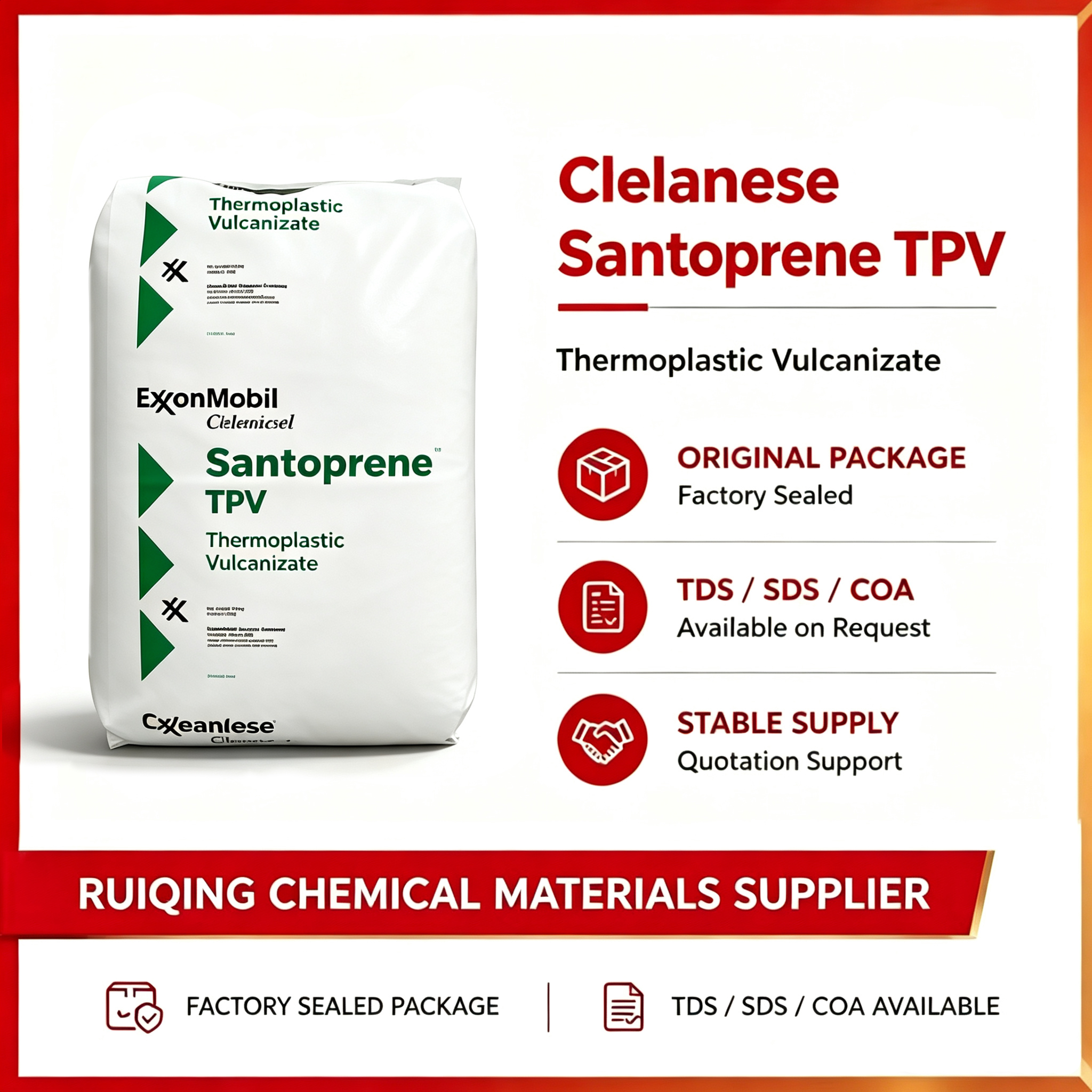
Santoprene 8191-55B100 is a soft, black, specialty thermoplastic vulcanizate from Celanese specifically formulated for bonding to engineering thermoplastics in hard/soft combination designs.
The material is particularly suited to applications where a soft elastomeric layer must be molded directly onto a harder thermoplastic substrate.
Typical compatible substrate families include:
- ABS
- PS
- PC
- PMMA
- ASA
- PET
- PPO/PS blends
- Selected PP constructions within the B100 family
Santoprene 8191-55B100 is therefore especially useful for:
- 2K / two-shot molding
- Cold-insert molding
- Soft-touch overmolding
- Hard/soft multi-material parts
- Coextruded bonded profiles
The grade combines approximately 53 Shore A hardness with 600% elongation at break, providing a soft elastomeric feel while maintaining useful toughness for flexible overmolded components.
It is also non-hygroscopic, which simplifies material handling compared with hygroscopic engineering plastics.
The B100 formulation is designed not only for adhesion but also for superior molded surface appearance, making the material especially relevant to visible soft-touch components such as grips, consumer electronics and automotive interior parts.
For more TPV products, visit our TPV Thermoplastic Vulcanizates Product Category →.
For current Santoprene portfolio information, see the Official Celanese Santoprene & Geolast Product Finder →.
Key Features of Santoprene 8191-55B100
| Feature | Engineering Benefit |
|---|---|
| 53 Shore A Hardness | Provides soft elastomeric behavior for grips and overmolded surfaces |
| Black Formulation | Suitable for automotive, consumer and industrial designs |
| 600% Elongation at Break | Supports large deformation and flexible overmolded geometries |
| 4.1 MPa Tensile Stress at Break | Provides useful mechanical strength |
| 1.0 MPa Stress at 100% Elongation | Supports a soft, low-modulus tactile response |
| Bondable TPV | Designed to adhere to selected engineering thermoplastics |
| 2K / Two-Shot Molding | Supports integrated hard/soft molded parts |
| Cold-Insert Molding | Can be molded over previously formed rigid substrates |
| Soft-Touch Performance | Suitable for grips and user-contact surfaces |
| Superior Surface Appearance | Useful for visible consumer and automotive components |
| Non-Hygroscopic | Simplifies moisture management before molding |
| Shear-Dependent Flow | Apparent viscosity decreases with increasing shear |
| Coextrusion Capability | Supports selected bonded multi-material profiles |
| Polyolefin-Based TPV | Combines elastomeric properties with thermoplastic processing |
| Manufacturing-Stream Recyclability | Controlled clean process scrap can be reprocessed |
Typical Applications for Santoprene 8191-55B100
Santoprene 8191-55B100 is especially useful where soft-touch feel and direct adhesion to a rigid engineering thermoplastic are required.
| Application Area | Typical Use |
|---|---|
| Soft-Touch Grips | Power tools, kitchen tools and consumer products |
| 2K Overmolding | Soft elastomer over rigid thermoplastic substrates |
| Automotive Interior | Grips, soft interfaces and molded functional parts |
| HVAC Flapper Door Seals | Flexible bonded sealing components |
| Consumer Electronics | Soft-touch housings and protective interfaces |
| Power Tools | Ergonomic grip surfaces |
| Kitchen Tools | Non-slip and soft-touch handles |
| Appliances | Flexible overmolded components |
| White Goods | Soft molded functional parts |
| Strain Reliefs | Flexible cable-support components |
| Seals & Gaskets | Bonded or stand-alone flexible components |
| Sporting Goods | Soft grip and impact-contact surfaces |
| Eyeglass Frames | Flexible comfort areas |
| Living Hinges | Flexible molded structures where design permits |
| Tie Layers | Selected multi-material constructions |
Typical Properties of Santoprene 8191-55B100
Physical Properties
| Property | Typical Value | Test Method |
|---|---|---|
| Density / Specific Gravity | 1.04 g/cm³ | ASTM D792 / ISO 1183 |
| Shore A Hardness, 15 s, 23°C | 53 | ISO 868 |
| Appearance | Black | Manufacturer Information |
| Product Form | Pellets | Manufacturer Information |
| Material Family | TPV / TPE-V | Manufacturer Information |
| Moisture Behavior | Non-Hygroscopic | Manufacturer Information |
The 55 in the grade designation should not automatically be treated as the current measured hardness. Published grade data gives approximately 53 Shore A.
Mechanical Properties
| Property | Typical Value | Test Method |
|---|---|---|
| Tensile Stress at 100% Elongation | 1.0 MPa | ASTM D412 |
| Tensile Stress at Break | 4.1 MPa | ASTM D412 |
| Elongation at Break | 600% | ASTM D412 / ISO 37 |
| Compression Set, 125°C / 70 h | 55% | ASTM D395B / ISO 815 |
| Shore A Hardness | 53 | ISO 868 |
The very high 600% elongation is particularly useful in soft-touch overmolding where the elastomeric section may need to stretch or deform around a rigid structure.
Bonding to Engineering Thermoplastics
The defining feature of Santoprene 8191-55B100 is its ability to bond to selected rigid thermoplastics.
The grade is specifically formulated for adhesion to:
- PC
- ABS
- PS
- PMMA
- ASA
- PET
- PPO/PS blends
This makes it highly relevant to products requiring a combination of:
rigid structural substrate + soft elastomeric surface
Typical designs include:
- Hard plastic handle + soft grip
- Rigid housing + flexible sealing edge
- Rigid automotive component + elastomeric interface
- Hard consumer shell + tactile soft-touch zone
The B100 family is also positioned by Celanese for PP bonding, which broadens the possible hard/soft material combinations.
2K / Two-Shot Molding
One of the strongest application areas for Santoprene 8191-55B100 is two-shot molding.
In a typical process:
- The rigid substrate is molded first.
- The mold indexes or transfers.
- Santoprene 8191-55B100 is injected onto the rigid substrate.
- The second material forms a bonded soft-touch or sealing layer.
This process can help eliminate:
- Adhesives
- Mechanical clips
- Secondary assembly
- Separate bonding operations
Potential advantages include:
- Better part integration
- Reduced assembly steps
- Cleaner appearance
- Consistent soft-touch geometry
- Improved automation
Cold-Insert Molding
Santoprene 8191-55B100 can also be used for cold-insert molding.
In this process, a previously molded rigid thermoplastic component is inserted into the mold and the TPV is molded around or onto it.
Cold-insert molding can be useful when:
- The rigid substrate is produced separately
- Two-shot equipment is not available
- Complex inserts are required
- Different production locations are involved
Bond strength depends strongly on:
- Substrate resin formulation
- Substrate cleanliness
- Mold temperature
- TPV melt temperature
- Contact pressure
- Interface geometry
- Residence time
Final adhesion should therefore always be validated using the customer’s exact substrate grade.
Soft-Touch Performance
Santoprene 8191-55B100 is specifically designed for soft-touch applications.
At approximately 53 Shore A, it provides a comfortable elastomeric feel suitable for hand-contact components.
Potential applications include:
- Tool handles
- Kitchen utensils
- Sporting goods
- Appliance controls
- Consumer electronics
- Automotive grips
Soft-touch overmolding can provide:
- Improved grip
- Reduced slip
- Better tactile feel
- Impact cushioning
- Improved perceived product quality
Superior Surface Appearance
Celanese specifically positions the grade for applications requiring superior part surface appearance.
This is important in consumer-facing parts where the TPV is visible.
Potential appearance requirements include:
- Smooth surface
- Consistent gloss
- Uniform texture
- Low flow marks
- Good color consistency
- Defined transition between hard and soft materials
Tool design and processing conditions should be optimized to support both adhesion and surface quality.
Non-Hygroscopic Behavior
Santoprene 8191-55B100 is described as non-hygroscopic.
This means it does not absorb moisture from ambient air to the same degree as polymers such as:
- PA
- PET
- PBT
Routine drying is therefore less critical under proper storage conditions.
However, Celanese permits optional desiccant drying if necessary.
For this grade, a published optional drying condition is:
70°C for 3 hours
This can be used where pellets have been exposed to moisture or where consistent processing conditions are desired.
Processing Guidelines for Santoprene 8191-55B100
The current grade-specific processing methods include:
- Injection Molding
- Multi-Injection Molding
- Coextrusion
The material is also shear dependent, which is important when optimizing injection speed, gate dimensions and screw speed.
Optional Drying
| Processing Parameter | Celanese Guidance |
|---|---|
| Routine Drying | Normally not required |
| Optional Desiccant Drying | 70°C × 3 h |
| Moisture Behavior | Non-Hygroscopic |
Two-Shot Injection Molding Conditions
For 2K / two-shot molding, published grade-specific guidance is:
| Processing Parameter | Recommended Range |
|---|---|
| Melt Temperature | 210–230°C |
| Mold Temperature | 30–50°C |
These conditions are particularly important because sufficient interface temperature can improve adhesion to the rigid substrate.
Insert Molding Conditions
For cold-insert molding, published guidance is:
| Processing Parameter | Recommended Range |
|---|---|
| Melt Temperature | 230–250°C |
| Mold Temperature | 25–50°C |
The higher melt-temperature range helps promote wetting and adhesion to a relatively cold rigid insert.
Why Two-Shot & Insert Temperatures Differ
The difference in recommended temperature is logical.
In two-shot molding, the rigid substrate may still retain heat from the first molding cycle.
In cold-insert molding, the rigid component is often significantly cooler.
A higher TPV melt temperature can therefore help:
- Improve substrate wetting
- Increase interface temperature
- Promote adhesion
- Reduce premature cooling at the interface
Actual settings should be optimized around the substrate polymer and part geometry.
Shear-Dependent Flow
Santoprene 8191-55B100 is shear dependent.
As shear rate increases, apparent melt viscosity decreases.
This means flow can often be improved by optimizing:
- Injection speed
- Screw speed
- Gate dimensions
- Runner geometry
rather than simply raising melt temperature.
This behavior is especially useful for:
- Thin overmolded layers
- Narrow grip geometries
- Small sealing lips
- Detailed soft-touch features
Gate Design
For overmolding, gate position can strongly affect:
- Adhesion
- Surface appearance
- Flow orientation
- Weld-line location
- Filling pressure
The gate should encourage the TPV melt to flow across the substrate surface with sufficient pressure and temperature to promote bonding.
Sharp flow interruptions should be minimized where possible.
Interface Design
Mechanical design can complement chemical adhesion.
Useful interface features may include:
- Undercuts
- Through-holes
- Ribs
- Retention grooves
- Large bonded surface area
These features can improve overall part reliability, especially where the overmolded section experiences peeling loads.
Substrate Preparation
The rigid substrate should be:
- Clean
- Dry
- Free from oil
- Free from mold-release residue
- Free from dust
- Free from excessive surface contamination
Mold-release agents can significantly reduce bonding performance.
For critical parts, bonding should be validated using the exact production substrate rather than only the polymer family name.
Bonding Variability
Adhesion can vary significantly between different commercial grades of:
- PC
- ABS
- PC/ABS
- PS
- PMMA
- ASA
- PET
because individual resin formulations may contain:
- Lubricants
- Mold-release agents
- Impact modifiers
- Fillers
- Flame retardants
- UV stabilizers
Therefore, “bonds to PC” does not mean identical bond strength to every PC grade.
The customer’s exact resin should always be tested.
Agglomeration During Storage
Bonding grades such as Santoprene 8191-55B100 may occasionally agglomerate during shipping or storage because of the nature of the bonding formulation.
This does not automatically indicate material degradation.
Before feeding the material, processors should check:
- Pellet flow
- Hopper feeding
- Bridging
- Pellet clumping
Proper material handling can help maintain stable feeding.
Material Compatibility
Santoprene TPV is incompatible with:
- POM / Acetal
- PVC
The molding machine should therefore be thoroughly purged when switching between these materials and Santoprene 8191-55B100.
This is especially important for bonding applications where contamination may negatively affect:
- Adhesion
- Surface appearance
- Processing stability
Heat-Aging Performance
Published grade-specific heat-aging data includes:
| Property | Condition | Typical Change |
|---|---|---|
| Tensile Strength | 100°C / 168 h | -28% |
| Tensile Strength | 125°C / 168 h | -61% |
| Elongation | 100°C / 168 h | -14% |
| Elongation | 125°C / 168 h | -70% |
| Shore A Hardness | 100°C / 168 h | -4 points |
| Shore A Hardness | 125°C / 168 h | +8 points |
These values can help engineers understand material-property retention after elevated-temperature exposure.
They should not be interpreted as universal continuous-use temperature ratings.
Chemical Resistance Data
Published grade testing also includes property retention after exposure to selected fluids.
Typical tested media include:
- 10% hydrochloric acid
- 50% sodium hydroxide
- 95% ethanol
- Water
- IRM 903 oil
The material shows relatively good property retention in water, acid and caustic exposure, while IRM 903 oil causes much larger mechanical-property changes.
For applications involving oil or aggressive fluids, exact compatibility should therefore be checked carefully.
Flammability
Published Santoprene 8191-55B100 data gives:
| Thickness | UL 94 Rating |
|---|---|
| 1.1 mm | HB |
| 3.0 mm | HB |
The grade should therefore be treated as an HB material, not as a flame-retardant V-0 TPV.
Why Choose Santoprene 8191-55B100?
The strongest reason to select Santoprene 8191-55B100 is its combination of soft-touch performance and direct adhesion to rigid engineering thermoplastics.
The grade provides:
- 53 Shore A hardness
- 1.04 g/cm³ density
- 600% elongation
- 4.1 MPa tensile stress at break
- 1.0 MPa stress at 100% elongation
- Excellent adhesion to selected engineering plastics
- 2K / two-shot molding capability
- Cold-insert molding capability
- Soft-touch feel
- Superior surface appearance
- Non-hygroscopic behavior
- Coextrusion capability
- Shear-dependent processing
- Black formulation
For manufacturers producing soft-touch grips, hard/soft automotive parts, consumer electronics, power tools or bonded sealing components, Santoprene 8191-55B100 is a highly relevant TPV grade.
Related Products
We supply Santoprene TPV grades for different bonding, hardness, overmolding and soft-touch requirements.
Typical product families include:
- Santoprene B100 bonding grades
- Santoprene bondable TPV
- Santoprene 2K molding grades
- Santoprene insert-molding grades
- Santoprene soft-touch grades
- Santoprene PC-bonding TPV
- Santoprene ABS-bonding TPV
- Santoprene PC/ABS overmolding TPV
- Santoprene automotive interior grades
View More TPV Thermoplastic Vulcanizates →
Technical Documents for Santoprene 8191-55B100
| Document Type | Description |
|---|---|
| TDS | Physical, mechanical and bonding data |
| SDS | Safety Data Sheet |
| B100 Bonding Guide | Engineering thermoplastic overmolding guidance |
| Injection Molding Guide | 2K and insert-molding recommendations |
| Coextrusion Guide | Bonded profile processing information |
| Chemical Resistance Information | Fluid-exposure data |
| COA | Batch-specific quality documentation where available |
Need technical documents for Santoprene 8191-55B100?
📧 Email: ruiqingchem@gmail.com
📝 Online form: Contact Us →
Please state Santoprene 8191-55B100 and specify your substrate material, molding method and required technical documents.
FAQ About Santoprene 8191-55B100
Q1: What is Santoprene 8191-55B100?
Santoprene 8191-55B100 is a soft, black bondable TPV from Celanese designed for hard/soft overmolding and adhesion to selected engineering thermoplastics.
Q2: What is the hardness of Santoprene 8191-55B100?
The published typical value is approximately 53 Shore A.
Q3: Is 8191-55B100 exactly 55 Shore A?
The grade designation contains 55, but the published typical test value is approximately 53 Shore A.
Q4: What is the density?
The typical density is approximately 1.04 g/cm³.
Q5: What is the elongation at break?
The published typical value is approximately 600%.
Q6: What is the tensile strength?
The typical tensile stress at break is approximately 4.1 MPa.
Q7: What is the stress at 100% elongation?
The typical value is approximately 1.0 MPa.
Q8: What materials can Santoprene 8191-55B100 bond to?
It is specifically formulated for selected grades of ABS, PS, PC, PMMA, ASA, PET and PPO/PS blends.
Q9: Can Santoprene 8191-55B100 bond to PP?
The Celanese B100 family is also positioned for bonding to PP, but actual adhesion should be validated with the exact PP grade.
Q10: Is Santoprene 8191-55B100 suitable for 2K molding?
Yes. Two-shot / multi-injection molding is one of its main intended processing methods.
Q11: Can it be used for insert molding?
Yes. Cold-insert molding is a key application for this grade.
Q12: What two-shot molding temperature is recommended?
A published starting range is approximately:
210–230°C melt temperature and 30–50°C mold temperature.
Q13: What insert-molding temperature is recommended?
Published guidance recommends approximately:
230–250°C melt temperature and 25–50°C mold temperature.
Q14: Does Santoprene 8191-55B100 need drying?
It is non-hygroscopic, so routine drying is normally limited. Optional desiccant drying at approximately 70°C for 3 hours may be used if desired.
Q15: Is Santoprene 8191-55B100 suitable for soft-touch grips?
Yes. Soft-touch applications are one of the grade’s specifically stated design targets.
Q16: Is Santoprene 8191-55B100 flame retardant?
No. Published data gives UL 94 HB at 1.1 mm and 3.0 mm, so it should not be marketed as a V-0 flame-retardant grade.
Request Santoprene 8191-55B100 Price & Technical Support
For pricing, availability, bonding evaluation or technical documents for Santoprene 8191-55B100, please provide:
- Required quantity
- Destination country or port
- Substrate material
- Exact substrate grade
- PC / ABS / PC-ABS / PS / PMMA / ASA / PET / PP application
- Two-shot or insert-molding process
- Required Shore hardness
- Soft-touch requirement
- Bond-strength requirement
- Surface-appearance requirement
- Part dimensions
- Operating temperature
- Chemical-contact environment
- TDS / SDS requirement
- COA requirement
- Sample requirement, if applicable
📧 Email: ruiqingchem@gmail.com