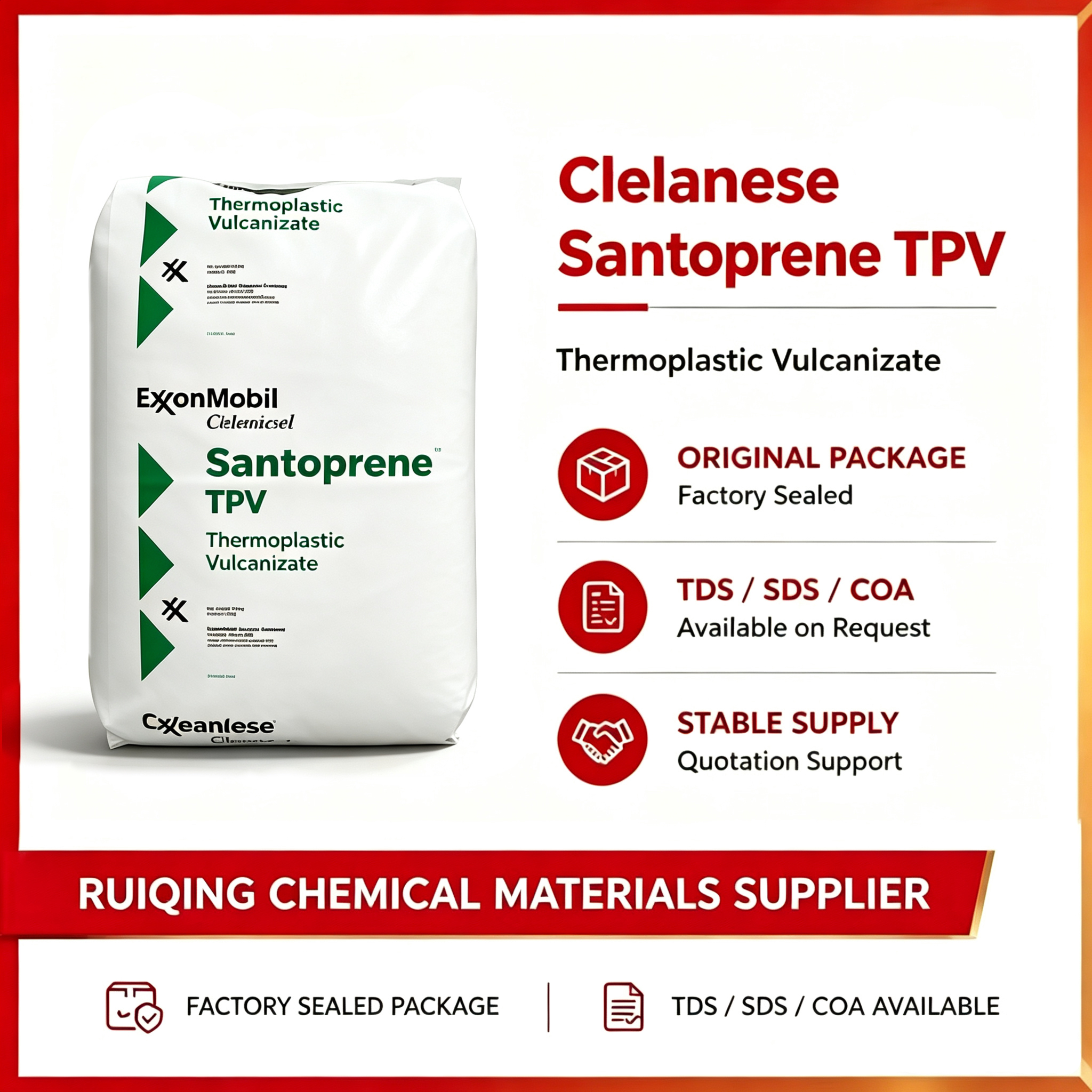
描述
Santoprene 591-65W175 is a black, UV-stabilized thermoplastic vulcanizate from Celanese developed for architectural glazing, outdoor sealing and precision extrusion applications.
The grade combines rubber-like flexibility with conventional thermoplastic processing and is particularly suitable for continuous extruded profiles used in building and construction.
Current Celanese Product Finder values include:
- 73 Shore A hardness
- Black appearance
- 439% elongation at break
- 7.0 MPa tensile stress at break
- 2.9 MPa tensile stress at 100% elongation
- 31% compression set at the listed 70°C reference condition
- UV-stabilized formulation
- Extrusion processing
Santoprene 591-65W175 is therefore particularly relevant when an outdoor sealing profile needs more firmness and mechanical support while maintaining elastomeric flexibility.
The grade is also described in current Celanese-derived technical listings as a soft, black polyolefin-based TPV designed for thin-wall architectural glazing and sealing applications, with good compression-set resistance and processing characteristics suited to long extrusion runs.
For more TPV products, visit our TPV Thermoplastic Vulcanizates Product Category →.
For the current Santoprene portfolio, see the Official Celanese Santoprene & Geolast Product Finder →.
Key Features of Santoprene 591-65W175
| Feature | Engineering Benefit |
|---|---|
| 73 Shore A Hardness | Provides a firm elastomeric response for sealing and profile applications |
| Black Formulation | Suitable for exterior architectural and sealing components |
| UV Stabilized | Supports outdoor applications exposed to sunlight |
| 439% Elongation at Break | Provides substantial flexibility |
| 7.0 MPa Tensile Stress at Break | Provides useful mechanical durability |
| 2.9 MPa Stress at 100% Elongation | Provides controlled resistance to deformation |
| 31% Compression Set | Supports sealing applications requiring recovery after compression |
| Architectural Glazing Positioning | Suitable for flexible glazing and construction profiles |
| Thin-Wall Extrusion Capability | Supports detailed profile sections |
| Long-Run Extrusion Performance | Designed for continuous industrial extrusion |
| Low Material Build-Up | Helps reduce deposits around screens and narrow die sections |
| Shear-Dependent Flow | Provides lower apparent viscosity at higher processing shear |
| Extrusion Processability | Suitable for continuous profiles and seals |
| Coextrusion Capability | Supports selected multi-material profiles |
| Thermoforming Capability | Broadens manufacturing options |
| Polyolefin-Based TPV | Combines elastomeric properties with thermoplastic processing |
Celanese’s portfolio-level data specifically identifies Santoprene 591-65W175 as UV stabilized, with extrusion processing and use in the building and construction sector.
Typical Applications for Santoprene 591-65W175
Santoprene 591-65W175 is particularly suitable for outdoor sealing components requiring a medium-firm elastomeric profile.
| Application Area | Typical Use |
|---|---|
| Architectural Glazing | Flexible glazing seals and profiles |
| Window Seals | Exterior window sealing components |
| Door Seals | Weather-resistant door profiles |
| Weatherstripping | Outdoor sealing against air and moisture |
| Façade Systems | Flexible interfaces for building-envelope systems |
| Glass Sealing Profiles | Flexible profiles around glazing assemblies |
| Construction Profiles | Continuous extruded building components |
| Outdoor Equipment | UV-stabilized flexible seals |
| Building Gaskets | Flexible compression sealing |
| Thin-Wall Profiles | Detailed extrusion geometries |
| Coextruded Profiles | Multi-material flexible profile constructions |
| Consumer Products | Black flexible sealing and protective parts |
The current Celanese Product Finder places this grade in Building & Construction and Consumer Goods, making those the strongest application categories for SEO.
Typical Properties of Santoprene 591-65W175
Physical Properties
| Property | Typical Value |
|---|---|
| Shore A Hardness | 73 |
| Appearance | Black |
| Polymer Family | TPV / TPE-V |
| Polymer Base | Polyolefin-based TPV |
| Product Form | Pellets / Granules |
| UV Stabilization | Yes |
The 73 Shore A hardness is important because the number 65 in the grade designation should not be interpreted as the current measured Shore A hardness. The current Celanese Product Finder reports 73 Shore A.
Mechanical Properties
| Property | Typical Value |
|---|---|
| Elongation at Break, 23°C | 439% |
| Tensile Stress at Break, 23°C | 7.0 MPa |
| Tensile Stress at 100% Elongation | 2.9 MPa |
| Compression Set, 70°C Reference Condition | 31% |
| Shore A Hardness | 73 |
These are the key grade-specific values currently shown by Celanese for Santoprene 591-65W175.
UV-Stabilized Outdoor Performance
A major feature of Santoprene 591-65W175 is its UV-stabilized black formulation.
This makes it especially relevant to components exposed to:
- Sunlight
- Outdoor weather
- Seasonal temperature changes
- Rain and moisture
- Building-envelope exposure
- Long-term exterior use
Celanese places the W175 grades in its building and construction portfolio and identifies 591-65W175 as UV stabilized.
Typical outdoor applications include:
- Window sealing
- Door sealing
- Architectural glazing
- Exterior profiles
- Building gaskets
- Weatherstripping
- Outdoor flexible interfaces
Architectural Glazing Applications
Santoprene 591-65W175 is specifically positioned for thin-wall architectural glazing and sealing applications.
Architectural glazing seals may need to accommodate:
- Glass movement
- Thermal expansion
- Building movement
- Wind loading
- Assembly tolerances
- Continuous compression
- Outdoor UV exposure
- Moisture and weather
A TPV such as Santoprene 591-65W175 provides rubber-like sealing behavior while retaining the processing efficiency of a thermoplastic.
This enables production using continuous extrusion rather than conventional rubber vulcanization.
Precision Thin-Wall Extrusion
One of the strongest technical selling points of the W175 family is precision profile extrusion.
Santoprene 591-65W175 is designed for thin-wall glazing and sealing profiles and is described as capable of continuous extrusion with good profile definition.
This is important for profiles incorporating:
- Thin sealing lips
- Flexible ribs
- Narrow channels
- Sharp profile transitions
- Small flexible contact surfaces
- Multiple sealing zones
These geometries are common in:
- Windows
- Doors
- Glass systems
- Building façades
- Weather seals
Long Extrusion Runs
Santoprene 591-65W175 is also designed for long extrusion runs with minimal material build-up on screen packs and narrow die sections.
This can provide practical production advantages such as:
- Reduced die cleaning
- Less process interruption
- Better profile consistency
- Longer continuous production runs
- More stable dimensions
- Reduced maintenance around screens and tooling
For manufacturers of architectural profiles, this processing characteristic may be just as important as the basic tensile properties.
Compression-Set Performance
Compression set is particularly relevant for window, door and glazing seals because the profile may remain compressed for long periods.
Celanese’s Product Finder gives a typical compression-set value of approximately 31% at the listed 70°C reference condition for Santoprene 591-65W175.
This makes the property important to applications such as:
- Compression seals
- Window gaskets
- Glazing profiles
- Door weatherstrips
- Building gaskets
When compressed between two surfaces, the elastomer must retain sufficient recovery to continue providing sealing pressure.
High Elongation for Flexible Profiles
Despite its relatively firm 73 Shore A hardness, Santoprene 591-65W175 retains approximately 439% elongation at break.
This provides substantial flexibility for profiles that may experience:
- Installation stretching
- Corner deformation
- Thermal expansion
- Repeated opening and closing
- Compression
- Flexing
- Misalignment
The approximately 7.0 MPa tensile stress at break also provides useful resistance to tearing or mechanical damage during installation and service.
Why Choose Santoprene 591-65W175?
The key value of Santoprene 591-65W175 is the combination of:
- 73 Shore A hardness
- Black UV-stabilized formulation
- 439% elongation
- 7.0 MPa tensile strength
- 2.9 MPa stress at 100% elongation
- 31% compression set
- Architectural glazing suitability
- Outdoor weather-sealing positioning
- Thin-wall extrusion capability
- Long-run extrusion performance
- Reduced build-up during continuous processing
- Thermoplastic recyclability within controlled manufacturing streams
For customers manufacturing window seals, door seals, glazing gaskets, outdoor profiles or architectural weatherstripping, Santoprene 591-65W175 is a relevant TPV grade to evaluate.
Processing Guidelines for Santoprene 591-65W175
Santoprene 591-65W175 is a shear-dependent TPV designed primarily around extrusion-based processing.
Published processing routes include:
- Profile extrusion
- Sheet extrusion
- Coextrusion
- Thermoforming
- Conventional thermoplastic extrusion
Drying
A practical Santoprene processing starting point is:
| Processing Parameter | Recommended Starting Point |
|---|---|
| Drying Temperature | Approx. 80°C |
| Drying Time | Approx. 3 hours |
| Dryer Type | Desiccant / dehumidified dryer |
For production, current lot-specific Celanese processing documentation should be used to confirm the final machine settings.
General Processing Temperature
A practical Santoprene TPV processing window is approximately:
175–230°C
Actual conditions depend on:
- Extruder size
- Screw design
- Profile wall thickness
- Die geometry
- Line speed
- Melt pressure
- Cooling system
- Surface-quality requirements
For Santoprene 591-65W175, the extrusion process should be optimized around stable profile definition rather than simply maximizing melt temperature.
Extrusion Processing
For Santoprene 591-65W175, particular attention should be paid to:
- Barrel-zone temperatures
- Screw speed
- Melt pressure
- Screen pack
- Adapter temperature
- Die temperature
- Drawdown
- Cooling rate
- Calibration
- Profile support
- Puller speed
- Final profile dimensions
Because the grade is used for detailed architectural profiles, small changes in die temperature, line speed or drawdown can affect:
- Lip thickness
- Corner definition
- Surface appearance
- Dimensional stability
- Seal compression
Shear-Dependent Flow
Santoprene 591-65W175 is shear dependent, meaning its apparent melt viscosity decreases as shear rate increases.
This behavior is beneficial for:
- Narrow die passages
- Thin sealing lips
- Complex profile sections
- Fine profile details
- Continuous extrusion
Tool design and screw speed should therefore be optimized together with temperature.
Coextrusion
Santoprene 591-65W175 can be used in coextrusion processes for selected multi-material profile constructions.
Potential coextrusion designs include:
- Rigid carrier + flexible seal
- Structural profile + sealing lip
- Multi-durometer flexible profiles
- Protective edge profiles
- Building weather seals
Actual material compatibility and adhesion should be evaluated using the exact substrate polymer and production process.
Surface Quality
Architectural sealing profiles are often visible after installation.
Important appearance requirements may include:
- Smooth surface
- Consistent gloss
- No melt fracture
- No contamination
- Consistent black color
- Sharp profile definition
- Minimal die lines
Santoprene 591-65W175’s extrusion-focused formulation makes it particularly suitable for this type of continuous profile production.
Related Products
We supply Santoprene TPV grades for different outdoor sealing, architectural glazing, extrusion and hardness requirements.
Typical product families include:
- Santoprene 591 W175 Series
- Santoprene UV-stabilized TPV grades
- Santoprene architectural glazing grades
- Santoprene outdoor sealing grades
- Santoprene weatherstrip grades
- Santoprene thin-wall extrusion grades
- Santoprene profile extrusion grades
- Santoprene coextrusion grades
- Santoprene building and construction TPV grades
View More TPV Thermoplastic Vulcanizates →
For grade-selection support, send us your profile dimensions, required hardness, UV requirement and processing method.
Technical Documents for Santoprene 591-65W175
| Document Type | Description |
|---|---|
| TDS | Physical, mechanical and processing data |
| SDS | Safety Data Sheet |
| UV Information | UV-stabilized outdoor application information |
| Extrusion Guide | Profile and thin-wall extrusion guidance |
| Processing Guide | Extrusion and coextrusion recommendations |
| Santoprene Product Finder | Celanese portfolio and grade-selection information |
| COA | Batch-specific quality information where available |
Need technical documents for Santoprene 591-65W175?
📧 Email: ruiqingchem@gmail.com
📝 Online form: Contact Us →
Please state Santoprene 591-65W175 and specify whether you require TDS, SDS, UV information, extrusion guidance or COA.
FAQ About Santoprene 591-65W175
Q1: What is Santoprene 591-65W175?
Santoprene 591-65W175 is a black UV-stabilized TPV from Celanese primarily used for architectural glazing, outdoor sealing and profile extrusion applications.
Q2: What is the hardness of Santoprene 591-65W175?
Current Celanese Product Finder data gives approximately 73 Shore A.
Q3: Is Santoprene 591-65W175 actually 65 Shore A?
No. The 65 in the grade designation should not be treated as its current measured hardness. Celanese currently lists approximately 73 Shore A.
Q4: What color is Santoprene 591-65W175?
The standard grade is Black.
Q5: Is Santoprene 591-65W175 UV stabilized?
Yes. Celanese Product Finder identifies the grade as UV stabilized.
Q6: What is the elongation at break?
The current typical value is approximately 439%.
Q7: What is the tensile stress at break?
The current typical value is approximately 7.0 MPa.
Q8: What is the stress at 100% elongation?
The typical value is approximately 2.9 MPa.
Q9: What is the compression set?
Celanese Product Finder lists approximately 31% at its 70°C reference condition.
Q10: Is Santoprene 591-65W175 suitable for architectural glazing?
Yes. The grade is specifically positioned for architectural glazing and sealing applications.
Q11: Can Santoprene 591-65W175 be used for outdoor window seals?
Yes. Its black UV-stabilized formulation makes outdoor sealing one of its main application areas.
Q12: Is Santoprene 591-65W175 suitable for thin-wall extrusion?
Yes. The grade is specifically designed for thin-wall architectural sealing profiles.
Q13: Is the material suitable for long extrusion runs?
Yes. Published grade information specifically notes long runs with minimal material build-up on screen packs or narrow die sections.
Q14: Can Santoprene 591-65W175 be coextruded?
Yes. Coextrusion is a listed processing method.
Q15: Is Santoprene 591-65W175 shear dependent?
Yes. Its melt viscosity decreases as processing shear increases.
Q16: What industries use Santoprene 591-65W175?
The strongest current Celanese market positioning is Building & Construction and Consumer Goods, especially glazing, weather sealing and flexible extruded profiles.
Request Santoprene 591-65W175 Price & Technical Support
For pricing, availability, technical documents or application support for Santoprene 591-65W175, please provide:
- Required quantity
- Destination country or port
- Architectural glazing / window / door / weather-sealing application
- Profile dimensions
- Required Shore hardness
- Minimum wall or sealing-lip thickness
- Outdoor UV requirement
- Service temperature
- Extrusion or coextrusion process
- Expected line speed
- Required color
- TDS / SDS requirement
- COA requirement
- Sample requirement, if applicable
📧 Email: ruiqingchem@gmail.com