
描述
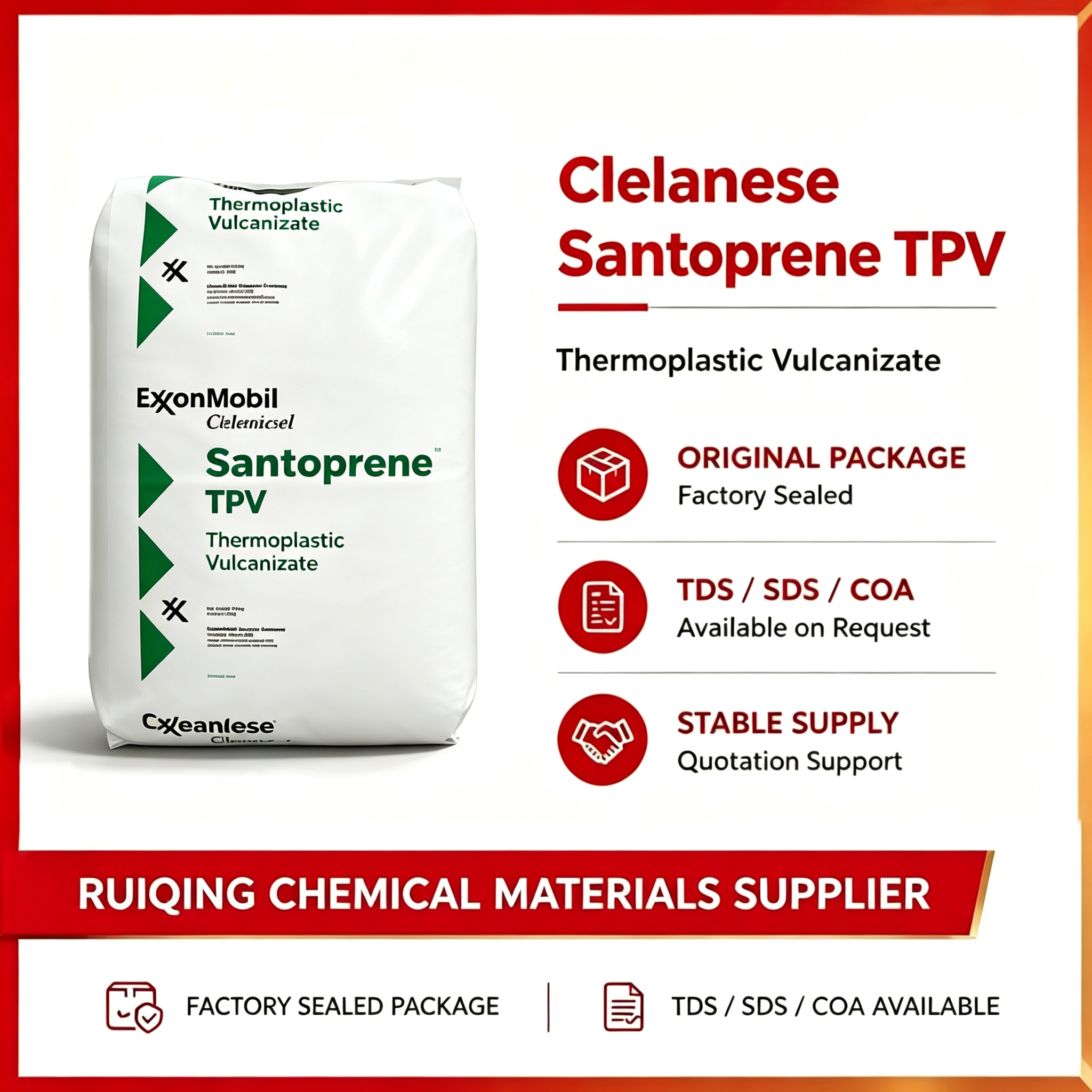
Santoprene 3293-40G is a hard, brownish thermoplastic vulcanizate from Celanese designed for technical applications requiring a combination of high mechanical strength, elastomeric flexibility and thermal-insulation performance.
Unlike many softer Santoprene grades measured on the Shore A scale, Santoprene 3293-40G is approximately 39 Shore D, placing it in a considerably harder TPV range.
Despite this relatively high hardness, the grade retains substantial elongation.
Current Celanese Materials Database values include:
- 39 Shore D hardness
- 0.930 g/cm³ density
- 9.9 MPa tensile stress at 100% elongation
- 18 MPa tensile stress at break
- 483% elongation at break
This combination is important because it gives the material significantly more structural support than a soft TPV while preserving rubber-like deformation capability.
Celanese also explicitly describes the material as providing good physical properties and thermal insulation for a wide range of applications.
Another important feature is its elevated-temperature aging performance. Published grade-specific data includes property changes after 168 hours at 150°C, providing useful information for applications exposed to prolonged heat.
Santoprene 3293-40G is shear dependent and can be processed using conventional thermoplastic equipment.
For more TPV products, visit our TPV Thermoplastic Vulcanizates Product Category →.
For the current Santoprene portfolio, see the Official Celanese Santoprene & Geolast Product Finder →.
Key Features of Santoprene 3293-40G
| Feature | Engineering Benefit |
|---|---|
| 39 Shore D Hardness | Provides a hard and structurally supportive elastomeric response |
| 18 MPa Tensile Stress at Break | Provides high mechanical strength |
| 483% Elongation at Break | Maintains substantial flexibility despite high hardness |
| 9.9 MPa Stress at 100% Elongation | Provides strong resistance to deformation |
| 0.930 g/cm³ Density | Offers relatively low material density |
| Thermal Insulation | Suitable for applications requiring thermal isolation |
| Heat-Aging Data at 150°C | Supports evaluation for elevated-temperature environments |
| Good Physical Properties | Suitable for demanding technical components |
| Shear-Dependent Flow | Melt viscosity decreases as processing shear increases |
| Injection Moldable | Suitable for complex molded components |
| Multi-Injection Moldable | Supports selected multi-material constructions |
| Extrudable | Suitable for continuous profiles and technical sections |
| Sheet Extrudable | Supports sheet and flat-profile applications |
| Coextrudable | Supports selected multi-material extrusion designs |
| Polyolefin Based | Combines thermoplastic processability with elastomeric behavior |
| Manufacturing-Stream Recyclability | Suitable production scrap may be reprocessed |
Typical Applications for Santoprene 3293-40G
Because Santoprene 3293-40G combines high hardness, tensile strength, flexibility and thermal-insulation characteristics, it can be evaluated for demanding industrial and automotive components.
| Application Area | Typical Use |
|---|---|
| Thermal Insulating Components | Flexible barriers and thermal-isolation parts |
| Industrial Seals | Firm elastomeric sealing components |
| Automotive Technical Parts | Flexible structural and protective components |
| Protective Covers | Tough elastomeric protection |
| High-Hardness Profiles | Extruded technical profiles |
| Flexible Structural Interfaces | Interfaces between rigid components |
| Heat-Exposed Components | Parts requiring elevated-temperature aging resistance |
| Grommets | Firm protective elastomeric components |
| Bumpers | Impact and contact protection |
| Flexible Housings | Tough technical housings or covers |
| Industrial Equipment | Components exposed to repeated deformation |
| Coextruded Profiles | Multi-material continuous components |
For SEO purposes, the strongest application positioning should remain around high-hardness TPV, thermal insulation, heat resistance and high-strength technical components, rather than food, medical or flame-retardant claims that are not part of the current grade sheet.
Typical Properties of Santoprene 3293-40G
Physical Properties
| Property | Typical Value | Test Method |
|---|---|---|
| Density | 930 kg/m³ / 0.930 g/cm³ | ISO 1183 |
| Shore D Hardness, 15 s | 39 | ISO 48-4 / ISO 868 |
| Resin Identification | TPV | ISO 1043 |
| Part Marking Code | >TPV< | ISO 11469 |
| Product Form | Pellets | Manufacturer information |
| Appearance | Brownish | Manufacturer information |
| Polymer Base | Polyolefin-based TPV | Manufacturer information |
The current Celanese Materials Database revision dated April 21, 2025 lists 39 Shore D hardness and 0.930 g/cm³ density.
Mechanical Properties
| Property | Typical Value | Test Method |
|---|---|---|
| Tensile Stress at 100% Elongation, Perpendicular | 9.9 MPa | ISO 37 |
| Tensile Stress at Break, Perpendicular | 18 MPa | ISO 527-1/-2 or ISO 37 |
| Elongation at Break, Perpendicular | 483% | ISO 527-1/-2 or ISO 37 |
| Shore D Hardness | 39 | ISO 48-4 / ISO 868 |
These values are especially notable because Santoprene 3293-40G maintains 483% elongation even at 39 Shore D hardness.
Heat-Aging Performance
One of the most useful grade-specific sections for Santoprene 3293-40G is its published high-temperature aging data.
Heat Aging at 150°C for 168 Hours
| Property | Condition | Typical Change | Test Method |
|---|---|---|---|
| Tensile Strength | 150°C / 168 h | +31% | ISO 188 |
| Tensile Strain at Break | 150°C / 168 h | -34% | ISO 188 |
| Shore D Hardness | 150°C / 168 h | +3.8 points | ISO 188 |
Celanese’s current grade sheet reports these changes after prolonged exposure at 150°C for 168 hours.
This data is valuable when evaluating the material for applications exposed to:
- Engine-compartment heat
- Industrial equipment
- Heated enclosures
- Thermal cycling
- Elevated ambient temperatures
- Heat-generating electrical or mechanical components
The increase in tensile strength and hardness, together with the reduction in elongation, indicates that the material becomes firmer after the specified heat-aging exposure.
Thermal Insulation
Celanese explicitly states that Santoprene 3293-40G combines good physical properties and thermal insulation.
This positioning makes the material relevant where a flexible polymer component must help separate or reduce heat transfer between adjacent parts.
Potential functions include:
- Thermal isolation interfaces
- Flexible spacers
- Insulating covers
- Protective profiles
- Heat-separated mounting elements
- Flexible barriers
The current grade sheet does not publish a numerical thermal-conductivity value, so the page should describe it as having thermal-insulation characteristics rather than claiming a specific W/m·K figure.
High-Hardness Elastomeric Performance
A defining characteristic of Santoprene 3293-40G is the combination of 39 Shore D hardness with 483% elongation.
This gives designers access to a material that feels and behaves considerably firmer than conventional soft TPV grades while retaining the ability to deform elastically.
This can be useful when a part needs:
- Better shape retention
- Higher mechanical support
- Toughness
- Elastic recovery
- Flexibility under load
- Impact resistance
- Reduced brittleness compared with rigid thermoplastics
The approximately 18 MPa tensile stress at break also gives the material strong mechanical performance for a TPV.
Why Choose Santoprene 3293-40G?
The main reason to select Santoprene 3293-40G is its combination of high hardness, tensile strength, elongation and thermal performance.
At approximately 39 Shore D, the grade provides substantially more support than typical soft Santoprene materials.
Its approximately 18 MPa tensile stress at break provides high mechanical strength.
The approximately 9.9 MPa stress at 100% elongation indicates a firm response under deformation.
At the same time, elongation at break remains approximately 483%, preserving significant elastomeric flexibility.
Celanese also explicitly positions the grade around thermal insulation, while the published 150°C aging data provides additional information for heat-exposed applications.
For customers requiring a high-hardness 39D TPV with strong tensile performance, substantial elongation and elevated-temperature aging data, Santoprene 3293-40G is a relevant grade to evaluate.
Processing Guidelines for Santoprene 3293-40G
Santoprene 3293-40G is shear dependent and is processed using conventional thermoplastic equipment.
The current Celanese Materials Database lists:
- Injection molding
- Multi-injection molding
- Extrusion
- Sheet extrusion
- Coextrusion
Celanese’s grade description also notes broader compatibility with conventional TPV processes such as blow molding, thermoforming and vacuum forming.
Current Grade-Specific Injection Conditions
| Processing Parameter | Celanese Guidance |
|---|---|
| Drying Recommended | Yes |
| Drying Temperature | 80°C |
| Drying Time | ≥3 hours |
| Dryer Type | Dehumidified / desiccant dryer |
| Processing Moisture Content | ≤0.08% |
| Maximum Regrind Level | 20% |
| Optimum Melt Temperature | 220°C |
| Minimum Melt Temperature | 215°C |
| Maximum Melt Temperature | 230°C |
| Optimum Mold Temperature | 30°C |
| Minimum Mold Temperature | 10°C |
| Maximum Mold Temperature | 50°C |
These are the current grade-specific conditions from the Celanese Materials Database revision dated April 21, 2025.
Injection Molding Notes
Celanese recommends holding pressure at approximately 50–75% of the actual injection pressure.
A relatively high screw speed of approximately 100–200 rpm is recommended.
Back pressure is not always necessary, but approximately 0.3–0.7 MPa can be used to help maintain melt homogeneity and consistent shot size. Higher back pressure may be used when processing masterbatch.
Important processing variables include:
- Melt temperature
- Injection speed
- Screw speed
- Holding pressure
- Back pressure
- Gate size
- Runner design
- Mold temperature
- Venting
- Cooling time
Extrusion Conditions
| Processing Parameter | Celanese Guidance |
|---|---|
| Melt Temperature Range | 195–225°C |
| Drying Temperature | 80°C |
| Drying Time | 3 hours |
The current grade sheet gives a specific extrusion melt-temperature range of 195–225°C.
For extrusion and coextrusion, processors should optimize:
- Barrel temperature profile
- Screw speed
- Melt pressure
- Adapter temperature
- Die temperature
- Draw-down
- Cooling
- Profile dimensions
- Surface finish
Shear-Dependent Flow
Santoprene 3293-40G has relatively high melt viscosity at low shear rates.
As shear rate increases, apparent viscosity decreases.
Celanese notes that increasing temperature has comparatively little effect on TPV melt viscosity, while smaller gates and higher shear rates help reduce viscosity and improve melt flow.
This is useful in:
- Thin molded sections
- Small gates
- Complex geometries
- Detailed technical components
- Extruded profiles
General Processing Window
Celanese recommends 3 hours of desiccant drying at approximately 80°C.
The broader Santoprene TPV processing window is approximately 175–230°C, although the current grade-specific injection recommendation for Santoprene 3293-40G is narrower at 215–230°C, with 220°C optimum.
Material Compatibility
Celanese states that Santoprene TPV is incompatible with acetal (POM) and PVC.
Processing equipment should therefore be thoroughly purged when changing between POM or PVC and Santoprene 3293-40G.
Related Products
We supply Santoprene TPV grades for different hardness, thermal, mechanical and processing requirements.
Typical Santoprene product families include:
- Santoprene 3293 Series
- Santoprene high-hardness TPV grades
- Santoprene heat-resistant grades
- Santoprene thermal-insulation grades
- Santoprene injection-molding grades
- Santoprene extrusion grades
- Santoprene coextrusion grades
- Santoprene industrial TPV grades
- Santoprene automotive technical grades
View More TPV Thermoplastic Vulcanizates →
For grade-selection support, send us your required hardness, operating temperature, tensile requirement and processing method.
Technical Documents for Santoprene 3293-40G
| Document Type | Description |
|---|---|
| TDS | Physical, mechanical, heat-aging and processing data |
| SDS | Safety Data Sheet |
| Heat Aging Information | 150°C / 168 h property-retention data |
| Processing Guide | Injection molding, extrusion and coextrusion guidance |
| Santoprene Product Finder | Celanese TPV portfolio information |
| COA | Batch-specific quality information where available |
Need technical documents for Santoprene 3293-40G?
📧 Email: ruiqingchem@gmail.com
📝 Online form: Contact Us →
Please state Santoprene 3293-40G and specify whether you require TDS, SDS, heat-aging data, processing information or COA.
FAQ About Santoprene 3293-40G
Q1: What is Santoprene 3293-40G?
Santoprene 3293-40G is a hard, brownish polyolefin-based TPV from Celanese combining strong mechanical properties with thermal-insulation characteristics.
Q2: What is the hardness of Santoprene 3293-40G?
The current Celanese Materials Database gives approximately 39 Shore D.
Q3: Is 3293-40G a 40 Shore A material?
No. The published hardness is 39 Shore D, not 40 Shore A.
Q4: What is the density?
The typical density is approximately 0.930 g/cm³.
Q5: What is the tensile stress at break?
The typical tensile stress at break is approximately 18 MPa.
Q6: What is the elongation at break?
The typical elongation at break is approximately 483%.
Q7: What is the tensile stress at 100% elongation?
The typical value is approximately 9.9 MPa.
Q8: Does Santoprene 3293-40G have thermal-insulation properties?
Yes. Celanese explicitly describes the grade as combining good physical properties with thermal insulation.
Q9: Does Santoprene 3293-40G have high-temperature aging data?
Yes. Celanese publishes property changes after 150°C for 168 hours.
Q10: How does tensile strength change after 150°C for 168 hours?
The published change is approximately +31% under the specified ISO 188 aging condition.
Q11: How does elongation change after heat aging?
The published change in tensile strain at break after 150°C / 168 h is approximately -34%.
Q12: Can Santoprene 3293-40G be injection molded?
Yes. Injection molding and multi-injection molding are current listed processes.
Q13: Can Santoprene 3293-40G be extruded?
Yes. Extrusion, sheet extrusion and coextrusion are current listed processing methods.
Q14: What injection melt temperature is recommended?
The current grade-specific recommendation is 220°C optimum, with a range of approximately 215–230°C.
Q15: What extrusion melt temperature is recommended?
The current Celanese grade sheet lists approximately 195–225°C.
Q16: Does Santoprene 3293-40G require drying?
Yes. Celanese recommends 80°C for at least 3 hours in a dehumidified dryer, with processing moisture at or below approximately 0.08%.
Request Santoprene 3293-40G Price & Technical Support
For pricing, availability, technical documents or application support for Santoprene 3293-40G, please provide:
- Required quantity
- Destination country or port
- Automotive or industrial application
- Required Shore hardness
- Operating temperature
- Heat-aging requirement
- Tensile-strength requirement
- Thermal-insulation requirement
- Required color
- Injection-molding or extrusion process
- Part thickness
- TDS / SDS requirement
- Heat-aging data requirement
- COA requirement
- Sample requirement, if applicable
📧 Email: ruiqingchem@gmail.com