描述
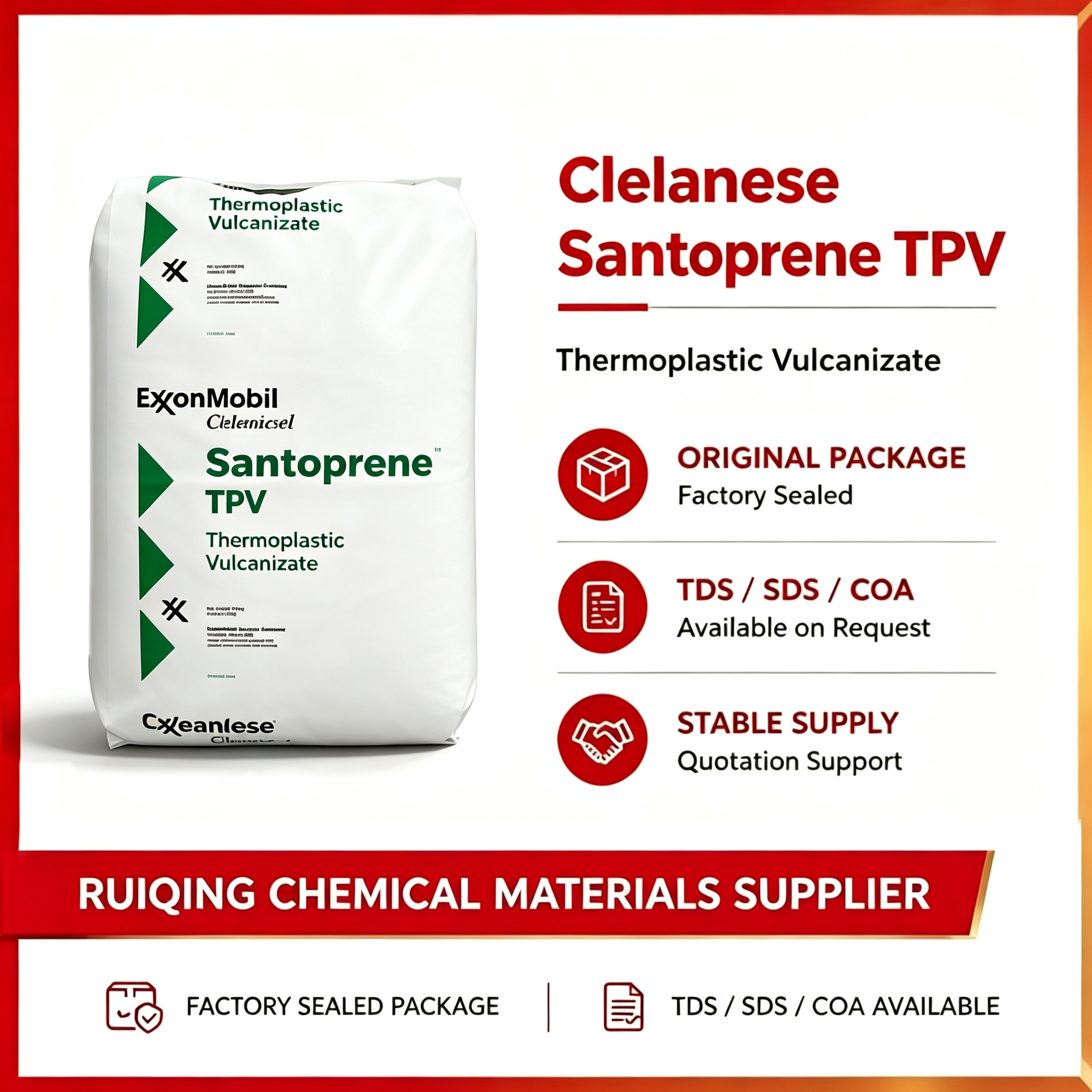
Santoprene 251-90 HF is a colorable, halogen-free flame-retardant thermoplastic vulcanizate developed by Celanese for demanding electrical and wire-and-cable applications.
The grade has been specifically developed for applications where designers require the flexibility of a TPV together with halogen-free flame-retardant performance.
Celanese’s current Materials Database describes Santoprene 251-90 HF as a shear-dependent TPV suitable for:
- Wire and cable extrusion
- Injection molding
- Multi-injection molding
- Conventional extrusion
- Sheet extrusion
- Coextrusion
- Blow molding
- Thermoforming
Current typical mechanical properties include:
- 90 Shore A hardness
- 610% elongation at break
- 11 MPa tensile stress at break
- 5.7 MPa tensile stress at 100% elongation
- 5.7 MPa tensile stress at 50% elongation
- 5.0 MPa stress at 10% elongation
- 3.9 MPa stress at 5% elongation
These properties give Santoprene 251-90 HF a relatively firm elastomeric feel while maintaining very high deformation capability.
The material also has a published oxygen index of 42%, reflecting its enhanced flame-resistant formulation.
According to Celanese’s latest 2025 material sheet, Santoprene 251-90 HF achieves UL 94 V-0 performance down to 1.6 mm based on internal testing.
The flame-retardant additive system is identified as non-halogenated and red-phosphorus-free.
This distinguishes Santoprene 251-90 HF from conventional brominated flame-retardant TPV grades.
For more TPV products, visit our TPV Thermoplastic Vulcanizates Product Category →.
For the broader Santoprene portfolio, see the Official Celanese Santoprene & Geolast Product Finder →.
Key Features of Santoprene 251-90 HF
| Feature | Engineering Benefit |
|---|---|
| Halogen Free | Supports electrical and cable designs requiring halogen-free materials |
| UL 94 V-0 @ 1.6 mm | Strong vertical-flame performance based on Celanese internal testing |
| 90 Shore A Hardness | Provides firm elastomeric support |
| 610% Elongation at Break | Maintains very high flexibility and deformation capability |
| 11 MPa Tensile Stress at Break | Provides strong mechanical performance |
| 5.7 MPa Stress at 100% Elongation | Provides controlled firm elastic response |
| 42% Oxygen Index | Indicates strong resistance to sustained combustion |
| Red-Phosphorus Free | Avoids a red-phosphorus flame-retardant system |
| Colorable | Supports customized color requirements |
| Wire & Cable Extrusion | Specifically designed for cable-processing applications |
| Injection Moldable | Suitable for molded electrical components |
| Coextrudable | Useful for multi-layer profiles and cable structures |
| Blow Moldable | Supports selected hollow components |
| Thermoformable | Broadens manufacturing flexibility |
| Manufacturing-Stream Recyclability | Polyolefin-based material can be recycled within controlled production streams |
The strongest value proposition of Santoprene 251-90 HF is the combination of 90A elastomeric flexibility, halogen-free flame retardancy and wire-and-cable processability.
Typical Applications for Santoprene 251-90 HF
Celanese specifically promotes Santoprene 251-90 HF for evolving electrical applications requiring halogen-free flame-retardant materials.
The manufacturer lists applications including drag-chain cables, robotic cables, mixed-signal cables, CAN bus cables and coaxial cables.
| Application Area | Typical Use |
|---|---|
| Drag-Chain Cables | Flexible cable jackets for repeated movement |
| Robotic Cables | Highly flexible cable protection |
| Mixed-Signal Cables | Flexible flame-retardant jacketing |
| CAN Bus Cables | Automotive and industrial communications cable protection |
| Coaxial Cables | Flexible external jackets and protective layers |
| Wire & Cable Jackets | Halogen-free flame-retardant outer jackets |
| Cable Boots | Flexible protection around cable entry points |
| Strain Reliefs | Molded flexible cable-support components |
| Electrical Connectors | Flexible connector housings and seals |
| Flexible Electrical Parts | Technical elastomeric electrical components |
| Industrial Cable Systems | Flexible flame-retardant protection |
| Automation Equipment | Components exposed to repeated motion |
| Telecommunications Equipment | Flexible cable and connector components |
Santoprene 251-90 HF is particularly attractive where both mechanical flexibility and halogen-free flame performance are required.
Typical Properties of Santoprene 251-90 HF
Physical Properties
| Property | Typical Value | Test Method |
|---|---|---|
| Density | 1110 kg/m³ / 1.110 g/cm³ | ISO 1183 |
| Shore A Hardness, 15 s | 90 | ISO 48-4 / ISO 868 |
| Resin Identification | TPV | ISO 1043 |
| Part Marking Code | >TPV< | ISO 11469 |
| Product Form | Pellets | Manufacturer information |
| Appearance | Colorable | Manufacturer information |
The current Celanese Materials Database revision dated 2025-05-12 gives a density of approximately 1.110 g/cm³ and hardness of 90 Shore A.
Mechanical Properties
| Property | Typical Value | Test Method |
|---|---|---|
| Stress at 5% Elongation | 3.9 MPa | ISO 527-1/-2 or ISO 37 |
| Stress at 10% Elongation | 5.0 MPa | ISO 527-1/-2 or ISO 37 |
| Tensile Stress at 50% Elongation | 5.7 MPa | ISO 527-1/-2 or ISO 37 |
| Tensile Stress at 100% Elongation | 5.7 MPa | ISO 37 |
| Tensile Stress at Break | 11 MPa | ISO 527-1/-2 or ISO 37 |
| Elongation at Break | 610% | ISO 527-1/-2 or ISO 37 |
| Shore A Hardness | 90 | ISO 48-4 / ISO 868 |
The unusually high 610% elongation at break means the grade retains substantial elasticity despite its relatively high 90A hardness.
Halogen-Free Flame-Retardant Performance
The most important technical feature of Santoprene 251-90 HF is its halogen-free flame-retardant system.
Celanese identifies the grade as:
- Halogen Free
- Non-halogenated flame retardant
- Red-phosphorus free
- UL 94 V-0 down to 1.6 mm based on internal testing
Flammability Properties
| Property | Typical Value | Standard |
|---|---|---|
| Flame Rating | V-0 | UL 94 / IEC 60695-11-10 |
| Thickness Tested | 1.6 mm | IEC 60695-11-10 |
| Oxygen Index | 42% | ISO 4589-1/-2 |
| Flame-Retardant Chemistry | Non-halogenated | Manufacturer information |
| Red Phosphorus | Free of red-phosphorus flame retardant | Manufacturer information |
The 42% oxygen index is particularly notable because it means the material requires a substantially oxygen-enriched atmosphere to sustain combustion under the relevant test method.
What Does HF Mean in Santoprene 251-90 HF?
The suffix HF refers to the grade’s halogen-free flame-retardant positioning.
This matters in wire-and-cable applications because halogen-containing cable compounds can release corrosive and toxic gases during combustion. UL distinguishes halogen-free material claims from separate low-smoke performance requirements, so HF should not automatically be interpreted as LSHF unless the finished cable construction has also been evaluated for low-smoke performance.
For your product page, the safest and strongest wording is therefore:
Halogen-Free Flame-Retardant TPV
rather than automatically calling the material:
Low-Smoke Halogen-Free TPV
unless the relevant complete cable system has the required low-smoke certification.
Wire & Cable Applications
Celanese specifically developed its newer Santoprene HF grades for electrical cable applications.
The official Celanese application page states that Santoprene 251-90 HF can be deployed in applications including:
- Drag-chain cables
- Robotic cables
- Mixed-signal cables
- CAN bus cables
- Coaxial cables
This makes the grade particularly relevant to:
- Factory automation
- Robotics
- Automotive electronics
- Industrial communications
- Data transmission
- Motion-control systems
- Flexible electrical equipment
Why Choose Santoprene 251-90 HF?
The main reason to choose Santoprene 251-90 HF is its combination of halogen-free flame resistance and elastomeric flexibility.
At approximately 90 Shore A, the material provides a relatively firm elastomeric structure.
Its approximately 610% elongation at break allows substantial deformation and supports applications involving cable bending and repetitive movement.
The approximately 11 MPa tensile stress at break gives the grade useful mechanical strength.
The approximately 42% oxygen index supports its flame-retardant positioning.
Most importantly, the grade uses a non-halogenated, red-phosphorus-free flame-retardant additive system and achieves V-0 performance down to 1.6 mm in Celanese internal testing.
For cable manufacturers trying to move away from conventional halogen-containing flame-retardant systems, Santoprene 251-90 HF provides a TPV-based route while retaining conventional thermoplastic processing.
For customers requiring a 90A halogen-free flame-retardant TPV for cable extrusion, robotic cable, drag-chain cable or electrical components, Santoprene 251-90 HF is a key grade to evaluate.
Processing Guidelines for Santoprene 251-90 HF
Santoprene 251-90 HF can be processed using conventional thermoplastic equipment.
Current Celanese data specifically lists:
- Wire and cable extrusion
- Injection molding
- Multi-injection molding
- Extrusion
- Sheet extrusion
- Coextrusion
- Blow molding
- Thermoforming
Drying & General Processing Conditions
| Processing Parameter | Celanese Guidance |
|---|---|
| Drying Recommended | Yes |
| Drying Temperature | 80°C |
| Drying Time | 3 hours |
| General Processing Window | 175–230°C |
| Screw Speed | 100–200 rpm |
| Back Pressure | 0.3–0.7 MPa |
| Holding Pressure | 50–75% of actual injection pressure |
Celanese recommends 3 hours of desiccant drying at 80°C and identifies a broad processing window of approximately 175–230°C.
Injection Molding Notes
For injection molding, Celanese recommends holding pressure at approximately 50–75% of actual injection pressure.
A relatively high screw speed of approximately 100–200 rpm is recommended.
Back pressure is not always required, but approximately 0.3–0.7 MPa may be used to help create a homogeneous melt and maintain consistent shot size. Higher back pressure may be used when processing masterbatch.
Important variables include:
- Melt temperature
- Injection speed
- Screw speed
- Holding pressure
- Back pressure
- Gate dimensions
- Runner design
- Mold temperature
- Venting
- Cooling time
Wire & Cable Extrusion
Because wire-and-cable extrusion is explicitly listed as a processing method, extrusion is one of the key processing routes for Santoprene 251-90 HF.
Processors should optimize:
- Barrel-zone temperatures
- Screw design
- Screw speed
- Adapter temperature
- Die temperature
- Melt pressure
- Line speed
- Draw-down ratio
- Jacket thickness
- Cooling
- Surface finish
- Concentricity
Shear-Dependent Flow
Santoprene 251-90 HF is specifically identified as shear dependent.
Increasing shear rate reduces apparent viscosity, which can help the material flow through extrusion dies, cable tooling and injection-molding gates.
Material Compatibility
Celanese states that Santoprene TPV is incompatible with acetal (POM) and PVC.
Processing equipment should therefore be thoroughly purged when changing between these materials and Santoprene 251-90 HF.
Related Products
We supply Santoprene TPV grades for different flame-retardancy, halogen-free, electrical and wire-and-cable requirements.
Typical Santoprene product families include:
- Santoprene HF flame-retardant grades
- Santoprene 251 Series
- Santoprene wire-and-cable grades
- Santoprene electrical grades
- Santoprene robotic-cable grades
- Santoprene cable-jacketing grades
- Santoprene coextrusion grades
- Santoprene specialty TPV grades
View More TPV Thermoplastic Vulcanizates →
If you need grade-selection support, send us your required flame rating, halogen-free requirement, Shore hardness, cable construction and processing method.
Technical Documents for Santoprene 251-90 HF
| Document Type | Description |
|---|---|
| TDS | Physical, mechanical, flame-retardant and processing data |
| SDS | Safety Data Sheet |
| Flammability Information | V-0 at 1.6 mm based on Celanese internal testing |
| Halogen-Free Information | Non-halogenated flame-retardant formulation |
| Wire & Cable Information | Cable extrusion and application guidance |
| Processing Guide | Injection molding, extrusion and coextrusion guidance |
| Santoprene Product Information | Celanese portfolio and application information |
| COA | Batch-specific quality information where available |
Need technical documents for Santoprene 251-90 HF?
📧 Email: ruiqingchem@gmail.com
📝 Online form: Contact Us →
Please state Santoprene 251-90 HF and whether you require TDS, SDS, flame-retardant, halogen-free or wire-and-cable information.
FAQ About Santoprene 251-90 HF
Q1: What is Santoprene 251-90 HF?
Santoprene 251-90 HF is a colorable, halogen-free flame-retardant TPV from Celanese designed primarily for electrical, wire-and-cable and flexible technical applications.
Q2: What does HF mean?
HF refers to the grade’s halogen-free flame-retardant positioning.
Q3: What is the hardness of Santoprene 251-90 HF?
The typical hardness is approximately 90 Shore A.
Q4: Is Santoprene 251-90 HF UL 94 V-0?
Celanese’s May 2025 material sheet states UL 94 V-0 down to 1.6 mm based on internal testing.
Q5: What is the elongation at break?
The typical elongation at break is approximately 610%.
Q6: What is the tensile stress at break?
The typical tensile stress at break is approximately 11 MPa.
Q7: What is the tensile stress at 100% elongation?
The typical value is approximately 5.7 MPa.
Q8: What is the density?
The typical density is approximately 1.110 g/cm³.
Q9: What is the oxygen index?
The current typical oxygen index is approximately 42% according to ISO 4589-1/-2.
Q10: Does Santoprene 251-90 HF contain halogenated flame retardants?
No. Celanese describes the additive system as non-halogenated.
Q11: Is it red-phosphorus free?
Yes. The current material sheet describes the flame-retardant additive system as red-phosphorus free.
Q12: Is Santoprene 251-90 HF suitable for wire and cable?
Yes. Celanese specifically lists wire-and-cable extrusion for this grade and promotes it for drag-chain, robotic, mixed-signal, CAN bus and coaxial cable applications.
Q13: Is Santoprene 251-90 HF low-smoke?
The grade is documented as halogen free, but halogen-free and low-smoke are separate performance claims. A finished cable should not automatically be called LSHF unless the required low-smoke evaluation has also been completed.
Q14: Can Santoprene 251-90 HF be injection molded?
Yes. Injection molding and multi-injection molding are explicitly listed processing methods.
Q15: What drying condition is recommended?
Celanese recommends desiccant drying for approximately 3 hours at 80°C.
Q16: What processing-temperature range is recommended?
Current Celanese guidance gives a broad processing window of approximately 175–230°C.
Request Santoprene 251-90 HF Price & Technical Support
For pricing, availability, technical documents or application support for Santoprene 251-90 HF, please provide:
- Required quantity
- Destination country or port
- Cable, electrical, robotic or industrial application
- Halogen-free requirement
- Required flame rating
- Minimum wall or jacket thickness
- Required Shore hardness
- Required color
- Cable construction
- Repeated-flex requirement
- Continuous operating temperature
- Injection-molding or extrusion process
- TDS / SDS requirement
- Flame-retardant documentation requirement
- Sample requirement, if applicable
📧 Email: ruiqingchem@gmail.com