描述
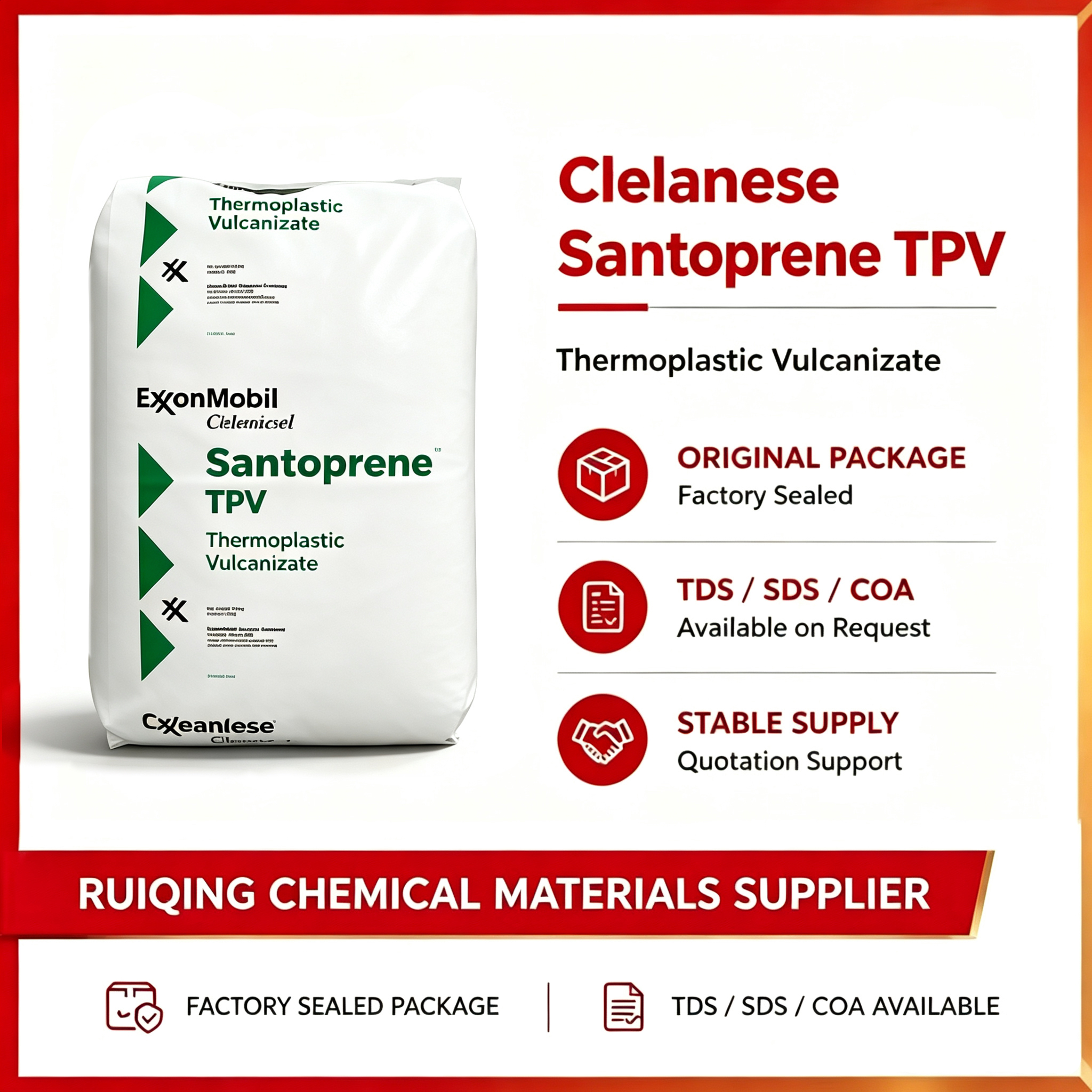
Santoprene 201-87 is a hard, colorable thermoplastic vulcanizate developed for applications requiring a combination of high mechanical strength, rubber-like elasticity and efficient thermoplastic processing.
The grade has a typical hardness of approximately 93 Shore A, placing it in the high-hardness range of Santoprene TPV materials.
Despite its relatively high hardness, Santoprene 201-87 retains substantial elasticity. Typical material data lists approximately 580% elongation at break, making it suitable for components that must withstand significant deformation without behaving like a rigid engineering plastic.
Its typical tensile stress at break is approximately 15 MPa, while tensile stress at 100% elongation is approximately 7.1 MPa.
Santoprene 201-87 also provides approximately 48 kN/m tear strength, giving the material good resistance to crack propagation, edge damage and tearing in demanding molded and extruded parts.
Excellent flex-fatigue resistance is one of the important characteristics of this grade. It can therefore be considered for components exposed to repeated bending, deformation, compression or movement during service.
The material also offers excellent ozone resistance, which is valuable for automotive, outdoor and industrial applications where elastomeric components may be continuously exposed to air and environmental aging.
Low-temperature performance is supported by a typical brittleness temperature of approximately -54°C.
Santoprene 201-87 combines these elastomeric properties with conventional thermoplastic processing, allowing manufacturers to use injection molding, extrusion, blow molding, thermoforming and vacuum-forming equipment.
Because the grade is supplied as a natural / colorable material, it also provides greater design flexibility for applications requiring customized color identification or appearance.
For more TPV materials, visit our TPV Thermoplastic Vulcanizates Product Category →.
Key Features of Santoprene 201-87
| Feature | Engineering Benefit |
|---|---|
| 93 Shore A Hardness | Provides a firm elastomeric feel and good resistance to deformation |
| Natural / Colorable | Supports customized product colors |
| 580% Elongation at Break | Maintains significant flexibility despite high hardness |
| 15 MPa Tensile Stress at Break | Provides strong mechanical performance |
| 48 kN/m Tear Strength | Helps resist tearing and edge damage |
| Excellent Flex-Fatigue Resistance | Suitable for repeatedly flexed components |
| Excellent Ozone Resistance | Supports outdoor and automotive service |
| Good Chemical Resistance | Useful for many industrial environments |
| Low-Temperature Flexibility | Typical brittleness temperature around -54°C |
| Thermoplastic Processability | Can be processed using conventional plastics equipment |
| Injection Moldable | Suitable for complex molded components |
| Extrudable | Suitable for profiles and continuous sections |
| Blow Moldable | Supports selected hollow flexible components |
| Thermoformable | Broadens manufacturing options |
The combination of hardness, elongation, tensile strength and environmental resistance makes Santoprene 201-87 particularly useful for demanding elastomeric components requiring greater stiffness than conventional soft TPV grades.
Typical Applications for Santoprene 201-87
Santoprene 201-87 can be considered for a wide range of automotive, industrial, electrical, appliance and consumer applications.
| Application Area | Typical Use |
|---|---|
| Seals | Firm elastomeric sealing components |
| Gaskets | Static and semi-dynamic sealing applications |
| Extruded Profiles | Weather-resistant technical and sealing profiles |
| Automotive Parts | Under-hood, exterior and technical elastomeric components |
| Protective Boots | Flexible protective covers |
| Bellows | Components exposed to repeated movement |
| Grommets | Cable and mechanical protection |
| Plugs | Protective sealing and closure applications |
| Flexible Housings | Tough protective components |
| Appliance Parts | Molded and extruded elastomeric components |
| Electrical Components | Protective technical parts |
| Industrial Components | Sealing, damping and protective applications |
| Tubing Components | Technical flexible sections |
| Color-Coded Parts | Components requiring customized colors |
| Blow-Molded Components | Selected hollow elastomeric parts |
The grade is especially suitable where a relatively hard TPV with high elongation and strong tear resistance is required.
Typical Properties of Santoprene 201-87
Physical Properties
| Property | Typical Value | Test Method |
|---|---|---|
| Density | 0.960 g/cm³ | ISO 1183 |
| Shore A Hardness, 15 s | 93 | ISO 48-4 / ISO 868 |
| Molding Shrinkage – Parallel | 1.5% | ISO 294-4 / ISO 2577 |
| Molding Shrinkage – Normal | 0.7% | ISO 294-4 / ISO 2577 |
| Resin Identification | TPV | ISO 1043 |
| Delivery Form | Pellets | Manufacturer information |
| Color | Natural / Colorable | Manufacturer information |
The relatively high Shore A hardness gives Santoprene 201-87 a firm elastomeric character while maintaining the flexibility associated with TPV materials.
Mechanical Properties
| Property | Typical Value | Test Method |
|---|---|---|
| Tensile Stress at 100% Elongation | 7.1 MPa | ISO 37 |
| Tensile Stress at Break | 15 MPa | ISO 37 / ISO 527 |
| Elongation at Break | 580% | ISO 37 / ISO 527 |
| Tear Strength | 48 kN/m | ISO 34-1 |
| Brittleness Temperature | -54°C | ASTM D746 |
| Compression Set, 70°C / 24 h | 36% | ISO 815 |
| Compression Set, 125°C / 70 h | 44% | ISO 815 |
Santoprene 201-87 combines high tensile strength with substantial elongation, allowing the material to resist mechanical loading while retaining elastomeric flexibility.
Its tear strength is particularly useful for components with edges, openings, thin sections or repeated mechanical movement.
Thermal Properties
| Property | Typical Value | Test Method |
|---|---|---|
| Continuous Upper Temperature Resistance, 1000 h | 135°C | SAE J2236 |
| RTI Electrical, 1.5 mm | 100°C | UL 746B |
| RTI Electrical, 3.0 mm | 100°C | UL 746B |
| RTI Strength, 1.5 mm | 90°C | UL 746B |
| RTI Strength, 3.0 mm | 95°C | UL 746B |
These thermal properties support the use of Santoprene 201-87 in automotive, industrial and electrical environments where elevated temperatures may occur.
Electrical Properties
| Property | Typical Value | Test Method |
|---|---|---|
| Comparative Tracking Index | PLC 0 | UL 746A |
| Arc Resistance Category | PLC 5 | UL 746 |
| Electric Strength, Short Time, 2 mm | 32 kV/mm | ASTM D149 |
| High-Amperage Arc Ignition, 1.5 mm | PLC 0 | UL 746A |
| High-Voltage Arc Tracking Rate | PLC 1 | UL 746A |
These characteristics can be useful when Santoprene 201-87 is evaluated for electrical protection, insulating components and technical molded applications.
Flex-Fatigue and Ozone Resistance
One of the most important advantages of Santoprene 201-87 is its resistance to repeated flexing.
Components such as boots, bellows, gaskets, flexible housings and sealing profiles may experience thousands or millions of deformation cycles during service.
Excellent flex-fatigue resistance helps the material maintain its mechanical integrity under this type of cyclic loading.
Ozone resistance is also important for components exposed to outdoor air, automotive environments and long-term atmospheric aging.
Traditional elastomers can suffer surface cracking when exposed to ozone under strain. Santoprene TPV materials are widely selected where improved environmental resistance is required.
Low-Temperature Performance
Santoprene 201-87 has a typical brittleness temperature of approximately -54°C.
This means the material can retain useful flexibility at temperatures far below room temperature.
Such behavior can be valuable for:
- Cold-climate automotive components
- Outdoor seals
- Industrial equipment
- Flexible protective parts
- Weather-exposed profiles
- Transportation components
Low-temperature requirements should always be considered together with component geometry, loading conditions and actual service environment.
Compression Set Performance
Compression set is an important parameter for sealing applications because it indicates how effectively an elastomer recovers after being compressed for an extended period.
Santoprene 201-87 shows typical compression-set values of approximately:
- 36% at 70°C for 24 hours
- 44% at 125°C for 70 hours
This makes the grade suitable for selected seals, gaskets and compressed elastomeric components where a combination of hardness and recovery is required.
Chemical and Environmental Resistance
Santoprene 201-87 provides good resistance to many chemicals commonly encountered in automotive, industrial and appliance environments.
The polyolefin-based TPV structure also contributes to good moisture and environmental resistance.
Typical applications may involve exposure to:
- Water
- Detergent environments
- Automotive fluids
- Atmospheric ozone
- Outdoor weathering
- Industrial environments
Actual chemical compatibility should be evaluated according to chemical concentration, exposure time, temperature and mechanical stress.
Processing Guidelines for Santoprene 201-87
Santoprene 201-87 can be processed using conventional thermoplastic equipment.
Suitable processing methods include:
- Injection molding
- Extrusion
- Blow molding
- Thermoforming
- Vacuum forming
Typical Processing Guidance
| Processing Parameter | Typical Guidance |
|---|---|
| Drying Temperature | 80–82°C |
| Drying Time | Approx. 3 hours |
| Maximum Processing Moisture | 0.08% |
| Maximum Regrind Level | 20% |
| Mold Temperature | 10–52°C |
| Back Pressure | 0.345–0.689 MPa |
| Injection Speed | Fast |
| Vent Depth | 25 µm |
| Extrusion Melt Temperature Reference | 204°C |
| General Santoprene TPV Processing Window | 175–230°C |
Santoprene TPV exhibits shear-dependent flow behavior, meaning apparent melt viscosity decreases as shear rate increases.
This behavior makes injection speed, gate geometry, screw speed and melt temperature important processing variables.
Injection Molding Considerations
For injection molding, processors should optimize:
- Melt temperature
- Mold temperature
- Injection speed
- Screw speed
- Back pressure
- Gate dimensions
- Runner dimensions
- Venting
- Cooling time
- Part thickness
- Shrinkage
Fast injection is often useful for achieving good filling and surface quality.
Mold design should provide sufficient venting to avoid trapped air and surface defects.
Extrusion Considerations
For extrusion, important variables include:
- Barrel-zone temperature
- Adapter temperature
- Die temperature
- Screw speed
- Melt pressure
- Draw-down
- Cooling rate
- Profile dimensions
- Surface finish
Extrusion parameters should be adjusted according to profile thickness, die geometry and required dimensional stability.
Material Changeover
Santoprene TPV should not be mixed with incompatible materials during processing.
Equipment should be properly purged when changing materials to help avoid contamination, degradation and processing instability.
Why Use Santoprene 201-87?
Santoprene 201-87 offers an attractive combination of properties for manufacturers that require a firm elastomeric material.
Its 93 Shore A hardness provides greater stiffness than softer TPV materials.
At the same time, approximately 580% elongation at break allows the material to undergo substantial deformation.
The typical tensile stress at break of approximately 15 MPa provides strong mechanical performance.
A tear strength of approximately 48 kN/m helps improve durability in mechanically demanding components.
Excellent flex-fatigue resistance supports repeatedly moving parts, while excellent ozone resistance supports outdoor and automotive service.
The material can also be processed using thermoplastic manufacturing methods, which can improve production efficiency compared with conventional vulcanized rubber processing.
Its natural / colorable appearance also gives manufacturers greater freedom in product design.
Related Santoprene TPV Products
We supply a broad range of Santoprene TPV grades for different hardness, color, processing and application requirements.
Typical available Santoprene families include:
- Santoprene 101 Series
- Santoprene 201 Series
- Santoprene specialty extrusion grades
- Santoprene appliance grades
- Santoprene automotive grades
- Santoprene sealing grades
For more grades, visit:
View More TPV Thermoplastic Vulcanizates →
If you are unsure which Santoprene grade is suitable for your application, you can also send us your hardness, temperature, processing method and application requirements.
Technical Documents for Santoprene 201-87
| Document Type | Description |
|---|---|
| TDS | Physical, mechanical, thermal and processing data |
| SDS | Safety Data Sheet |
| COA | Batch-specific quality information where available |
| UL Information | Relevant material recognition information |
| Processing Information | Injection molding and extrusion guidance |
| Grade Selection Support | Assistance according to hardness and application requirements |
Need documents, pricing or availability for Santoprene 201-87?
📧 Email: ruiqingchem@gmail.com
📝 Online form: Contact Us →
Please include the grade name Santoprene 201-87 and the required document or application information when submitting your inquiry.
FAQ About Santoprene 201-87
Q1: What is Santoprene 201-87?
Santoprene 201-87 is a thermoplastic vulcanizate with approximately 93 Shore A hardness. It combines elastomeric flexibility with thermoplastic processing characteristics.
Q2: What is the hardness of Santoprene 201-87?
The typical hardness is approximately 93 Shore A.
Q3: Is Santoprene 201-87 black?
No. Santoprene 201-87 is generally supplied as a natural / colorable grade, making it suitable for applications requiring customized colors.
Q4: What is the elongation at break?
The typical elongation at break is approximately 580%.
Q5: What is the tensile strength?
The typical tensile stress at break is approximately 15 MPa.
Q6: What is the tear strength?
The typical tear strength is approximately 48 kN/m.
Q7: Can Santoprene 201-87 be used at low temperatures?
The typical brittleness temperature is approximately -54°C, indicating useful low-temperature flexibility.
Q8: Is Santoprene 201-87 suitable for outdoor applications?
Yes. Excellent ozone resistance makes the grade suitable for many outdoor, automotive and weather-exposed components.
Q9: Is Santoprene 201-87 suitable for repeated flexing?
Yes. Excellent flex-fatigue resistance is an important characteristic of the grade.
Q10: Can Santoprene 201-87 be injection molded?
Yes. Injection molding is one of the main processing methods for Santoprene 201-87.
Q11: Can Santoprene 201-87 be extruded?
Yes. The grade is suitable for extrusion applications such as profiles and technical continuous sections.
Q12: Can Santoprene 201-87 be blow molded?
Yes. Blow molding can be considered for suitable hollow components.
Q13: Does Santoprene 201-87 need drying?
A typical recommendation is approximately 3 hours of drying at 80–82°C in a dehumidifying dryer.
Q14: What processing temperature should be used?
Santoprene TPV generally has a processing window of approximately 175–230°C. Actual settings should be adjusted according to the machine, process and part geometry.
Q15: Can Santoprene 201-87 be colored?
Yes. Santoprene 201-87 is a natural / colorable grade and can be considered for applications requiring customized colors.
Q16: Can I request the TDS and SDS?
Yes. Please contact us with the grade name and required document type.
Request Santoprene 201-87 Price & Technical Support
For pricing, availability, samples or technical documentation for Santoprene 201-87, please provide:
- Required quantity
- Destination country or port
- Application
- Required hardness
- Required color
- Injection molding or extrusion process
- Continuous operating temperature
- Peak operating temperature
- Minimum service temperature
- Chemical exposure
- Outdoor or ozone exposure
- Required TDS / SDS / COA
- Sample requirements
📧 Email: ruiqingchem@gmail.com