描述
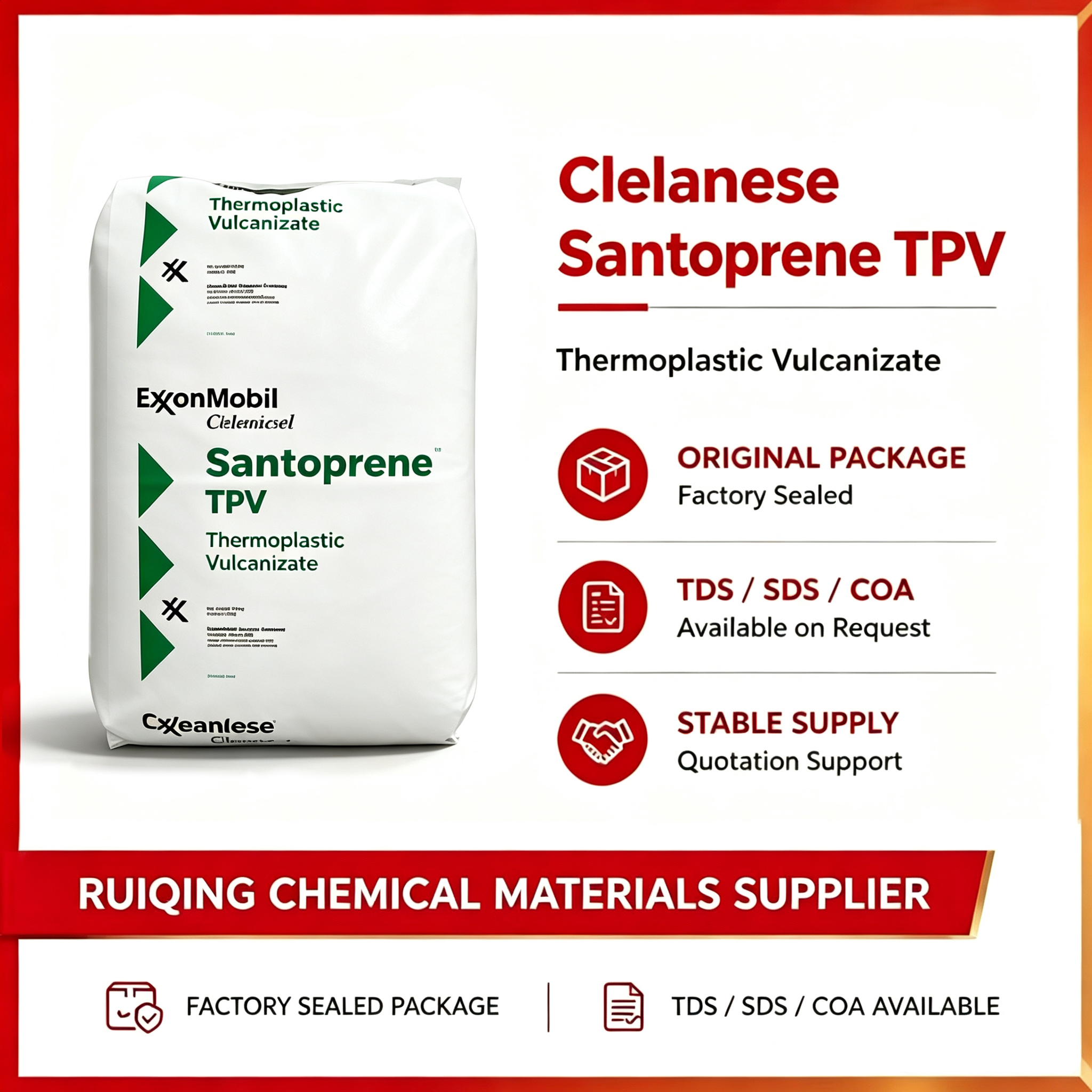
Santoprene 201-67W171 is a soft, natural and colorable thermoplastic vulcanizate (TPV) from Celanese specifically formulated for low-density foamed profile extrusion applications.
This is not a standard solid-profile TPV selected only by Shore hardness. Celanese identifies Santoprene 201-67W171 as a specialty grade for foamed profiles where the finished component needs a combination of reduced density, long-term sealing performance, low-temperature flexibility and heat weldability.
The current Celanese Product Finder places the grade in the specialty TPV group and describes its primary use as profile extrusion with water or chemical foaming.
The solid material has a Shore A hardness of approximately 71, making it a medium-soft TPV before foaming. Current grade data lists a density of approximately 0.960 g/cm³, elongation at break of approximately 450%, tensile stress at break of approximately 6.9 MPa, and tensile stress at 100% elongation of approximately 2.8 MPa.
These values describe the unfoamed material. The actual density, hardness and mechanical behavior of a finished foamed profile depend strongly on the foaming process, blowing-agent level, extrusion conditions, cell structure and profile geometry.
A major feature of Santoprene 201-67W171 is that it can be processed using water as a physical blowing agent or with selected chemical blowing agents.
Celanese states that physical foaming requires a specially modified thermoplastic extrusion line equipped with an adapted blowing-agent dosing system. The manufacturer also references a 30:1 extruder for mechanical-foaming processing.
The grade is shear dependent, like other Santoprene TPV materials. As shear rate increases, apparent melt viscosity decreases. This behavior is particularly relevant in foamed profile extrusion because screw design, screw speed, die geometry and pressure development all affect melt quality, foam nucleation and dimensional stability.
Santoprene 201-67W171 is also recommended for applications requiring excellent ozone resistance.
Ozone resistance is important for sealing profiles used outdoors or near air circulation because ozone can attack many unsaturated elastomers and cause surface cracking over time.
The material is polyolefin based and Celanese states that it is recyclable within the manufacturing stream. This can help manufacturers manage controlled production scrap during extrusion, subject to process stability and finished-part quality requirements.
The grade’s natural appearance also provides color flexibility. Customers can develop colored foamed profiles without starting from a black base compound, although pigments and additives can affect final material properties and foam behavior.
For more TPV materials, visit our TPV Thermoplastic Vulcanizates Product Category →.
For the current Celanese TPV portfolio, see the Official Celanese Santoprene & Geolast Product Finder →.
Key Features of Santoprene 201-67W171
| Feature | Engineering Benefit |
|---|---|
| Designed for Foamed Profile Extrusion | Purpose-built for low-density sealing profiles rather than only solid molding |
| Natural / Colorable | Supports custom color development for visible profiles and seals |
| Water-Foaming Capability | Can use water as a physical blowing agent |
| Chemical-Foaming Capability | Compatible with selected chemical blowing-agent systems |
| Long-Term Sealability | Supports sealing profiles that must maintain contact over time |
| Low-Temperature Flexibility | Helps profiles remain flexible in cold-service environments |
| Heat Weldability | Supports joining or fabrication of compatible profile sections |
| Excellent Ozone Resistance | Useful for weather-exposed and air-contact sealing applications |
| Shore A 71 | Medium-soft solid TPV base before foaming |
| 450% Elongation | Provides high extensibility for flexible sealing designs |
| Shear-Dependent Flow | Supports efficient extrusion when screw and die conditions are optimized |
| Polyolefin Based | Offers the processing characteristics of the Santoprene TPV platform |
| Manufacturing-Stream Recyclability | Controlled process scrap can be recyclable within the production stream |
The key distinction is that Santoprene 201-67W171 is engineered around the foaming process itself, not simply around hardness.
Typical Applications for Santoprene 201-67W171
Santoprene 201-67W171 is best suited to foamed sealing profiles where low density, flexibility and long-term sealing are important.
| Application Area | Typical Use |
|---|---|
| Foamed Sealing Profiles | Lightweight compressible profile seals |
| Building & Construction Profiles | Flexible sealing profiles for doors, windows or related systems where the finished design is validated |
| Weathersealing Profiles | Ozone-resistant flexible seals exposed to air and weather |
| Automotive Profile Seals | Foamed profile sections where the design requires a colorable TPV and validated performance |
| Industrial Enclosure Seals | Compressible extruded seals for housings and assemblies |
| Appliance Profiles | Lightweight flexible sealing sections |
| Heat-Welded Profile Assemblies | Joined seals or frames produced from weldable profile sections |
| Colored Foamed Profiles | Natural-base profiles requiring customer-selected pigmentation |
The exact application should always be validated against the required compression behavior, cell structure, temperature range, weathering requirement and sealing force of the finished foamed profile.
Typical Properties of Santoprene 201-67W171
Physical Properties
| Property | Typical Value | Test Method |
|---|---|---|
| Density | 960 kg/m³ / 0.960 g/cm³ | ISO 1183 |
| Shore A Hardness, 15 s | 71 | ISO 48-4 / ISO 868 |
| Appearance | Natural | Celanese Product Finder |
| Colorability | Colorable | Manufacturer description |
| Material Family | TPV / TPE | Manufacturer classification |
| Base Chemistry | Polyolefin based | Manufacturer description |
The 0.960 g/cm³ density refers to the solid TPV material. It should not be interpreted as the density of the final foamed profile.
Mechanical Properties
| Property | Typical Value | Test Method |
|---|---|---|
| Tensile Stress at 100% Elongation | 2.8 MPa | ISO 37 |
| Tensile Stress at Break | 6.9 MPa | ISO 527-1/-2 or ISO 37 |
| Elongation at Break | 450% | ISO 527-1/-2 or ISO 37 |
| Shore A Hardness | 71 | ISO 48-4 / ISO 868 |
These values describe laboratory specimens of the base material and provide a useful reference for resin selection.
Foamed profiles will not necessarily reproduce the same tensile, hardness or density values because the cellular structure changes the effective section properties.
Foaming Performance
Celanese identifies two principal approaches for Santoprene 201-67W171.
Water Physical Foaming
Water can be used as the physical blowing agent. This process typically requires a specially modified thermoplastic extruder, an adapted foaming-agent dosing system, stable melt pressure, controlled temperatures, suitable screw configuration and a die designed for foamed-profile expansion.
The goal is to create a controlled cellular structure while maintaining acceptable surface quality and dimensional stability.
Chemical Foaming
The grade can also be foamed with selected chemical blowing agents.
Chemical-foaming formulations should be optimized for decomposition temperature, gas evolution rate, TPV compatibility, desired foam density, cell size, extrusion speed and profile dimensions.
Celanese does not publish one universal final-foam density for Santoprene 201-67W171 because the finished density is process dependent.
Why Choose Santoprene 201-67W171?
The main reason to choose Santoprene 201-67W171 is that it is specifically engineered for low-density foamed profile extrusion.
A generic extrusion TPV may be suitable for solid profiles but may not provide the same processing behavior when a manufacturer introduces physical or chemical foaming.
Foamed profiles require stable cell formation, predictable expansion, adequate melt strength, acceptable surface appearance and consistent dimensional control.
The grade is intended to address this processing environment while retaining the elastomeric characteristics expected from Santoprene TPV.
Long-term sealability is particularly important. A foamed profile is often used because it can compress under relatively low force and conform to gaps or irregular mating surfaces. After repeated compression cycles, the seal must continue to provide contact.
Low-temperature flexibility is also valuable in building, automotive and outdoor sealing systems. A profile that becomes excessively stiff in cold weather may lose sealing efficiency or become difficult to assemble.
Heat weldability provides another manufacturing advantage. Profile sections may need to be joined into frames, corners or continuous sealing assemblies. A weldable TPV can simplify fabrication compared with certain thermoset rubber systems.
Excellent ozone resistance supports long-term exposure to outdoor air and environmental ozone.
The natural and colorable base is useful when the profile must be supplied in colors other than black.
For manufacturers developing lightweight, compressible, colored or weather-resistant foamed sealing profiles, Santoprene 201-67W171 is a highly targeted Celanese grade.
Processing Guidelines for Santoprene 201-67W171
Santoprene 201-67W171 is primarily intended for foamed profile extrusion.
General Processing Guidance
| Processing Parameter | Celanese Guidance |
|---|---|
| Drying Temperature | 80°C |
| Drying Time | 3 hours |
| General Processing Window | 175–230°C |
| Foaming Method | Water physical foaming or selected chemical blowing agents |
| Physical-Foaming Equipment | Specially modified thermoplastic extruder with adapted dosing equipment |
| Extruder Recommendation | 30:1 extruder referenced for mechanical foaming |
| Material Compatibility Warning | Incompatible with acetal (POM) and PVC |
Celanese recommends desiccant drying for approximately 3 hours at 80°C.
Although Santoprene TPV has a broad general processing window of approximately 175–230°C, actual foaming temperatures should be optimized for the selected blowing method and profile geometry.
Physical Foaming
When water is used as a physical blowing agent, Santoprene 201-67W171 requires equipment designed to introduce and control the blowing agent in the molten polymer.
Key process variables include blowing-agent dosage, screw design, screw speed, melt pressure, melt temperature, residence time, die pressure, die temperature, profile draw-down and cooling rate.
Too much gas generation can cause coarse cells, surface defects or unstable dimensions. Insufficient foaming can result in a density reduction that is smaller than the production target.
Chemical Foaming
When a chemical blowing agent is used, the decomposition profile of the additive should match the extrusion temperature range.
The processor should evaluate blowing-agent loading, activation temperature, dispersion, nucleation, cell uniformity, final density, surface appearance, profile dimensions and compression behavior.
Shear-Dependent Rheology
Like other Santoprene TPV grades, Santoprene 201-67W171 is shear dependent.
Higher shear reduces apparent melt viscosity, so screw speed and die design can have a major impact on flow. This is particularly important in foamed extrusion because melt rheology also affects gas retention and cell growth.
Purging & Material Changeover
Celanese states that Santoprene TPV is incompatible with POM and PVC.
Extrusion equipment should therefore be thoroughly purged when changing between these materials and Santoprene TPV.
Related Products
Santoprene 201-73W222 – Natural specialty TPV combining fluid and oxidative resistance for a broad range of applications.
Santoprene 591-56W175 – Black TPV for extrusion and injection molding with good UV performance for outdoor sealing.
Santoprene 691-65W175 – Natural TPV designed for thin-wall, glazing and sealing applications.
View More TPV Thermoplastic Vulcanizates →
Technical Documents for Santoprene 201-67W171
| Document Type | Description |
|---|---|
| TDS | Grade-specific physical, mechanical and processing information |
| SDS | Safety Data Sheet |
| Santoprene Product Finder | Current grade positioning and portfolio information |
| Water Foaming Technical Literature | Celanese technical guidance referenced for water foaming of Santoprene TPV |
| Chemical Foaming Technical Literature | Celanese technical guidance referenced for chemical foaming of Santoprene TPV |
| COA | Batch-specific quality information where available |
Need technical documents for Santoprene 201-67W171?
📧 Email: ruiqingchem@gmail.com
📝 Online form: Contact Us →
Please state Santoprene 201-67W171 and the required document type when submitting your inquiry.
FAQ About Santoprene 201-67W171
Q1: What is Santoprene 201-67W171?
Santoprene 201-67W171 is a natural, colorable TPV from Celanese specially formulated for low-density foamed profile extrusion.
Q2: What is the Shore hardness of Santoprene 201-67W171?
The current Celanese value is approximately Shore A 71 for the solid material.
Q3: What is the density?
The solid material density is approximately 0.960 g/cm³. The final density of a foamed profile depends on the foaming process and is not a single fixed grade value.
Q4: Can Santoprene 201-67W171 be physically foamed?
Yes. Celanese specifically states that the grade can be foamed using water as a physical blowing agent.
Q5: Can chemical blowing agents be used?
Yes. Celanese also identifies selected chemical blowing agents as a suitable foaming route.
Q6: What are the tensile properties?
Current data lists approximately 2.8 MPa stress at 100% elongation, 6.9 MPa stress at break and 450% elongation at break.
Q7: Is Santoprene 201-67W171 suitable for outdoor sealing?
The grade is specifically recommended for applications requiring excellent ozone resistance, which is an important property for many outdoor sealing systems.
Q8: Does Santoprene 201-67W171 require special extrusion equipment?
For physical foaming, yes. Celanese states that a specially modified thermoplastic extruder with an adapted blowing-agent dosing device is required.
Q9: What drying and processing conditions are recommended?
Celanese recommends desiccant drying for approximately 3 hours at 80°C. The broader Santoprene TPV processing window is approximately 175–230°C.
Q10: Is Santoprene 201-67W171 heat weldable?
Yes. Heat weldability is one of the grade-specific characteristics identified by Celanese, together with long-term sealability and low-temperature flexibility.
Request Santoprene 201-67W171 Price & Technical Support
For pricing, availability, technical documents or application support for Santoprene 201-67W171, please provide:
- Required quantity
- Destination country or port
- Profile cross-section
- Target finished foam density
- Required Shore hardness or compression force
- Physical or chemical foaming process
- Blowing agent currently used
- Extruder L/D ratio
- Screw diameter
- Extrusion speed
- Die dimensions
- Required profile color
- Outdoor / ozone exposure
- Minimum and maximum service temperature
- Heat-welding requirement
- Required TDS, SDS or COA
- Sample requirement, if applicable
📧 Email: ruiqingchem@gmail.com
📝 Send Inquiry →