描述
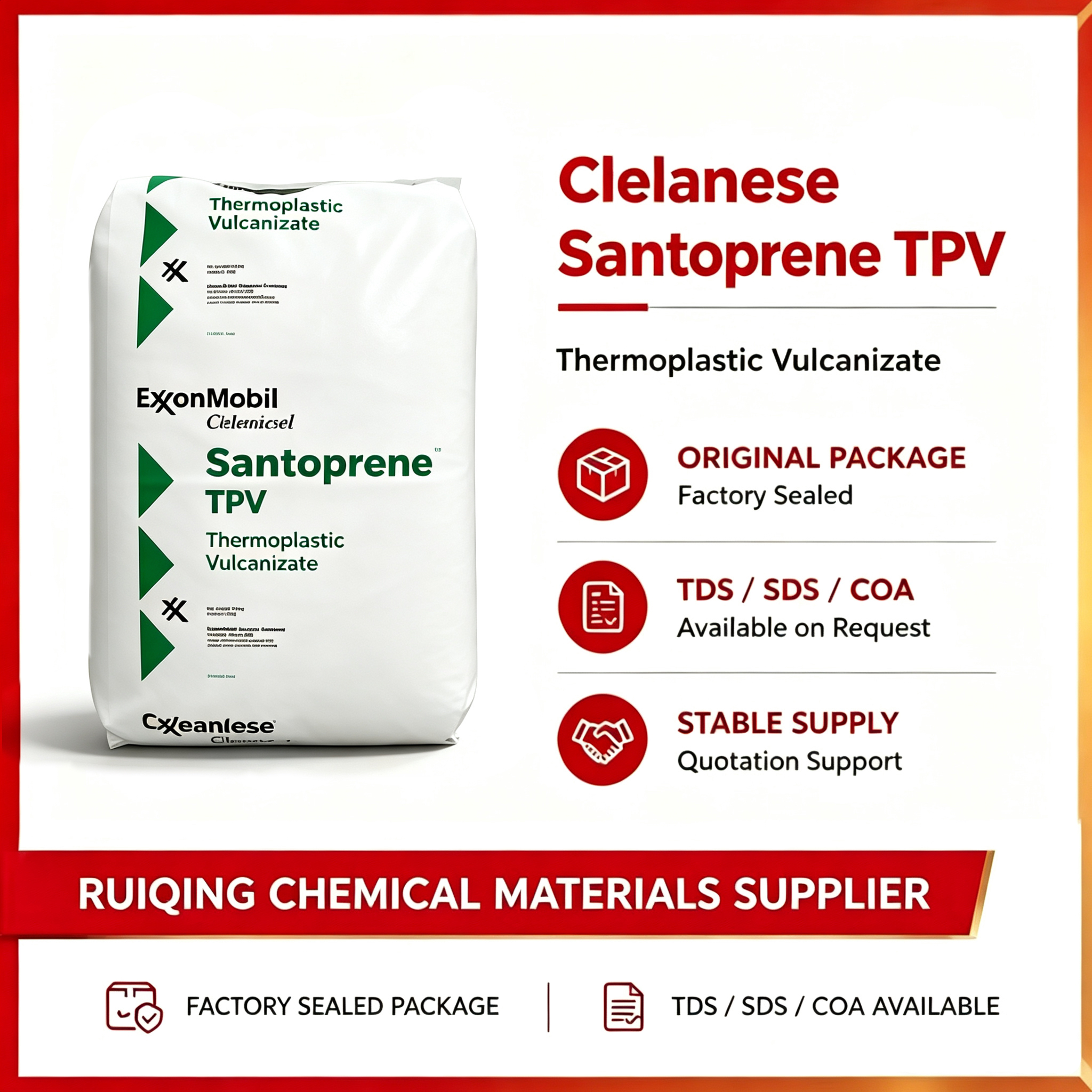
Santoprene 123-40 is a hard, black, UV-resistant thermoplastic vulcanizate (TPV) from Celanese designed for demanding applications that need a combination of elastomeric performance, high hardness, weatherability and conventional thermoplastic processing.
Celanese places Santoprene 123-40 in its UV black TPV grade group. The current Celanese product finder identifies this grade as a black material with approximately Shore D 41 hardness, improved UV stability and suitability for both extrusion and molding.
Unlike softer Santoprene grades normally specified in Shore A, Santoprene 123-40 is hard enough to be measured on the Shore D scale. This makes the material especially useful when an application requires stronger dimensional support and higher mechanical strength while still benefiting from the flexibility and recovery characteristics associated with TPV.
Current Celanese grade data describes Santoprene 123-40 as a polyolefin-based TPV with good physical properties and chemical resistance. It is designed for use on conventional thermoplastic equipment and can be processed by injection molding, extrusion, blow molding, thermoforming and vacuum forming.
The grade is also shear dependent. As shear rate increases, the apparent melt viscosity decreases. This characteristic supports good processability when screw speed, gate design, injection rate and extrusion conditions are correctly optimized.
One of the most important advantages of Santoprene 123-40 is its mechanical strength. Current Celanese data lists approximately 19.1 MPa stress at break, 9.1 MPa stress at 100% elongation and an unusually high 620% elongation at break.
This combination is notable because the material is relatively hard yet still retains very high elongation. It can therefore support designs that need both stiffness and substantial deformation capability.
Low-temperature performance is also strong. Current Celanese data gives a brittleness temperature of approximately -58°C, helping the material retain useful performance in cold-weather automotive, industrial and outdoor applications.
Celanese specifically highlights three grade-level features for Santoprene 123-40:
- Excellent flex-fatigue resistance
- Excellent ozone resistance
- Improved UV resistance
Together, these properties make the grade especially relevant to components exposed to repeated movement and outdoor weathering.
The density is approximately 0.960 g/cm³, helping keep parts lightweight compared with many conventional rubber or high-density elastomer systems.
Current Celanese grade information also lists multiple automotive OEM specification references, including General Motors, Mercedes-Benz, Volkswagen Group and Stellantis.
For more TPV products, visit our TPV Thermoplastic Vulcanizates Product Category →.
For Celanese’s current Santoprene portfolio, see the Official Celanese Santoprene & Geolast TPV Product Finder →.
Key Features of Santoprene 123-40
| Feature | Engineering Benefit |
|---|---|
| Shore D 41 Hardness | Provides a firm elastomeric response with greater dimensional support |
| Improved UV Resistance | Designed for outdoor and weather-exposed applications |
| Excellent Ozone Resistance | Supports long-term environmental durability |
| Excellent Flex-Fatigue Resistance | Suitable for components exposed to repeated movement |
| 620% Elongation at Break | Allows substantial deformation despite high hardness |
| 19.1 MPa Stress at Break | Provides high mechanical strength for a TPV |
| 9.1 MPa Stress at 100% Elongation | Supports mechanically demanding flexible parts |
| -58°C Brittleness Temperature | Retains useful low-temperature flexibility |
| Low Density | Approx. 0.960 g/cm³ supports lightweight part design |
| Good Chemical Resistance | Suitable for many automotive and industrial environments |
| Injection Molding & Extrusion | Compatible with conventional thermoplastic equipment |
| Blow Molding | Supports hollow flexible components |
| Thermoforming & Vacuum Forming | Broadens part-design and fabrication options |
| Manufacturing-Stream Recyclability | Controlled production scrap can be reworked where permitted |
Typical Applications for Santoprene 123-40
Santoprene 123-40 can be considered for applications requiring a hard black TPV with improved UV stability and strong mechanical performance.
| Application Area | Typical Use |
|---|---|
| Automotive Exterior Components | Weather-exposed flexible or semi-rigid TPV parts |
| Automotive Under-Hood Components | Protective parts requiring chemical and ozone resistance |
| Seals & Gaskets | Firm sealing components requiring dimensional support |
| Bellows & Boots | Repeated-flex protective components |
| Plugs & Grommets | Firm elastomeric sealing and protection parts |
| Flexible Housings | Tough covers and protective components |
| Outdoor Profiles | UV- and ozone-resistant extruded sections |
| Industrial Components | Flexible parts exposed to repeated stress |
| Electrical Protection Components | Tough elastomeric covers and insulating parts |
| Blow-Molded Parts | Hollow TPV components requiring flexibility and strength |
| Thermoformed Components | Formed sheets and protective parts |
| Consumer Durable Goods | High-hardness resilient components |
The strongest application fit is where a designer needs a hard black TPV with improved UV stability and high mechanical strength, rather than a soft sealing elastomer.
Typical Properties of Santoprene 123-40
Physical Properties
| Property | Typical Value | Test Method |
|---|---|---|
| Density | 960 kg/m³ / 0.960 g/cm³ | ISO 1183 |
| Shore D Hardness, 15 s | 41 | ISO 48-4 / ISO 868 |
| Resin Identification | TPV | ISO 1043 |
| Part Marking Code | >TPV< | ISO 11469 |
| Appearance | Black | Manufacturer information |
| Delivery Form | Pellets | Manufacturer information |
Mechanical Properties
| Property | Typical Value | Test Method |
|---|---|---|
| Stress at 100% Elongation | 9.1 MPa | ISO 527-1/-2 or ISO 37 |
| Stress at Break | 19.1 MPa | ISO 527-1/-2 or ISO 37 |
| Elongation at Break | 620% | ISO 527-1/-2 or ISO 37 |
| Brittleness Temperature | -58°C | ASTM D746 |
| Low-Temperature Brittleness | -58°C | ISO 812 |
| Shore D Hardness, 15 s | 41 | ISO 48-4 / ISO 868 |
These figures show the unusual property balance of Santoprene 123-40: high hardness and high tensile strength combined with very high elongation.
Electrical Properties
| Property | Typical Value | Test Method |
|---|---|---|
| Electric Strength, Short Time, 2 mm | 31 kV/mm | ASTM D149 |
| Dielectric Constant, historical reference | Approx. 2.6 | ASTM D150 / IEC 60250 |
UV, Ozone & Environmental Performance
The most important environmental characteristics of Santoprene 123-40 are defined directly by Celanese:
- Improved UV resistance
- Excellent ozone resistance
- Excellent flex-fatigue resistance
- Good chemical resistance
The current Celanese product finder places Santoprene 123-40 in the UV black TPV grades section, confirming that improved UV stability is central to this grade.
Automotive OEM Specification References
Current Celanese Materials Database information lists the following specification references for Santoprene 123-40:
| OEM | Specification / Reference |
|---|---|
| Stellantis / Chrysler | MS-AR-100 GGV |
| General Motors | GMW15812, Type 9 |
| Stellantis / FCA Group | 55248/02 EMP-140 |
| Li Auto | Q/LiA5310057 2021 (V2) |
| Mercedes-Benz Group | DBL 5562 |
| Volkswagen Group | TL 526 22 MD22 |
| Volkswagen Group | VW50123 |
These references make Santoprene 123-40 particularly relevant to automotive suppliers evaluating an established UV-resistant TPV platform.
Why Choose Santoprene 123-40?
The main reason to choose Santoprene 123-40 is its combination of high hardness and true elastomeric deformation capability.
A conventional rigid thermoplastic may provide hardness and strength but lack the recovery, flex-fatigue resistance and sealing behavior of an elastomer. A very soft TPV can provide flexibility but may not offer enough structural support for demanding components.
Santoprene 123-40 occupies the harder end of the TPV range. With Shore D 41 hardness and approximately 19.1 MPa stress at break, it can provide substantially more mechanical support than typical Shore A elastomers.
At the same time, the material retains approximately 620% elongation at break. This combination makes Santoprene 123-40 useful for parts that must bend or deform substantially without behaving like a soft rubber.
Improved UV resistance is another major reason to select this grade. Outdoor polymers can gradually lose mechanical properties or surface quality after prolonged ultraviolet exposure. Celanese specifically designed this grade for improved UV stability.
Excellent ozone resistance further supports long-term outdoor and automotive service.
Flex-fatigue resistance is important in bellows, boots, flexible housings and other components that repeatedly bend during operation.
Low-temperature capability also broadens the application window. The published brittleness temperature of approximately -58°C supports use in demanding cold environments.
The grade’s polyolefin-based TPV structure also offers thermoplastic processability. Parts can be produced without the separate vulcanization cycle required by conventional thermoset rubber.
Injection molding, extrusion, blow molding, thermoforming and vacuum forming provide engineers with several processing choices.
For customers seeking a hard black UV-resistant TPV with Shore D 41 hardness and high tensile performance, Santoprene 123-40 is a strong material candidate.
Processing Guidelines for Santoprene 123-40
Santoprene 123-40 can be processed using conventional thermoplastic equipment.
Celanese lists the following manufacturing methods:
- Injection molding
- Extrusion
- Blow molding
- Thermoforming
- Vacuum forming
Current Grade-Specific Processing Data
| Processing Parameter | Celanese Guidance |
|---|---|
| Drying Temperature | 82°C |
| Drying Time | 3 hours in a dehumidified dryer |
| Processing Moisture Content | ≤0.08% |
| Maximum Regrind Level | 20% |
| Mold Temperature Range | 10–52°C |
| Vent Depth | 25 µm |
| Back Pressure | 0.345–0.689 MPa |
| Injection Speed | Fast |
| Extrusion Melt Temperature | Approx. 210°C |
Celanese also recommends desiccant drying for approximately 3 hours at 80°C and states that Santoprene TPV has a broad processing window of approximately 175–230°C.
Injection-Molding Guidance
For injection molding Santoprene 123-40, processors should pay particular attention to:
- Fast injection speed
- Proper venting
- Sufficient shear generation
- Gate dimensions
- Mold temperature
- Back pressure
- Screw speed
- Cooling time
- Ejection behavior
- Part shrinkage
Historical Santoprene 123-40 processing guidance also lists melt temperatures around 216–232°C, screw speeds around 100–200 rpm, and a mold-temperature range of approximately 10–52°C.
These historical parameters are useful as a setup reference, while the current Celanese grade data and actual machine response should take priority.
Extrusion Guidance
The current Celanese grade sheet lists an extrusion melt-temperature reference of approximately 210°C.
During profile or tube extrusion, optimize:
- Feed-zone stability
- Barrel temperatures
- Screw speed
- Melt pressure
- Adapter temperature
- Die temperature
- Draw-down ratio
- Cooling
- Dimensional stability
- Surface finish
Shear-Dependent Flow Behavior
Santoprene 123-40 is a shear-dependent TPV.
As shear rate increases, apparent melt viscosity decreases. This means processing flow cannot be judged only from temperature. Gate design, injection speed, screw speed and die geometry can strongly affect melt flow and surface quality.
Material Compatibility
Celanese states that Santoprene TPV is incompatible with acetal (POM) and PVC.
When production changes from POM or PVC to Santoprene 123-40, the barrel, screw, hot runner or extrusion line should be properly purged.
Technical Documents for Santoprene 123-40
| Document Type | Description |
|---|---|
| TDS | Current Celanese physical, mechanical, electrical and processing data |
| SDS | Safety Data Sheet |
| OEM Specification Information | GM, Mercedes-Benz, VW, Stellantis and Li Auto references |
| Santoprene Product Finder | Celanese grade positioning and portfolio information |
| Processing Guide | Injection molding and extrusion processing guidance |
| COA | Batch-specific quality information where available |
Need technical documents for Santoprene 123-40?
📧 Email: ruiqingchem@gmail.com
📝 Online form: Contact Us →
Please state Santoprene 123-40 and the required document type when submitting your inquiry.
Related Products
More Santoprene and other TPV grades are available in our dedicated category:
View TPV Thermoplastic Vulcanizates →
Our TPV portfolio covers soft and hard grades for general-purpose molding, UV-resistant components, automotive sealing, profile extrusion, overmolding, appliance applications and other specialized elastomeric requirements.
FAQ About Santoprene 123-40
Q1: What is Santoprene 123-40?
Santoprene 123-40 is a hard black UV-resistant thermoplastic vulcanizate from Celanese with approximately Shore D 41 hardness.
Q2: What is the hardness of Santoprene 123-40?
The current Celanese grade data lists approximately Shore D 41 after a 15-second reading.
Q3: Is Santoprene 123-40 UV resistant?
Yes. Celanese identifies the grade as designed for improved UV resistance, and the current product finder places it in the UV black TPV family.
Q4: What is the elongation at break?
Current Celanese data lists approximately 620% elongation at break.
Q5: What is the tensile stress at break?
The current value is approximately 19.1 MPa.
Q6: How does Santoprene 123-40 perform at low temperature?
The published brittleness temperature is approximately -58°C.
Q7: Is Santoprene 123-40 suitable for outdoor applications?
Its improved UV resistance and excellent ozone resistance make it a strong candidate for outdoor and weather-exposed components.
Q8: Can Santoprene 123-40 be injection molded and extruded?
Yes. Celanese lists injection molding, extrusion, blow molding, thermoforming and vacuum forming.
Q9: What processing temperature is recommended?
The current extrusion reference is approximately 210°C, while Celanese states a broader Santoprene TPV processing window of approximately 175–230°C.
Q10: Does Santoprene 123-40 have automotive specification references?
Yes. Current Celanese data lists references including GM GMW15812 Type 9, Mercedes-Benz DBL 5562, VW50123, VW TL 526 22 MD22 and Stellantis specifications.
Request Santoprene 123-40 Price & Technical Support
For pricing, availability, technical documents or application support for Santoprene 123-40, please provide:
- Required quantity
- Destination country or port
- Automotive, industrial, outdoor or consumer application
- Required hardness
- Part geometry and wall thickness
- UV and outdoor exposure requirements
- Ozone exposure
- Minimum and maximum operating temperature
- Chemical or fluid exposure
- Injection-molding, extrusion, blow-molding or thermoforming process
- OEM specification requirement
- TDS, SDS or COA requirement
- Sample requirement, if applicable
📧 Email: ruiqingchem@gmail.com
📝 Send Inquiry →