描述
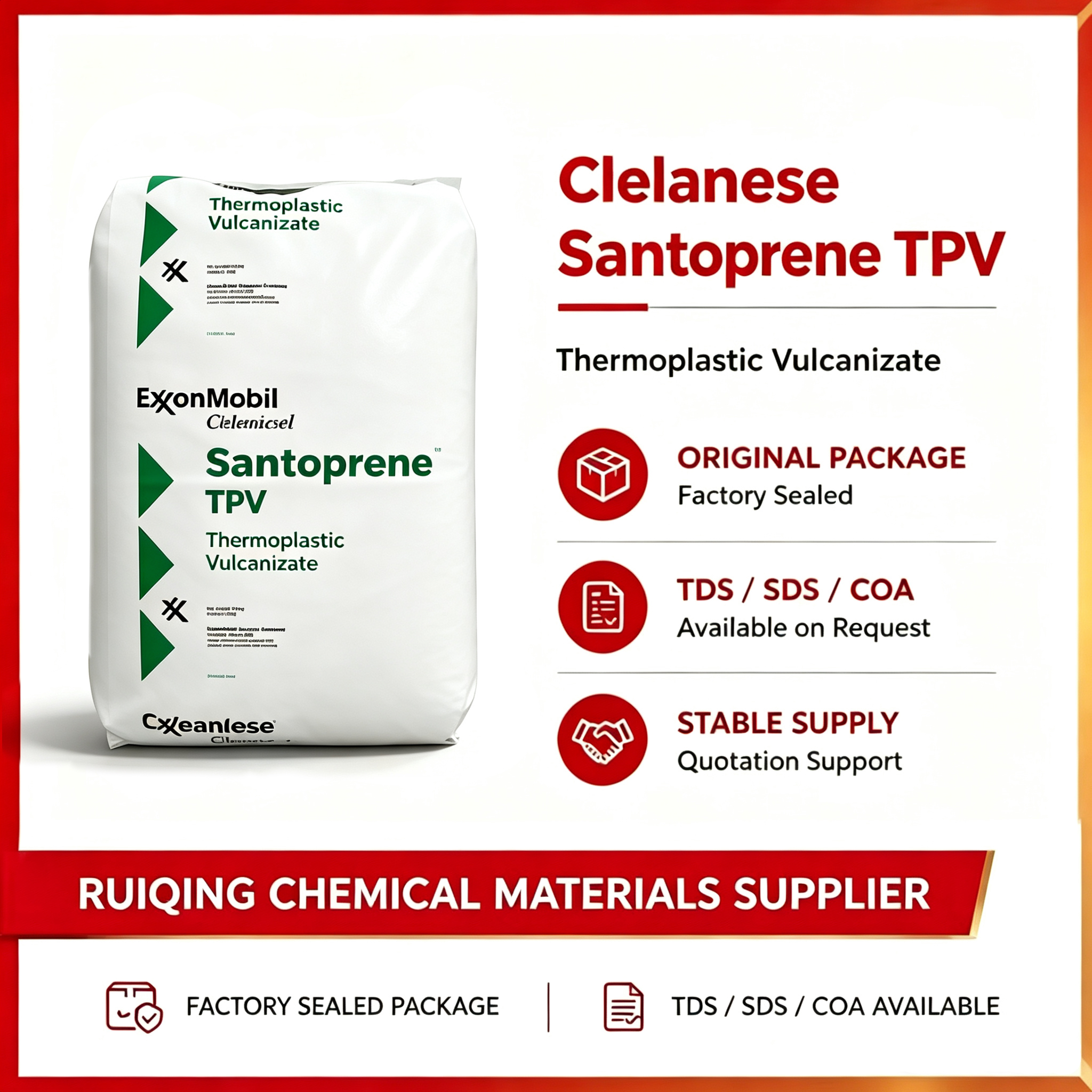
Santoprene 121-87 is a hard, black, UV-resistant thermoplastic vulcanizate (TPV) from Celanese designed for demanding molding and extrusion applications that require high hardness together with rubber-like flexibility.
Celanese places this grade in the UV black Santoprene TPV family. The current Celanese Product Finder lists Santoprene 121-87 at approximately Shore A 93, with black appearance and improved UV stability.
This combination makes the material especially useful for outdoor, automotive and industrial parts that need greater rigidity than conventional soft TPV grades while still requiring elastic deformation, fatigue resistance and weatherability.
The material is polyolefin based and combines the processing advantages of a thermoplastic with many performance characteristics associated with vulcanized rubber.
Unlike conventional thermoset rubber, Santoprene 121-87 can be processed using standard thermoplastic equipment without a separate vulcanization step during normal molding or extrusion.
Current Celanese product-selection information positions the 121 series for general-purpose extrusion and molding with improved UV stability.
The grade is also shear dependent. Its apparent melt viscosity decreases as shear rate increases. This characteristic allows the material to flow efficiently when injection speed, screw speed, gate design and extrusion conditions are properly optimized.
Mechanical performance is a major strength of this grade.
Current grade data lists approximately 15.2 MPa tensile stress at break, 6.8 MPa tensile stress at 100% elongation and approximately 600% elongation at break.
The combination of Shore A 93 hardness and 600% elongation is particularly notable. It allows the material to provide a much firmer response than softer TPV grades while still accommodating large elastic deformation.
The current tear-strength value is approximately 50 kN/m, supporting parts with lips, edges, thin sections and repeated mechanical loading.
Low-temperature flexibility is also strong, with a brittleness temperature around -58°C.
For heat resistance, current grade data lists a continuous upper temperature resistance of approximately 135°C for 1,008 hours according to SAE J2236-related evaluation.
The material also maintains useful performance after long-term heat aging. Current data shows only a relatively small change in tensile strength after 1,008 hours at 135°C.
Ozone and UV resistance are important reasons to select Santoprene 121-87 for exterior and weather-exposed components.
The current Celanese Product Finder specifically identifies this grade as a UV black TPV with improved UV stability.
This makes it well suited to weather seals, exterior trim, outdoor profiles, protective boots and other applications where sunlight exposure can accelerate degradation in less stabilized elastomers.
The material is also compatible with several thermoplastic processing methods, including injection molding, multi-injection molding, profile extrusion, sheet extrusion, coextrusion, extrusion blow molding, injection blow molding, thermoforming and vacuum forming.
For more TPV products, visit our TPV Thermoplastic Vulcanizates Product Category →.
For Celanese’s current TPV grade portfolio, see the Official Celanese Santoprene & Geolast Product Finder →.
Key Features of Santoprene 121-87
| Feature | Engineering Benefit |
|---|---|
| Shore A 93 | Provides a firm elastomeric response for structural seals and technical parts |
| Improved UV Stability | Supports exterior and weather-exposed applications |
| Excellent Ozone Resistance | Helps resist cracking in outdoor and automotive service |
| Excellent Flex-Fatigue Resistance | Supports repeated bending and cyclic deformation |
| 600% Elongation at Break | Allows substantial deformation despite high hardness |
| 15.2 MPa Tensile Stress at Break | Strong mechanical performance for a TPV |
| 50 kN/m Tear Strength | Helps resist tearing around edges, lips and thin sections |
| -58°C Brittleness Temperature | Supports cold-weather and low-temperature service |
| Good Chemical Resistance | Suitable for a wide range of industrial and automotive environments |
| Polyolefin-Based TPV | Combines low density with thermoplastic processing |
| Multiple Processing Methods | Injection molding, extrusion, blow molding and thermoforming are supported |
| Manufacturing-Stream Recyclability | Controlled process scrap can be recycled within the manufacturing stream |
| Black Appearance | Well suited to outdoor and automotive exterior components |
The core advantage of Santoprene 121-87 is the combination of high hardness, very high elongation and improved UV stability.
Typical Applications for Santoprene 121-87
Santoprene 121-87 is suitable for applications requiring a hard elastomer with excellent weathering, fatigue and chemical resistance.
| Application Area | Typical Use |
|---|---|
| Automotive Weather Seals | Exterior seals exposed to sunlight, ozone and temperature cycling |
| Exterior Trim Components | Flexible exterior parts requiring UV resistance |
| Interior Trim Components | Firm elastomeric interior components and protective parts |
| Seals & Gaskets | Higher-hardness static and dynamic sealing applications |
| Protective Boots | Flexible protective components around moving mechanisms |
| Bellows | Repeated-flex technical parts |
| Plugs & Grommets | Firm sealing and protective components |
| Outdoor Profiles | Extruded sections exposed to sunlight and weather |
| Industrial Covers | Protective elastomeric housings and covers |
| Flexible Tubes | Technical tubing in compatible chemical environments |
| Blow-Molded Components | Hollow elastomeric parts |
| Thermoformed Parts | Shaped TPV components with firm elastic behavior |
The grade is especially suitable where a conventional soft TPV does not provide enough hardness or mechanical support.
Typical Properties of Santoprene 121-87
Physical Properties
| Property | Typical Value | Test Method |
|---|---|---|
| Density | 0.970 g/cm³ | ISO 1183 |
| Specific Gravity | 0.968 | ASTM D792 |
| Shore A Hardness, 15 s | 93 | ISO 868 |
| Color | Black | Manufacturer information |
| Product Form | Pellets / Granules | Manufacturer information |
| Resin Identification | TPV | ISO 1043 |
| Part Marking Code | >TPV< | ISO 11469 |
The high Shore A hardness makes Santoprene 121-87 one of the firmer materials within the UV-black Santoprene TPV range.
Mechanical Properties
| Property | Typical Value | Test Method |
|---|---|---|
| Tensile Stress at 100% Elongation | 6.8 MPa | ASTM D412 / ISO 37 |
| Tensile Stress at Break | 15.2 MPa | ASTM D412 / ISO 37 |
| Elongation at Break | 600% | ASTM D412 / ISO 37 |
| Tear Strength | 50 kN/m | ASTM D624 / ISO 34-1 |
| Compression Set, 23°C / 22 h | 28% | ASTM D395B / ISO 815 |
| Compression Set, 125°C / 70 h | 65% | ASTM D395B / ISO 815 |
| Brittleness Temperature | -58°C | ASTM D746 / ISO 812 |
These properties show that the material combines high hardness with unusually high elongation for a TPV in this hardness range.
Heat Aging & Fluid Resistance
| Property | Typical Value | Test Condition |
|---|---|---|
| Tensile Strength Change | -3% | 135°C / 1008 h in air |
| Elongation-at-Break Change | -14% | 135°C / 1008 h in air |
| Hardness Change | +1 Shore A | 135°C / 1008 h in air |
| Tensile Strength Change in IRM 903 Oil | -21% | 125°C / 70 h |
| Elongation Change in IRM 903 Oil | -30% | 125°C / 70 h |
| Volume Change in IRM 903 Oil | 54% | 125°C / 70 h |
| Continuous Upper Temperature Resistance | 135°C | SAE J2236, 1008 h |
The oil-immersion data is useful for material screening in automotive and industrial environments where hydrocarbon exposure may occur.
Electrical Properties
| Property | Typical Value | Test Method |
|---|---|---|
| Dielectric Strength | 26 kV/mm | ASTM D149 |
| Relative Permittivity / Dielectric Constant | 2.7 | ASTM D150 / IEC 60250 |
These values provide useful design context for protective electrical and electronic components.
Why Choose Santoprene 121-87?
The main reason to choose Santoprene 121-87 is its unusual combination of firmness and elasticity.
A Shore A hardness of 93 gives the material much more structural support than softer TPV compounds.
At the same time, elongation at break remains approximately 600%, which means the material can still accommodate substantial deformation.
This balance is useful for parts such as exterior seals, weather strips, boots, protective profiles and grommets where both geometric stability and elastic recovery matter.
Improved UV stability is another major advantage.
Outdoor polymers are exposed to ultraviolet radiation, heat, moisture and ozone. Without suitable stabilization, these conditions can cause fading, embrittlement, cracking and loss of mechanical performance.
The 121 series is specifically positioned by Celanese as UV black TPV, making Santoprene 121-87 a strong candidate for exterior and weather-exposed applications.
The material’s excellent flex-fatigue resistance is important for parts that bend repeatedly during service.
Its excellent ozone resistance also improves durability in exterior and automotive environments.
The -58°C brittleness temperature supports low-temperature service and cold-climate applications.
The current 135°C / 1008-hour continuous upper-temperature rating provides useful thermal capability for under-hood and industrial components.
Thermoplastic processing also provides manufacturing advantages compared with conventional thermoset rubber.
Injection molding and extrusion can offer shorter cycles, easier automation and direct recycling of controlled process scrap.
For applications requiring a hard, black, UV-resistant TPV with high tensile strength, excellent elongation and broad thermoplastic processability, Santoprene 121-87 is a strong material choice.
Processing Guidelines for Santoprene 121-87
Santoprene 121-87 can be processed using:
- Injection molding
- Multi-injection molding
- Extrusion
- Profile extrusion
- Sheet extrusion
- Coextrusion
- Extrusion blow molding
- Injection blow molding
- Thermoforming
- Vacuum forming
Injection Molding Conditions
| Processing Parameter | Published Guidance |
|---|---|
| Drying Temperature | 82°C |
| Drying Time | 3 hours |
| Maximum Moisture Content | 0.08% |
| Maximum Regrind Level | 20% |
| Rear Barrel Temperature | 182°C |
| Middle Barrel Temperature | 188°C |
| Front Barrel Temperature | 193°C |
| Nozzle Temperature | 199–235°C |
| Melt Temperature | 204–232°C |
| Mold Temperature | 10–52°C |
| Injection Rate | Fast |
| Back Pressure | 0.345–0.689 MPa |
| Screw Speed | 100–200 rpm |
| Clamp Pressure | 41–69 MPa |
| Screw L/D Ratio | 16:1–20:1 |
| Screw Compression Ratio | 2.0:1–2.5:1 |
Celanese recommends desiccant drying for approximately 3 hours at 80–82°C.
Extrusion Conditions
| Processing Parameter | Published Guidance |
|---|---|
| Drying Temperature | 82°C |
| Drying Time | 3 hours |
| Melt Temperature | 204°C |
| Die Temperature | 210°C |
| Back Pressure | 5–20 MPa |
The manufacturer also notes that Santoprene TPV has a broad processing window of approximately 175–230°C.
Shear-Dependent Flow Behavior
Santoprene TPV is shear dependent.
As shear rate increases, apparent melt viscosity decreases. Therefore, processors should optimize:
- Screw speed
- Injection rate
- Gate size
- Runner dimensions
- Back pressure
- Melt temperature
- Mold temperature
- Die design
- Extrusion speed
- Cooling conditions
Increasing shear can often improve flow more effectively than simply raising melt temperature.
Material Compatibility
Celanese states that Santoprene TPV is incompatible with acetal (POM) and PVC.
Processing equipment should be properly purged when switching between these materials and Santoprene 121-87.
Automotive & OEM Specification References
Current grade information lists multiple OEM references for Santoprene 121-87, including:
| OEM | Specification / Reference |
|---|---|
| Ford | WSS-M2D382-B1 |
| General Motors | GMW15812, Type 8E |
| Mercedes-Benz Group | DBL 5562 |
| Hyundai | MS220-05, Type N |
| Volkswagen Group | VW 50123 |
| Stellantis / Chrysler | MS-AR-100 EGV |
| Stellantis / FCA | 55248/02 EMP-90 |
| Stellantis / PSA | PMP 01378_15_01963 |
| Renault | FRM 18-27-145 |
| Iveco | IVECO 15-5244 EMP-90 |
| Geely | Q/JLY J7110166B |
| Li Auto | Q/LiA5310057 |
These references make the grade particularly relevant to automotive suppliers working with exterior trim, seals, under-hood parts and other UV-exposed elastomeric components.
Related Products
Santoprene 121-80 – Black UV-stabilized TPV for general-purpose molding and extrusion applications.
Santoprene 123-40 – Higher-hardness black UV-stabilized TPV in the same UV-black family.
Santoprene 121-80B260 – Specialized black TPV for applications requiring grade-specific performance within the 121 family.
View More TPV Thermoplastic Vulcanizates →
Technical Documents for Santoprene 121-87
| Document Type | Description |
|---|---|
| TDS | Physical, mechanical, electrical, aging and processing data |
| SDS | Safety Data Sheet |
| Santoprene Product Finder | Celanese grade selection and positioning guide |
| Automotive Specification Information | OEM specification references for automotive applications |
| Processing Guide | Injection molding and extrusion guidance |
| COA | Batch-specific quality information where available |
Need technical documents for Santoprene 121-87?
📧 Email: ruiqingchem@gmail.com
📝 Online form: Contact Us →
Please state Santoprene 121-87 and the required document type when submitting your inquiry.
FAQ About Santoprene 121-87
Q1: What is Santoprene 121-87?
Santoprene 121-87 is a hard black UV-resistant thermoplastic vulcanizate from Celanese. It is designed for general-purpose extrusion and molding applications requiring high hardness, weatherability and elastomeric performance.
Q2: What is the hardness of Santoprene 121-87?
The current Celanese Product Finder lists approximately Shore A 93.
Q3: What is the tensile strength?
The current tensile stress at break is approximately 15.2 MPa.
Q4: What is the elongation at break?
The published elongation at break is approximately 600%.
Q5: Is Santoprene 121-87 UV resistant?
Yes. Celanese places the grade in its UV black TPV group and describes it as offering improved UV stability.
Q6: Is Santoprene 121-87 suitable for outdoor use?
Yes. Its UV stabilization, ozone resistance and black pigmentation make it suitable for many outdoor and weather-exposed applications.
Q7: What is the low-temperature performance?
The published brittleness temperature is approximately -58°C.
Q8: Can Santoprene 121-87 be injection molded and extruded?
Yes. The grade supports injection molding, extrusion, coextrusion, blow molding, thermoforming and vacuum forming.
Q9: What processing temperature is recommended?
Published injection-molding guidance gives a melt-temperature range of approximately 204–232°C. Extrusion guidance lists a melt temperature around 204°C and die temperature around 210°C.
Q10: Does Santoprene 121-87 need drying?
Yes. Published guidance recommends approximately 3 hours at 82°C in a dehumidified or desiccant dryer, with maximum moisture around 0.08%.
Request Santoprene 121-87 Price & Technical Support
For pricing, availability, technical documents or application support for Santoprene 121-87, please provide:
- Required quantity
- Destination country or port
- Automotive, industrial, outdoor or appliance application
- Seal, gasket, boot, profile or molded-part design
- Required Shore hardness
- UV and outdoor exposure conditions
- Continuous and peak operating temperature
- Minimum service temperature
- Compression-set requirement
- Chemical or oil exposure
- Injection molding, extrusion, blow molding or thermoforming process
- OEM specification requirement
- TDS, SDS or COA requirement
- Sample requirement, if applicable
📧 Email: ruiqingchem@gmail.com
📝 Send Inquiry →