描述
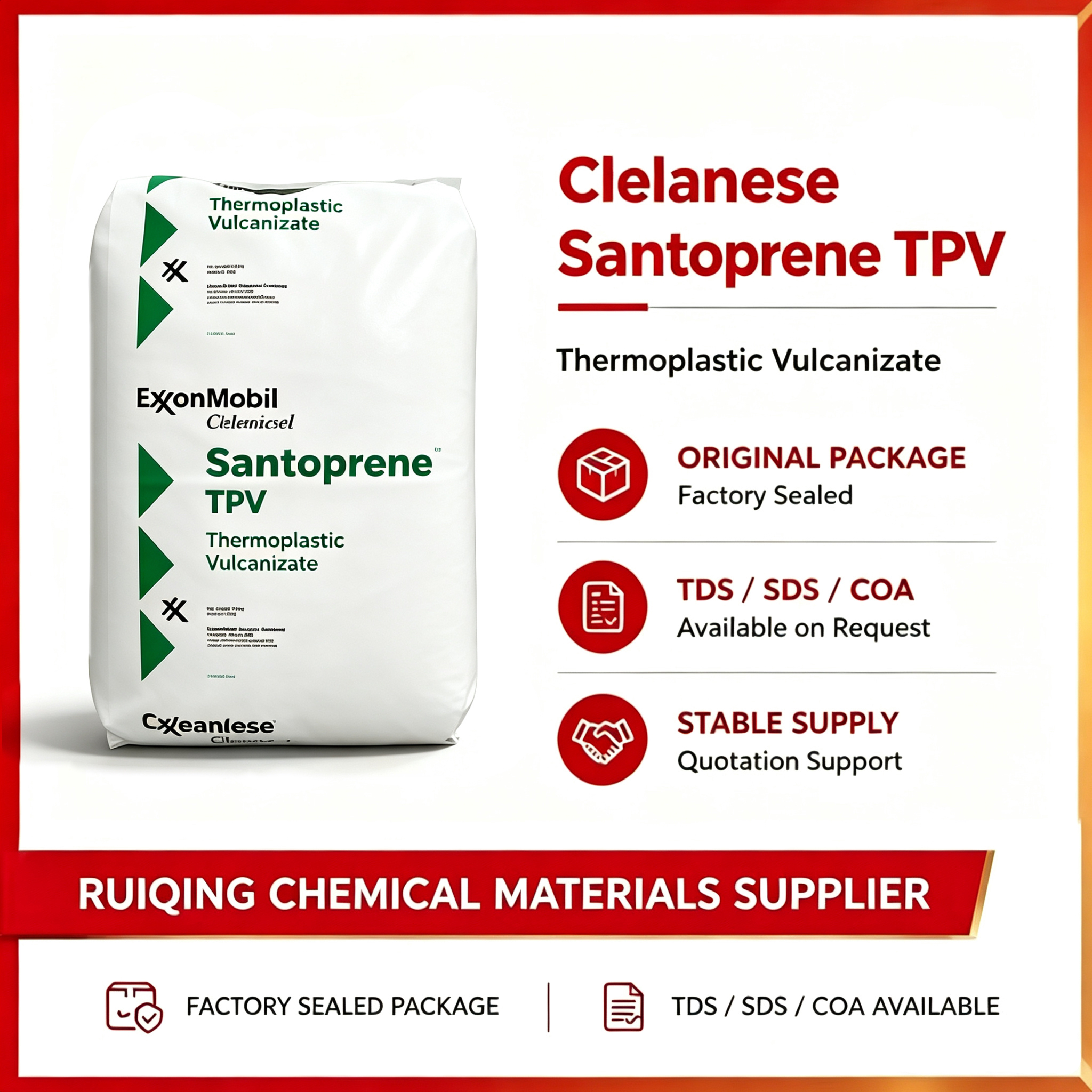
Santoprene 121-79W233 is a black thermoplastic vulcanizate (TPV) from Celanese specifically formulated for applications requiring excellent adhesion to vulcanized EPDM rubber.
This is not a conventional general-purpose TPV selected only by hardness. Celanese developed the grade to bond to sulfur-cured or peroxide-cured thermoset EPDM rubber in automotive sealing assemblies.
The primary target applications are automotive glass run channel corner molding, end caps and special fixation components.
That positioning makes Santoprene 121-79W233 particularly relevant to weatherseal manufacturers that extrude EPDM profiles and then require a thermoplastic material for molded corners, joints or terminal sections.
Traditional EPDM corner molding normally involves a thermoset rubber process with curing time. Celanese positions this grade as a thermoplastic alternative designed to provide shorter processing time compared with thermoset EPDM rubber.
The material is polyolefin based and can be processed on conventional thermoplastic injection-molding equipment.
It is also strongly shear dependent. As shear rate increases, apparent melt viscosity decreases, which helps the material fill complex corner geometries when injection conditions, gates and flow paths are optimized.
Current Celanese data lists a Shore A hardness of approximately 84.
Despite this relatively high elastomer hardness, Santoprene 121-79W233 retains very high elongation. Current grade data lists approximately 615% elongation at break, a tensile stress at break of approximately 7.4 MPa, and tensile stress at 100% elongation of approximately 3.6 MPa.
This combination is useful in automotive sealing assemblies because molded corners and end caps must remain flexible while also resisting tearing and deformation during installation and service.
Low-temperature performance is also strong. The current brittleness temperature is approximately -60°C.
That value supports use in automotive weatherseal systems exposed to cold climates.
The grade has a density of approximately 0.930 g/cm³, making it relatively lightweight compared with many conventional elastomer systems.
Compression set is approximately 49% at 70°C for 24 hours under the current ISO test condition.
Current flammability data lists a burning rate of approximately 49.4 mm/min at 2 mm thickness according to ISO 3795 / FMVSS 302 methodology.
Celanese’s product selection guide identifies overmolding or coextrusion onto EPDM rubber as the specific use positioning for Santoprene 121-79W233.
For more TPV materials, visit our TPV Thermoplastic Vulcanizates Product Category →.
For Celanese’s current TPV portfolio, see the Official Celanese Santoprene & Geolast Product Finder →.
Key Features of Santoprene 121-79W233
| Feature | Engineering Benefit |
|---|---|
| Excellent Adhesion to Vulcanized EPDM | Designed for direct bonding to sulfur- or peroxide-cured EPDM |
| Automotive GRC Corner Molding Grade | Developed for glass run channel corners, end caps and related fixations |
| Shore A 84 | Provides a firm elastomeric response for structural sealing corners |
| 615% Elongation at Break | Allows substantial deformation without brittle failure |
| 7.4 MPa Stress at Break | Provides useful strength for molded weatherseal components |
| -60°C Brittleness Temperature | Supports low-temperature automotive service |
| Thermoplastic Processing | Eliminates a conventional thermoset curing step during TPV molding |
| Shorter Processing Time | Specifically positioned as faster-processing than thermoset EPDM corner molding |
| Shear-Dependent Flow | Supports filling of complex geometries under optimized high-shear conditions |
| Polyolefin-Based TPV | Low density and manufacturing-stream recyclability |
| Injection Molding Capability | Can be processed on conventional thermoplastic injection equipment |
| EPDM Overmolding / Coextrusion Positioning | Celanese Product Finder identifies direct use with EPDM rubber |
The central advantage of Santoprene 121-79W233 is therefore not simply hardness or tensile strength. Its most important function is bonding to cured EPDM in automotive sealing systems.
Typical Applications for Santoprene 121-79W233
Santoprene 121-79W233 is primarily intended for automotive sealing systems.
| Application Area | Typical Use |
|---|---|
| Glass Run Channel Corner Molding | Molded corners joining or finishing extruded EPDM glass-run profiles |
| Automotive Weatherseal Corners | Molded corner sections requiring adhesion to cured EPDM |
| End Caps | Terminal sealing components on EPDM extrusions |
| Special Fixation Parts | Molded fixing sections integrated with rubber weatherseals |
| EPDM Overmolding | Injection molding directly onto vulcanized EPDM substrates |
| EPDM / TPV Hybrid Components | Components combining thermoset EPDM profiles with molded TPV sections |
| Automotive Seals & Gaskets | Specialized sealing assemblies where EPDM bonding is required |
| Weatherstrip Junctions | Molded transitions between extruded rubber sections |
| Window Sealing Systems | Corner and terminal sections in vehicle glass sealing systems |
| Door Sealing Systems | Molded EPDM-bonded junctions and fixation features |
The best fit for Santoprene 121-79W233 is where the component design specifically requires a molded TPV section to adhere to already-vulcanized EPDM rubber.
Typical Properties of Santoprene 121-79W233
Physical Properties
| Property | Typical Value | Test Method |
|---|---|---|
| Density | 930 kg/m³ / 0.930 g/cm³ | ISO 1183 |
| Shore A Hardness, 15 s | 84 | ISO 48-4 / ISO 868 |
| Resin Identification | TPV | ISO 1043 |
| Part Marking Code | >TPV< | ISO 11469 |
| Color | Black | Manufacturer information |
The density of approximately 0.930 g/cm³ is lower than many conventional rubber compounds and can contribute to lightweight sealing-system design.
Mechanical Properties
| Property | Typical Value | Test Method |
|---|---|---|
| Tensile Stress at 100% Elongation, Perpendicular | 3.6 MPa | ISO 37 |
| Stress at Break, Perpendicular | 7.4 MPa | ISO 527-1/-2 or ISO 37 |
| Elongation at Break, Perpendicular | 615% | ISO 527-1/-2 or ISO 37 |
| Brittleness Temperature | -60°C | ASTM D746 |
| Low-Temperature Brittleness | -60°C | ISO 812 |
| Compression Set, 70°C / 24 h | 49% | ISO 815 |
The unusually high 615% elongation at break is a notable characteristic of Santoprene 121-79W233, especially given its Shore A 84 hardness.
Flammability
| Property | Typical Value | Test Method |
|---|---|---|
| Burning Rate, 2 mm Thickness | 49.4 mm/min | ISO 3795 / FMVSS 302 |
The grade is not positioned as a flame-retardant TPV. Its key function is automotive EPDM bonding and corner molding.
EPDM Adhesion Positioning
Celanese specifically states that Santoprene 121-79W233 is formulated to bond to:
- Sulfur-cured thermoset EPDM
- Peroxide-cured thermoset EPDM
Target uses include:
- Corner molding
- End caps
- Special fixation applications
- Automotive glass run channel components
The grade is therefore much more application-specific than a standard general-purpose TPV.
Why Choose Santoprene 121-79W233?
The main reason to select Santoprene 121-79W233 is its ability to integrate a thermoplastic molding process with an existing vulcanized EPDM sealing profile.
Automotive weatherseals are often based on extruded EPDM because EPDM offers strong weather resistance, ozone resistance and long-term sealing performance.
The challenge appears at corners, joints and end sections.
A manufacturer may need to connect separate extruded profiles, form a complex molded corner or add a fixation feature that cannot be produced efficiently during profile extrusion.
Traditional thermoset EPDM corner molding requires another rubber-processing and curing step.
Santoprene 121-79W233 provides a thermoplastic alternative.
The grade is specifically formulated so that the molded TPV section can adhere to the cured EPDM substrate.
This can reduce processing time and simplify production compared with a conventional thermoset corner-molding process.
The material also maintains substantial flexibility. The current 615% elongation value means the molded junction can accommodate movement and installation deformation.
A Shore A hardness of 84 gives the material enough firmness to maintain corner geometry and fixation features.
The -60°C brittleness temperature supports weatherseal operation in cold climates.
Its low density also helps keep sealing assemblies lightweight.
For manufacturers of automotive glass run channels, weatherstrips and EPDM sealing systems, Santoprene 121-79W233 should therefore be evaluated primarily as an EPDM-bonding process material, not simply as another black 80A-class TPV.
Processing Guidelines for Santoprene 121-79W233
Santoprene 121-79W233 is designed for processing on conventional thermoplastic injection-molding equipment.
Current Celanese Processing Data
| Processing Parameter | Celanese Guidance |
|---|---|
| Drying Temperature | 82°C |
| Drying Time | 3 hours in a dehumidified dryer |
| Recommended Desiccant-Drying Reference | 80°C for 3 hours |
| Processing Moisture Content | 0.08% |
| Maximum Regrind Level | 20% |
| Back Pressure | 0.517 MPa |
| General Santoprene TPV Processing Window | 175–230°C |
Current Celanese documentation recommends desiccant drying for approximately 3 hours at 80°C.
The broader Santoprene TPV processing window is approximately 175–230°C.
Shear-Dependent Processing Behavior
Santoprene 121-79W233 is specifically described as shear dependent.
As shear rate increases, apparent melt viscosity decreases.
For corner molding and other complex geometries, processors should therefore optimize:
- Injection speed
- Screw speed
- Gate dimensions
- Runner design
- Back pressure
- Melt temperature
- Venting
- EPDM insert temperature
- EPDM surface condition
- Mold temperature
- Hold pressure
- Cooling time
The bonding result is influenced not only by the TPV grade but also by the condition of the EPDM substrate.
EPDM Substrate Considerations
For EPDM overmolding, control:
- EPDM cure system
- EPDM compound formulation
- Surface contamination
- Mold-release residues
- Storage history of the EPDM profile
- Cut-surface freshness
- Insert temperature
- Time between EPDM preparation and molding
- Injection pressure and melt contact
- Mold design at the bond interface
Because Santoprene 121-79W233 is designed specifically for sulfur- and peroxide-cured EPDM, the actual EPDM compound should still be validated in production trials.
Material Compatibility
Celanese states that Santoprene TPV is incompatible with acetal (POM) and PVC.
Processing equipment should therefore be properly purged when changing between those materials and Santoprene 121-79W233.
Santoprene 121-79W233 vs. Santoprene 121-80B265
Both grades target automotive weatherseal corner molding, but their priorities are different.
| Feature | Santoprene 121-79W233 | Santoprene 121-80B265 |
|---|---|---|
| Material Family | TPV | TPV |
| Color | Black | Black |
| Main Positioning | Excellent adhesion to vulcanized EPDM | Low friction + bonding to TPV and EPDM |
| Main Use | EPDM overmolding / coextrusion, GRC corner molding | GRC corner molding and end caps |
| Shore A Hardness | 84 | 79 current grade data |
| Elongation at Break | 615% | Not emphasized in current product finder |
| Stress at Break | 7.4 MPa | Not the primary selection parameter |
| Stress @ 100% Elongation | 3.6 MPa | Not the primary selection parameter |
| Compression Set, 70°C / 24 h | 49% | 46% |
| Low-Temperature Brittleness | -60°C | Approx. -64°C |
| Density | 0.930 g/cm³ | Approx. 0.919 g/cm³ |
| Special Feature | Dedicated cured-EPDM adhesion | Built-in low coefficient of friction and EPDM/TPV bonding |
Choose Santoprene 121-79W233 when the primary requirement is strong adhesion to sulfur- or peroxide-cured EPDM.
Choose Santoprene 121-80B265 when the design additionally prioritizes a built-in low-friction surface, strong flowability and good surface appearance for complex GRC corner molding.
Related Products
Santoprene 121-80B265 – Black low-friction TPV designed for automotive GRC corner molding, with bonding to EPDM and TPV.
Santoprene 121-70B265 – Softer black low-friction TPV for automotive weatherseal corner molding and end caps, with improved bonding to EPDM and TPV.
Santoprene 121-73W175 – Specialty 121-series TPV for automotive sealing applications where a different hardness and formulation profile is required.
View More TPV Thermoplastic Vulcanizates →
Technical Documents for Santoprene 121-79W233
| Document Type | Description |
|---|---|
| TDS | Current Celanese mechanical, physical and processing data |
| SDS | Safety Data Sheet |
| Santoprene Product Finder | Celanese grade positioning and application comparison |
| Processing Guide | Injection-molding guidance for Santoprene TPV |
| Automotive Application Information | EPDM corner molding and weatherseal application guidance |
| COA | Batch-specific quality information where available |
Need technical documents for Santoprene 121-79W233?
📧 Email: ruiqingchem@gmail.com
📝 Online form: Contact Us →
Please state Santoprene 121-79W233 and the required document type when submitting your inquiry.
FAQ About Santoprene 121-79W233
Q1: What is Santoprene 121-79W233?
Santoprene 121-79W233 is a black Celanese TPV specially formulated to bond to sulfur- or peroxide-cured thermoset EPDM rubber.
Q2: What is the main application?
The primary application is automotive glass run channel corner molding, together with end caps, weatherseal joints and special fixation components.
Q3: What is the hardness of Santoprene 121-79W233?
The current Shore A hardness is approximately 84.
Q4: What is the elongation at break?
Current Celanese data lists approximately 615% elongation at break.
Q5: What is the tensile stress at break?
The current stress at break is approximately 7.4 MPa.
Q6: Can Santoprene 121-79W233 bond directly to EPDM?
The grade is specifically formulated for adhesion to vulcanized sulfur-cured or peroxide-cured EPDM. Actual bond performance should still be validated with the specific EPDM compound and process.
Q7: What is the low-temperature performance?
Current Celanese data lists a brittleness temperature of approximately -60°C.
Q8: Can Santoprene 121-79W233 be injection molded?
Yes. Celanese states that the material can be processed on conventional thermoplastic injection-molding equipment.
Q9: What processing temperature is recommended?
Celanese gives a broad Santoprene TPV processing window of approximately 175–230°C and recommends desiccant drying for about 3 hours at 80°C.
Q10: What is the difference between Santoprene 121-79W233 and 121-80B265?
Santoprene 121-79W233 is primarily optimized for excellent bonding to vulcanized EPDM. Santoprene 121-80B265 combines EPDM/TPV bonding with built-in low-friction performance, high flowability and surface-quality advantages for GRC corner molding.
Request Santoprene 121-79W233 Price & Technical Support
For pricing, availability, technical documents or application support for Santoprene 121-79W233, please provide:
- Required quantity
- Destination country or port
- Automotive weatherseal application
- Glass run channel, door seal or other profile type
- EPDM cure system: sulfur or peroxide
- EPDM compound information
- Corner molding or end-cap design
- Required hardness
- Bond-strength requirement
- Low-temperature requirement
- Injection-molding equipment
- Mold / gate configuration
- Need for low-friction surface
- TDS, SDS or COA requirement
- Sample requirement, if applicable
📧 Email: ruiqingchem@gmail.com
📝 Send Inquiry →