描述
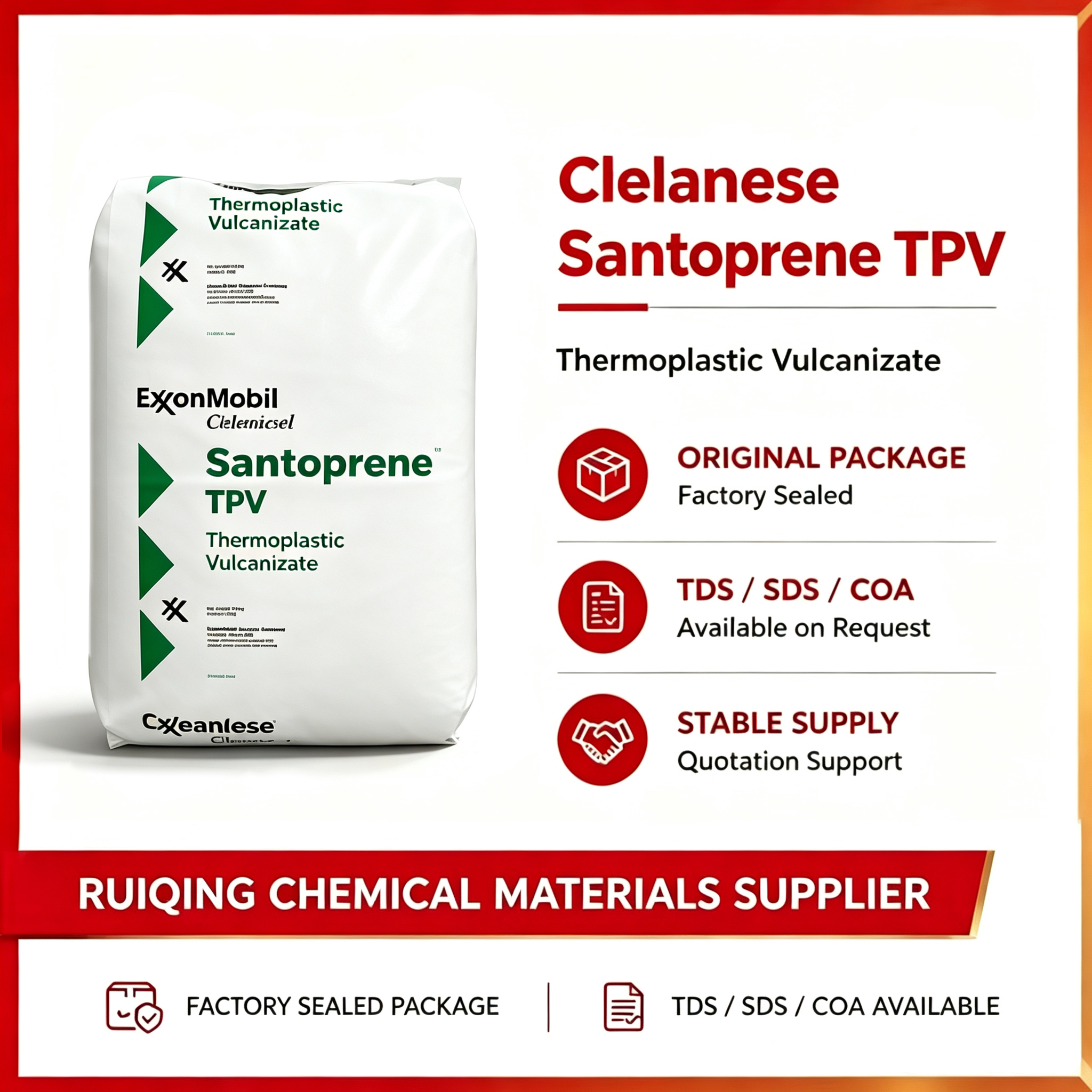
Santoprene 121-70E400 is a black thermoplastic vulcanizate (TPV) grade from the Santoprene product family now owned by Celanese.
Santoprene TPV combines the elastic behavior associated with vulcanized rubber with the processing advantages of thermoplastics. Celanese describes Santoprene TPV as a material platform used in demanding automotive, building and construction, industrial, consumer, electrical and other applications where sealing performance, elastic recovery, weathering resistance and process efficiency are important.
Santoprene 121-70E400 appears in Santoprene black-grades safety documentation and is therefore a genuine Santoprene designation. However, an important sourcing point should be understood: the current publicly available Celanese Product Finder prominently lists Santoprene TPV HR 121-60E400, but it does not currently publish a separate line item for 121-70E400.
For this reason, this page does not transfer numerical mechanical-property values from 121-60E400, 121-67W175, 121-70B260 or any other nearby grade to Santoprene 121-70E400.
The 121 family is historically associated with black TPV formulations designed for improved UV resistance and specialized automotive processing. Within the current Santoprene portfolio, 121-series materials include extrusion, weatherseal, specialty molding, glass-encapsulation and bonding grades.
The E400 designation is most clearly represented today by Santoprene TPV HR 121-60E400, which Celanese actively positions as a high-resilience TPV for static, semi-dynamic and dynamic automotive sealing. Celanese highlights enhanced elastic recovery, low compression set and suitability as an alternative to conventional EPDM weatherseal systems for that current E400 grade.
Accordingly, Santoprene 121-70E400 should be treated as a grade requiring current TDS and availability confirmation before a design or purchasing decision is finalized.
Santoprene TPV as a family offers several engineering advantages over conventional thermoset rubber: rubber-like flexibility and elastic recovery, resistance to ozone and weathering, chemical and oil resistance in suitable applications, high flex-fatigue resistance, thermoplastic extrusion and molding, potential part-weight reduction, and rework of suitable production scrap.
For more TPV materials, visit our TPV Thermoplastic Vulcanizates Product Category →.
For the current manufacturer portfolio, see the Official Celanese Santoprene TPV Page →.
Key Features of Santoprene 121-70E400
| Feature | Engineering Relevance |
|---|---|
| Santoprene TPV Technology | Combines rubber-like behavior with thermoplastic processing |
| Black Formulation | Suitable for technical and automotive components where black appearance is required |
| 121-Series Platform | Associated with improved UV stability in Santoprene grade-selection literature |
| E400 Family Context | Related naming family to current high-resilience extrusion grade 121-60E400 |
| Extrusion-Oriented Use | Relevant for continuous seals, profiles and flexible extrusion concepts |
| Weathering Resistance Platform | Santoprene TPV provides UV, ozone and weathering resistance |
| Elastic Recovery | Santoprene technology is widely used where sealing recovery is important |
| Flex-Fatigue Resistance | Useful for repeatedly flexed seals and profiles |
| Thermoplastic Processing | Avoids the separate vulcanization step required by conventional EPDM rubber |
| Rework Potential | Suitable Santoprene production scrap can be reprocessed under controlled conditions |
| Automotive Heritage | Santoprene TPV has decades of use in automotive sealing and under-hood applications |
The exact Shore hardness, tensile strength, elongation, compression set and processing window for Santoprene 121-70E400 should be taken from the latest grade-specific Celanese TDS rather than inferred from the grade name.
Typical Applications for Santoprene 121-70E400
Because current public grade-specific application literature for Santoprene 121-70E400 is limited, the following applications should be understood as 121-series / E400-family application context, not as an independent manufacturer qualification for every individual use.
| Application Area | Typical TPV Function |
|---|---|
| Automotive Weatherseals | Flexible sealing profiles exposed to outdoor weathering |
| Static Seals | Long-term sealing between fixed mating surfaces |
| Semi-Dynamic Seals | Seals experiencing limited movement during use |
| Dynamic Sealing Profiles | Flexible profiles requiring repeated elastic recovery |
| Door & Body Sealing | Automotive sealing systems replacing traditional EPDM designs |
| Window Sealing Profiles | Extruded black weather-resistant sealing sections |
| Coextruded Profiles | Soft TPV sealing layer integrated with compatible substrates |
| Flexible Industrial Profiles | Continuous extrusions requiring rubber-like flexibility |
| Protective Seals | Environmental sealing against dust, water and weather exposure |
| Automotive Exterior Components | UV- and ozone-exposed elastomeric parts |
Celanese currently promotes Santoprene TPV solutions for static, semi-dynamic and dynamic automotive weatherseals and specifically uses the E400 platform in this application area.
Published Data Status for Santoprene 121-70E400
Grade Identity
The Santoprene black-grades SDS issued before the Celanese acquisition transition lists 121-70E400 among the covered material designations. This confirms that the grade designation has existed within the Santoprene portfolio.
Current Public Product Finder Status
The current Celanese all-grades Product Finder includes many 121-series grades, including 121-50E500, 121-60E400, 121-50M100, 121-62M100, 121-75M100, 121-60M200, 121-75M200, 121-58W175, 121-67W175, 121-73W175, 121-65B200, 121-70B230 and 121-70B260.
The same current public Product Finder does not expose a current row for Santoprene 121-70E400.
Therefore, exact numerical values should be confirmed from a current Celanese TDS, archived manufacturer TDS or batch-specific technical documentation before they are used in a specification.
Typical Properties of Santoprene 121-70E400
| Property | Santoprene 121-70E400 Public Status |
|---|---|
| Material Family | TPV – verified Santoprene family |
| Manufacturer / Brand Owner | Celanese – current Santoprene owner |
| Color | Black – listed within Santoprene black-grade documentation |
| Product Form | Pellets – Santoprene TPV delivery form |
| Shore Hardness | Confirm from current grade-specific TDS |
| Density | Confirm from current grade-specific TDS |
| Tensile Strength | Confirm from current grade-specific TDS |
| Tensile Stress @ 100% Elongation | Confirm from current grade-specific TDS |
| Elongation at Break | Confirm from current grade-specific TDS |
| Tear Strength | Confirm from current grade-specific TDS |
| Compression Set | Confirm from current grade-specific TDS |
| Brittleness Temperature | Confirm from current grade-specific TDS |
| Continuous Use Temperature | Confirm from current grade-specific TDS |
| UL Classification | Confirm exact grade listing before specification |
| OEM Approval | Confirm exact grade and revision with Celanese |
This approach avoids a common problem with older Santoprene grades: nearby grades can have similar names while using different rheology, hardness, compression-set or bonding packages.
E400 Family Context
The best-documented current E400 grade is Santoprene TPV HR 121-60E400.
Current Celanese literature identifies that material as a high-resilience TPV developed for increasingly demanding automotive sealing requirements. Celanese highlights lower compression set, improved elastic recovery, a good Class-A surface and suitability for static and dynamic sealing concepts.
The current Product Finder gives 121-60E400 typical values of approximately:
| Property | Santoprene TPV HR 121-60E400 |
|---|---|
| Shore A Hardness | 64 |
| Elongation at Break | 440% |
| Tensile Strength | 6.4 MPa |
| Tensile Stress at 100% | 2.4 MPa |
| Compression Set, 70°C / 22 h | 21% |
These values belong to 121-60E400 only and are included here solely to explain the E400 product-family context. They must not be copied into a specification for Santoprene 121-70E400.
Why Choose Santoprene 121-70E400?
A customer normally searches for Santoprene 121-70E400 because the material may already be referenced in an existing drawing, legacy BOM, extrusion specification or approved material list, or because an older weatherseal program was validated around this exact designation.
In this situation, preserving the exact material identity matters. A nearby Santoprene grade may look similar by name but can differ in hardness, rheology, compression set, bonding behavior and surface appearance.
The correct commercial approach is to confirm whether the exact grade remains orderable in the target region, whether Celanese has a current replacement recommendation, whether the OEM specification still requires the exact designation, and whether a current alternative can be validated.
Santoprene TPV remains attractive because it provides rubber-like sealing performance while running through thermoplastic extrusion and molding equipment. Compared with conventional EPDM rubber, a TPV system can simplify manufacturing because there is no separate vulcanization stage during standard thermoplastic processing.
Celanese also emphasizes reduced part weight, process scrap rework and potential end-of-life recycling as important Santoprene benefits.
Processing Guidelines for Santoprene 121-70E400
A current public grade-specific processing sheet for Santoprene 121-70E400 was not located in the current Celanese public Product Finder.
Accordingly, processing conditions should not be copied from 121-60E400 or another 121-series material without confirmation.
Santoprene TPV as a family supports extrusion, injection molding, blow molding, physical foaming, chemical foaming and calendaring.
For an extrusion-oriented Santoprene 121-70E400 application, the converter should confirm the current technical sheet before production and optimize feed-zone temperature, compression-zone temperature, metering-zone temperature, adapter and die temperature, screw speed, melt pressure, draw-down ratio, cooling conditions, profile dimensions, line speed and surface finish.
Shear-Dependent Flow Behavior
Santoprene TPV is shear dependent. Increasing shear rate generally reduces apparent melt viscosity. Screw design, screw speed and die geometry can therefore influence flow and surface quality as strongly as temperature.
Excessive temperature should not be used as the only method for improving flow.
Drying and Material Handling
Drying requirements should follow the latest grade-specific Celanese TDS or processing guide. For production work involving an older or less-common grade designation, storage history and moisture handling should be confirmed before extrusion.
Santoprene 121-70E400 vs. Santoprene 121-60E400
| Feature | Santoprene 121-70E400 | Santoprene 121-60E400 |
|---|---|---|
| Material Family | Santoprene TPV | Santoprene TPV |
| Color | Black | Black |
| Series | 121 / E400 | 121 / E400 |
| Current Public Product Finder Row | Not currently shown | Yes |
| Current Celanese Weatherseal Promotion | Not specifically shown | Yes |
| High-Resilience Positioning | Confirm exact documentation | Explicitly stated by Celanese |
| Published Shore A | Confirm TDS | 64 |
| Published Elongation | Confirm TDS | 440% |
| Published Tensile Strength | Confirm TDS | 6.4 MPa |
| Published Compression Set | Confirm TDS | 21% @ 70°C / 22 h |
If a customer requests Santoprene 121-70E400, do not automatically substitute 121-60E400. Compare the latest TDS, hardness requirement, extrusion behavior, approved specification and end-use validation first.
Related Products
Santoprene 121-60E400 – Current high-resilience black TPV promoted by Celanese for static, semi-dynamic and dynamic automotive weatherseals.
Santoprene 121-67W175 – Black 121-series extrusion TPV tuned for profile extrusion and UV stability.
Santoprene 121-73W175 – Firmer black profile-extrusion TPV in the 121 W175 family.
View More TPV Thermoplastic Vulcanizates →
Technical Documents for Santoprene 121-70E400
For Santoprene 121-70E400, document verification is particularly important because the exact grade is not displayed in the current public Celanese Product Finder.
| Document Type | Recommended Check |
|---|---|
| TDS | Confirm latest revision and exact grade-specific properties |
| SDS | Confirm regional Celanese SDS and material designation |
| Availability Statement | Confirm whether the exact grade remains commercially available |
| Replacement Grade Information | Check whether Celanese recommends a current successor |
| OEM Approval | Confirm exact grade, OEM specification and revision |
| COA | Confirm batch-specific values where supplied |
Need documents or a current supply check for Santoprene 121-70E400?
📧 Email: ruiqingchem@gmail.com
📝 Online form: Contact Us →
FAQ About Santoprene 121-70E400
Q1: What is Santoprene 121-70E400?
Santoprene 121-70E400 is a black Santoprene TPV grade designation associated with the 121-series specialty material platform and E400 family.
Q2: Is Santoprene 121-70E400 a genuine Santoprene grade?
Yes. The designation appears in Santoprene black-grade safety documentation covering the product portfolio.
Q3: Is Santoprene 121-70E400 shown in the current Celanese Product Finder?
The current publicly available all-grades Product Finder does not show a separate 121-70E400 line item. It does show the current Santoprene TPV HR 121-60E400 grade.
Q4: Is Santoprene 121-70E400 a 70 Shore A material?
The “70” designation is a hardness reference in Santoprene naming practice, but the exact current Shore A value should be confirmed from the grade-specific TDS rather than assumed from the name.
Q5: Is Santoprene 121-70E400 an extrusion grade?
The E-series naming and E400 family context are associated with specialized extrusion and sealing applications. Exact processing recommendations should be confirmed from the grade-specific technical sheet.
Q6: Can Santoprene 121-70E400 be used for automotive weatherseals?
The 121-series and current E400 platform are strongly associated with automotive sealing. Use of the exact 121-70E400 grade should be confirmed against the customer’s OEM specification and latest Celanese documentation.
Q7: What is the compression set of Santoprene 121-70E400?
A current public exact value was not located. Do not use the 121-60E400 value as a substitute.
Q8: What are the tensile strength and elongation?
These values should be taken from the latest exact-grade TDS. Nearby 121-series values are not automatically transferable.
Q9: What is the difference between Santoprene 121-70E400 and 121-60E400?
121-60E400 is actively documented by Celanese as a high-resilience weatherseal TPV. The current public Product Finder does not separately list 121-70E400, so its exact current status and properties should be verified before substitution or specification.
Q10: Can you supply TDS, SDS or replacement-grade information?
Yes. Send the full grade designation Santoprene 121-70E400, required quantity, destination and application details so current documentation and supply status can be checked.
Request Santoprene 121-70E400 Price & Technical Support
For pricing, availability or grade verification for Santoprene 121-70E400, please provide the required quantity, destination country or port, existing OEM or customer specification, drawing or BOM grade designation, sealing type, required Shore hardness, compression-set target, extrusion profile dimensions, operating-temperature range, UV / ozone exposure and whether a current Celanese alternative is acceptable.
📧 Email: ruiqingchem@gmail.com
📝 Send Inquiry →