描述
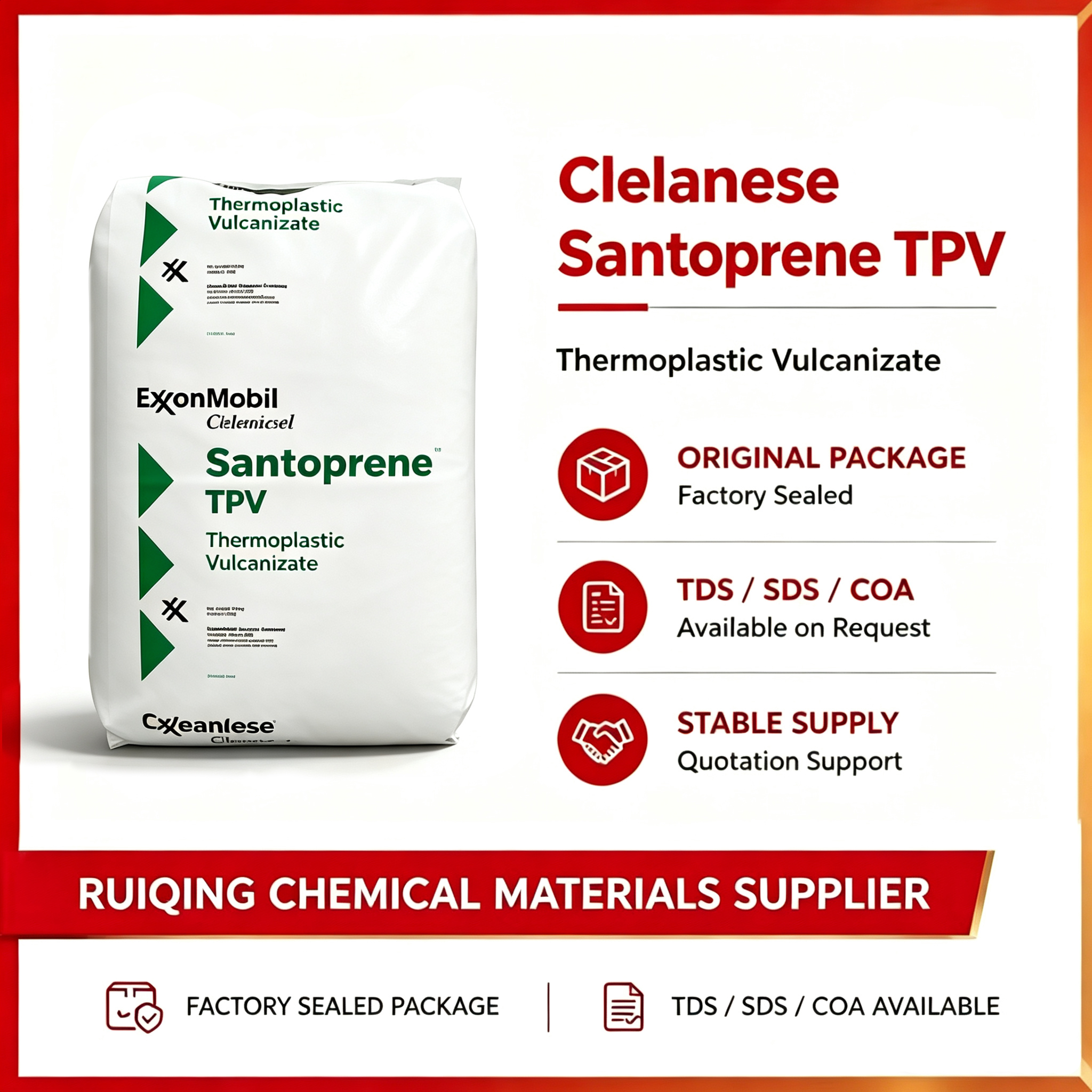
Santoprene 121-70B260 is a medium-hard black thermoplastic vulcanizate developed by Celanese for demanding automotive weatherseal corner molding and end-cap applications.
The grade is specifically designed for complex corners on dense extruded automotive weatherseals made from either TPV or EPDM rubber.
Its technical positioning is different from a standard general-purpose Santoprene TPV. Santoprene 121-70B260 combines three functions that are especially important for automotive sealing systems: a built-in low coefficient of friction, good bonding to TPV and vulcanized EPDM, and high shear-thinning flow behavior.
These characteristics help manufacturers mold complex corners directly onto extruded sealing profiles while maintaining good appearance and dimensional continuity.
Celanese states that Santoprene 121-70B260 was specially formulated as a thermoplastic alternative to thermoset EPDM rubber in automotive GRC corner-molding applications.
The thermoplastic route can provide shorter processing cycles because the material does not require the same curing step associated with conventional thermoset EPDM.
The grade also provides a surface appearance designed to harmonize with adjacent extruded profiles. Celanese specifically notes excellent surface aesthetics, no surface bleeding, and no significant change in friction after heat aging.
This is important for visible automotive weatherseal corners where differences in gloss, texture or surface behavior between the extrusion and the molded corner can reduce perceived quality.
The current Celanese Materials Database lists a Shore A hardness of approximately 68, making the material a medium-hard elastomer suitable for dense automotive sealing profiles.
Current mechanical data also lists approximately 520% elongation at break, 6.4 MPa tensile stress at break, 2.6 MPa tensile stress at 100% elongation, and 49% compression set at 70°C for 24 hours.
Density is approximately 0.910 g/cm³, which is low for an elastomeric material and can contribute to component weight reduction.
The grade is UV stabilized or weather stable, supporting exterior automotive sealing environments.
For more TPV materials, visit our TPV Thermoplastic Vulcanizates Product Category →.
For the Celanese TPV portfolio, see the Official Celanese Santoprene & Geolast Product Finder →.
Key Features of Santoprene 121-70B260
| Feature | Engineering Benefit |
|---|---|
| Shore A 68 | Medium-hard elastomeric response for dense weatherseal corners |
| Built-In Low COF | Reduces friction at moving or contacting sealing surfaces |
| Bonding to TPV | Supports molding onto TPV extruded profiles |
| Bonding to Vulcanized EPDM | Enables corner molding onto EPDM rubber profiles |
| High Shear-Thinning Behavior | Promotes flow into complex injection-molded geometries |
| Good Flowability | Supports detailed corner and end-cap designs |
| Excellent Surface Aspect | Helps match the appearance of adjacent extruded profiles |
| No Surface Bleeding | Supports stable surface quality after processing |
| Stable Friction after Heat Aging | Helps maintain low-friction behavior over time |
| UV / Weather Stable | Supports exterior automotive use |
| Thermoplastic Processing | Enables shorter cycles than many thermoset EPDM processes |
| Automotive OEM References | Current Celanese data lists Renault, SAIC Motor and VW Group references |
The defining advantage of Santoprene 121-70B260 is not simply its hardness. It is the combination of bonding, low friction, high-flow injection molding and surface matching for automotive sealing systems.
Typical Applications for Santoprene 121-70B260
Santoprene 121-70B260 is primarily intended for automotive weatherseal systems.
| Application Area | Typical Use |
|---|---|
| Automotive Weatherseal Corners | Injection-molded corners joining extruded sealing sections |
| Weatherseal End Caps | Molded end closures on TPV or EPDM profiles |
| Glass Run Channel Corners | GRC corner molding requiring low friction |
| Door Sealing Systems | Complex molded transitions on dense weatherseals |
| Window Sealing Systems | Corner and termination components around glazing |
| TPV-to-TPV Overmolding | Bonded corner molding onto TPV profiles |
| TPV-to-EPDM Overmolding | Molded corners bonded to vulcanized EPDM profiles |
| Automotive Exterior Sealing | Weather-exposed sealing components requiring UV stability |
The strongest application fit is complex automotive corner molding where both flowability and bonding to an existing extruded profile are critical.
Typical Properties of Santoprene 121-70B260
Physical Properties
| Property | Typical Value | Test Method |
|---|---|---|
| Density | 910 kg/m³ / 0.910 g/cm³ | ISO 1183 |
| Shore A Hardness, 15 s | 68 | ISO 48-4 / ISO 868 |
| Resin Identification | TPV | ISO 1043 |
| Part Marking Code | >TPV< | ISO 11469 |
| Color | Black | Manufacturer information |
| Delivery Form | Pellets | Manufacturer information |
| Special Characteristic | UV stabilized / weather stable | Manufacturer information |
Mechanical Properties
| Property | Typical Value | Test Method |
|---|---|---|
| Tensile Stress at 100% Elongation, Perpendicular | 2.6 MPa | ISO 37 |
| Tensile Stress at Break, Perpendicular | 6.4 MPa | ISO 527-1/-2 or ISO 37 |
| Elongation at Break, Perpendicular | 520% | ISO 527-1/-2 or ISO 37 |
| Shore A Hardness | 68 | ISO 48-4 / ISO 868 |
| Compression Set, 70°C / 24 h | 49% | ISO 815 |
Flammability Properties
| Property | Typical Value | Test Method |
|---|---|---|
| FMVSS Class | B | ISO 3795 / FMVSS 302 |
| Burning Rate @ 2 mm | 39 mm/min | ISO 3795 / FMVSS 302 |
Low-Friction & Bonding Performance
The main engineering value of Santoprene 121-70B260 is the integration of low-friction behavior and bonding capability.
Built-In Low Coefficient of Friction
Celanese describes the grade as having built-in low COF properties.
For glass-run channels and weatherseal systems, lower friction can help reduce drag between the sealing surface and moving glass or adjacent vehicle components.
Unlike a surface treatment added after molding, the low-friction behavior is designed into the material formulation.
Celanese also states that friction does not significantly change after heat aging, which helps support long-term performance.
Bonding to TPV and EPDM
Santoprene 121-70B260 is designed to adhere to:
- TPV extruded profiles
- Vulcanized EPDM rubber
This makes it especially valuable in automotive weatherseal corner molding, where a molded corner must join multiple extrusion sections securely.
Surface Harmony
The material is formulated to provide excellent surface appearance and color harmony with extruded profiles.
That is particularly important at visible corner joints, where differences in gloss, texture or color can be obvious.
Why Choose Santoprene 121-70B260?
The main reason to choose Santoprene 121-70B260 is its specialized positioning for automotive corner molding.
A general-purpose 70A TPV may provide the required hardness but may not offer the same combination of bonding, friction behavior and surface matching.
For weatherseal corner molding, the material must first flow into a complex mold cavity.
It must then bond reliably to the existing extruded profile.
After demolding, the corner should match the profile visually and should not create excessive friction during vehicle use.
Santoprene 121-70B260 was developed around these exact requirements.
Its high shear-thinning behavior helps the material fill complex corners without relying only on very high processing temperatures.
Its built-in low-friction system supports moving-glass and weatherseal interfaces.
Its ability to bond to both TPV and vulcanized EPDM gives manufacturers more flexibility in profile design and material selection.
Its surface appearance is designed to remain stable without bleeding and without significant friction change after heat aging.
The thermoplastic process also provides an important cycle-time advantage compared with thermoset EPDM.
Celanese specifically states that the grade was designed to enable shorter processing cycles than thermoset EPDM rubber in GRC corner-molding applications.
For manufacturers producing high-volume automotive weatherseal assemblies, this can support faster production and simpler processing.
Processing Guidelines for Santoprene 121-70B260
Santoprene 121-70B260 is intended for:
- Injection molding
- Multi-injection molding
Current Grade-Specific Injection Conditions
| Processing Parameter | Celanese Guidance |
|---|---|
| Drying Recommended | Yes |
| Drying Temperature | 65°C |
| Drying Time | ≥3 hours in a dehumidified dryer |
| Processing Moisture Content | ≤0.08% |
| Optimum Melt Temperature | 220°C |
| Minimum Melt Temperature | 210°C |
| Maximum Melt Temperature | 230°C |
| Optimum Mold Temperature | 50°C |
| Minimum Mold Temperature | 40°C |
| Maximum Mold Temperature | 60°C |
| Recommended Screw Speed | 100–200 rpm |
| Holding Pressure | Approx. 50–75% of actual injection pressure |
| Optional Back Pressure | Approx. 0.3–0.7 MPa |
The current Celanese Materials Database gives a relatively narrow grade-specific melt window of 210–230°C, with an optimum around 220°C.
Drying Guidance
The current grade sheet lists 65°C for at least 3 hours in a dehumidified dryer.
Celanese’s general processing note also mentions desiccant drying for approximately 3 hours at 80°C for Santoprene TPV broadly.
For production, the exact current grade-specific value should take priority when setting the initial drying condition for Santoprene 121-70B260.
Shear-Dependent Flow
Santoprene TPV has relatively high viscosity at low shear rates.
As shear increases, the apparent viscosity falls.
For this grade, that behavior is especially useful because complex automotive corners require good mold filling.
Celanese recommends a relatively high screw speed of approximately 100–200 rpm.
Smaller gates and higher shear rates can also help maintain lower apparent melt viscosity and improve flow.
Holding Pressure & Back Pressure
Holding pressure should generally be around 50–75% of the actual injection pressure.
Back pressure is not always necessary, but approximately 0.3–0.7 MPa may be used to improve melt homogeneity and shot consistency.
Material Compatibility
Celanese states that Santoprene TPV is incompatible with acetal (POM) and PVC.
Processing equipment should therefore be thoroughly purged when changing between these materials and Santoprene 121-70B260.
Santoprene 121-70B260 vs. Santoprene 121-80B260
| Feature | Santoprene 121-70B260 | Santoprene 121-80B260 |
|---|---|---|
| Material Family | TPV | TPV |
| Color | Black | Black |
| Main Application | Automotive weatherseal corner molding | Hard automotive weatherseal corner molding |
| Bonding to TPV | Yes | Yes |
| Bonding to Vulcanized EPDM | Yes | Yes |
| Built-In Low COF | Yes | Yes |
| Shore A Hardness | 68 | 78 |
| Elongation at Break | 520% | 640% |
| Tensile Stress at Break | 6.4 MPa | 11.0 MPa |
| Tensile Stress @ 100% | 2.6 MPa | 3.5 MPa |
| Compression Set, 70°C / 24 h | 49% | 62% |
| Density | 0.910 g/cm³ | 0.910 g/cm³ |
| Main Selection Difference | Softer / medium-hard corner grade | Harder / stronger corner grade |
Choose Santoprene 121-70B260 when the weatherseal corner requires lower hardness and more compliance.
Choose Santoprene 121-80B260 when a harder corner with higher tensile strength is required.
Automotive OEM References
Current Celanese material data lists the following references for Santoprene 121-70B260:
| OEM | Specification / Reference |
|---|---|
| Renault | FRM 18-27-206 / special part approval context |
| SAIC Motor | SMTC 5 320 024 |
| Volkswagen Group | VW 52703 |
Related Products
Santoprene 121-80B260 – Harder black low-friction TPV for automotive corner molding and end caps with bonding to TPV and EPDM.
Santoprene 121-70B230 – Black bonding grade for automotive weatherseal corner molding with low-friction characteristics.
Santoprene 121-70B265 – Black automotive corner-molding TPV from the B265 family.
View More TPV Thermoplastic Vulcanizates →
Technical Documents for Santoprene 121-70B260
| Document Type | Description |
|---|---|
| TDS | Current Celanese grade-specific physical, mechanical and processing data |
| SDS | Safety Data Sheet |
| Automotive Specification Information | Renault, SAIC Motor and Volkswagen Group references |
| Santoprene Product Finder | Grade comparison and automotive application positioning |
| Injection Molding Guide | Processing recommendations for Santoprene TPV |
| COA | Batch-specific quality information where available |
Need technical documents for Santoprene 121-70B260?
📧 Email: ruiqingchem@gmail.com
📝 Online form: Contact Us →
FAQ About Santoprene 121-70B260
Q1: What is Santoprene 121-70B260?
Santoprene 121-70B260 is a medium-hard black TPV from Celanese designed mainly for complex automotive weatherseal corner molding and end caps.
Q2: What is the hardness of Santoprene 121-70B260?
The current Celanese value is approximately Shore A 68.
Q3: Does Santoprene 121-70B260 bond to EPDM?
Yes. Celanese specifically states that the grade adheres to vulcanized EPDM rubber as well as TPV.
Q4: Does Santoprene 121-70B260 have low friction?
Yes. The grade includes built-in low coefficient-of-friction properties for automotive weatherseal applications.
Q5: What is the elongation at break?
Current Celanese data lists approximately 520% elongation at break.
Q6: What is the tensile stress at break?
The current value is approximately 6.4 MPa.
Q7: What is the compression set?
Current data lists approximately 49% at 70°C for 24 hours.
Q8: What processing method is recommended?
The grade is designed primarily for injection molding and multi-injection molding.
Q9: What melt temperature should be used?
The current grade-specific melt-temperature range is approximately 210–230°C, with an optimum around 220°C.
Q10: What is the difference between Santoprene 121-70B260 and 121-80B260?
Both are low-friction automotive corner-molding grades with bonding to TPV and EPDM. Santoprene 121-70B260 is softer at Shore A 68, while 121-80B260 is harder at Shore A 78 and provides higher tensile strength.
Request Santoprene 121-70B260 Price & Technical Support
For pricing, availability, technical documents or application support for Santoprene 121-70B260, please provide:
- Required quantity
- Destination country or port
- Automotive OEM or Tier 1 project
- Weatherseal profile material: TPV or EPDM
- Corner or end-cap geometry
- Required Shore hardness
- Low-friction requirement
- Bonding requirement
- Surface appearance requirement
- Injection-molding equipment
- Target cycle time
- OEM specification requirement
- TDS, SDS or COA requirement
- Sample requirement, if applicable
📧 Email: ruiqingchem@gmail.com
📝 Send Inquiry →