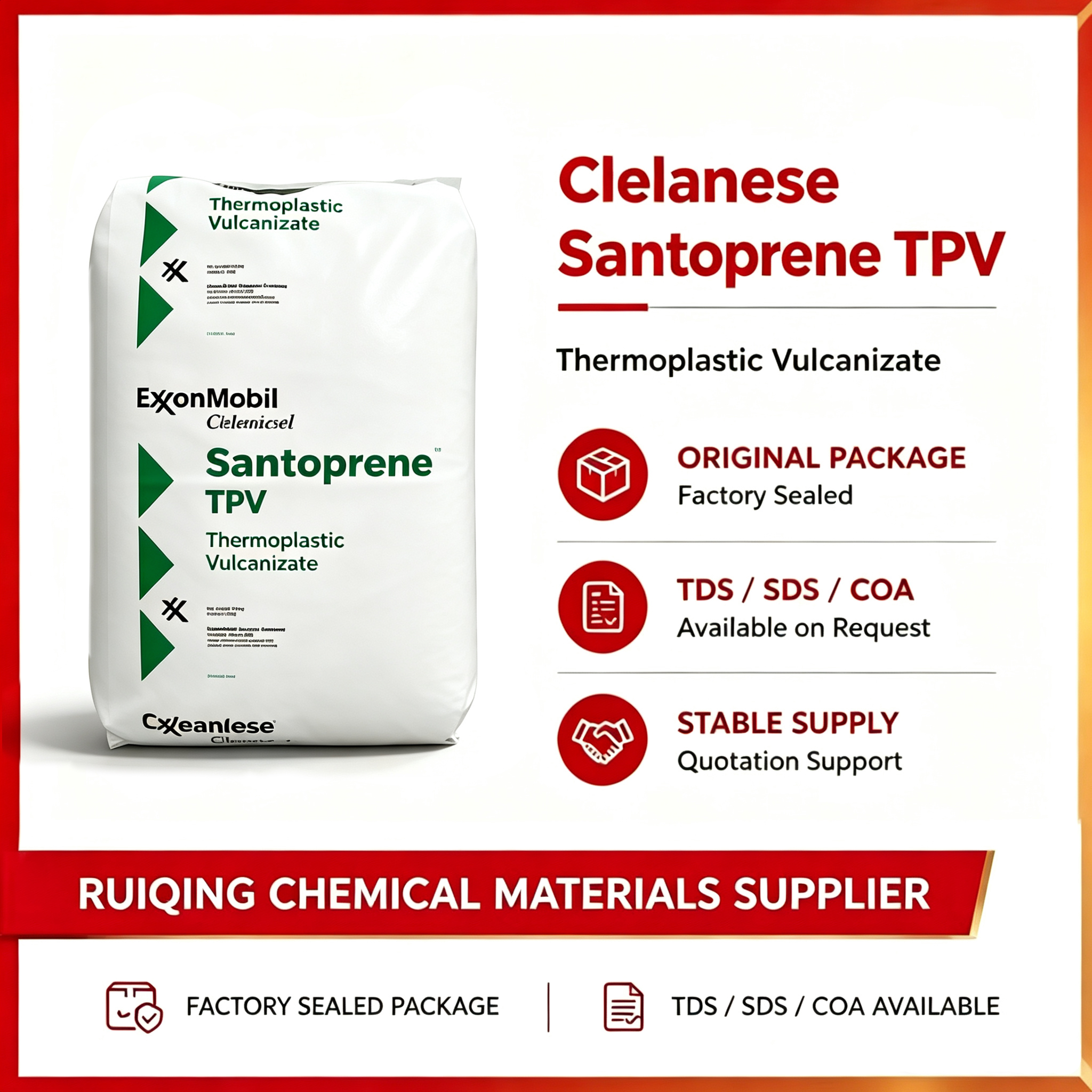
描述
Santoprene 121-70B230 is a soft black thermoplastic vulcanizate (TPV) from Celanese specifically formulated for bonding to sulfur- or peroxide-cured thermoset EPDM rubber.
Its principal use is not simply general-purpose sealing. Celanese developed this grade for demanding automotive sealing operations such as glass-run channel corner molding, end caps and special fixation applications, where a molded TPV section must bond reliably to an existing cured EPDM profile.
The grade also provides enhanced coefficient-of-friction performance, making Santoprene 121-70B230 particularly relevant to automotive weatherseals and glass-run channel systems where sliding behavior and surface interaction are important.
Celanese lists several grade-specific advantages:
- Designed to replace thermoset EPDM rubber in automotive glass-run channel corner molding
- Shorter processing time than conventional thermoset EPDM processing
- Adhesion to vulcanized EPDM over a wide temperature range
- Adhesion to TPV over a wide temperature range
- Enhanced coefficient-of-friction properties
- Good UV resistance
- Low fogging
- Paint-stain resistance
These features distinguish Santoprene 121-70B230 from standard general-purpose Santoprene grades.
The material has a Shore A hardness of approximately 74, placing it in a medium-firm elastomer range suitable for corner molding and exterior sealing components.
Current Celanese grade data lists approximately 470% elongation at break, 6.5 MPa stress at break, 2.6 MPa stress at 100% elongation, a 14.1 MPa shear modulus, and approximately 44% compression set at 70°C for 24 hours.
Its density is approximately 0.920 g/cm³, which is relatively low for an engineering elastomer and can support lightweight automotive sealing systems.
Santoprene 121-70B230 is a shear-dependent material. As shear rate rises, its apparent melt viscosity decreases, allowing efficient processing on conventional thermoplastic injection-molding equipment.
The grade is polyolefin based and Celanese states that it is recyclable within the manufacturing stream.
For more TPV materials, visit our TPV Thermoplastic Vulcanizates Product Category →.
For the current Celanese TPV grade range, see the Official Celanese Santoprene & Geolast Product Finder →.
Key Features of Santoprene 121-70B230
| Feature | Engineering Benefit |
|---|---|
| Shore A 74 | Medium-firm elastomeric response for automotive sealing geometry |
| EPDM Bonding | Bonds to sulfur- and peroxide-cured thermoset EPDM |
| TPV Bonding | Supports TPV-to-TPV joining in multi-component sealing systems |
| Low Coefficient of Friction | Helps control sliding behavior in glass-run channels and weatherseals |
| Good UV Resistance | Supports exterior automotive use |
| Low Fogging | Useful for vehicle sealing applications where interior fogging control matters |
| Paint-Stain Resistance | Helps minimize staining risk where the seal contacts painted body surfaces |
| 470% Elongation | High flexibility for molded corners and complex sealing geometries |
| 6.5 MPa Stress at Break | Useful mechanical strength for flexible exterior components |
| Shear-Dependent Flow | Supports thermoplastic injection molding with optimized shear |
| Manufacturing-Stream Recyclability | Allows controlled reuse of suitable process scrap |
| Shorter Processing Route | Designed to reduce processing time compared with thermoset EPDM corner molding |
The most important reason to select Santoprene 121-70B230 is its combination of EPDM adhesion and low-friction surface behavior.
Typical Applications for Santoprene 121-70B230
Santoprene 121-70B230 is primarily an automotive exterior sealing grade.
| Application Area | Typical Use |
|---|---|
| Glass-Run Channel Corner Molding | Injection-molded TPV corners bonded to cured EPDM profiles |
| Weatherseal End Caps | Molded end sections for automotive sealing systems |
| Special Fixation Parts | Molded fixing or joining areas in EPDM-based profiles |
| Automotive Window Seals | Flexible sealing around vehicle glass systems |
| Exterior Trim Seals | Black UV-resistant elastomeric joining components |
| EPDM-to-TPV Joining | Hybrid sealing systems combining vulcanized EPDM with TPV |
| TPV-to-TPV Bonding | Multi-part or multi-material thermoplastic sealing systems |
| Low-Friction Sealing Interfaces | Areas where controlled sliding against glass or adjacent surfaces is required |
The grade is especially appropriate when a normal TPV does not provide the required adhesion to cured EPDM or when friction behavior must be controlled.
Typical Properties of Santoprene 121-70B230
Physical Properties
| Property | Typical Value | Test Method |
|---|---|---|
| Density | 920 kg/m³ / 0.920 g/cm³ | ISO 1183 |
| Specific Gravity | Approx. 0.918 | ASTM D792 |
| Shore A Hardness, 15 s | 74 | ISO 48-4 / ISO 868 |
| Appearance | Black | Manufacturer information |
| Base Chemistry | Polyolefin-based TPV | Manufacturer information |
Mechanical Properties
| Property | Typical Value | Test Method |
|---|---|---|
| Stress at 100% Elongation | 2.6 MPa | ISO 527-1/-2 or ISO 37 |
| Stress at Break | 6.5 MPa | ISO 527-1/-2 or ISO 37 |
| Elongation at Break | 470% | ISO 527-1/-2 or ISO 37 |
| Shear Modulus | 14.1 MPa | ISO 6721 |
| Compression Set, 70°C / 24 h | 44% | ISO 815 |
The mechanical profile shows that Santoprene 121-70B230 remains highly extensible while providing enough firmness for molded automotive corner and end-cap components.
Bonding & Surface Performance
Celanese specifically states that Santoprene 121-70B230:
- Adheres to vulcanized EPDM over a wide temperature range
- Adheres to TPV over a wide temperature range
- Provides enhanced COF properties
- Offers good UV resistance
- Provides low fogging
- Is paint-stain resistant
For glass-run channel and weatherseal systems, these application characteristics can be more important than selecting a grade only by hardness.
Automotive OEM References for Santoprene 121-70B230
Current Celanese grade information lists the following OEM specification references:
| OEM | Specification / Reference |
|---|---|
| General Motors | GMW15825, Type 5 |
| Mercedes-Benz Group | DBL 5562 |
| Renault | FRM 18-27-093 / — |
| Volkswagen Group | VW 50180 |
These references make Santoprene 121-70B230 especially relevant to automotive weatherseal manufacturers and Tier 1 suppliers working with global OEM requirements.
Why Choose Santoprene 121-70B230?
A standard general-purpose TPV may have the correct hardness but still fail to bond adequately to cured EPDM.
That is the problem Santoprene 121-70B230 is designed to solve.
Traditional automotive weatherseals frequently use thermoset EPDM for the extruded profile. Corner sections, end caps and joining areas then need to be molded onto that already-cured EPDM substrate.
Creating a reliable bond between a thermoplastic elastomer and cured thermoset rubber is not automatic.
Santoprene 121-70B230 is specially formulated for this interface.
Celanese states that it adheres to both sulfur-cured and peroxide-cured thermoset EPDM over a wide temperature range. It also bonds to TPV, giving designers greater flexibility in hybrid sealing constructions.
The grade’s low-friction behavior is another important advantage. In automotive glass-run channels, the sealing surface interacts continuously with moving glass. Excessive friction can increase operating force, noise or wear.
The B230 family is specifically positioned around lower coefficient-of-friction performance, which is one reason it is used in glass-run channel corner-molding systems.
Good UV resistance supports exterior service, while paint-stain resistance is important where seals contact painted metal surfaces.
Low fogging helps address interior contamination concerns in vehicle environments.
For manufacturers trying to replace a conventional thermoset corner-molding process, Santoprene 121-70B230 can also offer a shorter thermoplastic processing cycle.
Processing Guidelines for Santoprene 121-70B230
Santoprene 121-70B230 is intended for processing on conventional thermoplastic injection-molding equipment.
Current Celanese Processing Guidance
| Processing Parameter | Published Guidance |
|---|---|
| Drying Temperature | 65°C |
| Drying Time | 3 hours in a desiccant dryer |
| Optimum Melt Temperature | 215°C |
| General Santoprene TPV Processing Window | 175–230°C |
| Primary Process | Injection molding |
Celanese recommends desiccant drying for approximately 3 hours at 65°C.
The published optimum melt temperature for Santoprene 121-70B230 is approximately 215°C.
Celanese also notes that Santoprene TPV generally offers a broad processing window of approximately 175–230°C.
Shear-Dependent Melt Behavior
Santoprene 121-70B230 is shear dependent. As shear rate increases, apparent viscosity falls.
For corner-molding production, processors should optimize:
- Melt temperature
- Injection speed
- Gate location and dimensions
- EPDM insert temperature
- Insert cleanliness
- Injection pressure
- Holding pressure
- Cooling time
- Venting
- Bonding-area geometry
Because adhesion to EPDM is a key function of the grade, substrate preparation and actual molding conditions should be validated on the production weatherseal profile.
Material Compatibility
Celanese states that Santoprene TPV is incompatible with acetal (POM) and PVC.
Processing equipment should be thoroughly purged when changing between these materials and Santoprene.
Santoprene 121-70B230 vs. Santoprene 121-65B200
| Feature | Santoprene 121-70B230 | Santoprene 121-65B200 |
|---|---|---|
| Material Family | TPV | TPV |
| Appearance | Black | Black |
| Main Positioning | EPDM / TPV bonding + low friction | Improved EPDM / TPV bonding |
| Shore A Hardness | 74 | 67 |
| Elongation at Break | 470% | 600% |
| Stress at Break | 6.5 MPa | 9.2 MPa |
| Stress @ 100% Elongation | 2.6 MPa | 2.3 MPa |
| Compression Set, 70°C | 44% | 48% |
| Low-Friction Positioning | Yes | Not the primary B200 positioning |
| Main Selection Reason | Lower friction + EPDM bonding | Softer EPDM-bonding grade |
Choose Santoprene 121-70B230 when the application requires EPDM bonding together with lower coefficient-of-friction behavior, especially for automotive glass-run channel corner molding.
Choose Santoprene 121-65B200 when a softer bonding grade is more appropriate and low-friction optimization is not the main requirement.
Related Products
Santoprene 121-65B200 – Black TPV with improved bonding to TPV and EPDM at approximately Shore A 67.
Santoprene 121-80B230 – Firmer black B230 grade with low-friction positioning and improved TPV / EPDM bonding.
Santoprene 121-70B260 – Automotive corner-molding TPV with low-friction behavior and improved bonding to TPV, EPDM and PP.
View More TPV Thermoplastic Vulcanizates →
Technical Documents for Santoprene 121-70B230
| Document Type | Description |
|---|---|
| TDS | Celanese mechanical, physical and processing data |
| SDS | Safety Data Sheet |
| OEM Information | GM, Mercedes-Benz, Renault and Volkswagen specification references |
| Santoprene Product Finder | Celanese TPV grade positioning and comparison |
| Automotive Grade Slate | Weatherseal, corner-molding and automotive application positioning |
| COA | Batch-specific quality information where available |
Need technical documents for Santoprene 121-70B230?
📧 Email: ruiqingchem@gmail.com
📝 Online form: Contact Us →
FAQ About Santoprene 121-70B230
Q1: What is Santoprene 121-70B230?
Santoprene 121-70B230 is a black Celanese TPV formulated for bonding to cured EPDM and TPV, especially in automotive glass-run channel corner molding, end caps and special fixation applications.
Q2: What is the hardness of Santoprene 121-70B230?
The current Shore A hardness is approximately 74.
Q3: Can Santoprene 121-70B230 bond to EPDM?
Yes. Celanese specifically states that the grade adheres to sulfur- or peroxide-cured vulcanized EPDM over a wide temperature range.
Q4: Is Santoprene 121-70B230 a low-friction TPV?
Yes. Enhanced coefficient-of-friction performance is one of the defining features of the B230 grade family.
Q5: What is the elongation at break?
Current Celanese data lists approximately 470% elongation at break.
Q6: What is the tensile stress at break?
The current value is approximately 6.5 MPa.
Q7: Is Santoprene 121-70B230 UV resistant?
Yes. Good UV resistance is listed as a key feature by Celanese.
Q8: What automotive applications is the grade designed for?
The principal applications are glass-run channel corner molding, weatherseal end caps, special fixation parts and EPDM-bonded exterior sealing systems.
Q9: What processing temperature is recommended?
Celanese lists an optimum melt temperature of approximately 215°C, with a broader Santoprene TPV processing window of approximately 175–230°C.
Q10: What OEM specifications are associated with Santoprene 121-70B230?
Current Celanese grade information lists GM GMW15825 Type 5, Mercedes-Benz DBL 5562, Renault FRM 18-27-093 and Volkswagen VW 50180.
Request Santoprene 121-70B230 Price & Technical Support
For pricing, availability, technical documents or application support for Santoprene 121-70B230, please provide:
- Required quantity
- Destination country or port
- Automotive weatherseal application
- Glass-run channel, end cap or fixation design
- EPDM cure system: sulfur or peroxide
- Existing EPDM profile specification
- Required Shore hardness
- Friction / COF requirement
- UV and outdoor exposure
- Paint-contact requirement
- Injection-molding equipment
- OEM specification requirement
- TDS, SDS or COA requirement
- Sample requirement, if applicable
📧 Email: ruiqingchem@gmail.com
📝 Send Inquiry →