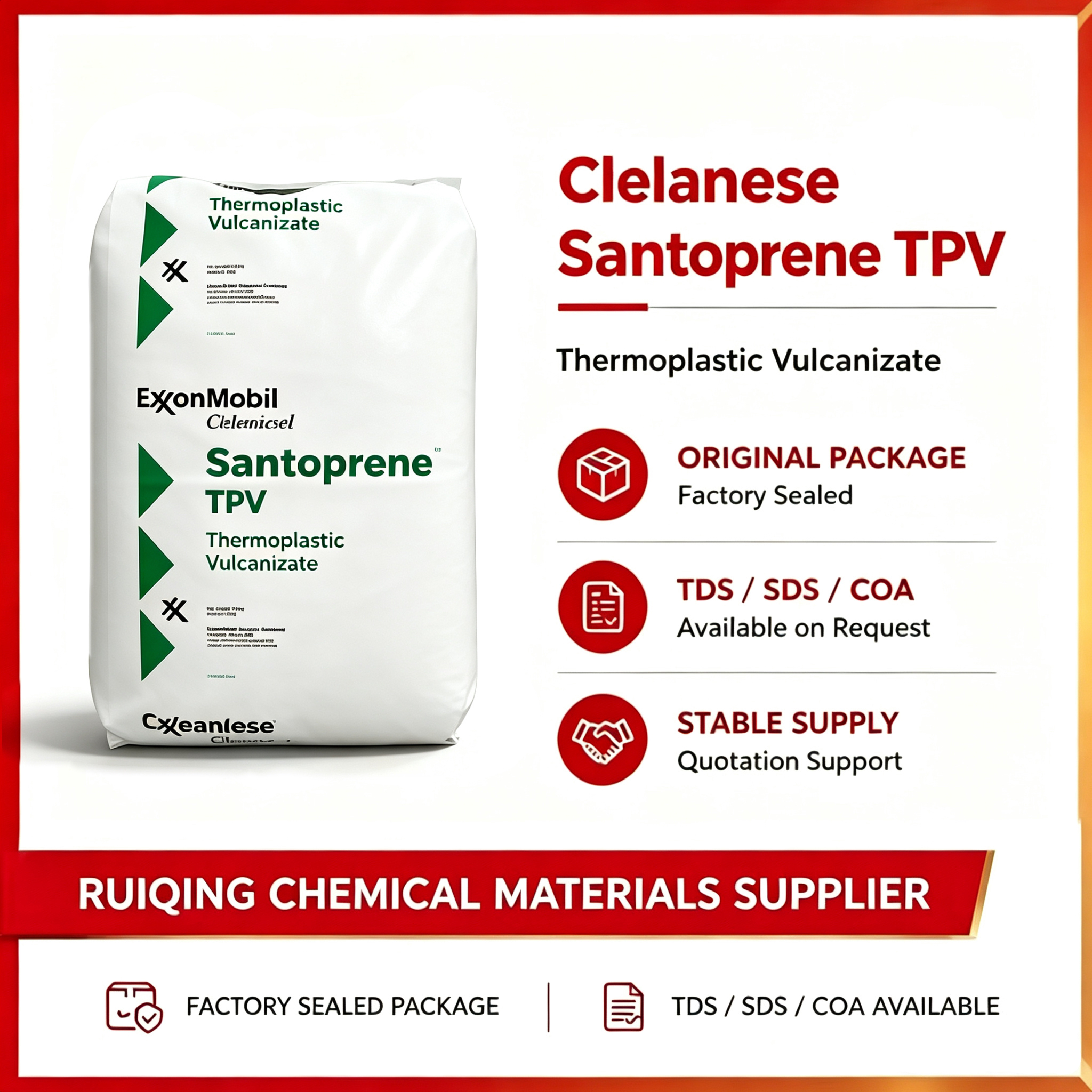
描述
Santoprene 121-60M200 is a soft, black, UV-resistant thermoplastic vulcanizate (TPV) from Celanese developed specifically for high-flow injection molding and premium surface appearance, with automotive glass encapsulation as a key application.
Unlike a conventional general-purpose TPV selected mainly by hardness, this grade is formulated around a combination of flow, appearance and weather resistance.
Celanese describes Santoprene 121-60M200 as a high-flow material designed for fast and easy injection molding, especially where part geometry is complex. The grade can be injected at lower molding temperatures or lower injection pressures than would otherwise be required for more difficult-flowing elastomer compounds.
Another major advantage is surface quality. The material is designed with higher gloss so that final appearance can be tailored through the mold surface. Celanese also recommends the grade for applications requiring superior part appearance with minimal to no visible flow defects or tiger-striping.
These characteristics make Santoprene 121-60M200 particularly relevant for visible automotive exterior parts where the elastomer must satisfy both functional and cosmetic requirements.
One of the strongest application examples is automotive glass encapsulation, where TPV is injection molded around or adjacent to glass to create an integrated sealing and styling element. Such parts can include fixed glass modules, quarter-light assemblies and related encapsulated exterior glazing systems.
The material is also UV resistant, which is important because automotive glass-encapsulation components can be exposed directly to sunlight, weathering and outdoor temperature cycles.
Current Celanese Materials Database data revised in April 2025 classifies the grade as UV stabilized / weather stable and high flow.
The grade has a Shore A hardness of approximately 61, placing it in the medium-soft range. This provides enough flexibility for sealing and encapsulation while also helping the molded geometry retain shape.
Current mechanical data lists approximately 2.06 MPa tensile stress at 100% elongation, 4.1 MPa tensile stress at break, 379% elongation at break, and 18 kN/m tear strength.
The current low-temperature brittleness value is approximately -59°C, supporting use in automotive exterior environments where winter exposure is important.
Compression-set performance is approximately 28% at 70°C for 24 hours and 44% at 125°C for 70 hours.
Density is approximately 0.950 g/cm³, helping keep molded encapsulation components lightweight.
The material is polyolefin based and Celanese states that it is recyclable within the manufacturing stream.
Santoprene 121-60M200 is primarily an injection-molding grade. Current Celanese documentation lists Injection Moulding and Multi Injection Moulding as supported processing methods.
For more TPV products, visit our TPV Thermoplastic Vulcanizates Product Category →.
For the Celanese Santoprene grade portfolio, see the Official Celanese Santoprene & Geolast Product Finder →.
Key Features of Santoprene 121-60M200
| Feature | Engineering Benefit |
|---|---|
| High Flow | Easier filling of complex injection-molded geometries |
| Shore A 61 | Balanced softness and dimensional support |
| UV Resistant | Suitable for weather-exposed automotive exterior applications |
| Higher Gloss Capability | Enables appearance tuning through mold-surface design |
| Superior Surface Appearance | Helps minimize visible flow marks and tiger stripes |
| Fast Injection Molding | Supports efficient high-volume production |
| Lower Pressure Processing Potential | Can help fill demanding parts at reduced injection pressure |
| 379% Elongation at Break | Provides useful flexibility for encapsulated sealing sections |
| -59°C Low-Temperature Brittleness | Supports cold-weather automotive service |
| 18 kN/m Tear Strength | Helps resist edge tearing in molded elastomeric sections |
| Multi-Injection Molding | Supports integrated multi-material manufacturing |
| Automotive OEM References | Current Celanese data lists multiple global OEM specifications |
The central value proposition of Santoprene 121-60M200 is not only softness. It is the combination of high flow, good appearance, UV stability and automotive qualification.
Typical Applications for Santoprene 121-60M200
The strongest application area for Santoprene 121-60M200 is automotive exterior injection molding.
| Application Area | Typical Use |
|---|---|
| Automotive Glass Encapsulation | Molded TPV around fixed vehicle glass |
| Quarter-Light Encapsulation | Flexible sealing and styling around quarter windows |
| Exterior Glazing Seals | Visible sealing sections requiring UV resistance |
| Integrated Window Modules | Multi-material molded glass and elastomer assemblies |
| Complex Automotive Moldings | High-flow molded parts with demanding geometry |
| Visible Exterior TPV Parts | Components where low flow-mark visibility is important |
| High-Gloss Molded TPV Parts | Parts where mold texture or polish is used to control gloss |
| Multi-Injection Molded Components | Integrated TPV sections in multi-material assemblies |
The grade should be considered especially when both processing ease and cosmetic quality matter.
Typical Properties of Santoprene 121-60M200
Physical & Rheological Properties
| Property | Typical Value | Test Method |
|---|---|---|
| Density | 950 kg/m³ / 0.950 g/cm³ | ISO 1183 |
| Shore A Hardness, 15 s | 61 | ISO 48-4 / ISO 868 |
| Molding Shrinkage – Parallel | 1.3% | ISO 294-4 / 2577 |
| Molding Shrinkage – Normal | 0.8% | ISO 294-4 / 2577 |
| Resin Identification | TPV | ISO 1043 |
| Part Marking Code | >TPV< | ISO 11469 |
| Delivery Form | Pellets | Manufacturer information |
| Special Characteristics | UV stabilized / weather stable, high flow | Manufacturer information |
The current molding-shrinkage data was measured on approximately 2.0 mm thick specimens at least 24 hours after molding according to Celanese test method TPE-X0080.
The relatively controlled shrinkage supports dimensional management in glass-encapsulation tooling.
Mechanical Properties
| Property | Typical Value | Test Method |
|---|---|---|
| Tensile Stress at 100% Elongation | 2.06 MPa | ISO 37 |
| Tensile Stress at Break | 4.1 MPa | ISO 527-1/-2 or ISO 37 |
| Elongation at Break | 379% | ISO 527-1/-2 or ISO 37 |
| Tear Strength | 18 kN/m | ISO 34-1 |
| Low-Temperature Brittleness | -59°C | ISO 812 |
| Compression Set, 70°C / 24 h | 28% | ISO 815 |
| Compression Set, 125°C / 70 h | 44% | ISO 815 |
The mechanical profile is appropriate for a soft encapsulation TPV: high elongation supports deformation, while moderate tensile and tear strength provide useful durability around glass edges and molded sealing lips.
Automotive OEM References for Santoprene 121-60M200
Current Celanese Materials Database documentation lists the following automotive references for Santoprene 121-60M200:
| OEM | Specification / Reference |
|---|---|
| Geely | Q/JLY J7110166B-2017 |
| General Motors | GMW15812P-TPV(EPDM+PP)-Type 5M, Black |
| Li Auto | Q/LiA5310057 |
| Mercedes-Benz | DBL5562 |
| Renault | FRM 18-27-205 / special part approval context |
| Stellantis | MS-AR-100 BMV-HF / 01378_21_03315 |
| Volkswagen Group | VW 50123 |
| Volkswagen Group | VW 50180 |
| Volkswagen Group | VW 52703 |
| Volkswagen Group | VW TL 527 03 |
These references are particularly relevant for automotive glass-encapsulation and exterior-sealing programs where an OEM-approved material platform may be required.
Why Choose Santoprene 121-60M200?
Santoprene 121-60M200 is designed for situations where a conventional TPV may meet hardness requirements but does not provide enough flow or visual quality.
Automotive glass encapsulation often involves long flow paths, thin sealing sections, complex corners and visible surfaces.
A material with insufficient flow can create incomplete filling, high injection pressures or visible knit lines and flow marks.
A material with poor surface reproduction can also leave tiger stripes, inconsistent gloss or other cosmetic defects.
Santoprene 121-60M200 addresses these problems through a high-flow formulation designed specifically for easy injection molding.
Celanese also highlights the ability to process the material at lower molding temperatures or lower injection pressures. This can help expand the processing window and reduce stress on tooling or insert assemblies.
The higher-gloss formulation gives the mold designer more control over the final appearance. A polished, textured or otherwise engineered mold surface can be used to tailor the gloss level.
UV resistance is another major benefit. Glass encapsulation is an exterior application, so resistance to sunlight and weather exposure is essential.
The Shore A 61 hardness keeps the material flexible enough to seal and conform around glass while providing a firmer response than very soft 40–50A TPV grades.
The -59°C low-temperature brittleness value supports use in cold climates.
Current automotive references from GM, Mercedes-Benz, VW Group, Geely, Li Auto, Renault and Stellantis also make the grade attractive for global vehicle programs.
For customers who need a black, UV-resistant, high-flow 60A-class TPV with superior molded appearance, Santoprene 121-60M200 is one of the most targeted Santoprene grades for glass encapsulation.
Processing Guidelines for Santoprene 121-60M200
Santoprene 121-60M200 is designed for:
- Injection molding
- Multi-injection molding
Current Grade-Specific Injection Conditions
| Processing Parameter | Celanese Guidance |
|---|---|
| Drying | Recommended |
| Drying Temperature | 80°C |
| Drying Time | ≥3 hours in dehumidified dryer |
| Processing Moisture Content | ≤0.08% |
| Optimum Melt Temperature | 210°C |
| Minimum Melt Temperature | 195°C |
| Maximum Melt Temperature | 230°C |
| Optimum Mold Temperature | 35°C |
| Minimum Mold Temperature | 10°C |
| Maximum Mold Temperature | 60°C |
| Recommended Screw Speed | 100–200 rpm |
| Holding Pressure | Approx. 50–75% of actual injection pressure |
| Optional Back Pressure | 0.3–0.7 MPa |
The current April 2025 Celanese data gives a grade-specific melt range of 195–230°C, with an optimum around 210°C.
The current mold-temperature range is 10–60°C, with an optimum around 35°C.
These grade-specific values should be preferred as the initial setup for Santoprene 121-60M200.
Celanese also publishes a broader Santoprene TPV family processing window of approximately 175–230°C, but the exact grade-specific range is more useful for production setup.
Shear-Dependent Flow Behavior
Santoprene TPV has relatively high melt viscosity at low shear rates.
As shear rate increases, apparent melt viscosity decreases.
For Santoprene 121-60M200, this behavior is particularly important because the material is intentionally designed as a high-flow injection grade.
Celanese notes that high screw speed of approximately 100–200 rpm is recommended. Smaller gates and higher shear can reduce apparent melt viscosity, while increasing temperature alone has relatively little effect on TPV viscosity. Back pressure may be used to improve melt homogeneity, with higher back pressure useful when processing masterbatch.
This means mold and gate design should work together with injection speed rather than relying only on higher barrel temperature.
Material Compatibility
Celanese states that Santoprene TPV is incompatible with acetal (POM) and PVC.
When changing from POM or PVC to Santoprene 121-60M200, thoroughly purge the barrel, screw, hot runner and related melt-contact areas.
Santoprene 121-60M200 vs. Santoprene 121-50M100
Both grades are black, UV-resistant injection-molding TPVs used in demanding automotive exterior applications, but their positioning is different.
| Feature | Santoprene 121-60M200 | Santoprene 121-50M100 |
|---|---|---|
| Main Positioning | High-flow premium-appearance glass encapsulation | Difficult injection molding / sealing |
| Shore A Hardness | 61 | 56 |
| Density | 0.950 g/cm³ | 0.915 g/cm³ |
| Tensile Stress at Break | 4.1 MPa | 4.39 MPa |
| Elongation at Break | 379% | 465% |
| Tear Strength | 18 kN/m | 15 kN/m |
| Compression Set, 70°C / 24 h | 28% | 31% |
| Compression Set, 125°C / 70 h | 44% | 42% |
| Surface / Flow Emphasis | Higher gloss, minimal tiger stripes, best flow | Improved appearance and easier molding |
| Main Selection Difference | Firmer and specifically optimized for high-flow encapsulation appearance | Softer and broader difficult-injection grade |
Choose Santoprene 121-60M200 when high flow, glass encapsulation and visible surface quality are major requirements.
Choose Santoprene 121-50M100 when a softer grade is preferred and the application needs good physical properties, chemical resistance and easier injection molding without the same high-gloss M200 emphasis.
Related Products
Santoprene 121-50M100 – Softer black UV-resistant injection TPV for sealing and difficult molded geometries.
Santoprene 121-75M200 – Harder black high-flow TPV from the same M200 glass-encapsulation family, with Shore A hardness around 76.
Santoprene 121-60E400 – Black automotive TPV in the 60A hardness range for specialized exterior applications.
View More TPV Thermoplastic Vulcanizates →
Technical Documents for Santoprene 121-60M200
| Document Type | Description |
|---|---|
| TDS | Current Celanese grade-level technical data |
| SDS | Safety Data Sheet |
| Automotive Approval Information | GM, Mercedes-Benz, VW Group, Geely, Li Auto, Renault and Stellantis references |
| Santoprene Product Finder | Celanese automotive grade selection guide |
| Injection Molding Guide | Processing guidance for Santoprene TPV |
| COA | Batch-specific quality information where available |
Need technical documents for Santoprene 121-60M200?
📧 Email: ruiqingchem@gmail.com
📝 Online form: Contact Us →
Please state Santoprene 121-60M200 and the required document type when submitting your inquiry.
FAQ About Santoprene 121-60M200
Q1: What is Santoprene 121-60M200?
Santoprene 121-60M200 is a soft black UV-resistant high-flow TPV from Celanese designed primarily for injection-molded automotive glass encapsulation and other appearance-critical exterior components.
Q2: What is the hardness of Santoprene 121-60M200?
The current Shore A hardness is approximately 61.
Q3: Why is Santoprene 121-60M200 used for glass encapsulation?
It combines high flow, UV resistance and excellent surface appearance. Celanese specifically highlights easy filling of complex parts, higher gloss and reduced visible flow defects or tiger stripes.
Q4: What is the elongation at break?
Current Celanese data lists approximately 379% elongation at break.
Q5: What is the tensile stress at break?
The current value is approximately 4.1 MPa.
Q6: What is the low-temperature performance?
Current Celanese data lists low-temperature brittleness at approximately -59°C.
Q7: What automotive approvals does Santoprene 121-60M200 have?
Current Celanese documentation lists references from General Motors, Mercedes-Benz, VW Group, Geely, Li Auto, Renault and Stellantis.
Q8: Does Santoprene 121-60M200 require drying?
Yes. Celanese recommends approximately 80°C for at least 3 hours in a dehumidified dryer, with moisture content at or below 0.08%.
Q9: What processing temperature should be used?
Current grade-specific data lists a melt-temperature range of approximately 195–230°C, with an optimum around 210°C.
Q10: What is the difference between Santoprene 121-60M200 and 121-50M100?
Santoprene 121-60M200 is firmer and specifically optimized for high flow, high-gloss appearance and automotive glass encapsulation. 121-50M100 is softer and positioned more broadly for difficult injection molding and sealing applications.
Request Santoprene 121-60M200 Price & Technical Support
For pricing, availability, technical documents or application support for Santoprene 121-60M200, please provide:
- Required quantity
- Destination country or port
- Automotive OEM or Tier supplier
- Glass encapsulation, quarter-light or other application
- Required Shore hardness
- Part dimensions and flow length
- Glass or insert geometry
- Required gloss / surface texture
- UV and weathering requirement
- Minimum service temperature
- Compression-set requirement
- Injection pressure limitations
- OEM specification requirement
- TDS, SDS or COA requirement
- Sample requirement, if applicable
📧 Email: ruiqingchem@gmail.com
📝 Send Inquiry →