描述
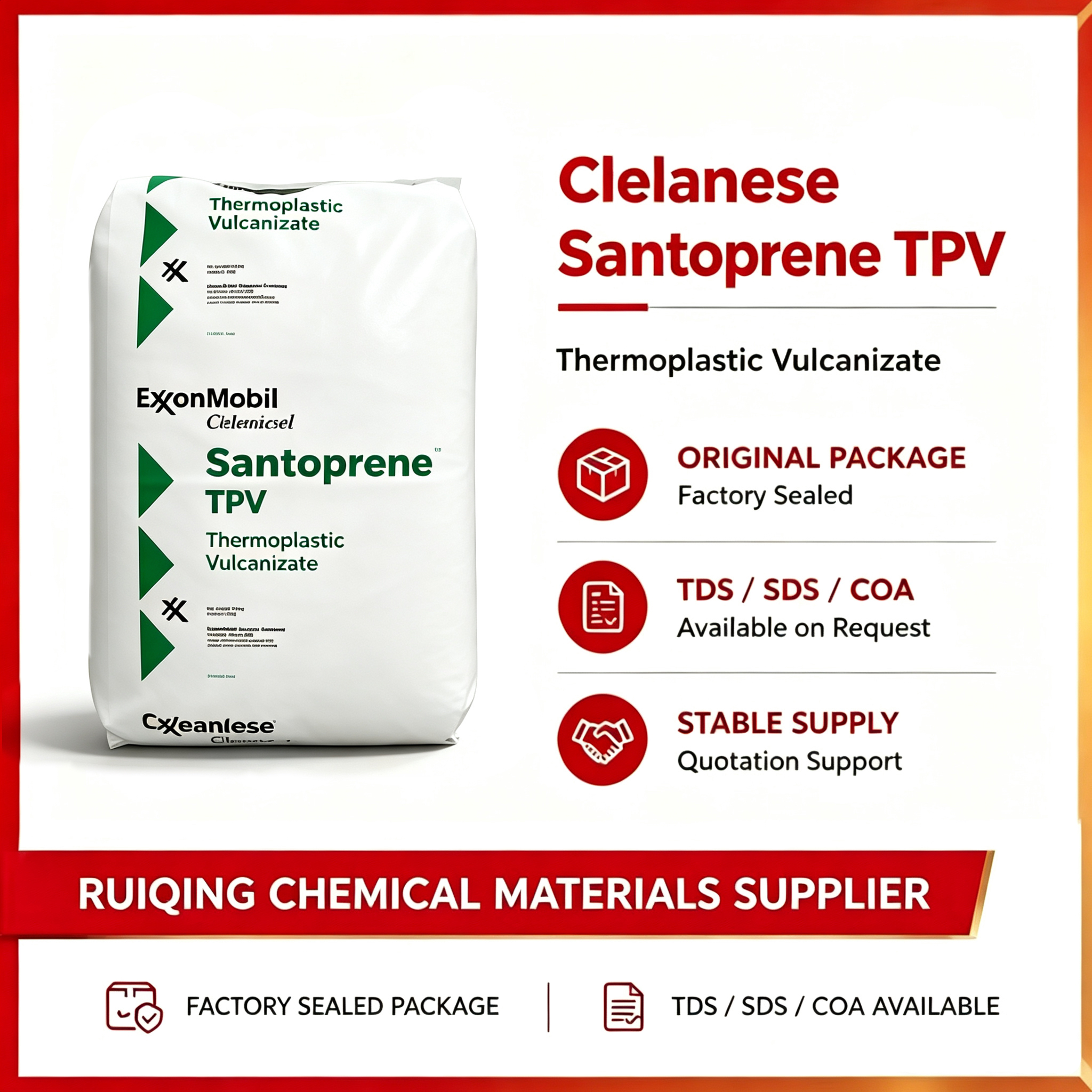
Santoprene 121-60E400 is a black, UV-resistant, high-resilience thermoplastic vulcanizate (TPV) from Celanese developed for demanding sealing applications, especially automotive static, semi-dynamic and dynamic weatherseals.
Celanese positions this grade as a high-resilience TPV designed to deliver enhanced elastic recovery and lower compression set than conventional TPV solutions. The company specifically promotes Santoprene 121-60E400 as an option for applications where EPDM rubber has traditionally been used because of demanding sealing requirements.
Its principal technical advantage is the combination of high resilience, low compression set and strong force retention.
Current grade data lists a Shore A hardness of approximately 64, placing the material in a medium-soft elastomer range suitable for weatherseal lips, glass-run channel sections, door seals, trunk seals and similar components that must repeatedly deform and then recover.
Current Celanese material data lists approximately 437% elongation at break, 6.4 MPa tensile stress at break and 2.4 MPa tensile stress at 100% elongation.
Compression-set performance is especially important for this grade. Current values are approximately:
- 20.5% at 70°C for 24 h
- 22.5% at 100°C for 24 h
- 30.3% at 125°C for 70 h
These values help explain why the material is positioned as a high-resilience sealing grade rather than as a standard extrusion TPV.
Celanese has also published comparative testing showing a step-change improvement in elastic recovery versus selected conventional Santoprene weatherseal grades. In one published comparison, Santoprene 121-60E400 showed lower compression set and improved force retention under demanding compression conditions.
The grade is designed for thin-wall and complex profile extrusion. Celanese specifically states that it can produce sections with excellent definition down to approximately 0.33 mm radius, while helping maximize extrusion run length with reduced material build-up on screen packs and narrow die sections.
This makes Santoprene 121-60E400 particularly relevant to automotive weatherseals, where profile geometry can include thin lips, narrow channels, coextruded sections and tight radii.
The material also provides excellent flex-fatigue resistance, excellent ozone resistance, improved UV resistance, good chemical resistance, conventional thermoplastic processing and manufacturing-stream recyclability.
Celanese’s current weatherseal system page positions Santoprene 121-60E400 as part of an integrated solution for replacing traditional EPDM in selected semi-dynamic and dynamic sealing applications. The company highlights potential advantages including weight reduction, easier processing, long-term sealing performance, aesthetics and recyclability.
For more TPV products, visit our TPV Thermoplastic Vulcanizates Product Category →.
For Celanese’s current weatherseal positioning, see the Official Celanese Santoprene TPV Weatherseal Solutions →.
Key Features of Santoprene 121-60E400
| Feature | Engineering Benefit |
|---|---|
| High Resilience | Supports repeated deformation with strong elastic recovery |
| Very Low Compression Set | Helps maintain sealing force over long service periods |
| Shore A 64 | Balanced softness and support for automotive sealing profiles |
| 437% Elongation | High flexibility for thin lips and complex profile geometries |
| 6.4 MPa Stress at Break | Useful tensile strength for a soft weatherseal TPV |
| Excellent Flex-Fatigue Resistance | Suitable for dynamic and semi-dynamic sealing movement |
| Excellent Ozone Resistance | Supports outdoor and automotive weather exposure |
| Improved UV Resistance | Designed for long-term exterior exposure |
| Thin-Wall Extrusion | Supports fine-profile sections and tight radii |
| Low Die Build-Up | Helps extend extrusion run length |
| Thermoplastic Processing | Avoids conventional thermoset vulcanization during part manufacture |
| Manufacturing-Stream Recyclability | Controlled scrap can be reprocessed where specification permits |
| Automotive Weatherseal Focus | Designed for static, semi-dynamic and dynamic sealing systems |
The strongest reason to select Santoprene 121-60E400 is its high elastic recovery combined with a low compression set profile.
Typical Applications for Santoprene 121-60E400
The main application area for Santoprene 121-60E400 is automotive weathersealing.
| Application Area | Typical Use |
|---|---|
| Glass Run Channels | Semi-dynamic and dynamic window sealing sections |
| Door Weatherseals | Primary and secondary vehicle door seals |
| Beltline Seals | Flexible sealing profiles around movable glass |
| Trunk / Liftgate Seals | Long-term compressed sealing sections |
| Static Weatherseals | Body sealing components requiring elastic recovery |
| Semi-Dynamic Seals | Profiles subjected to repeated compression and movement |
| Dynamic Seals | Sealing components interacting with moving glass or closures |
| Complex Extruded Profiles | Thin-wall profiles and narrow geometry |
| Coextruded Automotive Profiles | Soft sealing section combined with other compatible materials |
| Outdoor Sealing Systems | UV- and ozone-exposed elastomeric profiles |
Typical Properties of Santoprene 121-60E400
Physical Properties
| Property | Typical Value | Test Method |
|---|---|---|
| Density | 980 kg/m³ / 0.980 g/cm³ | ISO 1183 |
| Shore A Hardness, 15 s | 64 | ISO 48-4 / ISO 868 |
| Resin Identification | TPV | ISO 1043 |
| Part Marking Code | >TPV< | ISO 11469 |
| Color | Black | Manufacturer information |
| Product Form | Pellets | Manufacturer information |
Mechanical Properties
| Property | Typical Value | Test Method |
|---|---|---|
| Tensile Stress at 100% Elongation, Perpendicular | 2.4 MPa | ISO 37 |
| Tensile Stress at Break, Perpendicular | 6.4 MPa | ISO 527-1/-2 or ISO 37 |
| Elongation at Break, Perpendicular | 437% | ISO 527-1/-2 or ISO 37 |
| Shore A Hardness | 64 | ISO 48-4 / ISO 868 |
Compression Set
| Property | Typical Value | Test Method |
|---|---|---|
| Compression Set, 70°C / 24 h | 20.5% | ISO 815 |
| Compression Set, 100°C / 24 h | 22.5% | ISO 815 |
| Compression Set, 125°C / 70 h | 30.3% | ISO 815 |
These values are central to the material’s high-resilience positioning. Lower compression set generally means improved ability to recover after prolonged compression, which is important in weatherseals because the sealing lip must continue exerting force against the mating surface.
High-Resilience Weatherseal Performance
Celanese developed Santoprene 121-60E400 specifically to address performance gaps that historically limited TPV use in more demanding semi-dynamic and dynamic weatherseals.
The company highlights enhanced resilience, improved elastic recovery, lower compression set, better force retention, long-term sealing performance, good Class A surface potential, weight reduction versus traditional EPDM systems, easier thermoplastic processing, improved UV resistance and recyclability advantages.
In Celanese comparative testing, Santoprene 121-60E400 showed a substantial improvement in compression-set performance versus Santoprene 121-58W175 under demanding conditions.
Celanese also reports improved force retention in stress-relaxation testing. Under the company’s published ISO 3384A conditions at 70°C and 35% compression, the high-resilience grade maintained higher force retention than the conventional comparison material.
For weatherseal designers, maintaining sealing force helps manage wind noise, water ingress, dust ingress, glass stability, door-closing feel and long-term sealing performance.
Why Choose Santoprene 121-60E400?
The main reason to choose Santoprene 121-60E400 is that it is not simply another 60–65 Shore A TPV. It is a high-resilience sealing grade specifically developed for demanding weatherseal systems.
A standard TPV may provide adequate hardness and elongation but still lose force too quickly under long-term compression. Santoprene 121-60E400 addresses this through improved elastic recovery and lower compression set.
The Shore A 64 hardness offers a useful compromise between softness and profile stability. At the same time, 437% elongation gives designers enough flexibility for thin sealing lips and dynamic contact geometries.
Excellent flex-fatigue resistance is important for glass run channels and movable sealing interfaces. Improved UV and ozone resistance support long-term exterior automotive service.
Another major advantage is profile-extrusion capability. Celanese specifically designed the grade for thin-wall and complex-profile extrusion, including tight radii and narrow flow passages where conventional elastomers may be more difficult to process consistently.
The ability to run on thermoplastic extrusion equipment can also reduce processing complexity compared with traditional EPDM extrusion and curing systems.
For customers evaluating EPDM replacement, semi-dynamic weatherseals, dynamic weatherseals or glass-run channels, Santoprene 121-60E400 is one of Celanese’s most specialized TPV grades.
Processing Guidelines for Santoprene 121-60E400
Santoprene 121-60E400 is primarily optimized for extrusion, but current Celanese data also lists injection-molding guidance.
Injection Molding
| Processing Parameter | Celanese Guidance |
|---|---|
| Drying | Recommended |
| Drying Temperature | 80°C |
| Drying Time | ≥3 h in a dehumidified dryer |
| Processing Moisture Content | ≤0.08% |
| Optimum Melt Temperature | 200°C |
| Minimum Melt Temperature | 185°C |
| Maximum Melt Temperature | 220°C |
| Optimum Mold Temperature | 30°C |
| Minimum Mold Temperature | 10°C |
| Maximum Mold Temperature | 50°C |
Extrusion
| Processing Parameter | Celanese Guidance |
|---|---|
| Drying Temperature | 82°C |
| Drying Time | 3 h in a dehumidified dryer |
| Melt Temperature Range | 177–204°C |
For profile extrusion, actual zone temperatures, screw design, melt pressure and die temperature should be optimized around profile wall thickness, die land length, extrusion rate, surface appearance, dimensional stability, draw-down, cooling method and coextrusion configuration.
Thin-Wall & Complex Profile Extrusion
Celanese specifically designed Santoprene 121-60E400 for thin-wall and complex profiles. The manufacturer states that the grade can produce profile features with definition down to approximately 0.33 mm radius.
It is also designed to maximize run length with limited material accumulation on screen packs, narrow die sections and complex flow channels.
Shear-Dependent Flow
Santoprene TPV is shear dependent. As shear rate increases, apparent melt viscosity decreases. Therefore, extrusion and injection performance are affected strongly by screw speed, die geometry, gate size, injection speed, back pressure and melt pressure.
Santoprene 121-60E400 vs. Santoprene 121-58W175
| Feature | Santoprene 121-60E400 | Santoprene 121-58W175 |
|---|---|---|
| Material Family | TPV | TPV |
| Primary Positioning | High-resilience weatherseal TPV | Weatherseal / extrusion TPV |
| Shore A Hardness | 64 | Similar medium-soft range |
| Compression Set | Very low / improved | Higher in Celanese comparison |
| Elastic Recovery | High | Conventional |
| Force Retention | Improved | Lower in Celanese comparative testing |
| UV Resistance | Improved | Weatherseal-focused |
| Thin-Wall Extrusion | Yes | Yes |
| Dynamic Weatherseal Target | Strong focus | More conventional weatherseal positioning |
Celanese’s own published comparison shows Santoprene 121-60E400 as the step-out material for improved compression set and elastic recovery.
Related Products
Santoprene 121-58W175 – Weatherseal-oriented TPV for extrusion applications.
Santoprene 121-50E500 – Black specialty extrusion TPV tailored for robotic extrusion applications.
Santoprene 101-80 ECO-R – Recycled-content Santoprene TPV used by Celanese in sustainable automotive weatherseal system solutions.
View More TPV Thermoplastic Vulcanizates →
Technical Documents for Santoprene 121-60E400
| Document Type | Description |
|---|---|
| TDS | Current Celanese physical, mechanical and processing data |
| SDS | Safety Data Sheet |
| High-Resilience Weatherseal Brochure | Celanese performance comparison and weatherseal positioning |
| Santoprene Product Finder | Current portfolio comparison |
| Processing Guide | Injection and extrusion processing guidance |
| COA | Batch-specific quality information where available |
Need technical documents for Santoprene 121-60E400?
📧 Email: ruiqingchem@gmail.com
📝 Online form: Contact Us →
Please state Santoprene 121-60E400 and the required document type when submitting your inquiry.
FAQ About Santoprene 121-60E400
Q1: What is Santoprene 121-60E400?
Santoprene 121-60E400 is a black, high-resilience TPV from Celanese designed for thin-wall and complex profile extrusion, especially demanding automotive weatherseal applications.
Q2: What is the hardness of Santoprene 121-60E400?
The current Shore A hardness is approximately 64.
Q3: What is the elongation at break?
Current Celanese grade data lists approximately 437% elongation at break.
Q4: What is the tensile stress at break?
The current value is approximately 6.4 MPa.
Q5: What is the compression set?
Current values are approximately 20.5% at 70°C / 24 h, 22.5% at 100°C / 24 h, and 30.3% at 125°C / 70 h.
Q6: What is the main advantage of Santoprene 121-60E400?
Its main advantage is high resilience and elastic recovery with very low compression set, which helps maintain sealing force in demanding weatherseal systems.
Q7: Can Santoprene 121-60E400 replace EPDM?
Celanese specifically positions the grade as a TPV solution capable of replacing traditional EPDM in selected semi-dynamic and dynamic automotive weatherseal systems. Final validation depends on the seal design and OEM requirements.
Q8: Is Santoprene 121-60E400 UV resistant?
Yes. Celanese specifically states that the grade is designed for improved UV resistance and also provides excellent ozone resistance.
Q9: What extrusion temperature is recommended?
Current Celanese data lists an extrusion melt-temperature range of approximately 177–204°C.
Q10: What applications are best suited to Santoprene 121-60E400?
Key applications include glass run channels, automotive door weatherseals, semi-dynamic seals, dynamic seals, static seals and other thin-wall complex sealing profiles.
Request Santoprene 121-60E400 Price & Technical Support
For pricing, availability, technical documents or application support for Santoprene 121-60E400, please provide:
- Required quantity
- Destination country or port
- Automotive weatherseal application
- Static, semi-dynamic or dynamic seal
- Glass run channel or door-seal design
- Profile dimensions
- Minimum wall thickness
- Required Shore hardness
- Compression-set requirement
- Force-retention requirement
- UV / ozone exposure
- Continuous and peak operating temperature
- Extrusion or coextrusion process
- OEM specification requirement
- TDS, SDS or COA requirement
- Sample requirement, if applicable
📧 Email: ruiqingchem@gmail.com
📝 Send Inquiry →