描述
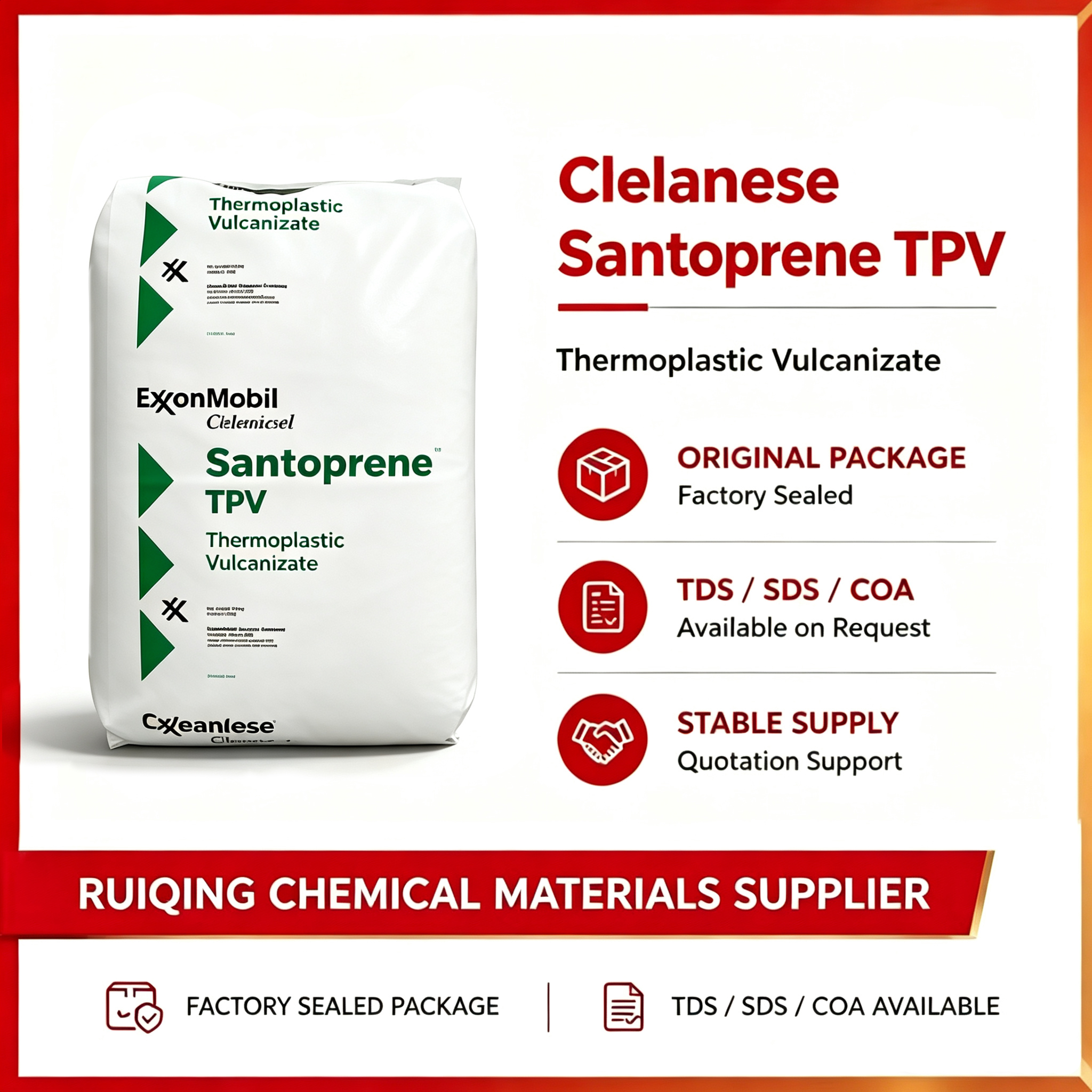
Santoprene 121-55W241 is a soft, black, UV-resistant thermoplastic vulcanizate (TPV) from Celanese developed for demanding injection-molded sealing applications, with a particularly strong position in automotive glass encapsulation.
Celanese describes the material as a polyolefin-based TPV that combines good physical properties with chemical resistance. It is also shear dependent, meaning its apparent melt viscosity decreases as shear increases during processing.
The current Celanese TPV Product Finder identifies Santoprene 121-55W241 as a black Shore A 59 grade with improved flow for easier processability and specifically notes that it is used in glass encapsulation.
The Celanese Materials Database adds several important grade-specific benefits. The material is recommended for applications requiring superior part surface appearance and is designed to be injected at lower molding temperatures or lower injection pressures.
These characteristics are especially valuable in glass-encapsulation molding, where the process must fill long, narrow or visually critical sealing geometries around automotive glass while maintaining a clean surface and controlled pressure on the glass or insert.
The grade has a Shore A hardness of approximately 59, placing it in the medium-soft elastomer range. Current grade-level data lists approximately 480% elongation at break, 4.8 MPa stress at break and 2.0 MPa stress at 100% elongation.
Low-temperature flexibility is another notable property. The Celanese Materials Database lists a brittleness temperature of approximately -63°C, which is relevant to automotive exterior applications exposed to winter conditions.
The material density is approximately 0.920 g/cm³. Santoprene 121-55W241 is also UV resistant, supporting exterior automotive glazing and sealing systems.
The material is polyolefin based and Celanese states that it is recyclable within the manufacturing stream.
For more TPV grades, visit our TPV Thermoplastic Vulcanizates Product Category →.
For Celanese’s official grade selection information, see the Official Santoprene & Geolast TPV Product Finder →.
Key Features of Santoprene 121-55W241
| Feature | Engineering Benefit |
|---|---|
| Shore A 59 | Soft sealing behavior with useful geometric support |
| Glass Encapsulation Grade | Specifically positioned by Celanese for automotive glass encapsulation |
| Improved Flow | Easier filling of complex or difficult injection-molded geometries |
| Superior Part Surface Appearance | Useful for visible automotive glazing and sealing components |
| Lower Molding Temperature Capability | Can help reduce thermal load during molding |
| Lower Injection Pressure Capability | Useful for insert molding and glass encapsulation processes |
| UV Resistance | Supports exterior automotive and outdoor applications |
| 480% Elongation at Break | High flexibility for sealing and encapsulation geometries |
| -63°C Brittleness Temperature | Strong low-temperature flexibility |
| Good Chemical Resistance | Useful for automotive and industrial sealing environments |
| Shear-Dependent Flow | Melt flow improves as shear rate increases |
| Manufacturing-Stream Recyclability | Allows controlled recycling of suitable production scrap |
The defining advantages of Santoprene 121-55W241 are its improved flow, glass-encapsulation positioning and superior molded surface appearance.
Typical Applications for Santoprene 121-55W241
Santoprene 121-55W241 is particularly suited to molded sealing systems where surface quality, flow and UV resistance are important.
| Application Area | Typical Use |
|---|---|
| Automotive Glass Encapsulation | Molded TPV around fixed glass, windows and glazing edges |
| Automotive Weather Seals | Exterior seals requiring UV and low-temperature performance |
| Exterior Trim Sealing | Flexible sealing around visible exterior components |
| Window Perimeter Seals | Soft molded edge protection and sealing |
| Insert-Molded Seals | TPV molded around glass or compatible inserts |
| Complex Injection-Molded Gaskets | Difficult-to-fill soft elastomeric components |
| Outdoor Sealing Components | UV-exposed flexible seals |
| Visible Molded TPV Parts | Components where surface appearance is important |
Typical Properties of Santoprene 121-55W241
Physical Properties
| Property | Typical Value | Test Method |
|---|---|---|
| Density | 920 kg/m³ / 0.920 g/cm³ | ISO 1183 |
| Specific Gravity | 0.918 | ASTM D792 |
| Shore A Hardness, 15 s | 59 | ISO 48-4 / ISO 868 |
| Color | Black | Manufacturer information |
| UV Resistance | Yes | Manufacturer description |
| Material Family | TPV / TPE | Manufacturer classification |
Mechanical Properties
| Property | Typical Value | Test Method |
|---|---|---|
| Stress at 100% Elongation | 2.0 MPa | ISO 527-1/-2 or ISO 37 |
| Stress at Break | 4.8 MPa | ISO 527-1/-2 or ISO 37 |
| Elongation at Break | 480% | ISO 527-1/-2 or ISO 37 |
| Shore A Hardness | 59 | ISO 48-4 / ISO 868 |
The high elongation of Santoprene 121-55W241 allows the material to accommodate substantial deformation around glazing edges and sealing interfaces.
Compression Set
| Property | Typical Value | Test Method |
|---|---|---|
| Compression Set, 23°C / 70 h | 29% | ISO 815 |
| Compression Set, 125°C / 70 h | 56% | ISO 815 |
The current Celanese Product Finder leaves the standardized 70°C / 22 h compression-set column blank for this grade, so that value should not be inferred from another Santoprene grade.
Low-Temperature Performance
| Property | Typical Value | Test Method |
|---|---|---|
| Brittleness Temperature | -63°C | ASTM D746 |
| Low-Temperature Brittleness | -63°C | ISO 812 |
Why Choose Santoprene 121-55W241?
The main reason to choose Santoprene 121-55W241 is not simply its Shore A 59 hardness. Its value comes from the processing and appearance characteristics designed around demanding molded sealing applications.
Automotive glass encapsulation can be challenging because the TPV must flow around a large glass perimeter, fill narrow sections and reproduce a clean surface while avoiding unnecessary molding pressure.
Celanese specifically positions Santoprene 121-55W241 for these difficult injection-molding conditions.
The grade’s improved flow supports easier filling, while its ability to be injected at lower molding temperatures or lower injection pressures provides additional process flexibility.
Its recommendation for superior part surface appearance is also important because many glass-encapsulation components are visible on the finished vehicle.
The material’s UV resistance supports exterior use, while the -63°C brittleness temperature provides strong cold-weather flexibility.
A Shore A hardness of 59 gives the material enough softness to behave as a functional seal without becoming excessively soft during handling or assembly.
The 480% elongation at break helps accommodate movement between glass, body structures and surrounding components.
For automotive suppliers, these characteristics make Santoprene 121-55W241 a more targeted choice than a generic 55–60A TPV when the application involves glass encapsulation, visible sealing surfaces or difficult injection filling.
Processing Guidelines for Santoprene 121-55W241
Celanese identifies Santoprene 121-55W241 primarily as an injection-molding grade.
Published Processing Guidance
| Processing Parameter | Celanese Guidance |
|---|---|
| Drying Temperature | 80°C |
| Drying Time | 3 hours |
| Dryer Type | Desiccant / dehumidified dryer recommended |
| General TPV Processing Window | 175–230°C |
| Flow Behavior | Shear dependent |
| Equipment | Conventional thermoplastic injection-molding equipment |
Celanese recommends desiccant drying for approximately 3 hours at 80°C.
The manufacturer also states that Santoprene TPV has a broad processing temperature window of approximately 175–230°C.
Because Santoprene 121-55W241 is designed for lower molding temperatures or lower injection pressures, processors should optimize the process around the actual part rather than automatically using the highest temperature or pressure available.
Shear-Dependent Flow Behavior
Santoprene TPV exhibits shear-thinning behavior. As shear rate increases, apparent melt viscosity decreases.
This means:
- Apparent viscosity falls as shear increases
- Flow through gates and narrow sections improves
- Complex cavities may fill more easily
- Higher injection speed can sometimes improve filling more effectively than simply raising melt temperature
Injection-Molding Optimization
When developing a process for Santoprene 121-55W241, evaluate melt temperature, mold temperature, injection speed, injection pressure, gate size and location, venting, holding pressure, cooling time, insert temperature, surface replication, weld-line appearance, flash control and demolding behavior.
Material Compatibility
Celanese states that Santoprene TPV is incompatible with acetal (POM) and PVC.
Injection-molding equipment should therefore be thoroughly purged when switching from POM or PVC to Santoprene 121-55W241.
Santoprene 121-55W241 vs. Santoprene 121-50M100
| Feature | Santoprene 121-55W241 | Santoprene 121-50M100 |
|---|---|---|
| Material Family | TPV | TPV |
| Color | Black | Black |
| Shore A Hardness | 59 | 56 |
| Elongation at Break | 480% | 465% |
| Stress at Break | 4.8 MPa | 4.4 MPa |
| Stress @ 100% Elongation | 2.0 MPa | 1.8 MPa |
| Main Processing Positioning | Improved flow; glass encapsulation | Improved flow for easier processability |
| Surface Appearance Positioning | Superior part surface appearance | General improved-flow positioning |
| Lower Pressure / Temperature Injection | Specifically highlighted | Not the defining published feature |
| Main Selection Reason | Glass encapsulation and visible sealing surfaces | General high-flow injection molding |
Both grades belong to Celanese’s improved-flow black Santoprene TPV portfolio.
Choose Santoprene 121-55W241 when the application is specifically focused on glass encapsulation, exterior sealing or superior molded appearance.
Related Products
Santoprene 121-50M100 – Black improved-flow TPV for easier injection molding.
Santoprene 121-62M100 – Black improved-flow TPV with approximately Shore A 67 hardness.
Santoprene 121-58W175 – Black UV-stabilized TPV tuned for profile extrusion performance.
View More TPV Thermoplastic Vulcanizates →
Technical Documents for Santoprene 121-55W241
| Document Type | Description |
|---|---|
| TDS | Grade-specific physical, mechanical and processing information |
| SDS | Safety Data Sheet |
| Product Finder | Celanese TPV grade selection and comparison |
| Automotive Grade Slate | Application positioning for automotive glazing and sealing |
| OEM Specification Information | Current Celanese Materials Database lists Hyundai MS220-05 Type J |
| COA | Batch-specific quality information where available |
Need technical documents for Santoprene 121-55W241?
📧 Email: ruiqingchem@gmail.com
📝 Online form: Contact Us →
FAQ About Santoprene 121-55W241
Q1: What is Santoprene 121-55W241?
Santoprene 121-55W241 is a soft black UV-resistant TPV from Celanese designed for difficult injection-molding applications, especially automotive glass encapsulation and sealing.
Q2: What is the hardness of Santoprene 121-55W241?
The current Celanese value is approximately Shore A 59.
Q3: Is Santoprene 121-55W241 used for glass encapsulation?
Yes. Celanese specifically identifies glass encapsulation as a key application for this grade.
Q4: What is the elongation at break?
Current grade data lists approximately 480% elongation at break.
Q5: What is the tensile stress at break?
The current value is approximately 4.8 MPa.
Q6: Why is Santoprene 121-55W241 suitable for difficult injection molding?
Celanese states that the grade offers improved flow, can be injected at lower molding temperatures or lower injection pressures, and is recommended where superior part surface appearance is required.
Q7: Is Santoprene 121-55W241 UV resistant?
Yes. The Celanese Materials Database describes the grade as a UV-resistant black TPV.
Q8: What is its low-temperature performance?
The current brittleness temperature is approximately -63°C.
Q9: What processing temperature is recommended?
Celanese gives a broad Santoprene TPV processing window of approximately 175–230°C and recommends drying for around 3 hours at 80°C.
Q10: What is the difference between Santoprene 121-55W241 and 121-50M100?
Both are black improved-flow TPV grades. Santoprene 121-55W241 is specifically positioned for glass encapsulation, superior surface appearance and lower-temperature or lower-pressure injection molding, while 121-50M100 is positioned more generally for improved flow and easier processability.
Request Santoprene 121-55W241 Price & Technical Support
For pricing, availability, technical documents or application support for Santoprene 121-55W241, please provide:
- Required quantity
- Destination country or port
- Automotive glass encapsulation, seal or other application
- Required Shore hardness
- Glass or insert material
- Part dimensions and flow length
- Surface appearance requirement
- UV / outdoor exposure requirement
- Minimum service temperature
- Injection-molding equipment
- Mold design and gate type
- Maximum injection-pressure requirement
- TDS, SDS or OEM specification documents required
- Sample requirement, if applicable
📧 Email: ruiqingchem@gmail.com
📝 Send Inquiry →