描述
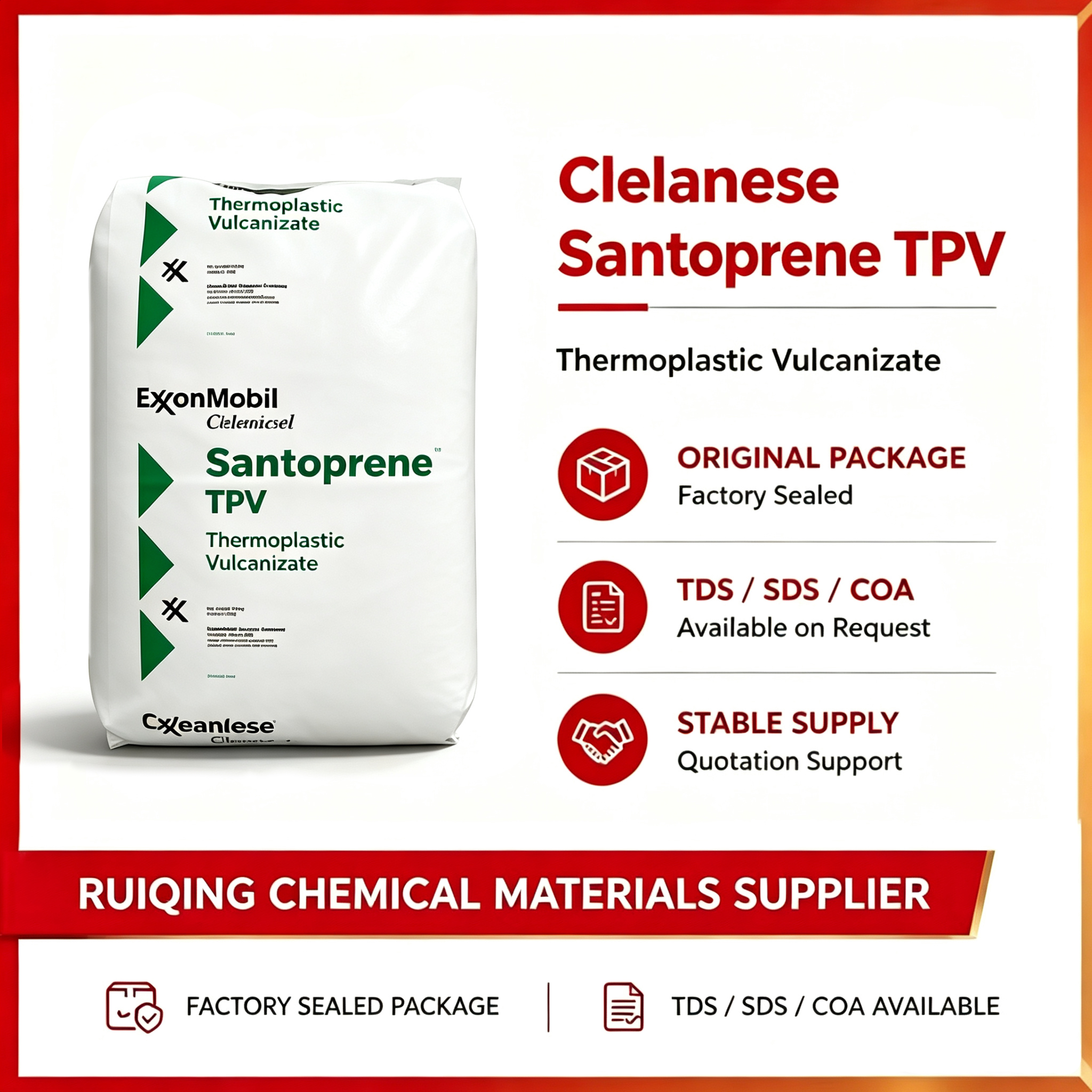
Santoprene 121-50M100 is a soft, black, UV-resistant thermoplastic vulcanizate (TPV) from Celanese developed for difficult injection molding applications that benefit from improved flow, fast filling and good molded-part surface appearance.
The grade belongs to the Santoprene 121 UV-black family. Celanese positions Santoprene 121-50M100 as an improved-flow TPV for easier processability, rather than as a standard general-purpose grade selected only by hardness.
Its key processing advantage is the ability to fill demanding mold geometries more easily. Celanese specifically states that the grade is designed for fast, easy injection molding, especially for complex part geometries.
This makes Santoprene 121-50M100 useful where a conventional TPV may require excessive injection pressure, higher melt temperature or larger gates to fill thin sections, long flow paths or complicated sealing geometries.
The grade is also recommended for applications requiring improved part surface appearance.
That feature is important for visible automotive and industrial components, glass-encapsulation details, molded seals and parts where surface quality is part of the final product requirement.
Celanese further notes that Santoprene 121-50M100 is designed to be injected at lower molding temperatures or lower injection pressures. This gives processors additional flexibility when working with complex molds, pressure-sensitive inserts or large molded elastomeric sections.
The current Shore A hardness is approximately 56, placing the material in the soft TPV range.
Current grade data lists approximately 465% elongation at break, 4.39 MPa tensile stress at break, 1.8 MPa tensile stress at 100% elongation and approximately 15 kN/m tear strength.
These values give Santoprene 121-50M100 the flexibility required for sealing applications while retaining enough strength for molded elastomeric parts.
Low-temperature flexibility is another important characteristic. Current Celanese data lists a brittleness temperature of approximately -60°C, supporting use in automotive and outdoor environments where very low temperatures may occur.
The grade is also UV resistant, making it more appropriate than a non-UV-stabilized black TPV where parts may experience sunlight or long-term environmental exposure.
Santoprene 121-50M100 is polyolefin based and shear dependent. As shear rate increases, its apparent melt viscosity decreases, helping the material fill narrow gates and complex mold cavities under high-shear injection conditions.
The material is UL recognized under current Celanese references QMFZ2.E80017 and QMFZ8.E80017.
Current flame data lists HB at 1.1 mm under UL 94.
Celanese also lists several automotive OEM specification references for this grade, including General Motors GMW15812 Type 4M, Mercedes-Benz DBL 5562, MAN M3236 A5, Hyundai MS220-05 Type K, Volkswagen TL 526 22 MD03 and VW50123, together with additional Stellantis, Renault and Li Auto references.
This makes Santoprene 121-50M100 particularly relevant to automotive Tier 1 suppliers requiring a soft, UV-stabilized, improved-flow TPV with an established OEM history.
For more TPV materials, visit our TPV Thermoplastic Vulcanizates Product Category →.
For the current Celanese grade portfolio, see the Official Celanese Santoprene & Geolast TPV Product Finder →.
Key Features of Santoprene 121-50M100
| Feature | Engineering Benefit |
|---|---|
| Improved Flow | Easier filling of complex injection-molded geometries |
| Shore A 56 | Soft elastomeric response for seals and flexible molded components |
| UV Resistance | Supports outdoor and automotive exterior applications |
| Fast Injection Molding | Designed for high-productivity molding cycles |
| Lower Injection Pressure Capability | Helps reduce pressure demand in difficult molds |
| Lower Molding Temperature Capability | Provides additional processing flexibility |
| Improved Surface Appearance | Suitable for visible molded parts and premium surface requirements |
| 465% Elongation at Break | High flexibility for seals and deformable parts |
| -60°C Brittleness Temperature | Supports low-temperature service |
| 15 kN/m Tear Strength | Useful resistance to edge damage and tearing |
| UL Recognized | Current Celanese documentation references E80017 |
| Automotive OEM References | Supported by multiple vehicle-manufacturer specifications |
| Manufacturing-Stream Recyclability | Controlled process scrap can be recycled within the manufacturing stream |
The main reason to choose Santoprene 121-50M100 is not simply its softness. Its defining feature is improved flow for easier injection molding.
Typical Applications for Santoprene 121-50M100
Santoprene 121-50M100 is particularly suited to injection-molded sealing and automotive components with complex geometry.
| Application Area | Typical Use |
|---|---|
| Automotive Seals | Soft molded sealing parts requiring UV stability |
| Glass Encapsulation Components | Injection-molded TPV around glass or trim systems |
| Complex Molded Gaskets | Thin or intricate elastomeric sealing geometries |
| Corner Molding | Molded transitions and complex sealing junctions |
| Weather-Sealing Components | UV-resistant black flexible components |
| Plugs & Grommets | Soft molded protection and sealing parts |
| Automotive Exterior Parts | Flexible black parts requiring weather resistance |
| Industrial Seals | Complex injection-molded gaskets and flexible interfaces |
| Visible Molded Components | Parts where improved surface appearance is important |
| Low-Pressure Injection Applications | Parts where reduced molding pressure is beneficial |
For a simple extrusion profile without demanding injection-flow requirements, another 121-series extrusion-focused grade may be more appropriate. The strongest fit for Santoprene 121-50M100 is complex injection molding.
Typical Properties of Santoprene 121-50M100
Physical Properties
| Property | Typical Value | Test Method |
|---|---|---|
| Density | 915 kg/m³ / 0.915 g/cm³ | ISO 1183 |
| Shore A Hardness, 15 s | 56 | ISO 48-4 / ISO 868 |
| Color | Black | Manufacturer information |
| Product Form | Pellets / Granules | Manufacturer information |
| UV Stabilization | Yes | Manufacturer positioning |
| Resin Identification | TPV | ISO 1043 |
The relatively low density of approximately 0.915 g/cm³ can help reduce part weight compared with denser elastomer systems.
Mechanical Properties
| Property | Typical Value | Test Method |
|---|---|---|
| Tensile Stress at 100% Elongation | 1.8 MPa | ISO 527-1/-2 or ISO 37 |
| Tensile Stress at Break | 4.39 MPa | ISO 527-1/-2 or ISO 37 |
| Elongation at Break | 465% | ISO 527-1/-2 or ISO 37 |
| Shear Modulus | 2.99 MPa | ISO 6721 |
| Tear Strength, Die C | 15 kN/m | ISO 34-1 |
| Brittleness Temperature | -60°C | ASTM D746 |
| Low-Temperature Brittleness | -60°C | ISO 812 |
| Compression Set, 70°C / 24 h | 31% | ISO 815 |
| Compression Set, 125°C / 70 h | 42% | ISO 815 |
The combination of Shore A 56 hardness and 465% elongation confirms that Santoprene 121-50M100 is a soft, highly deformable TPV suited to sealing and flexible molded parts.
Flammability Properties
| Property | Typical Value | Test Method |
|---|---|---|
| Flame Rating | HB | UL 94 |
| Thickness Tested | 1.1 mm | UL 94 |
| UL Recognition | Yes | UL 94 |
| UL File | QMFZ2.E80017 / QMFZ8.E80017 | UL |
The grade is not positioned as a flame-retardant TPV. Where a V-0 or similar flame rating is required, a dedicated flame-retardant Santoprene grade should be evaluated.
Automotive OEM References for Santoprene 121-50M100
Current Celanese Materials Database information lists the following OEM specification references:
| OEM | Specification / Reference |
|---|---|
| General Motors | GMW15812, Type 4M |
| Stellantis / Chrysler | MS-AR-100 AMV |
| Stellantis / FCA Group | 55248/02 EMP-50 |
| Li Auto | Q/LiA5310057 2021 (V2) |
| Mercedes-Benz Group | DBL 5562 |
| Renault | FRM 18-27-082 |
| MAN | M3236 A5 |
| Hyundai | MS220-05, Type K |
| Volkswagen Group | TL 526 22 MD03 |
| Volkswagen Group | VW50123 |
These references support the use of Santoprene 121-50M100 in qualified automotive components, subject to the specific part-level approval requirements of each customer.
Why Choose Santoprene 121-50M100?
The main advantage of Santoprene 121-50M100 is its high-flow injection-molding behavior.
Complex TPV parts can be difficult to fill because elastomeric melts may have relatively high apparent viscosity at low shear.
Long flow paths, thin sections, complex ribs and multiple sealing features can increase injection pressure and create incomplete filling or inconsistent surface appearance.
Santoprene 121-50M100 is specifically designed to address this challenge.
Its shear-dependent behavior allows apparent viscosity to decrease as shear increases, helping the melt move through gates and narrow sections.
Celanese also specifically positions the grade for fast injection molding, making it attractive for high-volume production.
The ability to mold at lower injection pressures can reduce stress on the machine, mold and inserted components.
The ability to use lower molding temperatures can also be useful where thermal exposure of inserts, adjacent materials or tooling is a concern.
Surface appearance is another important advantage. Celanese explicitly recommends the grade where improved molded-part appearance is required.
At Shore A 56, the material remains soft enough for seals and weather-resistant flexible components.
The -60°C brittleness temperature adds strong cold-weather performance, while UV stabilization supports exterior applications.
The grade also has a broad OEM specification history, which is valuable for automotive suppliers seeking an established TPV material rather than an unqualified generic compound.
For customers looking for a soft black UV-resistant TPV optimized for complex injection molding, Santoprene 121-50M100 is one of the most targeted grades in the Celanese 121 family.
Processing Guidelines for Santoprene 121-50M100
Santoprene 121-50M100 is designed primarily for injection molding and multi-injection molding.
Current Celanese Processing Guidance
| Processing Parameter | Published Guidance |
|---|---|
| Drying Temperature | 82°C |
| Drying Time | 3 hours in a dehumidified dryer |
| Maximum Processing Moisture | 0.08% |
| Maximum Regrind Level | 20% |
| Optimum Melt Temperature | 215°C |
| Mold Temperature Range | 10–52°C |
| Back Pressure | 0.345–0.689 MPa |
| Injection Speed | Fast |
| Vent Depth | 25 µm |
| General Santoprene TPV Processing Window | 175–230°C |
Celanese recommends desiccant drying for approximately 3 hours at 80–82°C.
The broader Santoprene TPV processing window is approximately 175–230°C.
Historical grade-specific guidance for Santoprene 121-50M100 also gives a melt-processing range of approximately 204–221°C, with barrel references around 182°C rear, 188°C middle, 193°C front and 199°C nozzle.
These historical values can be useful as starting points, but the current grade data and actual molding trial should take priority.
Injection-Molding Strategy
Because Santoprene 121-50M100 is designed for improved flow, processors should generally optimize:
- Fast injection speed
- Gate size and gate location
- Melt temperature
- Back pressure
- Mold temperature
- Screw speed
- Venting
- Holding pressure
- Cooling time
- Surface replication
The grade is particularly useful when complex geometry demands high flow but the processor wants to avoid excessive melt temperature or injection pressure.
Shear-Dependent Flow Behavior
Santoprene TPV is shear dependent.
As shear rate increases, apparent melt viscosity decreases.
This means that simply increasing melt temperature is not always the most effective way to improve filling. Gate design, injection speed and screw conditions can have a major influence on flow.
Material Compatibility
Celanese states that Santoprene TPV is incompatible with acetal (POM) and PVC.
When changing from POM or PVC, the barrel, screw, hot runner and feed system should be purged thoroughly before processing Santoprene 121-50M100.
Santoprene 121-50M100 vs. Santoprene 121-62M100
| Feature | Santoprene 121-50M100 | Santoprene 121-62M100 |
|---|---|---|
| Material Family | TPV | TPV |
| Color | Black | Black |
| Main Positioning | Improved flow / easier processability | Improved flow / easier processability |
| UV Stabilized | Yes | Yes |
| Shore A Hardness | 56 | 67 |
| Elongation at Break | 465% | 417% |
| Tensile Stress at Break | 4.4 MPa | 4.7 MPa |
| Tensile Stress @ 100% | 1.8 MPa | 2.4 MPa |
| Compression Set @ 70°C | 31% | 34% |
| Main Selection Difference | Softer / more compliant | Firmer / more supportive |
Both grades belong to the M100 improved-flow family.
Choose Santoprene 121-50M100 when the design needs a softer seal and greater compliance.
Choose Santoprene 121-62M100 when additional hardness and tensile support are required.
Related Products
Santoprene 121-62M100 – Black UV-resistant improved-flow TPV with approximately Shore A 67 hardness.
Santoprene 121-75M100 – Higher-hardness black M100 TPV for complex injection molding.
Santoprene 121-50E500 – Shore A 56 black TPV specifically tailored for robotic extrusion.
View More TPV Thermoplastic Vulcanizates →
Technical Documents for Santoprene 121-50M100
| Document Type | Description |
|---|---|
| TDS | Current Celanese physical, mechanical, flammability and processing data |
| SDS | Safety Data Sheet |
| UL Information | QMFZ2.E80017 / QMFZ8.E80017 recognition |
| Automotive Specification Information | GM, Mercedes-Benz, Hyundai, VW, MAN and other OEM references |
| Santoprene Product Finder | Celanese grade comparison and positioning |
| Injection Molding Guide | Processing and mold-design guidance |
| COA | Batch-specific quality information where available |
Need technical documents for Santoprene 121-50M100?
📧 Email: ruiqingchem@gmail.com
📝 Online form: Contact Us →
Please state Santoprene 121-50M100 and the required document type when submitting your inquiry.
FAQ About Santoprene 121-50M100
Q1: What is Santoprene 121-50M100?
Santoprene 121-50M100 is a soft black UV-resistant TPV from Celanese designed for improved flow and easier injection molding of complex part geometries.
Q2: What is the hardness of Santoprene 121-50M100?
The current Celanese value is approximately Shore A 56.
Q3: What is the elongation at break?
Current grade data lists approximately 465% elongation at break.
Q4: What is the tensile stress at break?
The current value is approximately 4.39 MPa.
Q5: Why is Santoprene 121-50M100 called an improved-flow grade?
Celanese specifically positions the grade for easier processability, fast injection molding, complex geometries and lower molding pressure or temperature.
Q6: Is Santoprene 121-50M100 UV resistant?
Yes. It is part of the black UV-stabilized 121-series portfolio and is described by Celanese as UV resistant.
Q7: What is the low-temperature performance?
The current brittleness temperature is approximately -60°C.
Q8: What processing temperature is recommended?
Celanese gives an optimum melt temperature around 215°C and a broad Santoprene TPV processing window of approximately 175–230°C.
Q9: Does Santoprene 121-50M100 need drying?
Yes. Celanese recommends drying at approximately 80–82°C for 3 hours in a dehumidified or desiccant dryer, with moisture at or below approximately 0.08%.
Q10: What is the difference between Santoprene 121-50M100 and 121-62M100?
Both are black UV-resistant improved-flow M100 grades. 121-50M100 is softer at Shore A 56, while 121-62M100 is firmer at approximately Shore A 67.
Request Santoprene 121-50M100 Price & Technical Support
For pricing, availability, technical documents or application support for Santoprene 121-50M100, please provide:
- Required quantity
- Destination country or port
- Automotive, industrial or other application
- Seal, gasket, encapsulation or molded-part design
- Required Shore hardness
- Part wall thickness
- Flow length and mold complexity
- Surface appearance requirements
- Injection-pressure limitations
- UV / outdoor exposure
- Continuous and peak operating temperature
- OEM specification requirement
- TDS, SDS, UL or COA requirement
- Sample requirement, if applicable
📧 Email: ruiqingchem@gmail.com
📝 Send Inquiry →