描述
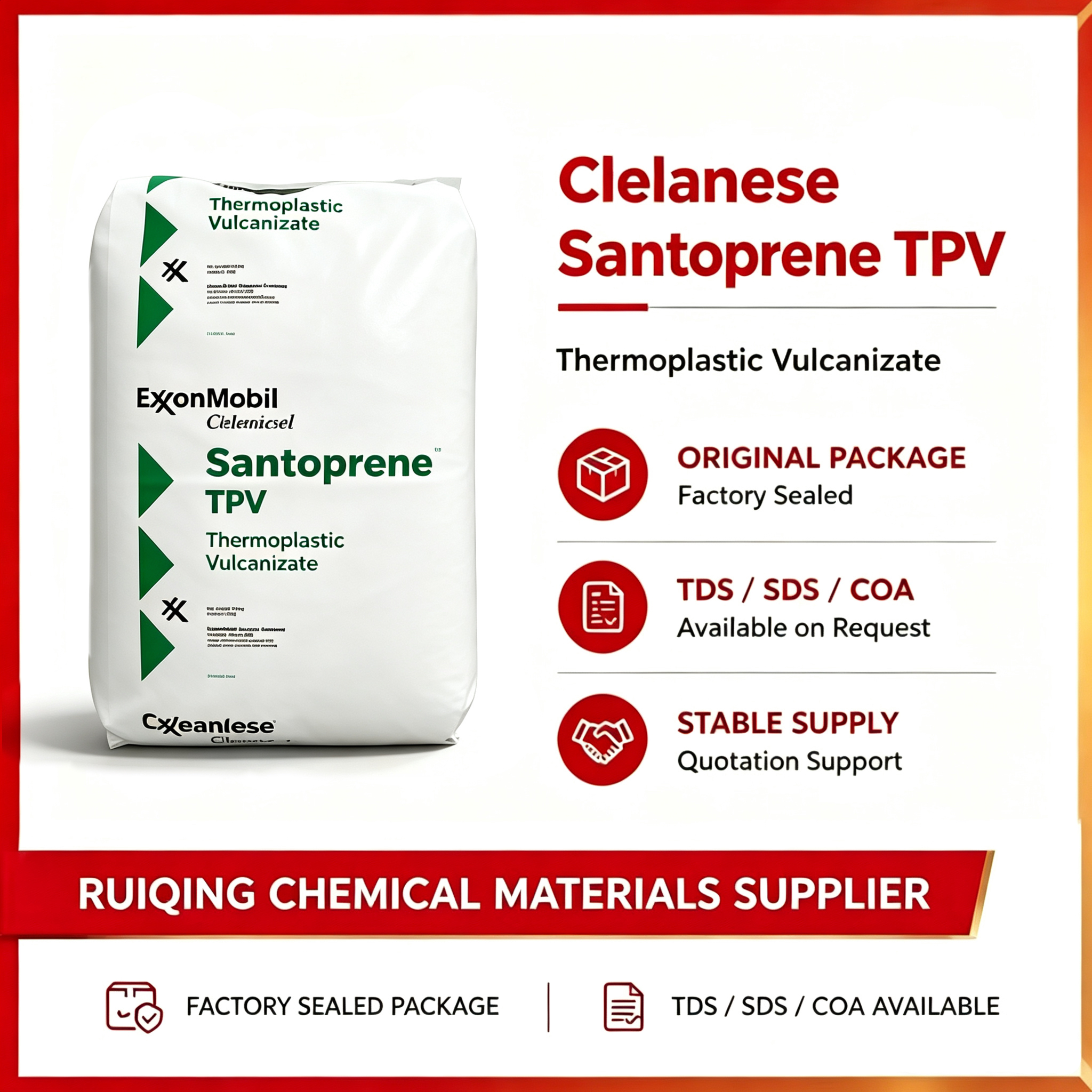
Santoprene 121-50E500 is a soft, black, UV-resistant thermoplastic vulcanizate (TPV) from Celanese developed specifically for robotic and specialty extrusion applications.
The most important characteristic of this grade is its controlled rheology. Celanese positions the material for processes where melt delivery, bead shape, surface quality and elastic recovery must remain stable during extrusion.
Unlike a standard general-purpose TPV selected mainly by Shore hardness, Santoprene 121-50E500 is engineered around extrusion behavior.
Celanese’s current product guide describes the grade as tailored for robotic extrusion, while the current grade sheet states that the material is intended for robotic or specialty extrusion applications.
The material is shear dependent, meaning its apparent viscosity decreases as shear rate increases. This behavior is important in robotic dispensing and profile extrusion because screw speed, die geometry, pressure and line speed can strongly influence melt flow and final profile quality.
The grade has a Shore A hardness of approximately 56, placing it in the soft-elastomer range.
Current Celanese data lists approximately 450% elongation at break, 4.0 MPa stress at break, 1.7 MPa tensile stress at 100% elongation, and a -61°C brittleness temperature.
This combination provides useful flexibility for weatherseals, exterior profiles and other elastomeric sections that must deform repeatedly while retaining shape.
Compression set is approximately 23% at 70°C for 24 hours and 41% at 125°C for 70 hours.
Celanese also highlights good elastic recovery, improved UV resistance and superior part surface appearance as defining features of Santoprene 121-50E500.
These characteristics make the grade particularly useful in visible exterior sealing and profile applications where appearance matters in addition to mechanical performance.
The material density is approximately 0.910 g/cm³, making it lighter than many conventional elastomer systems.
It is polyolefin based and Celanese states that it is recyclable within the manufacturing stream.
Current Celanese processing notes recommend desiccant drying for 3 hours at 80°C and provide a broad extrusion processing window of approximately 190–230°C.
The grade is incompatible with acetal (POM) and PVC, so processors should avoid contamination when changing materials.
For more TPV materials, visit our TPV Thermoplastic Vulcanizates Product Category →.
For Celanese’s current grade portfolio, see the Official Celanese Santoprene & Geolast TPV Product Finder →.
Key Features of Santoprene 121-50E500
| Feature | Engineering Benefit |
|---|---|
| Controlled Rheology | Supports stable melt delivery and bead/profile geometry during robotic or specialty extrusion |
| Tailored for Robotic Extrusion | Designed for automated extrusion processes requiring repeatability |
| Shore A 56 | Soft, flexible elastomeric response |
| 450% Elongation at Break | Supports high deformation without brittle failure |
| Good Elastic Recovery | Helps profiles and seals return toward their original shape |
| Improved UV Resistance | Supports outdoor and automotive exterior applications |
| Superior Surface Appearance | Useful for visible seals and trim components |
| -61°C Brittleness Temperature | Strong low-temperature flexibility |
| Low Density | Approx. 0.910 g/cm³ for lightweight designs |
| Polyolefin-Based TPV | Familiar thermoplastic extrusion behavior and low density |
| Shear-Dependent Flow | Flow responds strongly to shear, useful for controlled extrusion design |
| Manufacturing-Stream Recyclability | Controlled process scrap may be recyclable within the manufacturing stream |
The defining advantage of Santoprene 121-50E500 is not simply softness. It is the combination of controlled extrusion rheology, UV stability, elastic recovery and appearance quality.
Typical Applications for Santoprene 121-50E500
Santoprene 121-50E500 is most suitable for extrusion-based applications where soft elastomeric performance and stable bead/profile formation are important.
| Application Area | Typical Use |
|---|---|
| Robotic Extrusion | Automated deposition of TPV beads or sealing sections |
| Automotive Weatherseals | Flexible exterior sealing profiles exposed to UV and weather |
| Exterior Trim Seals | Visible black sealing sections where surface appearance matters |
| Specialty Extrusion Profiles | Complex or custom TPV profiles |
| Outdoor Sealing Profiles | UV-exposed seals and weather-resistant flexible profiles |
| Automotive Exterior Components | Soft elastomeric sections requiring UV resistance |
| Flexible Gaskets | Extruded gaskets requiring good elastic recovery |
| Coextruded Sealing Sections | Soft TPV layer combined with compatible substrates |
| Construction Profiles | Flexible outdoor sealing sections where UV durability is needed |
| Industrial Extrusions | Soft profiles requiring controlled rheology and consistent geometry |
For robotic extrusion, repeatability is critical. A material with unstable melt behavior can create variations in bead width, height, surface quality or placement.
The controlled rheology of Santoprene 121-50E500 helps make it a more targeted choice than a general-purpose molding TPV.
Typical Properties of Santoprene 121-50E500
Physical Properties
| Property | Typical Value | Test Method |
|---|---|---|
| Density | 910 kg/m³ / 0.910 g/cm³ | ISO 1183 |
| Specific Gravity | Approx. 0.908 | ASTM D792 |
| Shore A Hardness, 15 s | 56 | ISO 48-4 / ISO 868 |
| Resin Identification | TPV | ISO 1043 |
| Part Marking Code | >TPV< | ISO 11469 |
| Color | Black | Manufacturer information |
| Product Form | Pellets / Granules | Manufacturer information |
Mechanical Properties
| Property | Typical Value | Test Method |
|---|---|---|
| Tensile Stress at 100% Elongation, Perpendicular | 1.7 MPa | ISO 37 |
| Stress at Break, Perpendicular | 4.0 MPa | ISO 527-1/-2 or ISO 37 |
| Elongation at Break, Perpendicular | 450% | ISO 527-1/-2 or ISO 37 |
| Brittleness Temperature | -61°C | ASTM D746 |
| Shore A Hardness | 56 | ISO 48-4 / ISO 868 |
Compression Set
| Condition | Typical Value | Test Method |
|---|---|---|
| Compression Set, 70°C / 24 h | 23% | ISO 815 |
| Compression Set, 125°C / 70 h | 41% | ISO 815 |
Heat Aging
| Property Change | Condition | Typical Value | Test Method |
|---|---|---|---|
| Tensile Strength Change | 135°C / 168 h | -5% | ISO 188 / ASTM D573 |
| Elongation-at-Break Change | 135°C / 168 h | -5% | ISO 188 / ASTM D573 |
| Shore A Hardness Change | 135°C / 168 h | -1 point | ISO 188 / ASTM D573 |
These results support use where profiles may experience elevated service temperatures in addition to outdoor exposure.
Controlled Rheology of Santoprene 121-50E500
One of the most important technical features of Santoprene 121-50E500 is its controlled rheology.
Santoprene TPV behaves differently from a simple Newtonian polymer. Its apparent viscosity changes significantly with shear rate.
During extrusion, the material experiences high shear inside the screw, breaker plate, adapter and die. After exiting the die, shear drops sharply.
A robotic extrusion grade must therefore balance several behaviors:
- Sufficient flow through the extrusion system
- Stable melt pressure
- Good die exit behavior
- Controlled bead geometry
- Good elastic recovery
- Limited surface defects
- Repeatable output as robot speed changes
- Good integration with the intended assembly
The current Celanese product guide specifically labels Santoprene 121-50E500 as tailored for robotic extrusion.
This makes the grade especially valuable where automated equipment deposits a continuous sealing bead directly onto or around a component.
Why Choose Santoprene 121-50E500?
The main reason to choose Santoprene 121-50E500 is its targeted extrusion performance.
A general-purpose TPV may have the correct hardness but still be difficult to run in a robotic extrusion system.
If the melt is too fluid, the bead may collapse or spread.
If the melt is too elastic or unstable, the process may suffer from die swell, rough surfaces or inconsistent dimensions.
If melt pressure changes excessively with line speed, robotic deposition can become difficult to control.
Santoprene 121-50E500 is designed around this problem.
Its controlled rheology helps maintain predictable extrusion behavior.
Its Shore A 56 hardness provides a soft sealing response.
Its 450% elongation gives the material enough flexibility for deformed or curved sealing paths.
The -61°C brittleness temperature supports cold-weather exterior applications.
Improved UV resistance makes the grade more suitable for exposed seals and exterior profiles than an unstabilized soft TPV.
Superior surface appearance is another major advantage because weatherseals and exterior trim are often visible to the end user.
Good elastic recovery helps sealing profiles retain functional geometry after compression or deformation.
The low density of 0.910 g/cm³ can also reduce weight in long continuous profiles.
For customers who need a soft black UV-stabilized TPV specifically optimized for robotic or specialty extrusion, Santoprene 121-50E500 is much more targeted than a standard general-purpose molding grade.
Processing Guidelines for Santoprene 121-50E500
Santoprene 121-50E500 is primarily designed for extrusion.
Celanese Processing Guidance
| Processing Parameter | Published Guidance |
|---|---|
| Drying | Recommended |
| Drying Temperature | 80°C |
| Drying Time | 3 hours |
| Processing Temperature Window | 190–230°C |
| Primary Process | Extrusion / robotic extrusion / specialty extrusion |
| Material Compatibility | Incompatible with POM and PVC |
The material should be dried in a desiccant or dehumidifying dryer before processing.
The published 190–230°C extrusion window provides a practical starting range, but the optimum setting depends on screw design, output rate, die geometry, bead dimensions and line speed.
Extrusion Variables to Optimize
For Santoprene 121-50E500, processors should pay particular attention to:
- Feed-zone stability
- Screw speed
- Melt pressure
- Adapter temperature
- Die temperature
- Die land length
- Robot travel speed
- Bead dimensions
- Draw-down
- Die swell
- Cooling
- Surface appearance
Because the grade is shear dependent, changing robot speed or output rate may alter melt behavior even if barrel temperatures remain constant.
Material Changeover
Celanese states that Santoprene TPV is incompatible with acetal (POM) and PVC.
When changing from POM or PVC, processors should thoroughly purge the screw, barrel, adapter and die before introducing Santoprene 121-50E500.
Santoprene 121-50E500 vs. Santoprene 121-50M100
| Feature | Santoprene 121-50E500 | Santoprene 121-50M100 |
|---|---|---|
| Material Family | TPV | TPV |
| Color | Black | Black |
| Shore A Hardness | 56 | 56 |
| Elongation at Break | 450% | 465% |
| Tensile Stress at Break | 4.0 MPa | 4.4 MPa |
| Tensile Stress @ 100% Elongation | 1.7 MPa | 1.8 MPa |
| Compression Set, 70°C | 23% | 31% |
| Main Processing Focus | Robotic / specialty extrusion | Improved flow for easier processability |
| Main Selection Reason | Controlled rheology and extrusion stability | Higher-flow general processability |
The two grades have similar hardness, so the choice should not be based on Shore A alone.
Choose Santoprene 121-50E500 when robotic extrusion, controlled rheology, UV resistance and profile surface quality are the priorities.
Choose Santoprene 121-50M100 when easier flow and more general processability are more important.
Related Products
Santoprene 121-50M100 – Black Shore A 56 TPV with improved flow for easier processing.
Santoprene HR 121-60E400 – Higher-resilience black TPV with approximately Shore A 64 hardness and very low compression set for static and dynamic sealing.
Santoprene 121-58W175 – Black UV-stabilized extrusion grade for outdoor sealing applications.
View More TPV Thermoplastic Vulcanizates →
Technical Documents for Santoprene 121-50E500
| Document Type | Description |
|---|---|
| TDS | Current Celanese mechanical, physical and processing data |
| SDS | Safety Data Sheet |
| Santoprene Product Finder | Grade comparison and product positioning |
| Automotive Grade Slate | Celanese automotive extrusion-grade overview |
| Extrusion Guide | Santoprene TPV extrusion guidance |
| COA | Batch-specific quality information where available |
Need technical documents for Santoprene 121-50E500?
📧 Email: ruiqingchem@gmail.com
📝 Online form: Contact Us →
Please state Santoprene 121-50E500 and the document required.
FAQ About Santoprene 121-50E500
Q1: What is Santoprene 121-50E500?
Santoprene 121-50E500 is a soft black UV-resistant TPV from Celanese with controlled rheology for robotic and specialty extrusion.
Q2: What is the Shore hardness of Santoprene 121-50E500?
The current Celanese value is approximately Shore A 56.
Q3: Why is Santoprene 121-50E500 used for robotic extrusion?
Its rheology is specifically controlled to support stable extrusion output, bead geometry and surface quality in robotic and specialty extrusion systems.
Q4: Is Santoprene 121-50E500 UV resistant?
Yes. Celanese specifically identifies improved UV resistance as a key feature of this grade.
Q5: What is the elongation at break?
Current Celanese data lists approximately 450%.
Q6: What is the tensile stress at break?
The current value is approximately 4.0 MPa.
Q7: What is the compression set?
Current data lists approximately 23% at 70°C / 24 h and 41% at 125°C / 70 h.
Q8: What is the low-temperature performance?
The current brittleness temperature is approximately -61°C.
Q9: What extrusion temperature is recommended?
Celanese provides a broad processing window of approximately 190–230°C for this grade.
Q10: What is the difference between Santoprene 121-50E500 and 121-50M100?
Both are black Shore A 56 TPV grades. Santoprene 121-50E500 is tailored for robotic extrusion and controlled rheology, while 121-50M100 is positioned for improved flow and easier general processability.
Request Santoprene 121-50E500 Price & Technical Support
For pricing, availability, technical documents or application support for Santoprene 121-50E500, please provide:
- Required quantity
- Destination country or port
- Automotive, construction or industrial application
- Robotic extrusion or conventional profile extrusion
- Required Shore hardness
- Profile or bead dimensions
- Robot travel speed or extrusion line speed
- Outdoor / UV exposure
- Continuous and peak operating temperature
- Compression-set requirement
- Surface-appearance requirement
- Substrate or coextrusion material
- TDS, SDS or COA requirement
- Sample requirement, if applicable
📧 Email: ruiqingchem@gmail.com
📝 Send Inquiry →