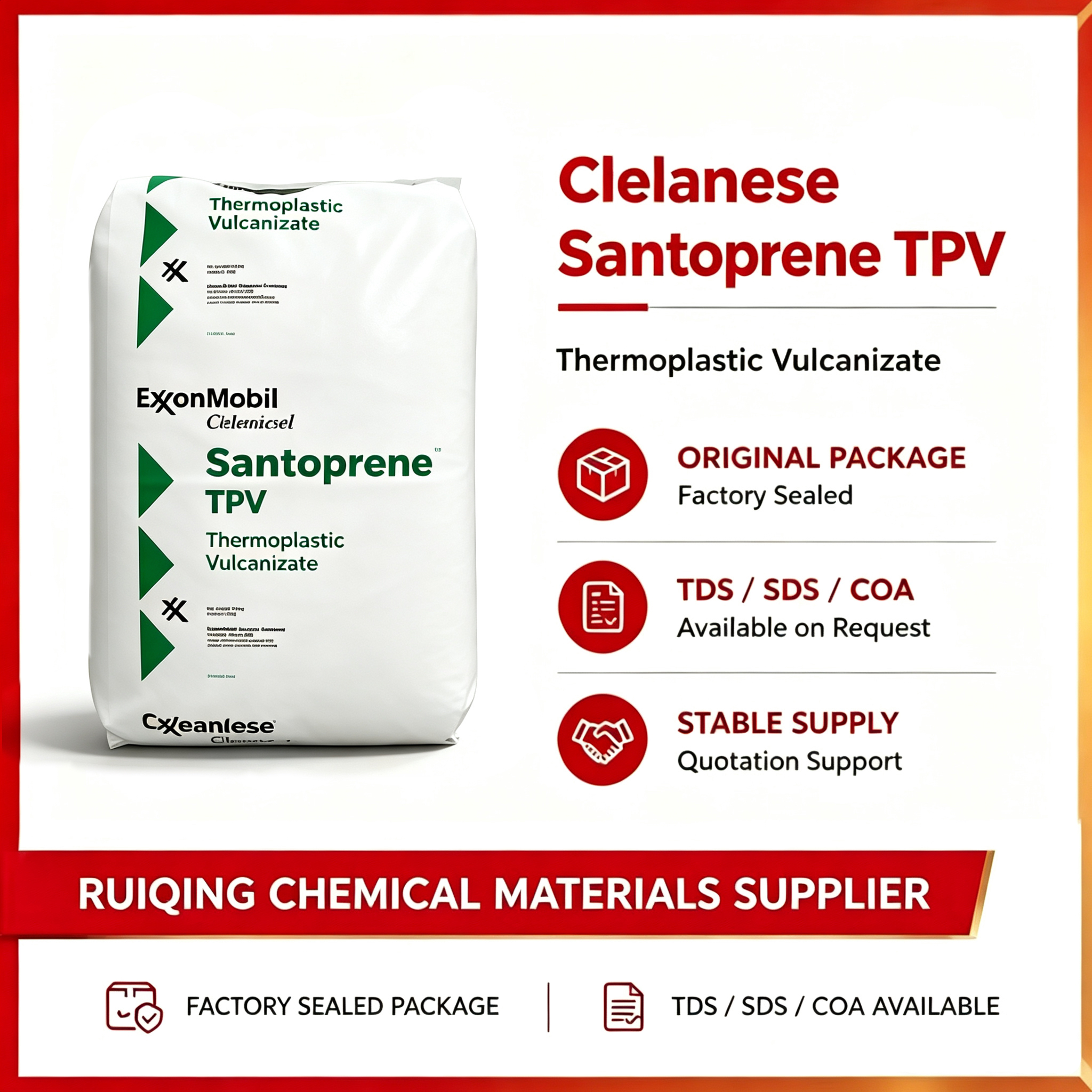
描述
Santoprene 121-40B265 is a soft, black thermoplastic vulcanizate (TPV) from Celanese developed primarily for automotive weatherseal corner molding, sails, muckets and end caps used with dense and sponge weatherseal profiles.
Unlike a general-purpose TPV selected mainly by hardness, Santoprene 121-40B265 is a specialized bonding and exterior-weatherseal grade. Celanese designed it to combine a low coefficient of friction, strong processability and good bonding to TPV and vulcanized EPDM rubber, particularly EPDM sponge profiles.
The grade is especially relevant to automotive sealing systems where an injection-molded corner, end cap or transition element must join an extruded weatherseal profile while maintaining a soft elastomeric feel and an attractive exterior surface.
Celanese describes Santoprene 121-40B265 as a high-flow injection molding grade with high shear-thinning behavior. This rheology is valuable for complex corner geometries because the apparent melt viscosity decreases as shear rate increases.
The grade also provides built-in low-friction properties. Lower surface friction can be valuable in weatherseal applications where glass, painted body panels or adjacent seals move against the TPV surface.
A major design feature is exterior UV stabilization. Celanese states that Santoprene 121-40B265 is stabilized to meet demanding automotive exterior weathering conditions, including references to SAE J2527 at 3.5 MJ/m² and PV 3930 at 5.8 MJ/m².
The material is also designed for excellent surface aesthetics and is described as showing no surface bleeding after heat or UV aging.
This is especially important for visible vehicle weatherseal corners, sails and end caps. Surface bleeding, blooming or aesthetic change can be unacceptable in exterior trim and sealing systems even when the mechanical function remains adequate.
The current Celanese Materials Database lists a Shore A hardness of approximately 40.5, placing Santoprene 121-40B265 in the very soft TPV range.
Current mechanical data includes approximately 578% elongation at break, 3.72 MPa tensile stress at break, 1.09 MPa tensile stress at 100% elongation, 16% compression set at 23°C for 24 hours, and 33% compression set at 70°C for 24 hours.
The current density is approximately 0.908 g/cm³, giving the grade a relatively low density for a soft elastomeric material.
One of the main reasons to use Santoprene 121-40B265 is its ability to replace thermoset EPDM in selected automotive weatherseal molding operations. Celanese specifically positions the grade as being formulated to replace thermoset EPDM rubber in automotive weatherseal and general molding applications.
The thermoplastic nature of TPV can reduce manufacturing complexity by eliminating the conventional curing step associated with thermoset EPDM. Celanese also highlights the potential for shorter processing cycle times.
For more TPV materials, visit our TPV Thermoplastic Vulcanizates Product Category →.
For Celanese’s Santoprene portfolio, see the Official Celanese Santoprene & Geolast Product Finder →.
Key Features of Santoprene 121-40B265
| Feature | Engineering Benefit |
|---|---|
| Shore A 40.5 | Very soft elastomeric feel for flexible weatherseal corners and end caps |
| High-Flow Injection Molding Grade | Helps fill complex corner geometries |
| High Shear-Thinning Behavior | Viscosity falls at higher shear, improving mold filling |
| Low Coefficient of Friction | Reduces drag against glass, paint and adjacent sealing surfaces |
| Bonding to TPV | Supports TPV-to-TPV weatherseal corner molding |
| Bonding to Vulcanized EPDM | Designed to bond to dense and sponge EPDM profiles |
| Exterior UV Stabilized | Designed for demanding automotive exterior exposure |
| SAE J2527 / PV 3930 References | Supports exterior weathering qualification work |
| No Surface Bleeding After Heat or UV Aging | Helps maintain visible surface quality |
| Excellent Surface Appearance | Important for exposed weatherseal corners and trim |
| Thermoplastic Processing | Avoids the normal thermoset rubber cure step |
| Shorter Cycle Potential | Celanese positions it for shorter cycles than thermoset EPDM |
| Low Density | Approx. 0.908 g/cm³ |
The defining value of Santoprene 121-40B265 is the combination of softness, low friction, EPDM/TPV bonding, UV stability and high-flow injection moldability.
Typical Applications for Santoprene 121-40B265
Santoprene 121-40B265 is primarily an automotive weatherseal material.
| Application Area | Typical Use |
|---|---|
| Weatherseal Corner Molding | Injection-molded soft corners joining extruded seal profiles |
| Sails | Molded weatherseal transition or decorative sealing sections |
| Muckets | Complex sealing junctions around vehicle glass and door systems |
| End Caps | Soft molded closures at the end of weatherseal profiles |
| EPDM Sponge Profile Overmolding | Injection molding onto vulcanized EPDM sponge |
| Dense EPDM Profile Bonding | Soft molded transitions on dense vulcanized EPDM |
| TPV Profile Bonding | TPV-to-TPV molded corners and joints |
| Automotive Exterior Seals | Visible sealing parts requiring UV resistance and surface quality |
| General Soft Molding | Complex soft parts where low friction and high flow are useful |
For most applications, the strongest fit is automotive dense and sponge weatherseal systems rather than a generic soft-touch consumer application.
Typical Properties of Santoprene 121-40B265
Physical Properties
| Property | Typical Value | Test Method |
|---|---|---|
| Density | 908 kg/m³ / 0.908 g/cm³ | ISO 1183 |
| Shore A Hardness, 15 s | 40.5 | ISO 48-4 / ISO 868 |
| Resin Identification | TPV | ISO 1043 |
| Part Marking Code | >TPV< | ISO 11469 |
| Color | Black | Manufacturer information |
| Delivery Form | Pellets | Manufacturer information |
| Special Characteristic | UV stabilized / weather stable | Manufacturer information |
The current Celanese product finder rounds the hardness to approximately Shore A 41, while the current grade-specific Celanese database lists 40.5 Shore A. The grade-specific value is the more precise number for the current page.
Mechanical Properties
| Property | Typical Value | Test Method |
|---|---|---|
| Tensile Stress at 100% Elongation, Perpendicular | 1.09 MPa | ISO 37 |
| Tensile Stress at Break, Perpendicular | 3.72 MPa | ISO 527-1/-2 or ISO 37 |
| Elongation at Break, Perpendicular | 578% | ISO 527-1/-2 or ISO 37 |
| Shore A Hardness, 15 s | 40.5 | ISO 48-4 / ISO 868 |
| Compression Set, 23°C / 24 h | 16% | ISO 815 |
| Compression Set, 70°C / 24 h | 33% | ISO 815 |
The very high elongation and low hardness confirm that Santoprene 121-40B265 is designed for soft, highly deformable sealing components rather than structural parts.
UV & Exterior Weathering Performance
| Feature | Celanese Positioning |
|---|---|
| Exterior UV Stabilization | Yes |
| SAE J2527 Exposure Reference | 3.5 MJ/m² |
| PV 3930 Exposure Reference | 5.8 MJ/m² |
| Surface Bleeding After Heat Aging | Designed to avoid bleeding |
| Surface Bleeding After UV Aging | Designed to avoid bleeding |
| Primary Market | Automotive exterior weatherseals |
The UV package is one of the key differences between Santoprene 121-40B265 and a generic soft TPV.
Why Choose Santoprene 121-40B265?
The strongest reason to choose Santoprene 121-40B265 is not simply its Shore A 40 hardness. It is the combination of properties engineered around automotive weatherseal corner molding.
A conventional weatherseal can combine extruded EPDM sponge, dense EPDM sections and molded corner elements. The molded material must flow into complex tooling, contact the existing profile effectively and maintain a durable interface.
At the same time, exterior vehicle seals must tolerate sunlight, heat, rain, temperature cycling and repeated movement against glass or painted surfaces.
Santoprene 121-40B265 addresses these requirements with a high-flow shear-thinning rheology, low-friction surface behavior and dedicated exterior UV stabilization.
Its ability to bond to vulcanized EPDM is particularly important. Celanese specifically mentions both dense and sponge EPDM.
The grade’s low hardness also helps the molded corner behave similarly to the adjoining soft weatherseal profile instead of creating an excessively rigid junction.
Another advantage is process cycle time. Thermoset EPDM requires curing, while TPV can be injection molded using thermoplastic processing methods. Celanese explicitly positions this grade as supporting shorter processing cycles than thermoset EPDM rubber.
The material’s excellent surface appearance and resistance to bleeding after heat or UV aging are important for visible corners and end caps.
For automotive sealing suppliers that need a soft black TPV for molded weatherseal junctions with low friction, EPDM bonding and exterior UV stability, Santoprene 121-40B265 is a highly targeted grade.
Processing Guidelines for Santoprene 121-40B265
Santoprene 121-40B265 is designed for injection molding and multi-injection molding.
Current Grade-Specific Injection Conditions
| Processing Parameter | Current Celanese Data |
|---|---|
| Drying Recommended | Yes |
| Drying Temperature | 65°C |
| Drying Time, Dehumidified Dryer | ≥3 hours |
| Maximum Processing Moisture | ≤0.08% |
| Maximum Regrind Level | 10% |
| Optimum Melt Temperature | 225°C |
| Minimum Melt Temperature | 210°C |
| Maximum Melt Temperature | 240°C |
| Optimum Mold Temperature | 50°C |
| Minimum Mold Temperature | 40°C |
| Maximum Mold Temperature | 60°C |
| Recommended Screw Speed | 100–200 rpm |
| Holding Pressure | Approx. 50–75% of actual injection pressure |
| Optional Back Pressure | Approx. 0.3–0.7 MPa |
For this grade, the current grade-specific Celanese database values should be the primary starting point.
Celanese also includes a general Santoprene processing note recommending approximately 80°C for 3 hours of desiccant drying and a broader family processing range of approximately 175–230°C.
Because those general notes differ from the grade-specific values of 65°C drying and 210–240°C melt temperature, production trials should prioritize the current grade-specific data and confirm the final settings with the latest Celanese TDS and actual tooling conditions.
Bonding to EPDM Sponge Profiles
Celanese provides several important process recommendations when molding Santoprene 121-40B265 onto EPDM sponge:
- Use a fast injection speed
- Use a high melt temperature
- Use a warm mold
- Keep injection pressure moderate
- Keep holding pressure relatively low
- Position the EPDM profile accurately in the mold
- Prevent deformation of the sponge profile
- Maximize surface contact between the TPV melt and EPDM
- Use a longer cooling time than a typical TPV to initiate recrystallization at the contact interface
These details are especially important because successful corner molding depends on both material selection and interface processing.
Shear-Dependent Flow
Santoprene TPV has relatively high viscosity at low shear rates, but the viscosity decreases as shear rate increases.
Celanese notes that increasing temperature alone has relatively little effect on melt viscosity compared with increasing shear.
Smaller gates and higher shear rates can therefore help keep melt viscosity low and improve filling of complex geometries.
Material Compatibility
Celanese states that Santoprene TPV is incompatible with acetal (POM) and PVC.
Equipment should be carefully purged when switching between these materials and Santoprene 121-40B265.
Santoprene 121-40B265 vs. Santoprene 121-70B265
| Feature | Santoprene 121-40B265 | Santoprene 121-70B265 |
|---|---|---|
| Material Family | TPV | TPV |
| Color | Black | Black |
| Main Positioning | Automotive weatherseal corner molding | Automotive weatherseal corner molding |
| Low Coefficient of Friction | Yes | Yes |
| Improved TPV / EPDM Bonding | Yes | Yes |
| Shore A Hardness | 40.5 / ~41 | ~70 |
| Compression Set, 70°C | 33% | ~36% in Product Finder |
| Primary Selection Difference | Very soft / highly compliant | Firmer weatherseal corner grade |
Both grades belong to the same B265 weatherseal concept and are positioned around low friction, improved bonding to TPV and EPDM, and automotive corner molding.
Choose Santoprene 121-40B265 when the molded junction must remain very soft and compliant.
Choose Santoprene 121-70B265 when the same general weatherseal functionality is needed with significantly higher hardness.
Related Products
Santoprene 121-70B265 – Firmer black B265 weatherseal corner-molding TPV with low friction and improved TPV/EPDM bonding.
Santoprene 121-80B265 – Higher-hardness B265 TPV for automotive corner molding requiring more structural support.
Santoprene 121-70B260 – Black low-friction bonding TPV for TPV/EPDM weatherseal applications and automotive corner molding.
View More TPV Thermoplastic Vulcanizates →
Technical Documents for Santoprene 121-40B265
| Document Type | Description |
|---|---|
| TDS | Current Celanese grade-specific mechanical and processing data |
| SDS | Safety Data Sheet |
| Santoprene Product Finder | Grade positioning and comparison within the B-series portfolio |
| Processing Guide | Injection molding and EPDM overmolding guidance |
| Weathering Information | SAE J2527 / PV 3930 exterior UV positioning |
| COA | Batch-specific quality information where available |
Need technical documents for Santoprene 121-40B265?
📧 Email: ruiqingchem@gmail.com
📝 Online form: Contact Us →
Please state Santoprene 121-40B265 and the required document type when submitting your inquiry.
FAQ About Santoprene 121-40B265
Q1: What is Santoprene 121-40B265?
Santoprene 121-40B265 is a soft black Celanese TPV developed primarily for automotive weatherseal corner molding, sails, muckets and end caps.
Q2: What is the hardness of Santoprene 121-40B265?
The current Celanese Materials Database lists approximately Shore A 40.5. The Product Finder rounds this to approximately Shore A 41.
Q3: Can Santoprene 121-40B265 bond to EPDM?
Yes. Celanese specifically states that the grade provides good bonding to vulcanized EPDM rubber, including dense and sponge EPDM profiles, as well as TPV.
Q4: Is Santoprene 121-40B265 UV stabilized?
Yes. It is an exterior UV-stabilized grade with Celanese references to SAE J2527 3.5 MJ/m² and PV 3930 5.8 MJ/m².
Q5: What is the elongation at break?
Current grade-specific data lists approximately 578%.
Q6: What is the compression set?
Current values are approximately 16% at 23°C / 24 h and 33% at 70°C / 24 h.
Q7: Why is Santoprene 121-40B265 suitable for automotive weatherseals?
It combines very soft hardness, low friction, TPV/EPDM bonding, high-flow injection molding, UV stability and excellent surface aesthetics.
Q8: What processing temperature is recommended?
Current grade-specific data lists 210–240°C, with an optimum melt temperature of approximately 225°C.
Q9: What drying conditions should be used?
Current grade-specific Celanese data lists 65°C for at least 3 hours in a dehumidified dryer, with processing moisture at or below 0.08%.
Q10: What is the difference between Santoprene 121-40B265 and 121-70B265?
Both are black low-friction B265 weatherseal corner-molding grades with improved TPV/EPDM bonding. 121-40B265 is much softer at about Shore A 41, while 121-70B265 is approximately Shore A 70.
Request Santoprene 121-40B265 Price & Technical Support
For pricing, availability, technical documents or application support for Santoprene 121-40B265, please provide:
- Required quantity
- Destination country or port
- Vehicle weatherseal application
- Corner, sail, mucket or end-cap design
- Dense EPDM, sponge EPDM or TPV profile
- Required Shore hardness
- UV / exterior exposure requirement
- Low-friction requirement
- Injection-molding equipment
- Insert profile geometry
- Bonding requirement
- OEM specification requirement
- TDS, SDS or COA requirement
- Sample requirement, if applicable
📧 Email: ruiqingchem@gmail.com
📝 Send Inquiry →