描述
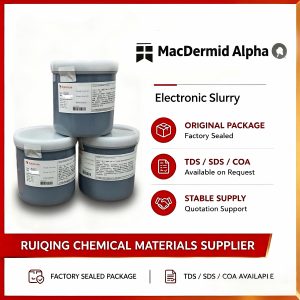
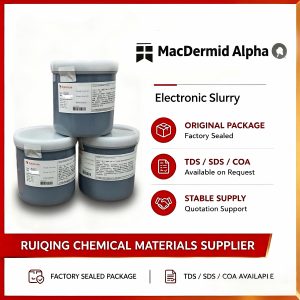
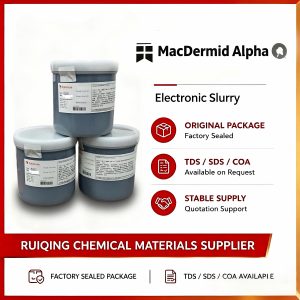
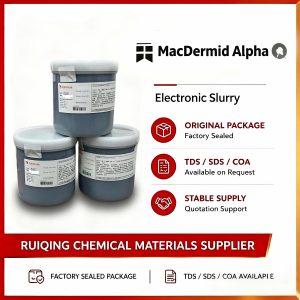
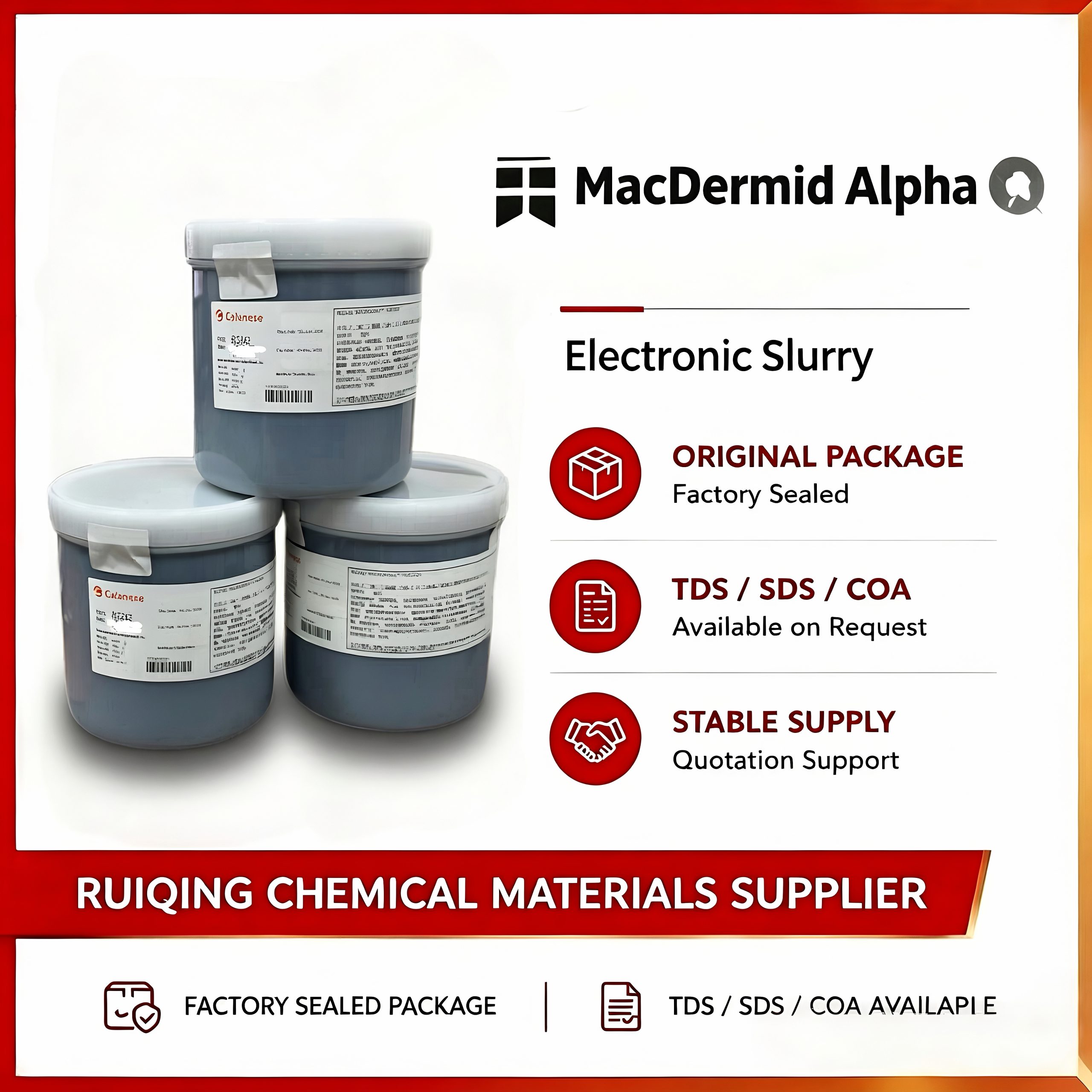
MacDermid Alpha Micromax 5815 High-Adhesion Air-Dry Conductive Silver
Type: Air-Dry Conductive Silver
Chemistry: Single-Component Epoxy
Adhesion: ≥700–1400 N/cm²
Shelf Life: 3 months refrigerated
Micromax 5815 is a single-component, epoxy-based air-dry / low-temperature-cure conductive silver composition for substrates that will not generally tolerate high-temperature firing, including paper, plastic, rubber, cloth, and wood. It exhibits good conductivity, high adhesion, and excellent resistance to abrasion, and may be electroplated to provide a solderable surface.
Micromax 5815 from MacDermid Alpha is an air-dry or low-temperature-cure conductive silver composition based on a suspension of specially prepared silver powder combined with an organic binder system. It is formulated for substrates that will not generally tolerate high-temperature firing, and produces electrically conductive paths on paper, plastic, rubber, cloth, wood, and similar materials. Application methods include dip, spray, brush, stylus, syringe, or screen print. Suggested uses include printed electronics, tantalum capacitors, static shielding, electrical games and toys, microwave applications, PC board repair, and electroplating base.
Micromax 5815 compositions are single-component, epoxy-based preparations suitable for use as conductive cements in lead and discrete component attachment. They exhibit good conductivity, high adhesion, and excellent resistance to abrasion. The family is divided into anhydride-cured and amine-cured types: anhydride-cured compositions display excellent thermal stability up to 250°C, while amine-cured products start to degrade appreciably above 200°C with attendant loss of properties; both can withstand short excursions to higher temperatures. While not suggested for direct solder, the compositions may be electroplated to provide a solderable surface.
Recommended cure schedules, after applying and allowing to air-dry until tack free, are 200°C for 0.7 hours, 180°C for 1.5 hours, or 160°C for 2.5 hours. These are minimum starting points; longer cure schedules may be required to optimize properties depending on end-use requirements. For example, in die-attach applications, a cure schedule of 2 hours at 200°C has been found to yield stable and reliable die-to-substrate interfaces capable of withstanding a high degree of thermal and physical stress. Drying or curing can be accelerated by heating; a system that dries or cures in 12–16 hours at 25°C can achieve the same degree of drying or curing in less than 2 hours at 60°C or less than 1 hour at 100°C. Store refrigerated at 0–5°C; unopened shelf life is 3 months.
Genuine MacDermid Alpha Micromax Imported Stock & Technical Support
We hold regular stock of authentic MacDermid Alpha Micromax 5815 air-dry conductive silver composition. Original factory TDS and batch-specific COA are available on request for your printed electronics and heat-sensitive substrate programs.
Request Sample, TDS & Quotation
Complete TDS, COA, and regulatory documentation available
Key Features of MacDermid Alpha Micromax 5815
- Air-dry / low-temperature-cure conductive silver composition
- Single-component, epoxy-based preparation
- Suitable for substrates that will not tolerate high-temperature firing
- Good conductivity, high adhesion, and excellent resistance to abrasion
- Adhesion strength values of ≥700, 1000, and 1400 N/cm² listed in the TDS
- Anhydride-cured type: excellent thermal stability up to 250°C
- Amine-cured type: degrades appreciably above 200°C
- May be electroplated to provide a solderable surface
- Application by dip, spray, brush, stylus, syringe, or screen print
- Recommended cure schedules: 200°C/0.7 h, 180°C/1.5 h, 160°C/2.5 h
- Room-temperature dry/cure in 12–16 hours; accelerated in <2 h at 60°C or <1 h at 100°C
- Refrigerated storage 0–5°C; 3-month shelf life unopened
Primary Applications
- Printed electronics — conductive paths on heat-sensitive substrates
- Tantalum capacitors — conductive cement and discrete component attachment
- Static shielding — conductive layer for static dissipation
- Electrical games and toys — conductive traces on low-temperature substrates
- Microwave applications — conductive paths on heat-sensitive materials
- PC board repair — conductive repair traces without high-temperature firing
- Electroplating base — conductive base layer for subsequent plating
Full Technical Specifications
| Property | Typical Value | TDS Reference |
| Product Type | Air-dry / thermoset epoxy conductive silver composition | TDS: Conductive Silver Compositions For General Purpose Air-Dry Applications |
| Application | Printed electronics, tantalum capacitors, static shielding, electrical games and toys, microwave applications, PC board repair, electroplating base | TDS: Suggested uses |
| Viscosity | Measured with Brookfield LVT, #2 spindle, 30 rpm | TDS: Brookfield LVT, #2 spindle, 30 rpm |
| Substrate Compatibility | Paper, plastic, rubber, cloth, wood, and other substrates that will not tolerate high-temperature firing | TDS: Product Description |
| Application Methods | Dip, spray, brush, stylus, syringe, screen print | TDS: Product Description |
| Adhesion Strength | ≥ 700, 1000, 1400 N/cm² listed in TDS Typical Physical Properties | TDS: Typical Physical Properties of Thermosetting Adhesion Strength (N/cm²) |
| Recommended Cured Thickness | 12 to 20 μm (0.48 to 0.8 mil) | TDS: Coverage |
| Coverage (Screen Print, 165/200 mesh) | 12 to 20 μm cured film | TDS: Coverage |
| Coverage (Brush/Band/Dip/Spray) | 13 to 18 μm cured film | TDS: Coverage |
| Cure Schedule (200°C) | 0.7 hours | TDS: Recommended Cure Schedules |
| Cure Schedule (180°C) | 1.5 hours | TDS: Recommended Cure Schedules |
| Cure Schedule (160°C) | 2.5 hours | TDS: Recommended Cure Schedules |
| Room Temperature Dry/Cure | 12 to 16 hours at 25°C | TDS: Effect of curing temperatures |
| Dry/Cure at 60°C | Less than 2 hours | TDS: Effect of curing temperatures |
| Dry/Cure at 100°C | Less than 1 hour | TDS: Effect of curing temperatures |
| Thermal Stability (Anhydride-Cured) | Excellent up to 250°C | TDS: Design |
| Thermal Stability (Amine-Cured) | Degrades appreciably above 200°C | TDS: Design |
| Die-Attach Reference Cure | 2 hours at 200°C | TDS: Design |
| Electroplating | May be electroplated to provide a solderable surface | TDS: Design |
| Thermal Conductivity (Cured Film) | 0.04 J/(cm·s·°C) | TDS: Typical Physical Properties |
| Specific Heat (Cured Film) | 0.30 J/(g·°C) | TDS: Typical Physical Properties |
| Modulus of Elasticity (Tensile) | 4 x 10¹⁰ Pa | TDS: Typical Physical Properties |
| Poisson’s Ratio | 0.35 | TDS: Typical Physical Properties |
| Shelf Life | 3 months | TDS: 3 months |
| Storage Temperature | 0 to 5 °C refrigerated | TDS: 0°C – 5°C |
Note: All listed values are typical and may vary by batch. Values based on MacDermid Alpha official TDS. Independent qualification testing is required prior to production use. Cure schedules listed are recommended as minimal starting points after applying and allowing to air-dry until tack free. Longer cure schedules may be required to optimize properties depending on end-use requirements.
Recommended Processing Conditions
| Parameter | Recommended Value | TDS Reference |
| Mixing Prior to Use | Stir to redisperse solids; use as received consistency | TDS: Application methods |
| Thinning | Use only the Micromax-recommended thinner; add with thorough blending to replace solvent losses or adjust application ease | TDS: Application methods |
| Application Methods | Dip, spray, brush, stylus, syringe, screen print | TDS: Application methods |
| Screen Mesh for Printing | 165 or 200 mesh screen for 12–20 μm cured film | TDS: Coverage |
| Dry/Cure (Room Temperature) | 12–16 hours at 25°C | TDS: Effect of curing temperatures |
| Dry/Cure (Accelerated) | < 2 hours at 60°C; < 1 hour at 100°C | TDS: Effect of curing temperatures |
| Recommended Cure Schedules | 200°C/0.7 h; 180°C/1.5 h; 160°C/2.5 h | TDS: Recommended Cure Schedules |
| Die-Attach Reference Cure | 2 hours at 200°C | TDS: Design |
| Drying Ovens | Continuous, box oven, or infrared | TDS: Effect of curing temperatures |
| Heat Application | Apply heat from the bottom up to permit internal gases to escape before the top surface dries | TDS: Effect of curing temperatures |
| Post-Cure Electroplating | May be electroplated to provide a solderable surface | TDS: Design |
Handling and Storage Recommendations
| Storage Rules | Store tightly sealed in a clean, stable environment at refrigerated temperature between 0°C and 5°C. Room temperature storage is not recommended. | TDS: 0°C – 5°C |
| Shelf Life | 3 months in unopened containers from date of shipment. | TDS: 3 months |
| Ageing Behavior | Gradual polymerization with viscosity increase and mechanical separation can be expected over a few months. | TDS: Storage and shelf life |
| Refrigerated Handling | Allow material to equilibrate to room temperature before opening to prevent moisture pickup from condensation. | TDS: Storage and shelf life |
| Solvent Handling | Observe safety precautions recommended by the solvent supplier when handling and using organic solvents. | TDS: Application methods |
| Transportation | Under normal shipping conditions, no temperature control is expected. For extended transport periods, confirm product suitability. | TDS: normal shipping conditions |
Official Technical Documentation
| Document Type | Document Introduction | Document Request |
| TDS | MacDermid Alpha Micromax 5815 original factory technical data sheet | Request TDS |
| COA | Batch-specific certificate of analysis | Request COA |
| SDS | Safety Data Sheet for handling and storage | Request SDS |
Frequently Asked Questions
Why is 5815 suitable for heat-sensitive substrates?
The TDS positions 5815 as an air-dry or low-temperature-cure formulation for substrates that will not generally tolerate high-temperature firing, including paper, plastic, rubber, cloth, and wood. Room-temperature drying takes 12–16 hours; heating to 60°C cuts that to under 2 hours, and 100°C to under 1 hour.
What adhesion strength does 5815 show in the TDS?
The TDS Typical Physical Properties table for thermosetting adhesion strength lists ≥700, 1000, and 1400 N/cm². This is one of the reasons 5815 is positioned for conductive cement and discrete component attachment.
How do anhydride-cured and amine-cured 5815 compare?
The TDS states that anhydride-cured compositions display excellent thermal stability up to 250°C, whereas amine-cured products start to degrade appreciably above 200°C with attendant loss of properties. Both systems can withstand short excursions to higher temperatures.
What cure schedules are recommended for 5815?
Recommended cure schedules are 200°C for 0.7 hours, 180°C for 1.5 hours, and 160°C for 2.5 hours. These are minimum starting points after air-drying until tack free; longer schedules may be needed depending on end-use requirements.
Can 5815 be electroplated?
Yes. While direct solder is not suggested, 5815 may be electroplated to provide a solderable surface, which makes it suitable as an electroplating base layer for applications that need solder attachment.
What cured film thickness does 5815 give?
Screen printing with a 165 or 200 mesh screen gives a cured film of 12–20 μm (0.48–0.8 mil). Brush, band, dip, or spray application normally gives 13–18 μm (0.5–0.7 mil).
How should 5815 be stored?
Store refrigerated at 0–5°C. Room temperature storage is not recommended. Unopened shelf life is 3 months from shipment. Allow the material to equilibrate to room temperature before opening to prevent moisture pickup from condensation.
Get MacDermid Alpha Micromax 5815 Bulk Pricing and Technical Support
We supply authentic MacDermid Alpha Micromax 5815 air-dry conductive silver composition for printed electronics and heat-sensitive substrate programs. Contact our team for bulk quotations, sample availability, technical documentation, and application support.
Inquire Bulk Price & Technical Support
Disclaimer: All technical data on this page are for general guidance only and are not product specifications. Buyers must carry out independent trials and verify suitability before bulk ordering. Actual values may vary between production lots.