描述
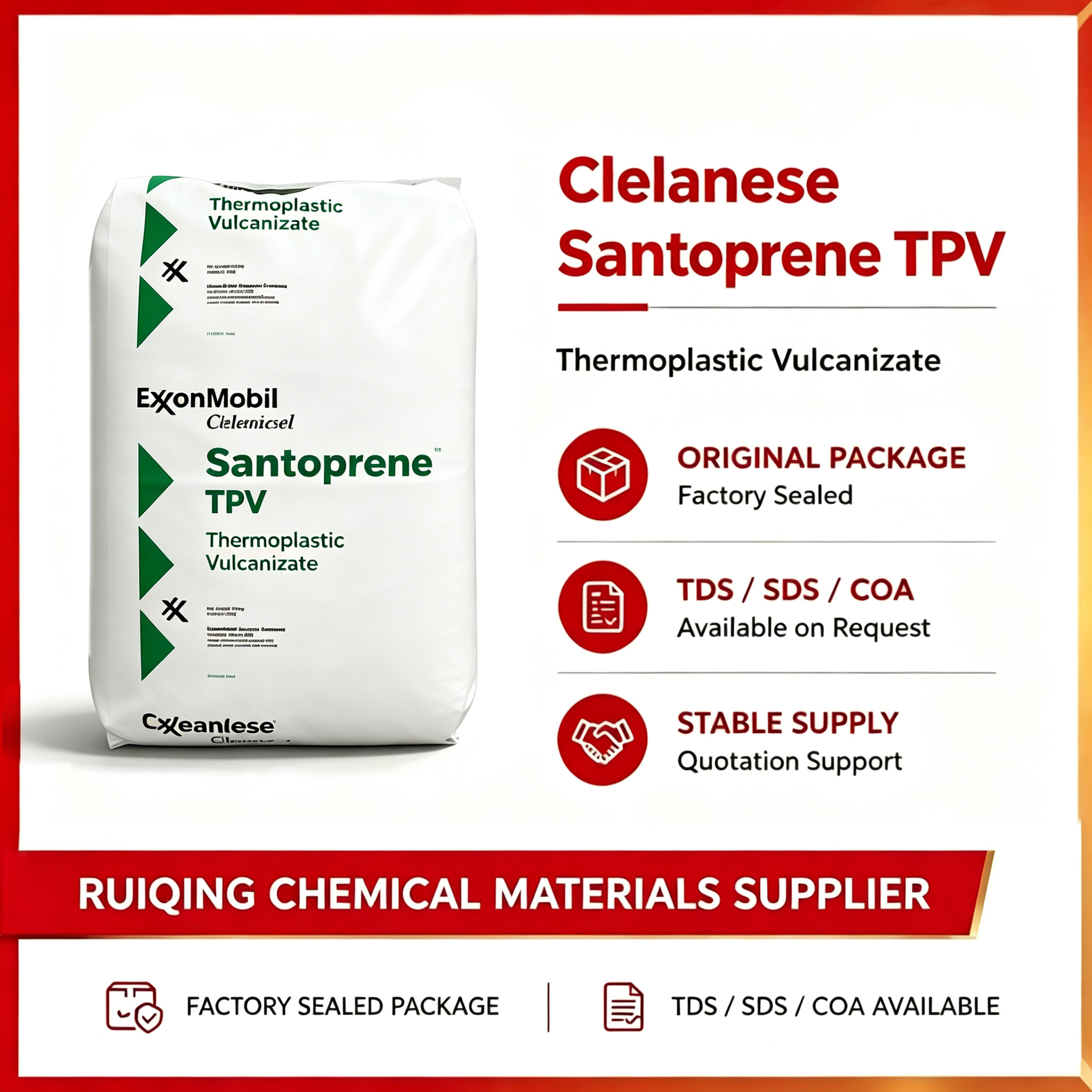
Santoprene 8201-50W185 is a soft, natural and colorable thermoplastic vulcanizate from Celanese developed specifically for pipe sealing applications requiring improved compression-set performance.
A major distinction of this grade is its positioning for ASTM F477 Low Head pipe seals.
The material combines rubber-like sealing behavior with the manufacturing advantages of a thermoplastic, allowing it to be processed on conventional injection-molding and extrusion equipment.
Current grade-specific Celanese Materials Database values include:
- 52.7 Shore A hardness
- 0.890 g/cm³ density
- 498% elongation at break
- 5.3 MPa tensile stress at break
- 1.51 MPa stress at 100% elongation
- 22% compression set at 23°C / 168 h
Celanese’s Product Finder and ASTM F477 application documentation use another qualification data set, showing approximately:
- 53 Shore A
- 575% elongation
- 5.1 MPa tensile strength
- 1.5 MPa 100% modulus
- 22% compression set at 70°C / 22 h
These figures should not be treated as contradictory. They come from different published test programs and methods.
For SEO and commercial use, the most important positioning of Santoprene 8201-50W185 is:
ASTM F477 pipe seal TPV + improved compression set + non-hygroscopic + natural/colorable + 53 Shore A.
For more TPV products, visit our TPV Thermoplastic Vulcanizates Product Category →.
For current Santoprene portfolio information, see the Official Celanese Santoprene & Geolast Product Finder →.
Key Features of Santoprene 8201-50W185
| Feature | Engineering Benefit |
|---|---|
| Approx. 53 Shore A Hardness | Provides a soft elastomeric response for pipe sealing |
| Natural / Colorable | Allows customized color formulations |
| ASTM F477 Low Head | Specifically developed for low-head pipe seal requirements |
| Improved Compression Set | Supports long-term sealing recovery |
| Non-Hygroscopic | Simplifies moisture handling in normal production |
| 498% ISO Elongation | Provides substantial flexibility and deformation capability |
| 5.3 MPa ISO Tensile Stress at Break | Provides useful mechanical strength |
| 1.51 MPa Stress at 100% Elongation | Supports flexible gasket behavior |
| Low Density | Approx. 0.890 g/cm³ |
| Good Chemical Resistance | Useful in pipe, water and drainage environments |
| Injection Moldable | Suitable for molded sealing rings and gaskets |
| Extrudable | Suitable for continuous flexible sealing profiles |
| Shear-Dependent Flow | Apparent viscosity decreases at higher shear rates |
| Polyolefin-Based TPV | Combines elastomeric properties with thermoplastic processing |
| Manufacturing-Stream Recyclability | Controlled clean process scrap can be reprocessed |
Typical Applications for Santoprene 8201-50W185
Santoprene 8201-50W185 is particularly suitable for pipe and construction sealing systems.
| Application Area | Typical Use |
|---|---|
| Drainage Pipe Seals | Flexible seals for drainage pipe joints |
| Sewer Pipe Gaskets | Compression sealing around pipe connections |
| Low-Head Pipe Seals | Applications designed around ASTM F477 requirements |
| Pipe Joint Gaskets | Flexible interfaces between pipe sections |
| Push-Fit Pipe Seals | Elastomeric sealing rings |
| Building Drainage Systems | Flexible sealing components |
| Construction Seals | Molded or extruded elastomer components |
| Water-System Seals | Selected non-pressure sealing applications |
| Flexible Gaskets | Injection-molded compression seals |
| Extruded Sealing Profiles | Continuous TPV sealing sections |
The strongest application keyword for this particular grade is pipe seal, rather than simply describing it as a general-purpose TPV.
Typical Properties of Santoprene 8201-50W185
Physical Properties
| Property | Typical Value | Test Method |
|---|---|---|
| Density | 890 kg/m³ / 0.890 g/cm³ | ISO 1183 |
| Shore A Hardness, 15 s | 52.7 | ISO 48-4 / ISO 868 |
| Commercial Hardness Reference | 53 Shore A | Celanese Product Finder |
| Appearance | Natural / Colorable | Manufacturer Information |
| Product Form | Pellets | Manufacturer Information |
| Resin Identification | TPV | ISO 1043 |
| Part Marking Code | >TPV< | ISO 11469 |
The grade name contains 50, but the current published typical hardness is approximately 52.7–53 Shore A.
Mechanical Properties
Current ISO Grade Data
| Property | Typical Value | Test Method |
|---|---|---|
| Tensile Stress at 100% Elongation | 1.51 MPa | ISO 37 |
| Tensile Stress at Break | 5.3 MPa | ISO 527-1/-2 / ISO 37 |
| Elongation at Break | 498% | ISO 527-1/-2 / ISO 37 |
| Compression Set, 23°C / 168 h | 22% | ISO 815 |
| Shore A Hardness | 52.7 | ISO 48-4 / ISO 868 |
These are the current grade-specific Celanese Materials Database values and should be used as the main technical table for the product page.
ASTM F477 Low Head Pipe Seal Performance
One of the most important reasons to select Santoprene 8201-50W185 is its documented positioning against ASTM F477 Low Head pipe-seal requirements.
Celanese published the following application-level values:
| Property | ASTM F477 Requirement | Santoprene 8201-50W185 |
|---|---|---|
| Shore A Hardness | 40–70 | 53 |
| Tensile Strength | ≥3.0 MPa | 5.1 MPa |
| 100% Modulus | ≥1.4 MPa | 1.5 MPa |
| Elongation at Break | ≥350% | 575% |
| Compression Set, 70°C / 22 h | ≤25% | 22% |
| Low-Temperature Hardness Increase at -10°C | ≤10 points | 5 points |
| Water Absorption / Volume Increase, 70°C / 48 h | ≤4% | 0.4% |
| Force Decay / Remaining Stress | ≥40% | 47.4% |
This ASTM application data is especially valuable for customers manufacturing:
- Pipe seals
- Drainage gaskets
- Sewer pipe joints
- Low-head sealing rings
- Infrastructure pipe components
Improved Compression-Set Performance
Compression set is critical in pipe seals because the gasket may remain compressed inside a joint for an extended period.
A sealing material should maintain enough recovery to continue applying pressure against the pipe interface.
For Santoprene 8201-50W185, Celanese specifically highlights improved compression set.
Published values include:
- 22% at 23°C / 168 h in current ISO grade data
- 22% at 70°C / 22 h in the ASTM F477 application test program
This makes compression-set performance one of the strongest technical selling points for the grade.
Potential applications include:
- Pipe socket seals
- Push-fit sealing rings
- Drainage joints
- Compression gaskets
- Long-term static seals
Low-Temperature Pipe Seal Performance
ASTM F477 qualification data also includes low-temperature hardness behavior.
At -10°C, Santoprene 8201-50W185 showed an approximately 5 Shore A point hardness increase in the published Celanese application test.
This is below the listed ASTM F477 maximum of 10 points.
For pipe sealing, controlled low-temperature hardness change is important because an elastomer that becomes excessively stiff may:
- Become harder to install
- Provide less conformity to mating surfaces
- Increase insertion force
- Lose sealing flexibility
Water Absorption Performance
Pipe seals may remain in contact with water for extended periods.
In Celanese’s ASTM F477 application testing, Santoprene 8201-50W185 showed approximately:
0.4% volume increase after 48 hours at 70°C in water
against a listed maximum requirement of 4%.
Low water uptake helps support:
- Dimensional stability
- Seal geometry
- Consistent compression
- Long-term pipe-joint performance
Force Decay / Stress Retention
A pipe gasket is continuously compressed after installation.
For this reason, long-term force retention can be just as important as initial hardness.
Published ASTM F477 application testing showed approximately:
47.4% remaining stress
against a minimum listed requirement of 40%.
This property helps support long-term sealing pressure within the pipe joint.
Natural & Colorable Formulation
Santoprene 8201-50W185 is supplied in a Natural formulation.
This makes it suitable for applications requiring:
- Gray seals
- White components
- Blue pipe-system identification
- Colored drainage seals
- Customized customer colors
Compatible masterbatch should be selected to maintain:
- Mechanical properties
- Compression-set performance
- Surface quality
- Processing stability
For regulated pipe applications, final color concentrate compatibility should also be considered during qualification.
Non-Hygroscopic Behavior
Another important characteristic of Santoprene 8201-50W185 is its non-hygroscopic formulation.
The material does not absorb atmospheric moisture in the same way as strongly hygroscopic engineering polymers.
This provides practical benefits including:
- Easier material handling
- Reduced drying sensitivity
- More stable storage
- Simpler production preparation
However, the current Celanese grade-specific processing sheet still recommends controlled drying before injection processing.
Therefore, “non-hygroscopic” should not be interpreted as meaning drying can never be useful.
Why Choose Santoprene 8201-50W185?
The strongest reason to select Santoprene 8201-50W185 is its specialized balance of sealing properties and pipe-application performance.
The grade provides:
- Approx. 53 Shore A hardness
- 0.890 g/cm³ density
- 498% ISO elongation
- 5.3 MPa ISO tensile stress at break
- 1.51 MPa stress at 100% elongation
- 22% compression set
- Natural/colorable appearance
- Non-hygroscopic formulation
- Improved compression-set performance
- ASTM F477 Low Head pipe-seal positioning
- Good water-exposure performance
- Good low-temperature hardness retention
- Injection and extrusion processing
- Shear-dependent flow
For customers manufacturing pipe gaskets, drainage seals, sewer seals and low-head sealing components, Santoprene 8201-50W185 is a highly relevant TPV grade.
Processing Guidelines for Santoprene 8201-50W185
Current grade-specific Celanese processing information lists:
- Injection Moulding
- Extrusion
The grade is shear dependent and can be processed using conventional thermoplastic equipment.
Drying Conditions
| Processing Parameter | Celanese Guidance |
|---|---|
| Drying Recommended | Yes |
| Drying Temperature | 80°C |
| Drying Time | ≥3 hours |
| Dryer Type | Dehumidified / Desiccant Dryer |
| Maximum Processing Moisture | ≤0.08% |
| Maximum Regrind Level | 20% |
Despite the material being described as non-hygroscopic, these current grade-specific conditions should be used for controlled processing.
Injection Molding Conditions
| Processing Parameter | Celanese Guidance |
|---|---|
| Optimum Melt Temperature | 200°C |
| Minimum Melt Temperature | 185°C |
| Maximum Melt Temperature | 220°C |
| Optimum Mold Temperature | 30°C |
| Minimum Mold Temperature | 10°C |
| Maximum Mold Temperature | 50°C |
| Screw Speed | 100–200 rpm |
| Holding Pressure | 50–75% of actual injection pressure |
| Back Pressure | 0.3–0.7 MPa when required |
These are 8201-50W185-specific settings, so they are more useful than applying a generic Santoprene processing window.
Optimum Melt Temperature
The recommended initial melt-temperature target is:
200°C
with a grade-specific window of approximately:
185–220°C
This allows the processor to optimize:
- Filling
- Surface appearance
- Cycle time
- Part dimensions
- Seal quality
Mold Temperature
The recommended mold-temperature range is:
10–50°C
with approximately:
30°C optimum
The actual mold setting depends on:
- Seal thickness
- Mold design
- Gate position
- Cycle-time target
- Surface requirements
- Part-release behavior
Screw Speed
Celanese recommends a relatively high screw speed:
100–200 rpm
Santoprene TPV is shear dependent, so increased shear can significantly reduce apparent melt viscosity.
This supports efficient filling without relying entirely on higher temperature.
Holding Pressure
Recommended holding pressure is approximately:
50–75% of the actual injection pressure
Holding pressure should be optimized to control:
- Part dimensions
- Sink
- Packing
- Seal geometry
- Surface quality
Excessive packing is generally unnecessary for flexible TPV parts.
Back Pressure
Back pressure is not always required.
Where improved melt homogeneity is needed, Celanese recommends approximately:
0.3–0.7 MPa
Higher back pressure can also be helpful when using color masterbatch.
Shear-Dependent Flow
Santoprene 8201-50W185 is shear dependent.
As shear rate increases:
apparent melt viscosity decreases.
This makes factors such as:
- Screw speed
- Injection speed
- Gate dimensions
- Extrusion die design
important when developing the process.
Increasing temperature alone is not always the most effective way to improve TPV flow.
Extrusion Processing
Santoprene 8201-50W185 can also be processed by extrusion.
This makes it relevant to continuous sealing profiles and pipe-gasket geometries.
Important extrusion variables include:
- Barrel temperatures
- Screw design
- Melt temperature
- Melt pressure
- Die geometry
- Line speed
- Cooling
- Profile calibration
For pipe seals, dimensional control is especially important because gasket cross-section directly affects installation and sealing pressure.
Pipe-Seal Design Considerations
When using Santoprene 8201-50W185 for a pipe seal, engineers should consider:
- Groove dimensions
- Seal cross-section
- Compression ratio
- Insertion force
- Pipe tolerance
- Joint movement
- Long-term force decay
- Water exposure
- Temperature range
- Installation conditions
ASTM F477 material performance is an important starting point, but final pipe-joint performance also depends on component geometry.
Heat Aging
Celanese’s ASTM F477 application testing also evaluated heat aging at 70°C for 96 hours.
Published changes included approximately:
- -1 Shore A point hardness change
- 2.6% loss in tensile strength
- 12% loss in elongation
These results support the grade’s pipe-seal positioning under the specified test conditions.
They should not be interpreted as a universal service-life prediction.
Material Compatibility
Santoprene TPV should be processed with appropriate purge procedures.
Particular care should be taken when transitioning from:
- POM / Acetal
- PVC
Contamination can affect:
- Processing stability
- Surface quality
- Mechanical properties
- Finished seal consistency
Manufacturing-Stream Recyclability
Santoprene 8201-50W185 is polyolefin based and can be recycled within appropriate manufacturing streams.
Clean controlled process scrap may include:
- Sprues
- Runners
- Start-up material
- Profile trim
- Selected rejected parts
The current Celanese grade sheet permits up to approximately 20% regrind as a processing reference.
For qualified ASTM F477 products, the manufacturer should ensure that any regrind use remains compatible with the final product’s required performance.
Related Products
We supply Santoprene TPV grades for different pipe-sealing, construction, hardness and processing requirements.
Typical product families include:
- Santoprene 8201 Series
- Santoprene pipe-seal TPV grades
- Santoprene ASTM F477 grades
- Santoprene low-compression-set grades
- Santoprene natural/colorable TPV
- Santoprene injection-molding grades
- Santoprene extrusion grades
- Santoprene building and construction grades
- Santoprene gasket materials
View More TPV Thermoplastic Vulcanizates →
Technical Documents for Santoprene 8201-50W185
| Document Type | Description |
|---|---|
| TDS | Physical, mechanical and processing data |
| SDS | Safety Data Sheet |
| ASTM F477 Information | Low Head pipe-seal performance information |
| Pipe Seal Application Data | Water absorption, force decay and low-temperature data |
| Injection Molding Guide | Grade-specific molding recommendations |
| Extrusion Information | Pipe-seal and profile processing guidance |
| COA | Batch-specific quality documentation where available |
Need technical documents for Santoprene 8201-50W185?
📧 Email: ruiqingchem@gmail.com
📝 Online form: Contact Us →
Please state Santoprene 8201-50W185 and specify whether you require TDS, SDS, ASTM F477 information, processing guidance or COA.
FAQ About Santoprene 8201-50W185
Q1: What is Santoprene 8201-50W185?
Santoprene 8201-50W185 is a natural, colorable TPV from Celanese specifically designed for pipe-seal applications and ASTM F477 Low Head requirements.
Q2: What is the hardness of Santoprene 8201-50W185?
Current data is approximately 52.7–53 Shore A.
Q3: Is the “50” in 8201-50W185 the exact hardness?
No. The grade designation contains 50, while current published typical hardness is approximately 53 Shore A.
Q4: What is the density?
Current grade-specific ISO data gives approximately 0.890 g/cm³.
Q5: What is the tensile stress at break?
Current ISO grade data gives approximately 5.3 MPa.
Q6: What is the elongation at break?
Current ISO grade data gives approximately 498%. Celanese’s separate ASTM F477 application test reports approximately 575%, so the test basis should be stated when using either number.
Q7: What is the stress at 100% elongation?
The current ISO grade-specific value is approximately 1.51 MPa.
Q8: What is the compression set?
Current grade data gives approximately 22% at 23°C / 168 h. Celanese’s ASTM F477 application testing also reports 22% at 70°C / 22 h.
Q9: Does Santoprene 8201-50W185 meet ASTM F477?
Yes. Celanese specifically positions Santoprene 8201-50W185 as meeting ASTM F477 Low Head requirements for pipe-seal applications.
Q10: Is Santoprene 8201-50W185 suitable for drainage pipe seals?
Yes. Pipe seals and drainage sealing are among the primary applications for this grade.
Q11: Is Santoprene 8201-50W185 non-hygroscopic?
Yes. Celanese describes it as non-hygroscopic.
Q12: Can Santoprene 8201-50W185 be colored?
Yes. The standard material is Natural / colorable.
Q13: Can Santoprene 8201-50W185 be injection molded?
Yes. Injection molding is a listed processing method.
Q14: Can Santoprene 8201-50W185 be extruded?
Yes. Extrusion is also listed for the grade.
Q15: What melt temperature is recommended?
Current grade-specific guidance gives approximately 185–220°C, with 200°C optimum.
Q16: What mold temperature is recommended?
The current recommended range is approximately 10–50°C, with 30°C optimum.
Request Santoprene 8201-50W185 Price & Technical Support
For pricing, availability, technical documentation or application support for Santoprene 8201-50W185, please provide:
- Required quantity
- Destination country or port
- Pipe / drainage / sewer application
- Pipe diameter
- Seal geometry
- ASTM F477 requirement
- Low Head requirement
- Required hardness
- Compression-set requirement
- Water-contact conditions
- Operating temperature
- Injection or extrusion process
- Required color
- TDS / SDS requirement
- ASTM F477 documentation requirement
- COA requirement
- Sample requirement, if applicable
📧 Email: ruiqingchem@gmail.com